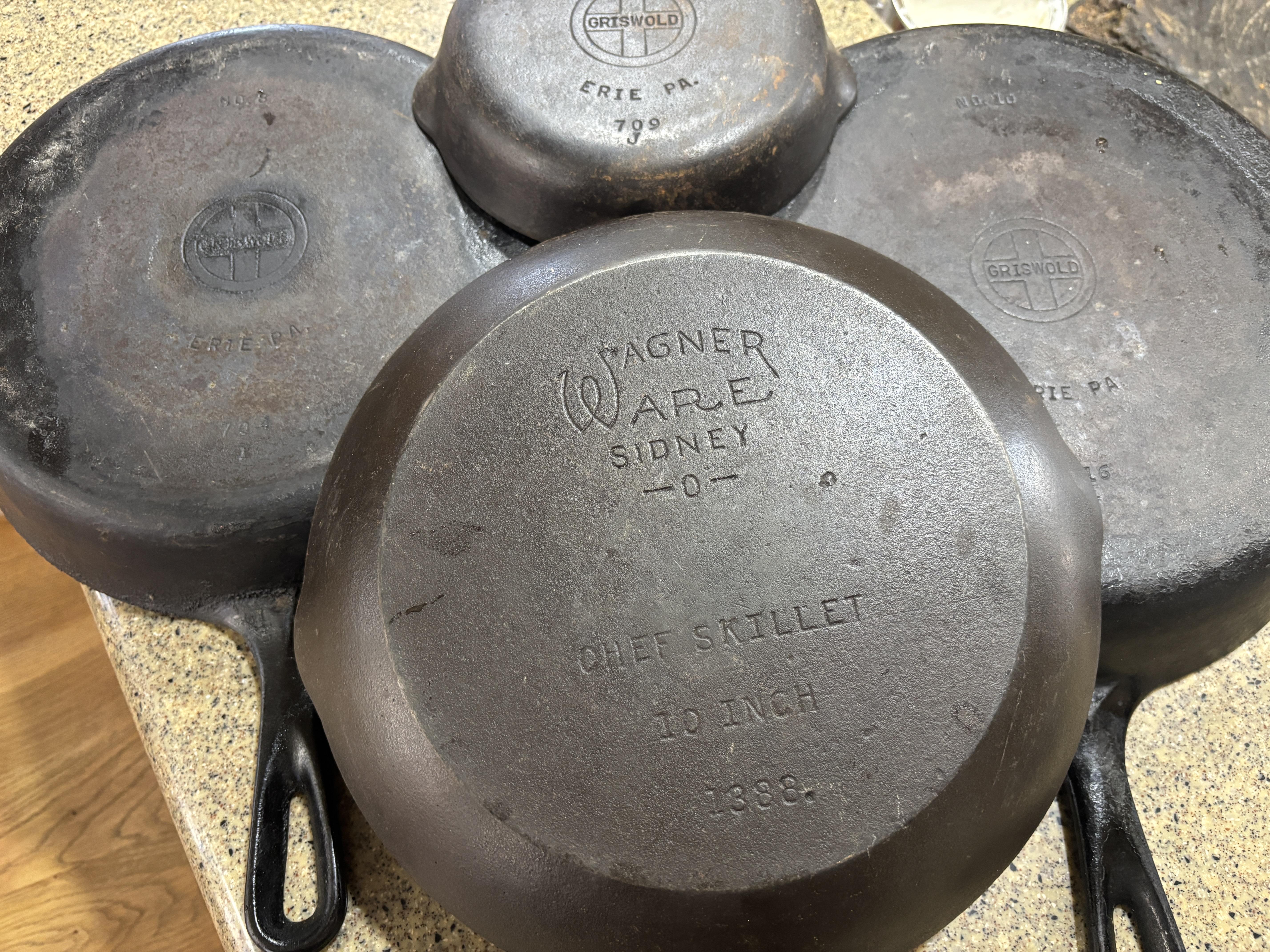
Seasoning Process
What is Seasoning on Cast Iron?
We’re used to hearing the word seasoning when talking about the herbs and spices you add to your food. But seasoning means something very different when talking about cast iron skillets and pans.
Seasoning your cast iron is when you create a protective coating on the skillet’s surface using oil or fat. Seasoning not only creates a somewhat non-stick surface on your cast iron skillet, but it also protects against rust. Despite common beliefs rust protection is the main purpose of seasoning cast iron.
How seasoning creates a protective coating on cast iron
To season your cast iron skillet (full step-by-step details later), you first coat your skillet in a light film of oil. Then you heat your skillet up past a certain temperature. When oil is heated while in contact with both oxygen and metal, it goes through a process called polymerization.
This basically means the oil turns into a rock-hard plastic surface that binds to the cast iron. If you repeat the process, another coat will form on top of the first coat, providing a thicker and stronger non-stick surface.
This is why a lot of people say that cast iron improves as you use it. When you cook with oil in your cast iron skillet, some of it may add to the coating and create a better non-stick surface.
It’s important to point out that we need to try and build many thin coats rather than try to form one thick coat. Remember that the oil needs to be in contact with both oxygen and metal to polymerize. This works best with very thin coats of oil as you will see later in the step-by-step process.
What is the best oil to season a cast iron skillet?
The type of oil you use will impact the quality of the coat you create. Everybody seems to have their own opinions on what oil is best for seasoning cast iron and there are a lot of myths and old wive’s tales on what works and what doesn’t.
Whatever type of oil you use, somebody will tell you that you’re doing it wrong. For example, you’ll often hear people say that bacon grease or lard creates the best cast iron seasoning. But is it really the best option?
Why do people say it’s the best? Well, it turns out that there are many better options, but those options weren’t available back in the day when cast iron was king. Back then, bacon grease was and readily available, so it was the default option for seasoning cast iron. That’s all it took for it to stick as part of tradition (like many cooking traditions and methods).
People don’t say bacon grease is the best because they’ve done A/B tests, they say it’s the best because that’s what they were told is the best. Think about what bacon actually is, I know bacon well, I cure it myself. Store bought bacon is cured though a process called pumping. A brine of salt, sugar, liquid smoke and sodium nitrite. Cure accelerators are also used like ascorbic acid. SO WE ALL CAN SEE BACON GREASE IS NOT A PURE FAT. We also fry it and get those tiny particles that form and contaminate the grease. Also not good seasoning.
So, while we can learn a lot from tradition, and cooking history, let’s look at the science on what really works.
Smoke Point
The other important factor to consider when choosing the type of oil for seasoning your cast iron is the oil’s smoke point. The smoke point is the temperature where the oil starts to break down (and create smoke).
When unsaturated fat starts to break down in the presence of oxygen, the molecules join together (called polymerization as explained earlier). If the temperature doesn’t reach the smoke point, the fat won’t cross link to form double bonds and you won’t get polymerization
So it’s important that you make sure you know the smoke point of any oil you use to season your cast iron and you heat the oil up past the smoke point. If you don’t heat it up high enough, it won’t polymerize.
Monounsaturated vs Polyunsaturated vs saturated fats
Now here's where I know I will get kickback from just about everyone, because we’ve all had good results using our personal oils of choice.
My personal tests have yielded great results using several oils and fats. One thing I find when I try to speak with scientists about this topic is this.
Monounsaturated fats are by far the worst to use. They are unstable and want to attract another molecule. This is why when exposed to air they go rancid.
It’s important that you make sure to avoid olive oil, avocado oil, sesame oil. They are all high in monounsaturated fat.
Here is where it gets fun, look for oils with low smoke points and high levels of polyunsaturated fat. So far the oil I find that's cheap and easy to find is grapeseed oil. Grapeseed oil is very high in polyunsaturated fat. It tops the charts, corn oil is another good choice.
Saturated Fats Those that stay solid at room temperature are actually not considered by science to be the best. That said, there is something to be said from the tons of folks using Crisco, Crisbee and lard. I personally cover all my bases by making a blend of Crisco, beeswax and grapeseed oil. I'm open for someone with access to a lab and knowledge in the scientific testing process to preform some tests for us . What experts are saying is store bought crisco and lard is hydrogenated and by adding the hydrogen it allows for some double bonds to cross link and form a polymer.
How to Season Your Cast Iron (Step-by-step)
Now that you understand how seasoning works and what type of oils work best, let’s look at a foolproof process you can follow to develop a great seasoning on your cast iron.
Step 1: Clean Your Cast Iron
First set your oven to 200 f
Whether you have a brand new cast iron skillet or bought an old second-hand skillet (which can be just as good or better than brand new), it’s a good idea to start by cleaning it. We want a perfectly clean surface so the oil can get perfect coverage and develop a strong bond with the metal.
Now that its clean wipe it dry and place it in the 200 degree oven for 10 minutes.
Step 2: Lightly cover the entire surface with oil
Set the oven to 50 degrees past your oils smoke point. (500f also works)
The key word here is lightly. Using too much oil will cause issues with polymerization and leaves a sticky surface.
Remove the item from the oven using gloves. Take your chosen oil and pour a teaspoon into the pan. I have a small rag about the size of a post it note, that i use to spread the oil. I found if I have too large of a rag it soaks up all the oil before i can spread it.
Make sure to cover the entire item including any handle and the bottoms.
Step 3 : Wipe it clean
This might be the most important step that may folks miss. After rubbing the oil on your cookware, pretend you made a mistake and decided to wipe it off. Yes really wipe all that oil off with a clean towel. The point is to leave a very thin layer that bonds to the iron that's not thick enough to chip off. Leaving too much oil on the item will also cause a pooling effect on your seasoning, looking splotchy and uneven.
Step 4: Heat your cast iron past your oil’s smoke point
Once your cast iron has a very thin coating of oil evenly across the entire surface, you can heat it up in the oven.
Why use an oven: while you could use a stove to
season your cast iron, it will give inconsistent results. A stove doesn’t heat your cast iron evenly compared to an oven which will provide constant and even heat across the entire surface of the cast iron. I highly recommend using an oven.
Place skillets in upside down to allow any oil that you missed to run away and not puddle on the cooking surface.
Bake for 1 hour then turn the oven off and allow the item to cool down with the oven.
At this point you're going to want to repeat all the steps except the washing. To speed things up you can wait until the oven cools to 200 deg and start from there at step 2.
That's it, you've done it, 1 coat is good for a touch up on your already seasoned iron, 3-5 coats are good for iron that has been stripped bare.
RECAP FOR THE KITCHEN clean your iron Heat in 200° oven 10 min Rub on oil Rub off oil Bake at 50° past smoke point or 500° for 1 hour