r/ExperiencedFounders • • 18d ago

AMA I'm Gal Zahavi, founding engineer at Wajo AI. We're building AI agents that make phone calls, book appointments, coordinate with businesses, and handle everyday tasks for you. I previously worked on Gemini CLI at Google. AMA!

13 Upvotes

Hey everyone!

I'm Gal. I've spent a good chunk of my career building AI developer tools, but these days I'm working on something a little different, getting AI to actually do things outside of a chat window.

I'm currently a founding engineer at Wajo AI, where we're building Fo, a personal AI assistant that handles real-world tasks for you. Things like calling businesses, booking appointments, coordinating with vendors, following up on orders, and all those annoying little tasks that somehow end up eating your entire afternoon.

The idea is pretty simple, instead of AI telling you how to get something done, why not have it actually do it for you? Turns out making that work is a lot harder than it sounds.

Before Wajo, I spent about five years at Google working on Cloud AI SDKs, Gemini Code Assist, and most recently Gemini CLI, where I led the security work. I also like building open-source stuff in my spare time, including IDX0 and Pickle Rick, a Gemini CLI extension I built for running continuous agent loops.

One of the bigger challenges we're dealing with at Wajo is getting agents to work reliably when things don't go as planned. For example, what happens when a business doesn't pick up the phone? Or the appointment you wanted isn't available? Or something that should be simple ends up needing three phone calls and a couple of days of back and forth?

These are the kinds of problems I've been spending a lot of time thinking about. It's not enough for an agent to understand what you want, it needs to figure out what to do next, follow through, and sometimes realize that getting a human involved is actually the better option.

We're also figuring out how these agents should work with actual people and businesses, because I don't think the answer is necessarily to automate absolutely everything.

Anyway, figured I'd introduce myself and share a bit about what we're building at Wajo. I'm really curious what other founders think about where AI agents are headed and what problems people are running into.

Happy to talk about Fo, the technical challenges behind it, my time working on Gemini at Google, going from a big company to an early-stage startup, or really anything else.

Hit me with any questions you wanna ask!


r/ExperiencedFounders • • 24d ago

AMA I’m JJ Tang, co-founder and CEO of Rootly. We raised a $15M Series A and built incident response software used by NVIDIA, Figma, and LinkedIn. Now we’re building AI agents for SRE. AMA!

20 Upvotes

Hey r/ExperiencedFounders!

I’m JJ Tang, co-founder and CEO of Rootly. Before starting Rootly, I worked in product at Instacart and spent a few years at IBM across Cloud and Watson Health. I was also the first employee at Ada earlier in my career.

The idea for Rootly came out of my time at Instacart. I saw firsthand how messy incident response becomes as engineering teams and systems scale. An outage isn’t just about finding what broke. Someone needs to coordinate the response, page the right people, keep everyone updated, document what happened, and make sure the same problem doesn’t keep coming back. So, we built custom incident tooling to help us at Instacart.

That eventually became Rootly. We started by building incident management and on-call infrastructure, and today teams use Rootly for incident response, on-call, communications, retrospectives, status pages, and the broader incident lifecycle.

More recently, a huge part of our focus has shifted toward AI SRE. Instead of AI just summarizing an incident after the fact, we’re building agents that can actually participate in the investigation: looking at telemetry and code changes, pulling together context, forming hypotheses, and helping engineers figure out what's broken and how to stop it faster.

We went through Y Combinator S21, raised a $15M Series A, and Rootly is now used by engineering teams at companies including NVIDIA, Figma, DoorDash, Replit, Canva, Superhuman, Brex, and others.

There are a lot of interesting questions we’re dealing with as AI gets more involved in production systems. How much autonomy should an agent actually have during an incident? Where should humans stay in the loop? How do you earn enough trust for an engineering team to rely on an agent when production is actively on fire? And what happens to on-call as these systems get better?

Happy to talk about any of that, as well as going from product at Instacart to founder, YC, fundraising, enterprise sales, building for SRE teams, or growing Rootly over the last five years.

I’ll be answering questions on November 5 @ 10:00 am EST. Thanks for the opportunity; ask me anything!


r/ExperiencedFounders • • 11h ago

Has anyone gotten a second look from YC in the same batch after a pass?

Post image
5 Upvotes

My cofounder and I interviewed for YC W27 with a deep-tech hardware startup early November.
Full thread in image.

Thanks for coming in to talk with us today. You guys are impressive engineers - I was quite impressed with your open source contributions to serious libraries.

I think what you're working on is promising, but we'd like to see you make more progress before we think you're ready to do a batch. You guys seem like pretty cracked builders - how about you go build it? That sounds better than just getting LOIs.

You guys are clearly talented and the kind of founders I'd personally like to work with, so I'd love to keep in touch and follow along on your progress. Maybe we can chat again once you've built some stuff?

^this was Nov 11th.

We mentioned that we would be working on a demo later that week on the call and, so we sent the partner the video a few days later, once it was ready (Nov 17th). We re-forwarded it a week later and haven’t heard back.

If you’ve been in this spot, did an update get YC to take another look in the same batch? What did you send that got a response? Would you follow up once more with the partner who emailed us, reach out to the other interviewer, or wait until there’s something new to share?


r/ExperiencedFounders • • 5h ago

I want to do IRL Founders Open Mic, no pitches, no product talk, no selling, just real, raw, founder stories, what are your thoughts?

Thumbnail reddit.com
1 Upvotes

r/ExperiencedFounders • • 13h ago

Validating an early concept for compliance PDF workflows — what actually breaks in your review process?

Thumbnail starlette-intelligence.runs-on.dev
1 Upvotes

We're in the very early stages of building Starlette Intelligence — right now we only have a concept landing page and an early prototype focused on PDF sharing inside a single platform.

Our hypothesis is that teams reviewing compliance, audit, or underwriting packets waste massive amounts of time jumping between scattered PDFs and losing track of where specific proof lives.

Before we commit months to building deeper verification features, we want to validate the workflow with people who actually live this pain:

  • How are you currently sharing, reviewing, and signing off on multi-PDF compliance/audit packets?
  • Where does your current setup (shared drives, email, Excel checklists, existing RegTech tools) feel most broken?
  • Looking at our concept page, what feels genuinely useful vs. like a solution looking for a problem?

Brutal honesty welcome — trying to make sure we build something compliance teams would actually trust and use.


r/ExperiencedFounders • • 1d ago

Need experienced product leadership without hiring a full-time Head of Product?

Thumbnail reddit.com
2 Upvotes

r/ExperiencedFounders • • 1d ago

Fundraising When interacting with VC's, should you disclose what other VC's are interested?

2 Upvotes

As the title says - we're fundraising, and we currently have a couple of funds interested in leading, and a couple who have expressed interest in following. We're in the stage of DD/ negotiating term sheets with the leads, but it is all moving in the direction of us closing this round next week.

A new VC is interested; we told them we're ready to close the round but they can make an offer to lead since nothing's signed or exclusive, but they want to know who our leads are first.

Never really had someone ask before; Dr. Google says don't tell them because they can basically collude to bring the price down, but I'm curious if anyone here has had a similar experience? Is it alright to share your leads, or should you keep it confidential until you have at least a term sheet?


r/ExperiencedFounders • • 2d ago

2026年开始一个AI业务还来得及吗?

Thumbnail reddit.com
1 Upvotes

r/ExperiencedFounders • • 2d ago

Is reaching $400k ARR in our first commercial year realistic for a B2B SaaS startup?

3 Upvotes

Hey everyone,

I'm a 19-year-old co-founder of a Canadian B2B software startup. We're three co-founders currently building a product for an established industry with significant digitalization opportunities. I'd prefer to keep the specific industry and product confidential for now.

Where we currently stand:

  • Three co-founders: CEO, CTO and COO.
  • A functional product still under active development.
  • A paid founding customer with approximately 20 employees, allowing us to test, validate and improve the product in a real operational environment before our commercial launch.
  • $100k CAD in planned initial funding.
  • No recurring revenue yet.

Our plan for 2027:

  • Q1: Test, improve and stabilize the product with our founding customer while building the foundations of the company.
  • Q2: Official commercial launch.
  • Q3: Accelerate customer acquisition and introduce an additional revenue stream.
  • Q4: Reach 40 paying businesses, including 35 in Quebec and 5 in Ontario.

We're targeting an average annual contract value of approximately $10k CAD, with a minimum year-end objective of $300k ARR and an ambitious target of $400k ARR.

Our customer acquisition strategy will primarily rely on founder-led sales, cold outreach, industry relationships, in-person meetings and customer referrals.

We don't plan to raise institutional capital in 2027. We want to validate our product, establish a repeatable sales process and demonstrate genuine commercial traction first.

Our plan for 2028:

We're aiming to raise a $3–3.5M USD seed round from American VCs around Q2 2028. The purpose of this round would be to aggressively accelerate growth, expand into the United States, build our teams and increase our product development capabilities.

Our target would be to reach $1–2M CAD in ARR by the end of 2028.

My biggest concern right now is customer acquisition. Building the product is one thing, but convincing 40 established businesses to trust a new software company and replace their existing systems is an entirely different challenge.

We're entering an established and competitive software market, so differentiation, credibility and customer trust will be critical.

I'd love to hear from experienced B2B SaaS founders:

  • How difficult was it to acquire your first 10, 25 and 40 customers?
  • Is reaching $300–400k ARR within nine months of commercial operations realistic?
  • How would you approach customer acquisition with our initial capital?
  • What would you prioritize during the three months before launch?
  • Would this level of traction be sufficient to raise $3.5M USD from American VCs?
  • What are the biggest weaknesses or blind spots in our strategy?

We're extremely ambitious, but I want to make sure our execution strategy is grounded in reality.

I'm not looking for validation or encouragement. I'd genuinely appreciate honest, critical feedback from founders who have been through this stage.

Thanks!


r/ExperiencedFounders • • 2d ago

Quem na sua empresa responde pelo crescimento como um todo, e não só por uma área?

3 Upvotes

Trabalho com estratégia de crescimento em empresas de médio porte e vejo um padrão que se repete: marketing bate a meta de leads, comercial bate a meta de conversão, produto entrega o roadmap, e a receita não sai do lugar.

Na maioria dos casos o problema não está em nenhuma área. Está entre elas. Ninguém responde pelo resultado combinado.

Em empresa pequena, quem faz isso é o fundador, sem perceber: decide prioridade, resolve conflito, conecta as pontas. Depois de certo tamanho isso vira gargalo, porque ele continua sendo o único que enxerga o todo.

O teste que costumo usar: toda decisão de prioridade entre marketing, vendas e produto ainda passa pelo CEO? Se sim, a função de "executivo de crescimento" já existe na empresa. Só não tem dono.

Lá fora esse papel tem vários nomes (Growth Executive, Chief Growth Officer, às vezes CRO), mas a função é a mesma: integrar as áreas e responder pela receita, não por uma métrica de área.

Queria saber como vocês resolvem isso:

  • O fundador continua sendo esse integrador?
  • Já tentaram contratar alguém para o papel? Funcionou?
  • Ou dividiram por áreas e aceitaram o desalinhamento?

(Transparência: sou o autor. Escrevi um texto mais longo sobre o tema aqui, para quem quiser ir mais fundo.)


r/ExperiencedFounders • • 3d ago

I run a software studio. One of the most valuable things we do for founders is tell them what NOT to build.

Thumbnail
bbuilds.org
0 Upvotes

I am one of the people behind a small product engineering studio.
We work with founders on everything from MVPs to production handover.
Over time, I have noticed something interesting.
A founder comes to us asking "I need an app with these 15 features".
But after talking through the business, we sometimes realise they don't actually need an app with 15 features.
They need to answer one question first.

Will people actually use this? or Can this workflow work operationally? or Can we acquire the first 20 customers?

So instead of building the full product, we will sometimes recommend a much smaller version. Not just a prototype, it can be a manual workflow behind a simple interface.
A single feature instead of ten, sometimes even not building anything and just telling them just to use Claude first.

And honestly, this can feel counterintuitive when you are running a software business. The obvious commercial incentive is to sell more development.

But we have found the opposite can happen.
A founder who spends 1000$ validating something instead of 5000$ building the wrong thing is much more likely to trust you with the next 5000$.

AI has made this even more interesting.
Today, getting a basic product built has become incredibly cheap. Tools like Claude, Cursor etc can produce surprisingly capable software.

So I am curious, If building software is becoming dramatically cheaper, what do you thing founders actually need from a software studio now?

Is it:
- product thinking

- technical architecture

- validation?

- speed of execution?

- someone who can take ownership from idea to production?

- something else?

I am genuinely interested in hearing from founders who have built something recently, especially what you wish your development partner had told you before you started building.


r/ExperiencedFounders • • 3d ago

Looking for tech leaders who can share their story

Thumbnail reddit.com
2 Upvotes

r/ExperiencedFounders • • 3d ago

I need help from startup CEOs/founders who have experience with VCs!!!

1 Upvotes

Hello!

If YOU are a startup CEO/founder who has gotten VC investment, could PLEASE fill my survey... Your response can save my work and help me defend it.

I'm writing my master thesis and I've endlessly tried to reach startup CEOs and only managed to get a few responses (so far my hypotheses are not statistically significant).

Takes around 7-8min to complete. Please help me graduate!

Link to Qualtrics survey: https://qualtricsxmtcw7djrmh.qualtrics.com/jfe/form/SV_3KK3WSMFAM3YYZM

More about the topic:

I am researching the factors that influence value creation through the non-financial post-investment support provided by VC firms.
The goal is to identify how collaboration between VC firms and startups could be improved and how the value created through this support could be increased.


r/ExperiencedFounders • • 4d ago

What's one decision you made as a founder that made no difference to revenue immediately, but made a huge difference to the business later?

3 Upvotes

I've been thinking about this lately.

When you're running a company, it's easy to spend most of your attention on things you can measure. Revenue, customer growth, new deals, delivery timelines.

But some of the decisions that matter most don't show up in those numbers straight away.

Hiring someone you can trust. Spending time fixing a process that keeps causing problems. Saying no to a customer request that isn't right for the product. Giving your team more ownership.

You may not see an immediate result, but these decisions shape how the company grows over time.

I've seen this happen across different stages of building a business.

Would love to hear from other founders: what's one decision you made that paid off much later than you expected?


r/ExperiencedFounders • • 4d ago

RegTech / FinTech founders: where is the actual underserved gap in compliance document workflows (US/UK/EU) for a tech-only founder?

0 Upvotes

I'm a software developer looking to build in RegTech / compliance operations for US, UK, or European markets. My strength is engineering (deterministic verification pipelines + AI agents), not legal or regulatory interpretation.

The deeper I dig into the obvious "RegTech gaps," the more crowded they look—KYC/KYB is saturated, audit tie-outs have DataSnipper and Fieldguide, and regulatory circular tracking requires massive legal teams.

Right now I'm testing a narrow thesis: don't interpret regulations—just verify messy multi-PDF packets against a buyer's own compliance/audit Excel checklist (with strict deterministic math and page-level proof so humans stay in control of approvals).

For founders or operators who know US/UK/EU RegTech:

  1. Where do regulated teams (lenders, accounting firms, insurance, compliance ops) still have an ugly, manual document-to-checklist gap that incumbents haven't solved?
  2. Can a developer without a regulatory background realistically enter by building the checklist-verification engine (letting the buyer own the rules), or is a compliance co-founder non-negotiable from Day 1?

r/ExperiencedFounders • • 4d ago

Startup founders: Are you happy with what your tech team is delivering?

Thumbnail reddit.com
2 Upvotes

r/ExperiencedFounders • • 4d ago

Founder-led sales has become the bottleneck in my deeptech B2B/B2G startup. How did you get out of it?

Thumbnail reddit.com
1 Upvotes

r/ExperiencedFounders • • 5d ago

Founders: Are you getting the right outcomes from your tech initiatives

Thumbnail reddit.com
1 Upvotes

As companies grow, I’ve noticed a pattern that can become quite expensive: The engineering team is constantly busy, but it’s difficult to connect the work to business outcomes. The requirement/product roadmap keeps changing based on the latest customer request or leadership priority. Features get shipped, but adoption doesn’t necessarily follow. Product, sales and engineering teams have different interpretations of what needs to be built. The founder is still the person making most of the important product decisions.

Everyone wants to explore AI, but it’s unclear which use cases are actually worth investing in.
Often, the problem isn’t a lack of developers or effort. It’s a lack of product clarity, prioritisation, ownership and execution discipline.

A little about me: I’ve spent many years in technology and product roles, including product leadership at a largest CRM MNC, and currently lead technology for a growing business. I’ve worked across product strategy, large-scale platforms, engineering teams and technology transformation.

I’m now building an independent Product & Technology Advisory practice, focused on helping startups and growing businesses get more value from their technology investments.

The idea is fairly simple: help founders identify what’s slowing their product down, where engineering effort is getting wasted, what needs fixing first, and how to build better product practices without necessarily hiring a full-time senior product leader.

I’d love to hear from founders/cofounders here:

  • Which of these problems resonates most with your current experience?
  • Do you have a dedicated product leader, or does product management still sit with the founder/CTO?
  • Would an independent, time-bound assessment of your product and execution challenges be useful?

If you’re dealing with some of these challenges and would like to explore whether I can help, feel free to DM me. Happy to share how I approach the work and discuss whether there’s a fit.

PS: Not pitching a large consulting engagement. The intention is to solve specific problems, pragmatically.


r/ExperiencedFounders • • 5d ago

Bootstrapped marketplace founder watching a funded competitor accelerate. When is it time to raise? (i will not promote)

Thumbnail reddit.com
1 Upvotes

r/ExperiencedFounders • • 5d ago

0 to 187k Google search impressions in 3 months (TL;DR it's all bots)

Thumbnail
gallery
3 Upvotes

TL;DR: 86% of the impressions were bot scrapers on Google. Unclear if bot traffic affects AEO at all, not even sure how we can measure it.


We launched a new website late August with zero search presence, it's a small B2B services site built with Next.js on Cloudflare Workers via OpenNext, with Payload as the CMS and D1/R2 behind it.

So far, we've measured

1.7K clicks, 187K impressions, average position 5.1. Most of that isn't what it looks like. This post covers the technical work and then what the numbers really mean. I've kept our niche and keywords out of it on purpose.

1. Crawl and index hygiene

  • Canonicals. Set metadataBase and a self-referencing canonical on all 13 route types. Paginated blog and author listings all canonicalised to page 1, which folded the deeper pages, and the older posts only they linked to, into page 1. Now ?page=2 and beyond canonicalise to themselves and get their own title. ?page=1 301s to the bare URL.
  • Real 404s. /blog?page=99 returned a 200 with an empty grid that Google could index. Past the last page it's a 404 now, and so is a junk page parameter.
  • Lowercase slugs enforced in the CMS.
  • Sitemaps split by type: the main one, the programmatic pages and the tools each get their own. That way GSC shows indexing per type. lastmod is a real content date (see section 3), never the CMS save time.
  • Domain consolidation. We had 20 posts on an older domain. We moved them and 301'd every slug one to one rather than pointing everything at the homepage.

2. Structured data

JSON-LD per page type: Organization and WebSite site-wide, then BlogPosting, BreadcrumbList, FAQPage where there's a real FAQ, and ItemList on ranked list posts. BlogPosting carries an author entity with its own author page.

3. Honest freshness dates

The CMS's updatedAt is not a modified date. It moves on every save. One bulk edit with no prose changes gave sixteen posts the same modified time. Publish that as dateModified or sitemap lastmod and you're claiming freshness the content doesn't have.

  • Posts have a lastSubstantiveUpdate field that an editor sets only when the content really changed. dateModified, article:modified_time and lastmod use it, fall back to the publish date, and ignore it if it lands on publish day.
  • Landing pages get their dates from git. A prebuild script runs git log over each page's own directory and its copy entry, and writes a generated file that gets committed. A tweak to a shared component doesn't bump anything. A copy change to that page does, and the visible "Updated <Month Year>" line follows. Nothing auto-rolls the month.

4. Meta and share cards

  • Titles held to about 60 characters and descriptions to what the SERP preview actually shows. We checked every page against an OG inspector rather than guessing.
  • Per-post Open Graph images generated with next/og. It does run on Workers.
  • CMS fields for an SEO title, an SEO description and a short "quick answer" paragraph that sits high in the post.

5. Internal linking

Across the whole blog there was 1 link from one post to another. We took it to 69 and left no orphans. That was manual work: for each post, find the 3 to 5 others it genuinely relates to and link from body text.

6. Programmatic pages

We built 120 directory-style reference pages from a dataset we maintain, each with its own data rather than a template with a swapped noun. They're read at build time only and kept out of the Worker bundle. Shipping them inside it added real weight to cold starts (more on that below). They got their own sitemap. These pages ended up taking a big share of the impressions, mostly the machine kind described in the next section.

7. Speed on Workers

This took the most effort and moved rankings the least. It still mattered for us. Cold starts. The Worker script was about 28MB raw, 6.66MB gzipped, and Payload alone was 9MB+ of that. After the site sat idle, the first request took 1.3 to 2.45 seconds to first byte. Around 0.75 to 1s of that passed before our code even ran, which is the isolate loading the script.

What we tried, in order:

  1. Cached CMS reads with tags, invalidated from Payload's afterChange hooks. That helped warm requests and did nothing for cold ones.
  2. A patched OpenNext cache. Pages rendered at runtime were coming back STALE on fresh isolates because Next assumed a 1s revalidate window. We patched @opennextjs/aws so they serve as cache hits. That got rid of the 200 to 800ms re-renders.
  3. Moved the programmatic data out of the bundle: 6.66MB down to 6.18MB gzipped. Better, but a cold isolate still had to load the whole Next app.
  4. Put a 4KB Worker in front. This was the fix. It serves GET HTML from the Cache API, keyed on hostname and build id, and only calls the Next Worker through a service binding on a miss. It bypasses /admin, /api, /_next, RSC requests and preview cookies. Pages older than 5 minutes refresh in the background. Behind that sits an R2 "shelf" shared across colos, so a miss in one location reads from R2 instead of waking Next.
  5. Purge by page. OpenNext doesn't emit x-next-cache-tags outside minimal mode, so we patched it to record tags and add the header. The front Worker stores copies tagged with hashed versions of those tags. A CMS publish purges only the matching pages, re-renders the edited page first and marks the rest stale. Same idle test after the front Worker went live: 57 to 155ms TTFB. Cached pages answered in 53 to 101ms when I checked today.
  6. Other speed work:
  • Images resized through Cloudflare and served from a separate R2 media subdomain. Cold image variants went from 1-4s to 0.5-1.1s.
  • The LCP image gets priority. First-viewport layout is settled in CSS so LCP doesn't wait for hydration.
  • A hero video went from 18.7MB (1080p) to 3.7MB (720p) and is deferred.
  • Third-party tags were the biggest TBT cost. Mobile TBT was 425 to 712ms, with GTM and GA taking 250 to 420ms of it. Tag Manager now loads on first interaction or 5s after load, and the session recorder at 10s. The trade-off is that a bounce without any touch inside 5s goes uncounted. We accepted that.
  • Mobile TBT is measured in GitHub Actions as the median of 5 Lighthouse runs against prod after every deploy. A busy laptop gave us 345ms and 1,720ms for the same page on the same afternoon, so we stopped trusting local runs. Lighthouse on the homepage (Nov 14): 90 performance and 100 SEO on mobile. Desktop scored 100 on both. Did any of this move rankings? I can't show that it did. Position changes line up with content and indexing dates, not with the speed deploys.

What the numbers actually say

Last 28 days vs the 28 before: | | Sep 26 to Oct 23 | Oct 24 to Nov 20 | |---|---|---| | Clicks | 269 | 1,365 | | Impressions | 9,261 | 179,167 | | Pages getting impressions | 117 | 234 | Weekly clicks went from 3 (week of Aug 24) to 650 (week of Nov 9). 90% of those clicks went to one post. It's a consumer how-to that has nothing to do with what we sell, ranking around position 4 to 6. Our commercial pages are still on pages 4 to 8 for their main terms.

86% of impressions are machines

The query report is full of this pattern (keywords swapped out):

Query shapeImpressionsClicks
<platform> · <community A> alternatives28,8950
<platform> · <community B> alternatives19,8230
<platform> · <community C> alternatives13,8910
<platform> · <community D>13,7860
<platform> · <community E> alternatives13,7470

No person types a middle dot into Google. Of 150,932 impressions on queries GSC names, 129,484 (86%) have this shape, and together they got 0 clicks. GSC now has a separate report for Google's generative AI features. It shows 49.3K impressions for us, nearly all arriving after Oct 28.

My read is that these are the background searches an AI answer runs before it writes a reply. One comparison post picked up about 30K of those AI impressions and 0 clicks. There's a second tell. Long, chatty question-style queries show up in our GSC word for word, and they match prompts we track in an AI visibility tool. Some of our impressions are our own monitoring. If your impressions jumped this autumn and your clicks didn't, filter the query report for non-human shapes before you report the number to anyone.

Then it dropped

The last week of the chart falls hard. Comparing Nov 11-15 with Nov 16-20, the top post went from 474 clicks to 157. Its average position barely moved (6.2 to 6.5) while impressions halved, so it looks like a demand drop, not a lost ranking. GSC's most recent days are always incomplete as well. I don't have a confident explanation yet. We're going to keep measuring top of the funnel broad search impressions and monitor bottom of the funnel high intent searches.

What I'd tell someone starting from zero

  • Do the hygiene in a weekend: canonicals, real 404s, split sitemaps, JSON-LD. It's table stakes.
  • Don't fake freshness. Tie dates to real changes.
  • If you're on serverless, measure cold TTFB after 15 to 45 minutes of idle, not right after a deploy. A warm test hides the whole problem.
  • Measure TBT in CI, not on your laptop. Defer third-party tags and accept the data loss.
  • Split impressions into human and machine query shapes. The total means very little now. Ultimately, good content wins SEO. I'm hoping the bump in bot scraping Google means it equals som kind of AEO indexing ,but there's zero way to tell. Happy to go deeper on the front Worker or the OpenNext patches in the comments.

r/ExperiencedFounders • • 6d ago

Startup founders: Are you happy with what your tech team is delivering?

Thumbnail reddit.com
0 Upvotes

r/ExperiencedFounders • • 6d ago

Founders: How do you evaluate your first Head of Marketing/CMO after 10 months when revenue is still founder-led?

Thumbnail reddit.com
1 Upvotes

r/ExperiencedFounders • • 8d ago

Is there a group for actual founders?

3 Upvotes

Asking for a friend…

DM me


r/ExperiencedFounders • • 8d ago

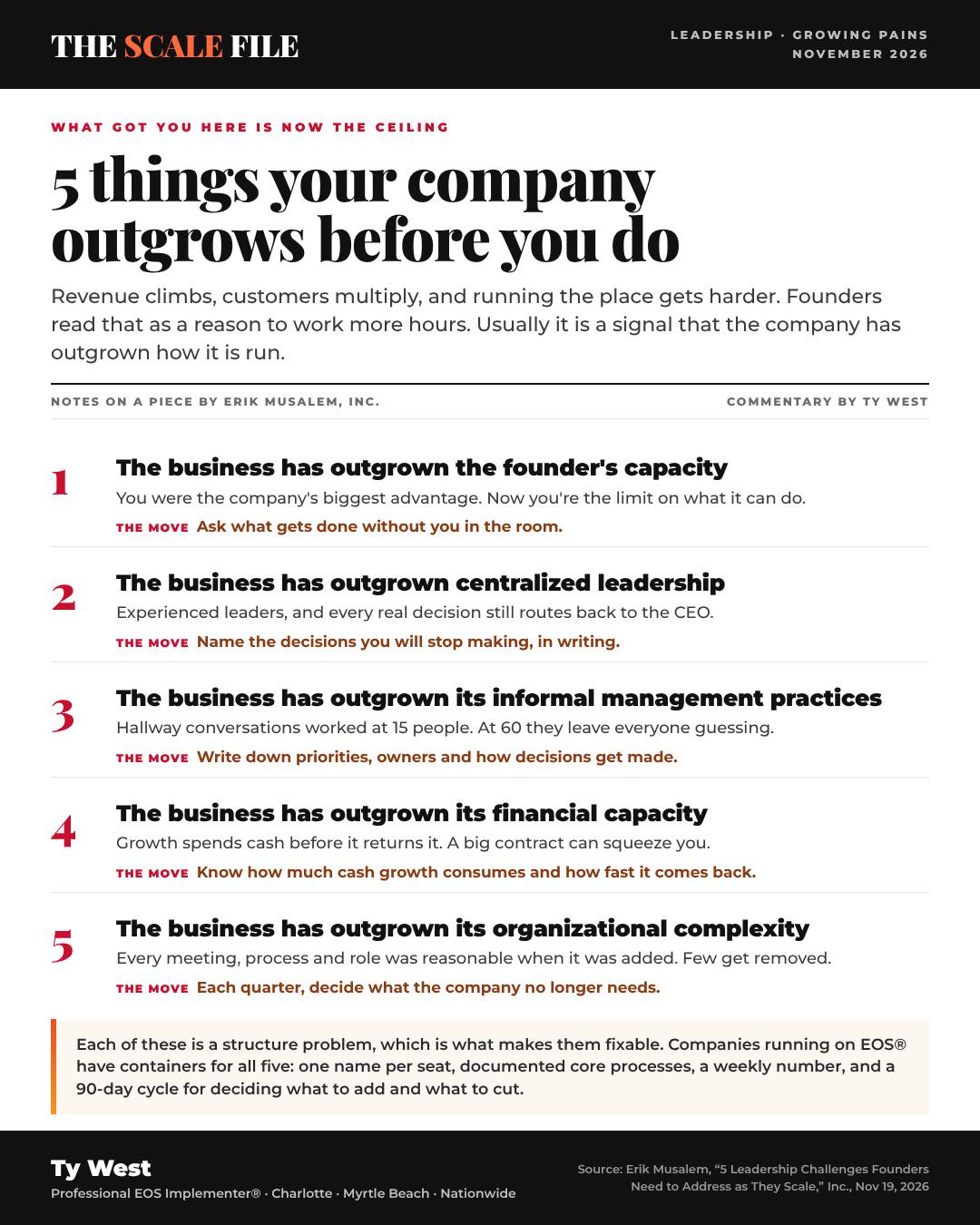
5 things your company outgrows before you do

Post image
6 Upvotes