r/Lenormand • u/Fate_Fabrice • 11h ago
Discussion Directionality in Lenormand Cards: A List
Creating a list with card direction meanings is something that has been on my mind for a long time. Having everything organized in one place seems pleasing. Please note, however, that the meanings are not created by me, or exhaustive or even definitive by any means. I have picked them up from various resources and interactions with other readers, as well as my experience up to this point. This is just all I have come to know so far. If you know something more, or even have different meanings for some stuff, please feel free to share it with us! This is a list that I wish to keep and add to, and I hope it proves just as useful for other fellow readers. ❤️
*I will also include a note about Trumping at the end of the post.
- The Cavalier/Rider: Depending on which direction he faces in your deck, what is behind him shows where he is coming from, the news he is bringing with himself. What is ahead of him shows where he is headed, his destination, or what follows the news as a consequence. Some readers see the card below the horse’s hooves as what it is trampling on: whatever matter the card below denotes gains a sense of swiftness, too. To some readers, it is important that he always faces right, moving towards the future. The Rider, as a person, is highly fashionable and thus, can be concerned with “trends” in certain contexts. Thus, the card behind or below is “left in the dust” and the card ahead is the new thing that emerges and is, perhaps, fancied more.
- The Cloverleaf: Based on the Dondorf deck, some readers see the left side as luckier than the right. There are more leaves on the left side. Also, the right side’s leaves are more shadowed, and we see a few sharp, thorn-like points which are absent from the left side. One side is lucky, the other shows the precariousness of luck.
- The Ship/Boat: Same as the Rider, depending on which direction the Ship is facing on your deck. However, the Ship moves across a greater distance and is slower, so it provides you with the long-term perspective regarding the matter at hand. Also, we know that ships sail in the direction that the wind blows, so depending on the direction the Ship faces on your deck, you can look at the cards ahead of it in order to see the areas where there are opportunities for advancement and where a “favorable wind is blowing”.
- The House: No specific meaning. According to the traditional instructions, however, if this card ends up in the middle of the Grand Tableau and below the significator, the querent should beware of their surroundings, as matters that should otherwise have stayed private are brought forth and maybe gossiped about by others.
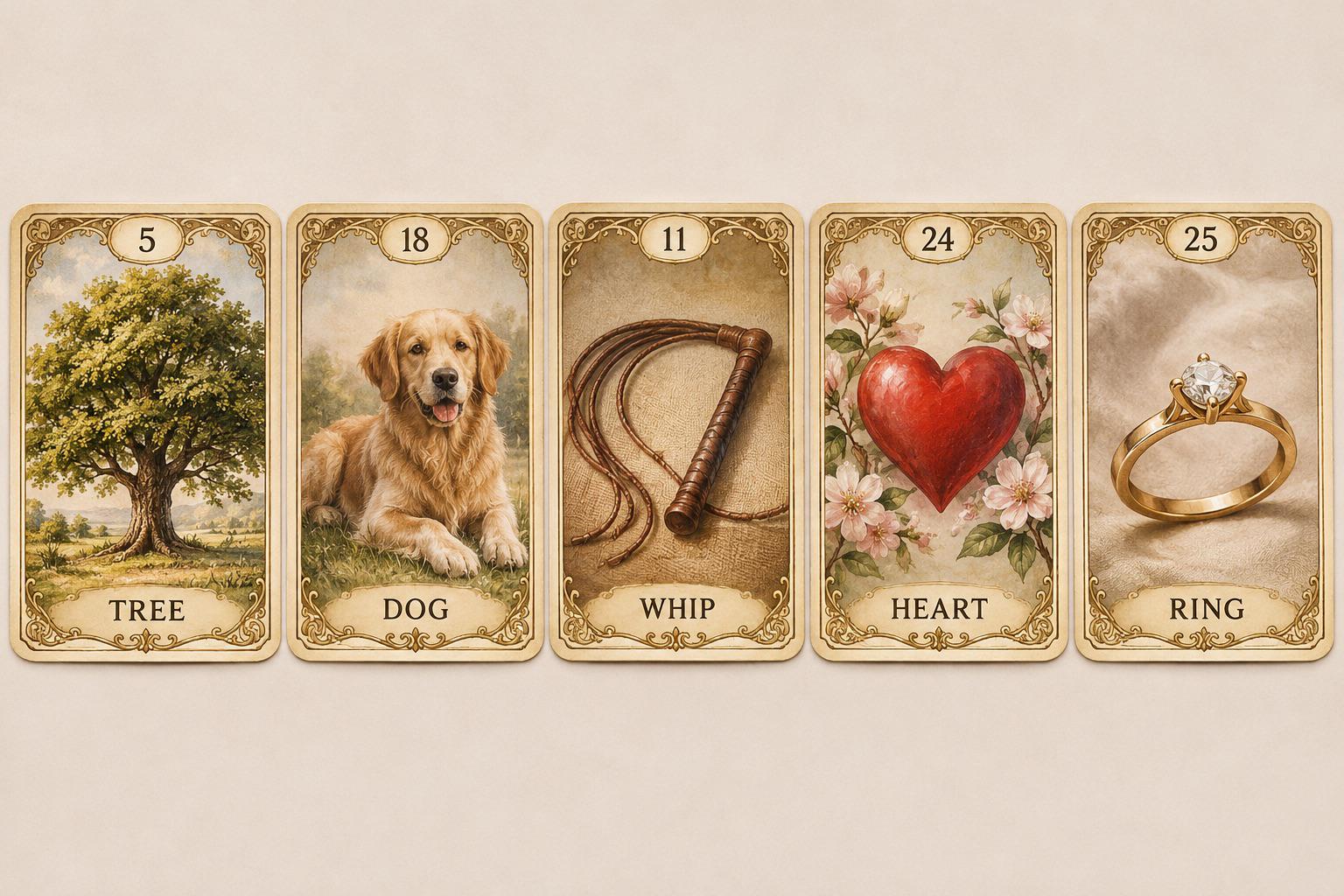
- The Tree: In the Dondorf deck, the left side appears lusher than the right; in fact, there is a withered branch on the right side. Consequently, the lush side of the Tree removes what is unhealthy (it is the healthier side), and the unhealthy side casts a shadow over the card that faces it. Additionally, the roots of the Tree can be regarded as the past and the ancestors; the top shows how those matters manifest in real life. Also, the roots can drain the card below them, while the branches on top nudge the card above them upward and give them a boost. The roots can also represent the Underworld, while the bark is the Midworld, the one we reside in, and the upper branches the Upperworld.
- The Clouds: There is a light and a dark side in some decks. In decks where it’s not obvious, one may use the direction the King of Clubs faces. Some readers say that where he looks is the light side, others believe that it is the dark side. I agree with the latter view. Some may also use the density of the Clouds to discern light and dark. Nevertheless, the dark side is held to be more ominous than the light side. Both sides are still Clouds, but the troubles are beginning to disperse on the light side. You are not in the midst of the storm, but are rather dealing with the aftermaths.
- The Snake/Serpent: The direction that the Snake faces gets poisoned; that card is what the Snake most desires and what will ultimately be where the querent gets bitten and betrayed. This shows what she charms you with, what tempts the querent. The Snake’s tail is what she is hiding from you, or, what is being complicated and twisted; it shows the detour as opposed to the sting. It becomes more obvious if we see the crooked branch that the Snake’s tail is clinging to (in the Dondorf deck); it is split into an uneven fork. The same analogy can be applied to the card’s inset, the Queen of Clubs. I once met a card reader who used the “intelligent, wise” aspect of the serpent a lot in their interpretations. The Snake’s belly (the card below) showed the hidden knowledge and the advantage the Snake has against the querent. If she is above your card and “slithers above your head”, she has you at the most vulnerable position. If the Snake is above the other significator card, you should beware that person as it is influencing them.
- The Coffin: In some decks, there is a cloth, or a pall, over the Coffin. The clothed side shows what is already ended, while the bare side shows what has become “sickly”. In decks where there is no pall, readers distinguish between the wider and the narrower side, like what we see in the Piatnik deck. In some decks one also sees candles; the side with the candles is the dead side. It symbolizes the soul’s passage and the Light of Christ for those who are Christians. It reminds one of the ancient Christian vigil.
9**. The Bouquet of Flowers**: No specific meaning.
10. The Scythe: The Scythe’s blade is dangerous. The Scythe looms like a threat over the card below, too. The handle is what you gather/reap, or it adds a quality of suddenness to the card that touches it. It gives the card above “a kick in the shin”, meaning that it speeds things up! This last observation is especially true for decks in which the handle is depicted facing upwards.
11. The Whip/Birchrod: I only know of one directional significance, and it’s applied in magical contexts. The cards that face the whip show the nature of the magic and how it looks; certain cards, especially the negative cards, would point to the presence of black magic if they fall on this side. The broom, or the twigs, show how this can be swiped away and how one can cleanse things. The card that the Jack of Clubs looks at can also be used to represent the source of the conflict/arguments. It is what angers the Jack.
12. The Birds/Owls: No specific meaning.
13. The Child: No specific meaning.
14. The Fox/Renard: The card that the Fox faces, or the card that its nose points to, is dishonest and wrong. The Fox’s tail is honest; the card touching the tail has a more cunning rather than deceiving quality. The Fox also affects the cards below, both in the vertical and diagonal directions. Those are red-flagged and take on his less favorable qualities. If a person card, however, lands on top of the Fox, they are more shrewd and intelligent rather than a liar.
15. The Bear: The card beneath the Bear’s paws is a source of strength, which the querent can use to their advantage. In readings where a lot of negative cards surround the significator, however, if the Bear is above, it can be the “beast that looms over our head”. It will overpower us and bring us harm rather than aid.
16. The Stars: No specific meaning. The only point to note is that the Celestial cards (the Stars, the Sun and the Moon) are always better when they are above and preferably to the right in relation to the significator. That way, they can light the way and illuminate the path. They are also a sign of blessing and protection, especially when above and clustered together. If the Lily is close, it’s even better.
17. The Storks: As with the Rider and the Ship, some readers pay attention to the movement that this card brings and see what is behind the Stork as the origin of movement, and what the Stork is facing as where that change is headed. If the Stork lands above the significator, it is an auspicious sign and the querent is “elevated”. However, with certain cards around, like the Ship, the Coffin, and the Tower, it points to a recent bereavement and somebody who has been grieving.
18. The Dog/Hound: No specific meaning.
19. The (High) Tower: The cards below the Tower show the past/current forecast, and the ones above show long-term future developments. It is also unfavorable when it rises between the Gentleman and the Lady, as it shows the person to the left initiating a separation; other cards must support this interpretation. If it comes after a person card, they may be a widow(er)/divorced, or just lonely.
20. The (Forest) Garden/Park: No specific meaning, other than the fact that if it comes before a person card, it makes that person an extrovert and extremely sociable. If it’s to the right, it shows a more reserved and selective individual.
21. The Mountain: In some decks, one side is visibly steeper than the other. Climbing the steep side is harder than climbing the other side, so the obstacles it poses are more difficult to navigate. Like the Tower, it isn’t a good card to see rising between two people; it isn’t good when it weighs above a card in certain contexts, either. Some also use the cards above and below the Mountain to distinguish between two different situations/environments. Mountains are what separate villages and cities from each other; they can show borders. Thus, the two sides may be drastically different. Some decks show one area with snow, and the other with evergreen trees.
22. The Crossroads/Roads/Ways/Paths: In some decks, one of the forks is visibly wider than the other, which is the best route to take and thus shows the best decision. In some decks, one route is depicted with an accident occurring on it. In the Dondorf deck, the wider route is on the right side. On the left side, and in the distance, a flock of birds can be seen. In some cultures, including my own, it’s bad when birds cross over a certain path, especially crows. So, it further reinforces the idea that on this deck, the left road is not a good one to take. We could also read the cards around the Roads as causes/situations, and then follow the Roads and see where each of them leads to.
23. The Mice: The Mice take away/gnaw away at/erode what is to their left and hide/ruin/defecate on what is to their right. The card on the left side shows what you lose; you lose further on the topic shown by the card on the right side as a result of that initial loss. Alternatively, you can use the head of the biggest mouse or the mouse on top of the others to show what is being gnawed away at, and their tail to show what is being dirtied/ignored.
24. The Heart: Not exactly a directional meaning, but some decks depict this card with a thorn close to the Heart. Our Heart is vulnerable, and certain negative cards can “prick” it, if they surround it. In the Dondorf deck, the thorns are mainly shown below the Heart and the surrounding flowers. Not everything is soft on our heart all the time; we may get hurt.
25. The Ring: If it falls to the left of the significator and far, it shows a separation. If on the right, a union is on the horizon. If cards like the Ring, the Heart and the Bouquet form a cluster, they can show being courted, or asked out. Throw the Moon into the mix, and you are getting wooed.
26. The Book/Grimoire: This is where I’ve seen the most prominent differences in interpretation. Some see the Book’s spine as what is already known, and the pages as what is being left a secret. Other readers reverse this rule. In some decks where the Book is shown open, like the Carta Mundi and Piatnik, the side that depicts an image (in Carta Mundi this is the side with the mirror drawn on it), shows what is known and the other page shows what is unknown or is still a secret. What is below the Book is what you already know, and what is above is what you still have to work out on your own.
27. The Letter: No specific meaning, other than the fact that if it comes before a person card, it makes them superficial. It doesn’t have to be a person. It just adds an element of superficiality to the card that follows it. If it falls after your significator, you are the recipient of the communication (letters, emails, phone calls, FaceTime, etc.) If it comes before your significator, you are the one who initiates things.
28 & 29. The Gentleman and The Lady: Some readers specifically prefer that the Lady faces left and the Gentleman faces right. Some read the cards depending on the direction the significator faces. To some, it is also important whether they face each other or have their backs turned to one another. Nevertheless, the card they look at shows the area they are interested in or concerned with. Cards above and to the right exert a greater influence over the significators compared to the ones below and to the left.
30. The Lilies: Per the traditional associations, we already know that whatever card the Lilies crowns is turned virtuous and possesses a high moral value. If it’s below a card, especially the significator, those values get stepped on and thus the morality of the person (or situation) is made questionable.
31. The Sun: No specific meaning, aside from the note I made earlier about the celestials. In some decks, the Sun is shown with a few faint clouds, so it has the power to disperse the Clouds and shine its rays through them, depending on the context. It also makes whatever card that follows it “bigger”, for good or bad.
32. The Moon: No specific meaning, aside from the note I made earlier about the Celestial cards. In the majority of decks, the Moon is shown as illuminating part of the scenery, while the rest is left in shadows. Recognition and honor vs the lack of those two things.
33. The Key: The Key says ‘yes’ to whatever is to its left. What follows the Key is ‘certain’ to happen. Some view the Key’s bit as the part that ‘unlocks’, while the shaft is what ‘locks’ and keeps the cards touching itself ‘locked’. Different readers may reverse this rule. In decks where the Key is tipped/tilted, some readers take the tip of the Key as the part that unlocks and the head as the part that locks. The card above the Key also gains importance; it’s as if the Key projects a big exclamation mark on it. Some readers also reverse this and take the card the Key is pointing at below as important. If the Key is above the significator, providence is on their side and everything happens at the right time!
34. The Fish(es): No specific meaning. The direction of the flow and the Ship that is depicted in the background in some decks may be significant. The Ship, the Fish, and the Anchor are cards that are connected to each other in more than one way.
35. The Anchor: No specific meaning. The Anchor is two-faceted. It can either give you stability, or it can chain you down. In some decks, it is shown with a literal chain. The Anchor sinks and weighs down.
36. The Cross: This is, again, a card on which perspectives vary a lot. Whatever is to the Cross’s left is diminished/finished and pulled down. The card to the Cross’s right is pushed and gains stress/importance. If it comes before a person card, you are either about to meet them, or it’s a person that’s returning from the past. They may or may not be pleasant to deal with. Some readers see the card below the Cross as what gets crushed/stabbed, thus burdened and hurt the most. Others see that card as the main source of aid; if we liken it to the Cross of Christ, the card below is aiding in carrying the Cross. In contrast, the card above shows the main source of the pain and burden: it is the card that the upper-tip of the Cross nudges. Again, this may be reversed and some readers may see the card above as being “nudged up” and gaining urgency. The card below is also pinned/fixed in place and doesn’t move/budge.
Trumping:
The concept of trumping cards is different from directionality, but nevertheless, it is important. It occurs among four animal cards of the deck: the Serpent, the Fox, the Mice, and the Storks. In certain decks, like the Blue Owl, the Serpent and the Fox face the same direction. If the Snake is “biting at the Fox’s tail or heels”, the cunning plots of the Fox are effectively neutralized and neither animal can harm the querent, as they are preoccupied with each other. The Snake is spending her venom somewhere else and the Fox is in too much of a trouble to get sneaky.
The Snake can also eat the Mice. If the Snake’s belly is full, it no longer desires to come after you and bite you. The Mice can no longer steal from you and leave a mess behind, either.
Likewise, the Stork can eat the Snake. In some decks, like the Piatnik, it is shown with a frog in its mouth. Traditionally, the Queen of Clubs is the bad, evil queen, while the Queen of Hearts is the good queen. If the Stork manages to creep up behind the Snake when she isn’t looking, she manages to strike her and thus, the detours will go away. Things will change for the better. If, however, the Snake sneaks up on the Stork, “bad wins over good”.
Of course, using all of this information depends on the card-reader’s own intuition and the context. Nevertheless, they are fascinating to study and worthy to note.