r/spaceporn • u/Busy_Yesterday9455 • 14h ago
NASA High-resolution view into Victoria, captured by NASA's Opportunity
Credit: NASA / JPL-Caltech / Jason Major
r/spaceporn • u/Busy_Yesterday9455 • 14h ago
Credit: NASA / JPL-Caltech / Jason Major
r/spaceporn • u/Newhorizons1975 • 3h ago
Mosaico 1,2 por 1,8 tomado con dwarf mini,total tomas 480, obturador 30, ganancia 60, filtro astro,tomada por primera vez con draks, apilado y procesado con stelar studio y snapseed.
r/spaceporn • u/Neaterntal • 13h ago
Was taken by Panhellenic Offshore Sailing Club in Mikrolimano 24.11.26
Distance: 6.6 km with the Moon at 1.6° Sony a7iii @ Sony 200-600 with 2x teleconverter Shutter speed: 1/200, f/13, ISO 400 @ 978mm
📸Babis Kotsiotas https://www.facebook.com/groups/photonium/permalink/4551958815064499/?rdid=gPRJqOT0uJB0dtsU#
r/spaceporn • u/G_Marius_the_jabroni • 8h ago
r/spaceporn • u/Busy_Yesterday9455 • 14h ago
On Sept. 26, 2022, DART impacted the asteroid moonlet Dimorphos, a small body just 530 feet (160 meters) in diameter. It orbits a larger, 2,560-foot (780-meter) asteroid called Didymos.
DART was the first-ever mission dedicated to investigating and demonstrating one method of asteroid deflection by changing an asteroid’s motion in space through kinetic impact.
Credit: NASA
r/spaceporn • u/Busy_Yesterday9455 • 20m ago
Link to the video with sound. It's loud!
Completed in 1963, it was the world's largest single-aperture telescope for 53 years, surpassed in July 2016 by the Five-hundred-meter Aperture Spherical Telescope (FAST) in China.
On August 10 and November 6, 2020, two of the receiver's support cables broke and the NSF announced that it would decommission the telescope. The telescope collapsed on December 1, 2020.
In 2022, the NSF announced the telescope would not be rebuilt, with an educational facility to be established on the site.
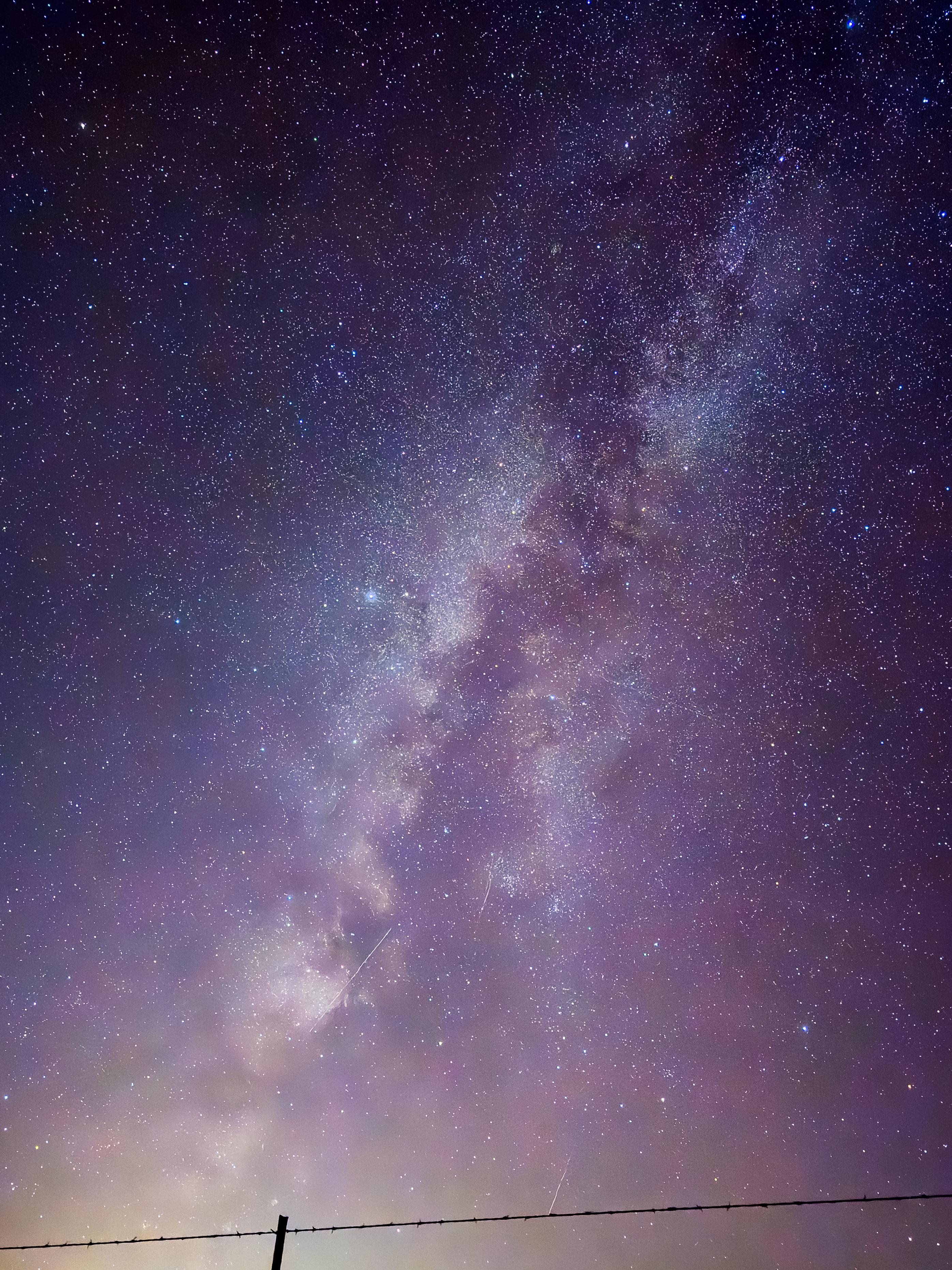
r/spaceporn • u/Curious-Light2392 • 13h ago
iPhone 15 pro max - western Oklahoma.
r/spaceporn • u/Busy_Yesterday9455 • 1d ago
Credit: Zubuyer Kaolin
r/spaceporn • u/ojosdelostigres • 1h ago
Image credit: Egidio Vergani from Milan, Italy
r/spaceporn • u/odddiv • 20h ago
My latest attempt to get the Trapezium Cluster clearly defined within Orion
~20 hours of integration in SHO with a 2600MM from my Bortle 5 backyard
r/spaceporn
•
u/Busy_Yesterday9455
•
1d ago
What does the new sharpest image of our Sun show? Instability. To be clear, a certain kind of interactive process called the Kelvin-Helmholtz instability (KHI). This instability can create waves and swirls when two streams flow past each other -- in this case variable streams of solar magnetic plasma.
Long hypothesized to occur on the Sun's surface, KHI streaks and swirls were confirmed in just-released dramatic high-resolution images taken recently by the Inouye Solar Telescope in Hawaii, USA. The featured false-yellow image, actually taken in deep blue, is the highest resolution image yet of the Sun in visible light. It spans about the radius of the Earth, but its finest details are city sized. Visible are several smooth tops of changing solar granules, while the edges of the flower-like structures have been found to harbor multiple KHI swirls.
Future research may investigate how the KHI helps move energy and magnetic fields, and may even heat the surrounding solar corona.
Credit: NSF, NSO, AURA, MPS, Inouye Tel
r/spaceporn • u/Neaterntal • 14h ago
March 23, 2008
Description from 2008
As NASA's Mars Exploration Rover Opportunity creeps farther into "Endurance Crater," the dune field on the crater floor appears even more dramatic. This false-color image taken by the rover's panoramic camera shows that the dune crests have accumulated more dust than the flanks of the dunes and the flat surfaces between them. Also evident is a "blue" tint on the flat surfaces as compared to the dune flanks. This results from the presence of the hematite-containing spherules ("blueberries") that accumulate on the flat surfaces.
Sinuous tendrils of sand less than 1 meter (3.3 feet) high extend from the main dune field toward the rover. Scientists hope to send the rover down to one of these tendrils in an effort to learn more about the characteristics of the dunes. Dunes are a common feature across the surface of Mars, and knowledge gleaned from investigating the Endurance dunes close-up may apply to similar dunes elsewhere.
Before the rover heads down to the dunes, rover drivers must first establish whether the slippery slope that leads to them is firm enough to ensure a successful drive back out of the crater. Otherwise, such hazards might make the dune field a true sand trap.
Credit NASA/JPL/Cornell
https://science.nasa.gov/resource/endurance-craters-dazzling-dunes-2/
r/spaceporn • u/ojosdelostigres • 1d ago
r/spaceporn • u/Newhorizons1975 • 22h ago
Tomada con dwarf mini,200 tomas ,obturador 45,ganancia 60, filtro duo band, apilado y procesado con stelar studio y snapseed.
r/spaceporn • u/SVPREMIANVS • 1d ago
J2157–3602(the little red dim dot in the center) is an ultra-luminous quasar and supermassive black hole. It has the bolometric luminosity of 2.29 * 10^48 ergs/s which equals to 600 trillion solar luminosity. Refined spectroscopic redshift of z = 4.692 means that we see it as it was 12.5 billion years ago. Due to the expansion of universe, it now has the comoving distance of 25 billion light years away from earth. The black hole powering the quasar had the mass of 34 billion suns.
Credits: SkyMapper Southern Sky Survey/ESO
r/spaceporn • u/Neaterntal • 1d ago
Sadly the image resolution isn't good enough yet to derive a photogrammetry model.
credit NASA / ESA / Simeon Schmauß
https://bsky.app/profile/stim3on.bsky.social/post/3n37m372u7s2q
r/spaceporn • u/Busy_Yesterday9455 • 1d ago
r/spaceporn • u/Busy_Yesterday9455 • 2d ago
Credit: Dr. Sebastian Voltmer
r/spaceporn • u/Busy_Yesterday9455 • 2d ago
Beauty is in the eye of the beholder. And there is much to behold in today's featured image. The Milky Way shines bright in the sky of Brazil, over the white sand dunes and dark lagoons of Lençóis Maranhenses National Park. We can see different parts of the Milky Way as it apparently rotates in the sky every night and throughout the year.
This composite image was taken later in the night in July from a latitude of approximately 2º south. It shows some prominent Milky Way features, such as dark dust lanes and colorful nebulas. But does the Galaxy really appear arched like a rainbow in the sky? No, this is an artifact of a picture taken with a wide-angle lens.
As the Galaxy was artfully framed by the photographer, it matches the contour of the dark lagoon creating the illusion of a cosmic eye, half in space and half on the ground. Is this eye in the sky looking back at you?
Credit: Ignacio Fernández
r/spaceporn • u/ojosdelostigres • 2d ago
The bright, rapidly rotating star Gamma (γ) Cassiopeiae illuminates two nearby nebula: the reflection nebula IC 59 (below and to the left of the star) and the emission nebula IC 63 (directly below). The latter is sometimes called the Ghost of Cassiopeia.
r/spaceporn • u/Neaterntal • 1d ago
NASA / ESA / Daniel Marín
https://bsky.app/profile/p-s-v.bsky.social/post/3n37q5rfx6c2h
r/spaceporn • u/Neaterntal • 1d ago
This video from Norwalk, OH. It appears this fireball was visible from several states across the Great Lakes Region. (Video: Charell Schluchter)
https:// x. com/ChrisWTOL/status/2125767792339058990
https:// x. com/JAtanackov/status/2125974970589143256