r/SpeculativeEvolution • • 7d ago Bravo

Molaria [Molaria] The Doomed… Molaria?-400 my P.E., The Concrete Forests

Thumbnail
gallery
251 Upvotes

Far away from this world, running parallel to our own, a unique and bizarre biosphere has grown, Molaria. Over the last 400 million years in the present era, the descendants of Ranzania and the rest of the organisms that were once introduced to the planet have diversified and developed hundreds of forms that give Molaria's biota a picturesque and unique appearance, very different from what we are accustomed to seeing on Earth. This is due to the planet's extreme conditions,featuring a 54 degree axial tilt, which causes almost the entire planet to be steeped in an extreme climate, very strong winds, and abrupt changes between seasons.

Even so, life found a way and managed to find a small strip of land where nearly all existing fauna concentrated, the equator. Here the climate is relatively stable compared to the rest of the planet, and winds strong enough to destroy vegetation rarely occur, allowing the emergence of tall, tree like flora, even though they actually descend from macroalgae that eventually developed pillar like shapes with very flexible segmented branches.

Moving among these are organisms such as C. prasinus. Despite their shape vaguely resembling that of terrestrial arthropods, they are in fact colonies of terrestrial brittle stars capable of moving across land. Around 100 million years in the present era, the first colonial brittle stars appeared, echinoderms with tetraradial symmetry that used specialized arms to transmit information to one another and link their blood systems in a chain. Over time, several groups specialized, and one of them comprised the ancestors of these creatures. Each of the segments has its own mouth, its own respiratory system, its own heart, and even its own brain. Despite this, all modules operate in unison, crawling slowly along the algal segments and feeding on fungi and small flora growing on their surface, using their jaws to scrape them off. This specific species has 5 segments: a defined front segment with a specialized arm bearing compound eyes very similar to those of arthropods, a rear segment with an arm that serves as an antenna and olfactory organ, alongside the middle segment,which presents no arms specialized as legs and handles reproduction exclusively. Because of this, unlike many other species in this group, these colonies cannot split apart, as one of the halves would lose the capacity for reproduction.Instead, they detach whichever last segment they hold, leaving it behind to its fate, where it usually serves as bait for their predators.

Foraging among the branches is an individual of Q. thyellodis. Despite appearances, this organism is actually a descendant of the Ranzania that were introduced to Molaria long ago. Their ancestors, the slugfish, were similar to present day flatfish, except that instead of swimming, they used a muscular foot derived from a ventral sucker to glide across surfaces and grip other organisms, typically algae on which they fed. After coming onto land, this clade developed an immense biodiversity, occupying every possible niche across the surface of Molaria, both on land and through groups that returned to the sea. This specific species belongs to a group adapted to living in sheltered, windless areas, as instead of living pressed against the ground like the rest of terrestrial Ranzania, its foot divided into two limb like structures, with which it moves along tree branches at a much higher speed than it would have if using a single foot. Its lateral fins have derived into sensory arms that allow it to detect small prey in the wood and grab them to bring them to its mouth, while the fin on the opposite side became an antenna sensitive to changes in pressure, temperature, and similar stimuli, allowing the organism to detect a storm hours before it passes through the forest in order to find shelter as soon as possible


r/SpeculativeEvolution • • 8h ago

Uncategorized Speculative Biology [OC] The femboy-themed seed world. ◕ω◕

Thumbnail
gallery
121 Upvotes

-red pandas- -sugar gliders- -New Caledonian giant geckos-

-Rosy maple moth- -Orchid Mantis- -Axolotl- -White's tree frog-

-Venezuelan Poodle Moth- -Sparklemuffin Peacock Spider-

-bamboo- -cherry trees- -maple trees- -Blue shark-

-Australian cuttlefish- -Clownfish- -mackerel- -Broadly flat lizard-

what are your thoughts? What should I name the planet? Who will take carnivorous niches, and who will take herbivorous niches?


r/SpeculativeEvolution • • 15h ago Bravo

Posthumans [OC] Syrse's interesting extinct fellas

Thumbnail
gallery
191 Upvotes

**Fabuvendit**

Fabuvendits are characterized by their imposing stature, lean yet heavily muscled bodies, and, most notably, dense masses of fat that are both firm and remarkably elastic, allowing them to withstand considerable physical impacts.

Their name literally translates to "weak-hearted", as their greatest enemy is cardiovascular failure. Weighing over 4.5 tonnes (10000 pounds) and reaching heights of up to 3.5 metres (11.5ft) in the largest species, Fabuvendits push the limits of biological endurance on Syrse. Their fast metabolism places an enormous strain on their bodies, resulting in a relatively short lifespan that rarely exceeds twenty years.

Their brief lifespan, combined with an early age of sexual maturity, has contributed to the remarkable diversity of this family, which encompasses approximately one hundred species.

All Fabuvendits are carnivorous. However, rather than relying on teeth, which they entirely lack, they use their fists to subdue their prey. A single punch delivered by a fully grown, large-sized Fabuvendit can be powerful enough to kill a sizeable rival/prey instantly.

The iron axe-like appendage attached to their hindquarters serves 2 purpose, it helps maintain balance by counterweighting their massive bodies, while also protecting their rear during rapid pivots and sudden changes of direction.

**Tartavendit**

True walking tanks, Tartavendits are almost entirely immune to external threats. Weighing over 13 metric tonnes and measuring up to 8 metres in length, these colossal creatures fear no thunder or fire.

Their entire bodies are covered in thick protective armour, while their hindquarters are reinforced by an extremely heavy iron axe-like appendage. This structure serves a provides additional protection while acting as a counterweight to help them maintain balance.

Tartavendits are highly opportunistic feeders, consuming virtually anything they come across, from vegetation to animal carcasses. They generally lead solitary, passive lives and rarely display aggressive behaviour.

Their only known challengers are particularly large Fabuvendits, which occasionally manage to inflict damage upon their armoured hide. Even then, such encounters rarely result in anything more than superficial injuries.

However, much like their Fabuvendit (close cousins actually) relatives, Tartavendits are particularly susceptible to cardiovascular complications. This vulnerability becomes especially pronounced when they are lying on their sides or backs, as their enormous weight places additional strain on their circulatory system.

**Diminuter**

Diminuters derive their name from their natural habitat, the Diminumates: vast salt plains supporting a unique and highly specialized ecosystem.

Among the organisms inhabiting these regions are some Syrsophores, native life forms that existed on Syrse long before humans came. Resembling terrestrial coral, these small colonial organisms produce salt crystals as for protection, which also anchor them firmly to the ground.

To exploit this unusual food source, Diminuters have evolved exceptionally powerful forelimbs, equipped with enormous hands and long, sharp, iron fingers. These allow them to dig through compacted salt deposits and reach the Syrsophores buried beneath the surface.

Diminuters are generally massive creatures, with some individuals exceeding five metres (16,4ft) in height. They possess a relatively slow metabolism, allowing them to survive in an environment where resources are scarce and conditions are particularly harsh.

With no natural predators, Diminuters occupy a dominant position within the ecosystem. They are among the very few species capable of surviving in such an inhospitable environment.

Novibes

Novibes are the only large-bodied ibes known to inhabit the warm climatic regions of Besolut.

As an adaptation to these higher temperatures, they lack the thick coats and beards typically found in other ibes, leaving their powerful musculature fully exposed. Males possess the distinctive T-shaped head structure that gave this family its name. This unusual shape consists of attachment points for the masseter muscles.

Scarcity of prey and other resources makes Novibes particularly aggressive. Females of the Firolin species, in particular, are notorious for their cannibalistic behaviour.

Their size is comparable to that of other ibes, with males reaching between 3 and 3.5 metres in height, while females generally measure around 2.1 metres.

By Syrsean standards, Novibes are intelligent. They are capable of using tools to hunt and construct rudimentary shelters.

**Sadomat**

The Sadomats were among the most diverse animal groups of the Middle Syrsean period. They inhabited nearly every major landmass and sustained themselves on a wide variety of plant matter.

They were characterized by their elongated necks, relatively athletic bodies and long limbs. Despite their seemingly defenceless appearance, certain species, such as the Sadomat Hivek, were exceptionally aggressive and fast. Their natural predators were limited to highly specialized hunters, including the Fabuvendits.

Their eventual extinction across Syrse remains particularly puzzling. Sadomats maintained a symbiotic relationship with a bacteria found throughout the planet. During the Safhi Cidon extinction event, this bacteria disappeared, disrupting the biological relationship upon which Sadomats depended. Unable to survive without their symbiotic counterpart, the entire group eventually vanished from every region of Syrse.

**Revosifex**

One of the most primitive groups of humans ever to emerge on Syrse, the Revosifex are regarded by modern Syrseans in much the same way we regard certain Cambrian organisms that left no surviving descendants.

Early humans on Syrse faced numerous biological challenges, one of the most significant being the need to filter and eliminate iron and other chemical compounds, which were extraordinarily abundant across the planet.

Before the evolution of the specialized iron-removal systems now found in nearly all living organisms on Syrse, early life forms had to develop alternative means of dealing with these accumulating pollutants.

The Revosifex were the first group of Gires to undergo significant diversification and spread across Syrse. Their evolutionary success was caused by one thing: a dorsal crest designed to accumulate and store harmful substances within the body.

Although this adaptation gave them a distinct evolutionary advantage and set them apart from other early humans, it ultimately became their downfall. Their prominent dorsal crest made them more vulnerable to predation and cancers, turning what had once been their greatest biological asset into a fatal evolutionary liability.

Thanks Google translate


r/SpeculativeEvolution • • 5h ago Bravo

Future Evolution [OC] Iguanotherium gigantus. A descendant of the Mexican spiny tailed iguana 50 million years after human extinction

Thumbnail
gallery
23 Upvotes

brief evolutionary history: After the Holocene extinction wiped out large mammalian herbivores in North America and Mexico the large herbivore niche was left open. Populations of Mexican spiny tailed iguanas slowly began takeing advantage of the lack of large herbivores grazing and eating leaves from shrubs. Over millions of years these iguanas slowly grew larger in size over generations to taking advantage of the abundant food developing a stockier build and thicker legs. Around 38 million years into the future the first members of the genus Iguanotherium evolved possessing tall neural spines to support muscle attachments around the neck and tail. They also posses a nasal horn(females almost entirely lack this) used in mating related fights for dominance where males shove at each other using the nasal horn to poke at the rival male to keep them at bay, they also posses the signature segmented looking tail of spiny tailed iguanas only taken to the extreme with the tip having thagomizer like spikes to counter predators like terrestrigator ferox (will talk about this in a future post, essentially a terrestrial alligator). Eventually around 45 million years into the future some members of the genus radiated into North America becoming the species Iguanotherium gigantus.

Stats:
Length: male 8 to 9 meters, female 6 to 7 meters
Height: male 2.0 to 2.3 meters (at top of head), female 1.5 to 1.8 meters (at top of head)
Mass: male 1,500 to 2,200 kg, female 750 to 1,250 kg
Diet: Grass, fernss, lower tree leaves.

Previous post for this project:
https://www.reddit.com/r/SpeculativeEvolution/comments/1y6ktbn/oc_barychen_titanus_a_future_descendant_of_the/


r/SpeculativeEvolution • • 21h ago Bravo

Alien Life [OC] Planet Lethe - Greater Sea Maw Satellite Imagery

Thumbnail
gallery
351 Upvotes

The Oculus Survey Satellite is one of many such satellites deployed to study Lethe for potential points of interest in an otherwise empty surface. It was NOT designed to detect and image alien wildlife in their natural habitat.

But, on this occasion, it appears that the two are one in the same.

One of the very few somewhat clear images ever taken of the somehow extremely elusive Greater Sea Maw swimming close enough to the surface of the water to be photographed. This truly gargantuan specimen is theorised to extend in total body length around 8km, suggesting that it is still not yet fully grown.

While Lesser Sea Maws have been studied somewhat intenseively by researchers, Greater Sea Maws are a true mystery. How they reach and maintain this size in such a nutrient poor environment is completely unknown. Much less is known about even their basic biology.

Greater Sea Maws have been encountered under the ocean surface previously, but due to their size individuals often don't even realise they are within the mouth of such a creature until the light disappears, and the currents increase in strength. Typically, this is an inescapable fate, and anyone caught within such a situation is advised to turn on their tracking beacon to allow for future efforts.

While the individual here is still very impressive in size, even if not fully grown, researchers have reason to believe that Greater Sea Maws could potentially grow to 20kms or more. Evidence presented for this is the remains of the 'Old Mother', thought originally to be a small island chain within the Brine Sea (an enormous brine pool with its own weather patterns) at the bottom of Lethe's oceans, now confirmed to be the petrified remains of a colossal Greater Sea Maw specimen.

Research into how these creatures even exist is still ongoing.

---

Many people wanted to see a Greater Sea Maw, so here it is! Or, at least a satellite photo of one.

I am very sick right now so this one is a little bit simpler of a post. Still, I hope everyone enjoys!

If you have any questions about Lethe, the Sea Maws, or other creatures or phenomenon please feel free to ask!

Lethe is an Ocean World where everything is designed around phobias, so drop your greatest fears below and we'll see what I can do maybe ;D

Thanks for your continued support fellow Kappa Station Researchers!~


r/SpeculativeEvolution • • 11h ago Bravo

Alien Life [OC] A Coastal Macaw Hog Probes for Food

Post image
49 Upvotes

On a planet lightyears from Earth, a small macaw hog sniffs for a meal using its two dexterous sniffing appendages. Unfortunately, all that grows on this small freshwater beach is the sparse purple grass that infests most non-arid parts of this world.
Just recently, this hog had done some choreography with its two vestigial back legs to try to attract a mate. The long, competitive mating dance had cost it lots of energy, hence its current predicament.

Critique is welcome, both biological and artistic in nature. This design isn’t really meant to be final, it’s more of a ”sketch” to play around with body plans.


r/SpeculativeEvolution • • 15h ago Bravo

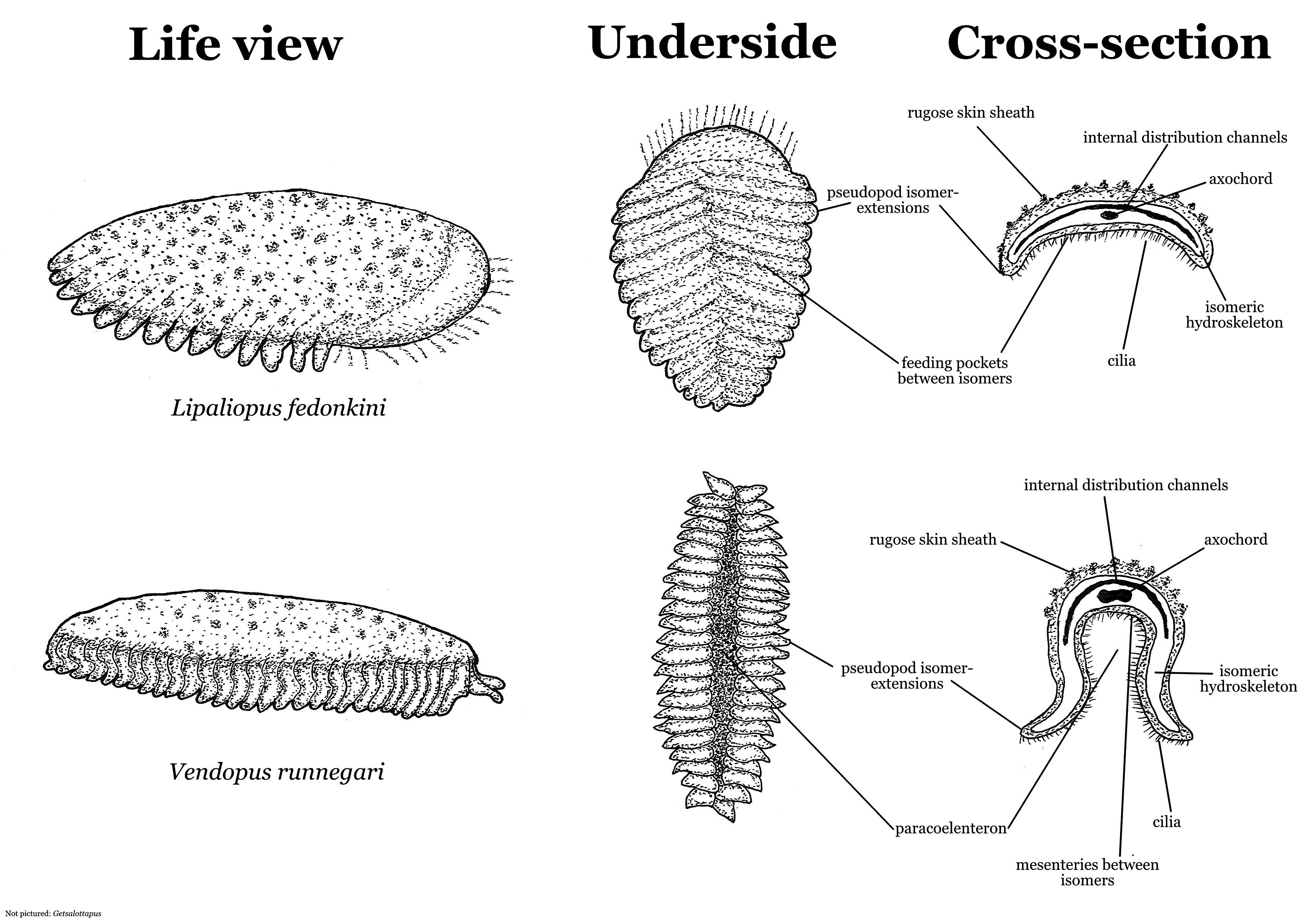
Alternate Evolution Ediaquarium: Vendopoda, Early Cambrian proarticulates (relatives of Dickinsonia)[OC]

Post image
105 Upvotes

r/SpeculativeEvolution • • 19h ago

Alien Life [Credit: C.M. Kösemen] What do you think the Lopsiders' Pets (fauna native to this high-gravity planet) were like?

Post image
54 Upvotes

I enjoy speculating on the alien life of All Tomorrows as much as I enjoy speculation on the posthumans thenselves, especially before the Redux comes out. Excited to hear your thoughts!


r/SpeculativeEvolution • • 14h ago

Question/Discussion Is there a reason for no Club-tails and/or Whip-tails in mammals ?

11 Upvotes

Hi!

While working on my own spec-evo project, I thought about different defense mechanisms in animals and club and whip tails came to my mind.

Is there a reason mammals didn't evolve such things and is it even possible for them to evolve such a thing, and if so, is context important in such thing?

I know I can create my own silly things without the need for science, but I still like to be semi-realistic in my works.

Thank you in advance!


r/SpeculativeEvolution • • 10h ago Bravo

Fan Art/Redesign [OC][Media: Mystery Flesh Pit National Park] Immanis Colosseus redesign

Post image
4 Upvotes

Redesign of the Permian Basin Superorganism’s Species from MFPNP. This is my first time doing spec evo so it might violate the Square Cube Law a little
The PBSO is a single organism that found its way into the Permian Basin in Texas, and got way bigger than every other member of its species due to finding a wet nutrient rich zone. This is just the life stages of its species


r/SpeculativeEvolution • • 7h ago

Future Evolution My world rat 3

2 Upvotes

In the early 22nd century, Earth’s average temperature rose by 6 degrees, triggering the Holocene Mass Extinction. Humans and their domesticated animals went extinct, and top predators, as well as large animals with limited habitats, also became extinct. The only survivors were rats that preyed on cockroaches... Five million years later, these rats had evolved into mysterious creatures. We will explore them.

Name: Mangrove Jellyfish Mouse

Appearance: It has sharp projections inside its mouth and thick skin.

Habitat: It lives in mangrove forests in the tropical rainforests and tropical seas of the Americas, including the Caribbean.

Behavior: It excretes highly concentrated urine. The reason for this is that if they cannot filter out seawater, they will become dehydrated; therefore, they excrete urine with a high salt concentration. They also eat a lot of jellyfish, which are mostly made up of water. They hunt actively at low tide but sleep in their burrows at high tide. Furthermore, they are not marine animals; for now, they are more adapted to life on land, similar to Pakicetus.

Social Behavior: Currently, they are increasingly living solitary lives due to a lack of food resources and the need to hunt across a wide territory. Although they are currently about 50 cm in size, their young are still

small, so living in groups actually hinders them.


r/SpeculativeEvolution • • 1d ago

Fan Art/Redesign [OC] [Media: Godzilla] "Retaliation"

Post image
62 Upvotes

A male Baikal Gojira (Monstrorex nakajimaii) breaks the helpless Herbivore stereotype by preventing a juvenile from being the next meal of a female Earthquake Whale (Agnostoscetus onkodis)

Inspired by an artwork from Godzilla: Savage Planet, by Wyatt Andrews Workshop


r/SpeculativeEvolution • • 15h ago

Question/Discussion I need help with naming a species. Can someone help?

4 Upvotes

I want to name an animal Blind, Armed King of the trench's carpet {Genus name, species name} with either Latin or/with Ancient Greek words; can someone help me? ('Armed' in the sense that it possesses limbs; or more accurately, appendages)

I also came up with an idea for the name: Typhlomeloregis fossatapeti, is this correct?


r/SpeculativeEvolution • • 15h ago

Question/Discussion Need help designing orcs?

4 Upvotes

Ok im trying to design orcs for my fantasy world i decided to make them synapsids amd taking heavy inspiration from lystrasaurus but had few questions first is would knuckle walking design be best build for strength i want my orcs to be extremely strong but bad in distance or stamina related things 2nd there homeland is a extremely harsh desert woth pockets of jungle plateaus as safe areas. Would knuckle walking cause problems with them moving in said desert ?


r/SpeculativeEvolution • • 8h ago

Question/Discussion if a whale species moved back to land and evolved prehensile limbs what is most likely to become the prehensile limb? (question also applies to alien whale like body plans) What prehensile organ would be most effective?

0 Upvotes

What sort of prehensile organ is most likely to be evolved by an alien or earth whales relandifiying?

What evolutionary pressures would lead to whales with prehensile organs? It could be evolved on land or sea.

Beyond what is most likely, what organ would make the most effective, and how much would it cost metabolically, what would be some trade offs?

The Earth animal above is used for reference.


r/SpeculativeEvolution • • 17h ago Bravo

Uncategorized Speculative Biology [OC] The Monster of the Continentales

Post image
6 Upvotes

In this region of the Continentales range, the biomes are harshly divided from lush hills to desertic highlands. This is thanks to Shelves. Shelves are large rock formations who block water. Infact, they can be over 100m deep. This allows them to block and dry the soil, creating drastic contrast. In this highland range, one of the largest animals is the Therocephalosuchus continentalis/atrox. These large crocodiles are closely related to Molochs and Macairodons and this couple fights over a Porcus versatilis corpse, a common animal in this region.

Therocephalosuchus grow to 6-8m in length, around 1,1-2 tons in weight and possess a shockingly high bite of 30-35k newtons. These behemoths have large ziphodont teeth, and these teeth are pachydont, making them more resistant to torque and pressure. These teeth are about 9-15cm long. They are mesothermic and live up to 60-70 years.

These animals have no predators in adulthood and are superpredators in these sparse highlands and badlands, but juveniles are vulnerable. They feed on whatever they can catch easily usually being large slow herbivores. They need around 18-24kg of food daily

They reproduce every 3-3,5 years having a clutch of 20-25 eggs, with 20-30% surviving normally. Parents may protect their clutches but young are left alone after the first or second week.

Therocephalosuchus have good eyesight and smell and mediocre hearing and their intelligence is nothing spectacular.


r/SpeculativeEvolution • • 1d ago

Alien Life [OC] Lacopus

Thumbnail
gallery
42 Upvotes

The Lacopus are practically a sister species of my future humans. They were the first sophonts humans ever found and so they established an early relationship with them that persisted for 20 million years, that resulted in the two species coevolving alongside each other.

Before anyone asks, NO HUMANS DID NOT ENSLAVE THEM. The Lacopus willingly took labor jobs because that’s what their society was already centered around and they were being fully paid for the jobs they did.


r/SpeculativeEvolution • • 15h ago

Question/Discussion Has anyone ever made a spec-evo project about an ocean world that had to evolve to living under ice?

3 Upvotes

There’s probably already a word like that in our solar system, Europa, which is one of the moons of Jupiter. There are already organisms and entire ecosystems that have evolved to live in the ocean on earth. Can you imagine a whole planet that has never experienced sun light? Can you imagine what it would look like if there were intelligent organisms like us on those planets?


r/SpeculativeEvolution • • 11h ago Bravo

Alien Life [OC] THE KAELEN!

Thumbnail
gallery
1 Upvotes

The Kaelen (kaelenis dominans)

The Kaelen is an alien species in another universe.. it’s sapient and weird.

The Kaelen live on the moon vita, and its gas giant is oros-9 a gas giant larger and bigger then Jupiter and is actually warmer because it sits in the Goldilocks zone. It has an orange dwarf star.

Kaelen are viviparous, they have a gestation of 12-13 months. When an infant is born, it is a grub. The grub has three stages: neogrub, 0-3 years old, relatively new and still learning it’s still learning to crawl. Ligongrub, 3-6 years old, it’s a more experienced crawler and plays more. 6-10 years old is last grub stage, and it’s a very experienced crawler. It plays a lot, shows effection, and develops fears. Scientists usually describe Kaelen as insectoid and mammalian, as females lactate from there chest to feed the baby and the baby is a grub that metamorphosis. They have copper blood, not iron blood.

The male is larger, at 8-9 feet. While the female is 6-7 feet. The male has chest fluff parallel to a lions mane, as it does the same thing: attract females! The fluffier chest means the healthier male, though when the male reaches old age (50-100) he starts losing his chest hair and getting ready for death. For a female and a male, the prime reproductive, hunting, and great days are 18-49 years old.

A teenager is 10-18 years old, they are smaller as male teenagers are 5-6 feet and female teenagers are 4-5 feet. The teenager is growing, and just like human teenagers, they do stunts.

The Kaelen are semi aquatic aswell, they have semi webbed hands and feet. Though the male needs to wear special chest clothing that seems like a binder but it’s to stay streamlined. They make clothes out of animal hides and while my drawing doesn’t show it, they aren’t usually naked unless they go underwater.

Kaelen live in the continent northern taraland and the other continent is southern taraland, there’s only two continents because the rest are island…

The horns aren’t horns, they are antennae. They are used for scent, touch, and even hearing.

The grubs are more animalistic then adults, and they are blind despite there wide eyes. Grubs detect their mothers from the scent of warm milk, and they can be distressed when their mother isn’t near.

There is big, insectoid and mammalian megafauna and microfauna and megamushroom forests they live in.

Kaelen are great swimmers, makes are powerful “torpedo” swimmers while females are agile swimmers. Since they are semi aquatic, they use fishnets and underwater spears to hunt underwater, hunting fish and shrimp dolphins.

On land, they hunt giant arachnids (such as the herospider and the gigantoscorpion) the size of elephants and large bodies, and they also eat mushrooms because mushrooms replace plants on this planet using a symbiotic algae to photosynthesis but they are also heterotrophic eating dead matter. The algae gives the mega mushrooms 60 percent of the energy they make in exchange for a home (the algae is microscopic).

Anyways, the Kaelen have both endo skeletons and exo skeleton… as a grub the endo skeleton is cartilaginous and they only have the exo skeleton on their head and limbs. Grubs are so cute! They even have cute little fat tushys!! Awwwww-

Their culture and language is complex as there is many, though we can infer it because they have heavy chewing mandibles as adults their languages sound like hard clicks and clanks. Scientists have observed that one of the adults words include “shk” which means food, “rk-krick” which means love, and “tck-tck” which means baby.

A common rituals and practices include praying to a deity or just praying to no one when their child is about to metamorphosis (making silk coming out their anus.) and wearing jewelry and clothing, which can be considered masculine for males and feminine for females.

The ecosystem of Kaelens is amazing, and unlike anything on earth. From giant, bovid or proboscidean or primate like arachnids (like the herospider which resembles earths bulls but has eight legs and mandibles or the tree scorpion which is as large as a gorilla and even knuckle walks with large front arms and eats fruit on trees or the elephant tick a trunk nosed elephant like giant tick!) to predatory arachnids (like the ambush scorpion, a large lion like scorpion that hunts large herbivores or the cat spider a spider that hunts small gubs) to gubs, gubs are small insect like animals filling the niche of earth arachnids and insects (like the subterranean tick, a tick that’s filled the niche of ants or the redip a large spider like animal that catches flying animals like the glider a blood sucking animal in its silky nets).

Now the flora is actually fungi with black algae cells in them, from the ground mycelium filling the niche of grass to mega mushrooms or megashrooms filling the niche of trees with hard wood and turning a fruiting body into the extension of the main organism to the bee mushrooms mushrooms that open up and use gubs like flying stars which are are fast insects that look similar to ladybugs to drink their sap and spread spores.

Not to mention, the sky of vita is so magnificent because it has a large gas giant in the sky with an orange sky with a large star named viraurantiacus that shines brightly, with bird sized gubs (like the hawk moth or flying spider or pecking tailed fly) zooming through the sky…

Also, the aquatic life is also very strange with dolphin like viviparous lactating smart shrimp that basically take the niche of dolphins to the mega prawn a large shark like predator to even frog crabs, crabs that take the niche of frogs with tadpole like larvae that metamorphosis into this crab we also have small and large fishes like claws (like the lobster tailed claw) and even hornfish (shrimp like small fish the size of sardines)

The largest land animal on vita rivals many sauropods and is larger then most, and it is the gigantospider. The gigantospider gestates for a long period, before laying eggs that hatch shortly after. The animal had actual lost its exo skeleton, relying mostly on its actually internal skeleton. Though it still technically had a exo skeleton that wasn’t that thick and acting like armor for them. It was a fungivore grazing on fungi and the spider had six desert roux legs for walking and the front legs for grasping stuff to put in their jaws. It had a long thick body with flat mandibles and all its eyes were pretty wide. The largest animal in general was the giant shrimp whale or GSW and it still lives today being the size of a large blue whale, it gave live birth and is closely related to shrimp dolphins. It filter fed on aquatic fungi the size of krill with chitinous scales elongated like baleen in its mouth.

How do babies play? They do cuddle piles (going in a pile after breastmilk to lay and rest and burp) and baby wrestle (crawling onto eachother and pushing eachother for fun) to the grub slide (sliding off small slide shaped rocks) and even dancing (especially when mom makes them)!

Decorating the cocoon is seen as impure and biologically speaking it can block air from coming in the cocoon, teenagers do speak in slang and have different styled clothing then adults but this changes every new generation, certain tribes worship the gas giant but other tribes see it as how we see our moon thinking the moon is larger then the gas giant and some other tribes think the gas giant and the sun are brothers and some think they orbit it the gravity doesn't effect their hunting styles much as they already are adapted to it, they don't need rafts actually they ar every good swimmers but they make shroomie houses and spears with mushroom sticks and this rock known as the vita aka fishnets out of mycelium and yeah, a specific family tradition is to decorate the gigsmushroom the cocoon is on similar to how we decorate Christmas trees.

The grass is actually a genus of mushrooms known as exomycete, they have external mycelium that eats dead matter and carries no black algae (black algae effects a different family known as megamycete). What about megamycete? Megamycete have two families, fruiting fungi (who use a similar “pollination” to spread the spores of the fungi and then make a sweeter fruiting organism) fruiting fungi are known as malummycete. Fruiting fungi use red algae not black algae and also eat dead matter. The other take the niche of your normal mushrooms and trees this is known as eumycete which is divided into arbormycete (which use black algae rather then the red algae in fruiting fungi) and arbormycete uses photosynthesis and heterotrophs, but the next group known as Occisormycete which abandoned photosynthesis to become the niche of regular fungi! All of these are in a group known as regularimycete, alongside the group known as molds. Molds and regularimycete are in one group known as MCF (multicellular fungi) a sister group so SCF (single celled fungi).

Animals are divided into xenoporifa (aka simple, spongy, immobile animals carrying coralidae and euporifa) and billatera. Billatera is divided then into kaelenidae and gubs. Gubs (anus first) carry three branches. Slimes (mollusk and annelid like animals), arthopods (insectoid animals), and avenidae (bird like animals aka just large flying gubs, did you know that these bird like animals have feathers which are actually modified chitinous scales?!). Kaelenidae is divided into.. gigantoarthopoda (giant arthropod like animals aka the gigantospiders and giant scorpians and other large spiders), felisaraena (the spider cats and primate like scorpions), and kaeleninae (the large cetacean like crustaceans and the kaelen.)

Bacteria are divided into lithovoria, photosynthidae, infectivora, and the fungivora. Photosynthidae are further divided into the red algae and the black algae.

Green grubs are more common in warmer climates like western northern taraland southern taraland, while purple grubs are more common in eastern and northern north taraland.

And that's the kaelen! Goodbye!


r/SpeculativeEvolution • • 1d ago

Future Evolution [OC] Barychen titanus. A future descendant of the cape barren goose

Post image
16 Upvotes

Brief evolutionary description: After most large ratites in Australia went extinct due to human caused climate change the large herbivore niche was left open. A population of cape barren goose(Cereopsis novaehollandiae) started to lose the ability to fly as they slowly got heavier and specialized more into grazing, got stronger thicker legs to support their weight, and got much larger with females weighing up to 1,100kg and measuring up to 4 meters tall and males being up to 650 kgs and up to 3.3 meters in height. These giant birds eventually became so successful that they can be found nearly everywhere on future Australia.


r/SpeculativeEvolution • • 1d ago Bravo

Alien Life [OC] A biome of boiling and bumbling waters, which create an endless haze stretching beyond the horizon

Thumbnail
gallery
296 Upvotes

The first chapter in my "book" Saga of the Orion Arm: Biology of Unta'varct. Covering all biomes and a very basic overview of the planet and how it is affected by its biomes and species.

A little snippet about the biome displayed above-

On the arid planet Unta'varct, there are the boiling swamps called moistlands. Steam rises high into the orange skies, causing a constant haze stretching on for kilometres. Animals here are mostly birds and larger land species; fish life is almost completely absent due to the waters' hot-to-boiling temperatures.

View the higher resolution page here- https://drive.google.com/file/d/1BkLJAAyIzLXWkK9DirqrnmQsitYHB-um/view?usp=sharing


r/SpeculativeEvolution • • 1d ago Bravo

Alternate Evolution [OC] Chupacabra

Post image
91 Upvotes

The Chupacabra (Daemonoceras estlahtolmachiotl) is an example of a Devil. A lineage of mammals that are sister to the monotremes. Evolving in Antarctica from the Late Triassic and having diversified towards the end of the Cretaceous where they spread across Gondwana; though now the lineage is restricted to the warmer Antarctica, South America, and North America.

The Chupacabra itself is a badger sized species and a prolific predator of animals ranging from agoutis, armadillos, ground sloths, and in recent days; young goats and chickens. The species is found across much of South America, the Southern United States, and the Caribbean where it fills a role of a bulky mesopredator.

Anecdotal stories exist of the Chupacabra hunting larger prey by biting at arteries of the legs of large animals and running away to wait for the prey to bleed out; though it is unclear if this behavior is actually something they do or simply a folkloric misunderstanding.


r/SpeculativeEvolution • • 6h ago

Question/Discussion How would a prehensile whale belly work? (Or a prehensile belly in general in general)

0 Upvotes

Example.

A prehensile Whale belly.

A prehensile belly-if a belly button and ambelical cord is seen on earth then what about a reverse umbilical cord? An appendage from the belly

A prehensile belly-if a belly button and ambelical cord is seen on earth then what about a reverse umbilical cord? An appendage from the belly

Though the spring like mechanism could be limiting.

If it isn't a bone then it is a tentacle.

Possible muscles:

The intestines (or blubber supplements)

a hump in the back could play a role if its a spring

Though the hump, and the entire appendage would have more then being prehensile.

Particularly if it was a whale (would be dual function)

Would shape the entire distribution of weight and pressure in the animal

Another possibility is a bone(in addition to the above stuff)

It sounds like an organ that would evolve from factors unrelated to the need for prehensility

Whales with a snake like spine would be interesting though a bone in the middle of creature would shape normal snake motion.

If it isn't a tentacle then it can't be stored in a pouch

As noted to control it they would need to see it. Unless it is a olfactory organ(how that would work underwater is unclear but being able to detect chemical composition of the surrounding water could be beneficial

A muscle would be needed to ensure the belly button limb gets back into the body

And the intestines would do interesting movements as it happens unrelated to food-like could eating accidentally trigger the belly limb popping out-not impossible

One last thought

Releasing blubber to utilize the spring(though isnt that what the nervous system is for?)

(Added) What if Whale bellies were prehensile what would need to change?


r/SpeculativeEvolution • • 1d ago Bravo

Future Evolution [OC] Sol'Kesh - The Calitross Matron

Post image
40 Upvotes

Happy Thanksgiving my American neighboUrs!
Rushed this one along since its the most turkey like bird I have for Sol'Kesh, and 9th out of 12 creatures for the Tundrus* expansion.

*I'm going to also add the Last Bloom Wealdwoods biome so now I need to think of a name for this wintry expansion.