r/AcademicQuran • u/Paleo-Arabic • 7h ago
Pre-Islamic Arabia Paleo Arabic Canaanite Scriptures
Im doing a deep dive into canaanite texts and ive deciphered text hidden for thousands of years!
The crazy part is Im still only scratching the surface!
r/AcademicQuran • u/AutoModerator • 8h ago
This is the general discussion thread in which anyone can make posts and/or comments. This thread will, automatically, repeat every week.
This thread will be lightly moderated only for breaking our subs Rule 1: Be Respectful, and Reddit's Content Policy. Questions unrelated to the subreddit may be asked, but preaching and proselytizing will be removed.
r/AcademicQuran offers many helpful resources for those looking to ask and answer questions, including:
r/AcademicQuran • u/Paleo-Arabic • 7h ago
Im doing a deep dive into canaanite texts and ive deciphered text hidden for thousands of years!
The crazy part is Im still only scratching the surface!
r/AcademicQuran • u/academic324 • 23h ago
Hello everyone from r/academicquran ; I hope you are doing well. I have decided to create a subreddit called r/academicshia because I see a lack of discussion regarding Shia Islam specifically in the academy, and the goal of the subreddit is to spark discussion in Shia academic studies as I feel it is very understudied. Hopefully, one day this subreddit will help to start making Shia academic studies as mainstream as Sunni Islam is in academic studies.
Your support would be appreciated in contributing to and sparking academic discussion in Shia Islam.
Thank you all very much :)
r/AcademicQuran • u/mat68676867 • 1d ago
I hear many people talk about how the Quran was and is completely different from other Arabic poetry at the time and that still nothing has come close to it. How different/revolutionary was the Quran compared to other Arabic stories or poetry at the time? Is it so revolutionary that it's near impossible for it to have been written by one or a group of Arabs at the time? Also has any other Arabic literature been able to match it when it comes to innovating the genre?
Thanks
r/AcademicQuran • u/chonkshonk • 1d ago
The report of ʿUqba ibn ʿĀmir: Dhū al-Qarnayn as a young man of the Rūm who founded Alexandria
The “Ibn al-Faylasūf” report: Ḥimyarite origin and a mother from the Rūm
The Land of Darkness: “May God have mercy on my brother Dhū al-Qarnayn”
The “two horns of the world” gloss: a Prophetic attribution in al-Zamakhsharī
Muʿādh ibn Jabal: a Companion attribution naming him al-Iskandarūs
Ibn ʿAbbās and Saʿd ibn Abī Waqqāṣ in the Western Arabic Alexander romances
Ibn ʿAbbās in the Qiṣṣat al-Iskandar attributed to ʿUmāra ibn Zayd
Ibn ʿAbd al-Ḥakam: Alexander at the head of the account of Alexandria’s foundation
Ibn ʿAsākir: Companion material collected in a biography headed by Alexander son of Philip
Wahb ibn Munabbih: a narrative explicitly naming Dhū al-Qarnayn al-Iskandar
Qatāda ibn Diʿāma: “Alexander is Dhū al-Qarnayn”
Muqātil ibn Sulaymān: the direct gloss “Alexander Caesar”
Ibn Isḥāq and Ibn Hishām: the Egyptian-Greek genealogy and the founder of Alexandria
r/AcademicQuran • u/TexanLoneStar • 1d ago
For example: how the Christians of Najran pointed out the "daughter of Aaron" bit, but now Christians/Muslims began to speak about how there is no evidence of early any group of Christians that believe that Jesus was a non-divine prophet and Messiah, who prophesied Ahmed, created birds from clay, spoke in a cradle, healed people, brought down a table from heaven, and was no crucified?
You can find these various beliefs among various self-claimed Christian groups; but there's no evidence of a singular identifiable group that help to these beliefs. When do you start to see this brought up by Christians, or realized by Muslims? You find some groups that are close, like the Ebionites, but they do not hold these beliefs.
Further, if it can be found, how is this reconciled by the ending of Surah as-Saff saying the believing group, with these specific beliefs, were made the "apparent/victorious" (zahirin) over the disbelieving group of the Children of Israel when, not only is there no evidence of a such as sect with these collective believes; but there's even much less evidence that they were made zahirin over the disbelieving Jews who continued in Judaism?
r/AcademicQuran • u/mariavasquez111 • 1d ago
This is a good sign that honest discussion is happening based on the evidence, and this is what is needed for proper understanding and interfaith dialogue. Thank you, AcademicQuran community, for upholding high standards of mutual understanding and for a fruitful conversation. A popular dawah organizer/influencer has shared that he now supports the academic position (due to the historical scholarship and evidence) that Dhul Qarnayn is based on the folklore narratives of Alexander the Great during the period of late antiquity. He has shared his views publicly (albeit with some natural pushback). This is normal for all faiths. It will take time for this reformational understanding to grow into a helpful positive movement that will impact lives. Thank you to the courageous academics and especially the Muslim scholars in this community here who have been bold to step out into social community spaces and share your academic positions with the general population. May the legacy of Dr. Muhammad Ahmad Khalafallah and Dr. Fazlur Rahman be remembered. Progress is happening. They will be proud!
r/AcademicQuran • u/DizzelReturns • 1d ago
Lets run Yrh and yhwh together shall we?
Ya rikh = *Yareah = moon hebrew yareach/*Ugaritic: yrḫ
Ya like yah means moon, or iah.
What does rkh mean? In Ancient Egyptian hieroglyphs, the triliteral root rkḥ meant "fire," "heat," or "to burn". [1, 2]
Verbal use. Dating back to the Pyramid Texts and the Book of the Dead, it meant "to light a fire" or "to burn up". In 19th Dynasty medical texts, it was used to describe heating substances.
Calendar months. Two months of the ancient Egyptian civil calendar were named after this root: Rkḥ-wr ("Great Burning") and Rkḥ-nḏs ("Little Burning"), corresponding to periods of seasonal heat. [1, 2]
r-ḥ / r-w-ḥ (𐎗𐎈 — rḥ**):** Means "wind," "breath," or "spirit" (cognate with Hebrew ruaḥ and Arabic rūḥ). It can also mean "scent" or "fragrance" (cognate with Hebrew reaḥ and Arabic rīḥ).
similar to the hebrew reach or arabic reah, howah like hovah which sounds like the transliteration of yhwh
**Hebrew (**hōwāh — הוֹוָה): A cognate from the same Proto-Semitic root meaning "ruin," "disaster," or "abyss" (something one falls into).
iah hovah, yhwh.. wh sounds hawaa' howah, like r-ḥ / r-w-ḥ (𐎗𐎈 — rḥ**):** Means "wind," as we said below.
Can also mean smell. or like lunar smell, or lunar fragrance.
yh is also written and pronounced iah, yah, yhwh which sounds like yahwah in arabic which means he likes something or someone (Yeah these types moon worshipers are like that with their languages, don't ask me why)
So yrh and yhvh/yhwh ultimately means the same thing.
A moon god of ruin and smell.. a burn mark....yhada yhada (see what i did there?)
Now phrases like Ruach Ha-Kodesh or the holy spirit or al ruh al qoddos don't seem so vague at all, do they? Who could it be.. Oh.. Yarikh aka men aka sin aka warihu (yes sounds reah) aka a-ʔyur and so on and so forth.
And now to conclude.
Who is gog and magog? they say the akkadian render gog or gugu or gyges of matgog
some say ogyges.
I like ogyges more...
And you'll see why in a sec.
simply put..
In Akkadian (māt Gūgi), mātu (shortened to māt) strictly means "land" or "country" (cognate with Aramaic mātā).
Meanwhile, the Semitic word for "water" is mû in Akkadian, mayim in Hebrew, and māʾ in Arabic. They sound similar, especially in English transcription, but they are completely unrelated roots.
This is where ogyges comes into play.
Ogyges (Ōgúgēs) — An ancient Greek primeval flood hero in Boeotia.
Gyges (Gúgēs / Gūgu) — A 7th-century BCE historical king of Lydia (māt Gūgi).
Og (ʿÔg) — A biblical giant king of Bashan who survived into Israelite conquest legends (and in Jewish folklore, survived Noah's flood).
Gog (Gôg) — Ezekiel's apocalyptic northern warlord adapted from Gūgu of māt Gūgi.
Modern Linguistic Reference: Robert S. P. Beekes, Etymological Dictionary of Greek (Brill, 2010), under the entries Ὠκεανός (Ōkeanós) and Ὠγύγης (Ōgúgēs), where Beekes classifies both words as non-Indo-European Pre-Greek substrate loanwords (noting the rare initial Ō- pattern). [1, 2, 3]
The "Ogen" Bridge: Early Greek writers, such as Pherecydes of Syros, recorded archaic variations of Okeanos as Ōgen (Ὠγήν) and Ōgenos (Ὠγενός). These shorter, older forms share the exact same opening consonant-vowel structure (Ōg-) as Ogyges (Ὠγύγης). [1, 2, 3]
Both names carry connotations of the dawn of time. Okeanos is the eldest of the Titans and the cosmic source of all waters, while the adjective derived from Ogyges—Ogygios (Ὠγύγιος)—became a standard Greek poetic word meaning "primeval," "primal," or "from the earliest ages." [1, 2]
ALL ACCORDING TO THE SCHOLARS NOT ME BTW (Most of this stuff any, you can all research and look into ofc)
Classical Reference: Summaries on Wikipedia's Ogyges article and Wiktionary's Ὠκεανός entry document both the Pre-Greek substrate classification and the long-standing scholarly hypothesis linking Ogyges to the primeval ocean-stream Okeanos. [1, 2]
2. The Ogygian Deluge & Lake Copais
Ancient Greek & Roman Sources:
Pausanias, Description of Greece (Book 9, Boeotia, 9.5.1), identifies Ogyges as the aboriginal king of the Ectenes in Boeotia, after whom early Thebes was named Ogygia.
Sextus Julius Africanus (preserved in Eusebius, Praeparatio Evangelica 10.10) and Varro (De Re Rustica 3.1.3) record the Ogygian deluge as the earliest flood in Greek tradition, predating Deucalion's flood.
Strabo (Geography 9.2.16–18) discusses the periodic flooding of Lake Copais in Boeotia when its underground limestone drainage channels (katavothrai) became blocked. [1, 2, 3]
3. Ogygia ("Navel of the Sea")
Primary Classical Text: Homer, Odyssey, Book 1, lines 50–54 (and Book 7, lines 244–254), where the goddess Athena describes Calypso's remote island Ogygia as "the navel of the sea" (ὀμφαλὸς θαλάσσης).
References: Covered in The Odyssey Full Text (Book I) on Owl Eyes and GreekMythology.com's Ogygia entry. [1, 2]
The sun sets in a pond on the edge of the world, of course it does...
After all...
What does gog translate to hebrew and arabic????????????????? Oh.
Gog (גּוֹג) as "Burning / Fire / Roof-peak": While Gôg isn't the standard Hebrew word for fire (ʾēš), it strongly echoes Hebrew words for blazing/burning or highest peak/roof (gāg, גָּג)—fitting the fiery, scorching imagery of Ezekiel 38–39 (where Gog is judged with "torrential rain, hailstones, fire, and sulfur").
Okay, what about Ma-gog? Well we know that Gog and magog are interpenetrated as just names or terms for either a king or a kind of evil folks who'll flip the table on muslims at their avengers endgame play in the endtimes
Well, ma.. could short of mayim gog.. Water gog.. and magog also can also mean majij which means salter or bitter.
Huh.. Does this ring any bells?
Enter a story told by Plato in Timaeus and Ovid in Metamorphoses), the fall of the Sun Chariot and the Great Deluge are treated as twin chapters of the same cosmic cycle: Phaethon loses control of the Sun chariot, scorching the earth and boiling the seas before Zeus strikes him down with a thunderbolt into the waters of the river Eridanus.
In Plato's Timaeus (where an Egyptian priest explains flood myths to the Greek statesman Solon), the priest explicitly explains that the myth of Phaethon's fiery fall is a memory of a celestial body shifting off course and scorching the earth—followed directly by the gods purifying the earth with a massive deluge (Deucalion's flood).
How about
The Aztec Myth of the "Five Suns" (Water Sun / Nahui-Atl)
In Aztec cosmology, the world went through sequential eras called "Suns," each ending when that Sun fell or was destroyed:
The Fourth Sun (Nahui-Atl, "Four-Water"), ruled by the water goddess Chalchiuhtlicue, ended when the Sun fell from the sky, causing the heavens to collapse into the earth and unleashing a catastrophic world flood that drowned humanity and turned survivors into fish.
Even Egypt, ancient cosmology was built around that exact same daily drama—Ra descending into the watery abyss (Nun / Duat) at sunset, battling chaos in the deep waters, and rising reborn at dawn.
Early Greek thinkers like Empedocles and Anaximander argued that the Sun's heat scorched and evaporated the fresh moisture out of the primeval ocean, leaving behind a bitter, salty residue ("the sweat of the earth"). [1]
As the sun baptising itself is ofc a sign of danger, cause she's a heavy girl, a bit too round.
Jokes aside, this is what it ultimately could actually mean be something akin to the fifth sun myth.
Gog and magog metaphoricaslly being the two suns that were too bright for the earth, one of the gods flung a rabbit across Tecuciztecatl's face—dimming his light and turning him into the Moon (which is why the Aztecs saw the silhouette of a rabbit on the full moon).
the Sun Goddess (Amaterasu) and Moon God (Tsukuyomi) were born directly from purifying water (misogi) or the divine archer Hou Yi shot down nine suns, leaving just one Sun (and his wife Chang'e later ascended to become the goddess of the Moon, complete with the Jade Rabbit).
or
In Hindu cosmology, cosmic eras (Yugas) end in fire and a great deluge (Pralaya), after which the gods and demons churn the primordial Ocean of Milk to recover lost treasures—including the Moon (Chandra), which rises directly out of the churning sea.
or the norse ragnarok legends, go figure.
And so dhul qarnyn was born.
All before common era.
Before islam and judaism and christianity.
Feel free to share and research more.
Peace. 👍
r/AcademicQuran • u/DizzelReturns • 1d ago
pt.1 : https://www.reddit.com/r/exmuslim/comments/1y71ysr/origin_of_gog_and_magog_yes_its_pagan_pt1/
Cont.
WHY WAS ALEXANDER THE GREAT THE TWO HORNED ONE? WHO IS ZEUS/JUPITER AMMON? WHY IS MOON WORSHIP RELEVANT?
In 331 BCE, Alexander the Great traveled across the western desert of Egypt to the Siwa Oasis to consult the oracle of Ammon (identified by Greeks as Zeus-Ammon and by Romans as Jupiter Ammon), where priests greeted him as the god's son. [1, 2, 3, 4]
Who Was Jupiter Ammon?
Being named the son of Ammon aligned with traditional royal ideology in Egypt and reinforced Alexander's claim to divine lineage alongside his mortal father, King Philip II of Macedon. [1, 2]
After the Siwa visit, Alexander increasingly leaned into his divine status. Posthumous coinage minted by his successors—and later Roman imagery—depicted him wearing the horns of Ammon as a mark of divinity. As discussed in Quintus Curtius's essay on Alexander's divine origins, the desert pilgrimage became a turning point in how he viewed his destiny and authority. [1, 2, 3]
In egypt at the end of a prayer they would say amen re.
Indeed Judaism and christianity and islam adopted that.
Typically removing the "RE" part.
in the paradigm of creation'
hiding the light
this is also why in judaic/yiddish ammon is used to refer to "people"
as in the sun being hidden behind the moon
considering ISLAM (and probably judaism and christianity since iudh used to mean day/light in old irish) is lunar-oriented, they just therefor use the amen part
How so? enter Mēn (Greek: Μήν) was an ancient Anatolian moon god widely worshipped in Phrygia and across western Asia Minor (modern-day Turkey), particularly during the Hellenistic and Roman periods
Mēn (Greek: Μήν "month; Moon") was a lunar god worshipped in the western interior parts of Anatolia. He is attested in various localized variants, such as Mēn Askaenos in Antioch in Pisidia, or Mēn Pharnakou at Ameria in Pontus.
Mēn was probably a Phrygian deity, associated with the local descendant of the Hitto-Luwian moon god Arma, and is often found in association with Persianate elements, especially with the goddess Anahita.[1] Lunar symbolism dominates his iconography. The god is usually shown with the horns of a crescent emerging from behind his shoulders, and he is described as the god presiding over the (lunar) months.[2] Strabo describes Mēn as a local god of the Phrygians. Mēn may also be influenced by the Zoroastrian lunar divinity Mah.[3]
We know how islam borrows way to much from Zoroastrianism and sabians.
take for example Almaqah or Almuqh (Sabaean: 𐩱𐩡𐩣𐩤𐩠; Arabic: المقه) was national deity of the Sabaeans of the pre-Islamic Yemeni kingdom of Saba', representing the Moon or Sun god. He was also worshipped in Dʿmt and Aksum in Ethiopia and Eritrea. The main center for his worship was at the Awwam Temple, which remained in use until the fourth century AD.[1]
"God of Strength / Power" (ʾIl-muqah): The most common scholarly hypothesis breaks the name into two Semitic components: ʾIl (or ʾIlum, meaning "god" or "deity," cognate with Hebrew El and Arabic Ilāh) and a second element derived from the Semitic root M-Q-H or Q-W-H (meaning "strength," "power," or "might"). [1, 2]
Hittite Era (c. 1400–1180 BCE): The Hittites conquered and ruled northern Syria, including the territory around Harran and Carchemish. In fact, a famous 14th-century BCE Hittite treaty (the Suppiluliuma–Shattiwaza treaty) explicitly mentions the Moon God of Harran (Sin) as a divine witness.
Centuries later, the Persian Achaemenid Empire conquered this exact same region. Persian governors and Zoroastrian religious practices spread through Anatolia and northern Mesopotamia, leaving lasting cultural footprints in cities like Harran.
Harran remained a famous center of ancient Mesopotamian astral religion (worshipping the Moon God Sin and the planets) long after Christianity and Islam arrived. These practitioners became known as the Harranian Sabians.
hittites shaped the legal and structural framework of early Israelite religion (specifically the suzerainty treaty model used for the biblical Covenant).
After the Persian King Cyrus the Great (a follower of Mazda/Zoroastrian traditions) freed the Jews from Babylonian exile and funded the rebuilding of the Jerusalem Temple, Zoroastrian theology heavily influenced Second Temple Judaism. Concepts like angels, demons, a final judgment, resurrection of the dead, and the cosmic battle between good and evil became much more prominent in Jewish texts during and after Persian rule.
In the 14th century BCE, the Hittites signed treaties with the Kingdom of Mitanni (located in northern Syria/Mesopotamia).
The ruling class of Mitanni spoke an Indo-Aryan language and invoked gods like Mitra, Varuna, and Indra in their treaties with the Hittite king. These are the exact same ancient deities found in early Hindu texts and the pre-Zoroastrian Iranian pantheon (where Mitra became the Zoroastrian divine figure Mithra).
Hittites, Persians/Zoroastrians, and Sabians—intersected in Harran (in modern-day southeastern Turkey), which was the most famous center of moon worship in the ancient world for over 2,500 years:
The Temple of Ehulhul: Harran housed a massive, world-famous temple dedicated to the Moon God Sin.
The Hittites: The Hittites adopted the Hurrian moon god Kushuh and honored the Moon God of Harran in their royal treaties (c. 1350 BCE) because treaties were sworn by the eternal, unchanging cycles of the sky.
The Persian/Zoroastrian Connection: Even after the Persian Empire conquered Harran, the city's moon cult remained prestigious. (In Zoroastrianism itself, while Ahura Mazda, Fire, and the Sun took top priority, the moon deity Mah was still honored as a vital purifier and protector of cattle and growth.)
The Sabian Connection: Harran held onto its ancient moon worship longer than almost anywhere else. The Harranian Sabians continued worshipping the Moon God Sin well into the Islamic Golden Age (10th–11th centuries CE), blending ancient Babylonian astral worship with Greek philosophy.
Why this could mean the abrahamists are surviving neo-hittites:
Queen Puduhepa (13th century BCE): One of the most powerful queens in Hittite history, she was the daughter of a Hurrian priest. She reorganized the Hittite pantheon, elevating Hurrian deities—including the Moon God Kushuh—to much higher prominence in state rituals and rock sanctuaries like Yazılıkaya.
When the Hittite Empire collapsed during the Bronze Age Collapse, Hittite culture survived in smaller, independent city-states across southeastern Turkey and northern Syria—such as Carchemish, Malatya, and Sam'al (Zincirli).
The Northern Hittites were absorbed by Phrygians and Greeks in central Turkey.
They spoke Luwian (a closely related sister language to Hittite) and kept Hittite royal titles, art, and hieroglyphic writing alive for another 500 years (until ~700 BCE), modern historians call them the Neo-Hittites (or Syro-Hittites).
Any way
While Neo-Hittite rulers initially wrote royal monuments in Hieroglyphic Luwian, Aramaic (written in an alphabetic script) quickly became the everyday language of trade, diplomacy, and administration across the region.
Many Neo-Hittite and Aramean rulers erected bilingual inscriptions (in Luwian and Aramaic, or Phoenician). Aramaic treaties, tomb monuments, and personal names regularly invoked the moon god—either as Sin or under the Aramaic lunar name Shahr / Šēr (and occasionally Aramiš, an Aramaicized form of Luwian Arma).
lunar name shahr
Historical Lineage
Related Words & Cognates
Month: Shares the same PIE root tied to measuring lunar cycles.
Monday: Comes from Old English Mōnandæg, meaning "moon's day".
Other IE languages: Related to Greek mḗnē ("moon") and mḗn ("month"), Latin mēnsis ("month"), and Sanskrit māsaḥ ("moon, month").
r/AcademicQuran • u/DizzelReturns • 1d ago
Biblical Hebrew (Gōḡ and Māḡōḡ) and originally referred to a northern ruler and his land in the Book of Ezekiel. Their exact linguistic roots remain uncertain, with several competing scholarly and historical theories. [1, 2, 3, 4]
Biblical and Linguistic Origins
Later Folklore
Gogmagog: In medieval British legend, the biblical names merged and evolved into Gogmagog, a giant in Geoffrey of Monmouth's Historia Regum Britanniae (later split into two giants, Gog and Magog, in London civic folklore). [1, 2]
Medieval Arab lexicographers (such as Ibn Manzur in Lisān al-'Arab and al-Zamakhshari) debated whether the names were foreign or derived from triliteral Arabic roots:
Root '-j-j (أ ج ج — "to blaze" or "to surge"):
Root m-j-j (م ج ج — "to spit out" or "be salty/bitter"):
The Book of Ezekiel records a series of visions received by the prophet Ezekiel, a priest of Solomon's Temple, who was among the captives during the Babylonian exile. The exile, he tells his fellow captives, is God's punishment on Israel for turning away, but God will restore his people to Jerusalem when they return to him.[20] After this message of reassurance, chapters 38–39, the Gog oracle, tell how Gog of Magog and his hordes will threaten the restored Israel but will be destroyed, after which God will establish a new Temple and dwell with his people for a period of lasting peace (chapters 40–48).[21]
"Son of man, direct your face against Gog, of the land of Magog, the prince, leader of Meshech and Tubal, and prophesy concerning him. Say: Thus said the Lord: Behold, I am against you, Gog, the prince, leader of Meshech and Tubal ... Persia, Cush and Put will be with you ... also Gomer with all its troops, and Beth Togarmah from the far north with all its troops—the many nations with you."[22]The Book of Ezekiel records a series of visions received by the prophet Ezekiel, a priest of Solomon's Temple, who was among the captives during the Babylonian exile. The exile, he tells his fellow captives, is God's punishment on Israel for turning away, but God will restore his people to Jerusalem when they return to him.[20] After this message of reassurance, chapters 38–39, the Gog oracle, tell how Gog of Magog and his hordes will threaten the restored Israel but will be destroyed, after which God will establish a new Temple and dwell with his people for a period of lasting peace (chapters 40–48).[21]
"Son of man, direct your face against Gog, of the land of Magog, the prince, leader of Meshech and Tubal, and prophesy concerning him. Say: Thus said the Lord: Behold, I am against you, Gog, the prince, leader of Meshech and Tubal ... Persia, Cush and Put will be with you ... also Gomer with all its troops, and Beth Togarmah from the far north with all its troops—the many nations with you."[22]
Christian texts following in the tradition of the Alexander Romance, such as the Syriac Alexander Legend (late 7th century) and the Apocalypse of Pseudo-Methodius (7th century) would continue to identify Gog and Magog as among those barbarian groups encapsulated behind Alexander's walls, but they would also combine this with the apocalyptic motif of Revelation and assert that the end of the world would also involve the barbarian groups penetrating through the wall and bringing about the apocalypse.[49]
in the Syriac Alexander Legend dating to 629–630, Gog (Syriac: ܓܘܓ, gwg) and Magog (Syriac: ܡܓܘܓܵ, mgwg) appear as kings of Hunnish nations.[h][84] Written by a Christian based in Mesopotamia, the Legend is considered the first work to connect the Gates with the idea that Gog and Magog are destined to play a role in the apocalypse.[85] The legend claims that Alexander carved prophecies on the face of the Gate, marking a date for when these Huns, consisting of 24 nations, will breach the Gate and subjugate the greater part of the world.[i][86][87]
The Pseudo-Methodius, written originally in Syriac, is considered the source of the Gog and Magog tale incorporated into Western versions of the Alexander Romance.[88][89] The earlier-dated Syriac Alexander Legend contains a somewhat different treatment of the Gog and Magog material, which passed into the lost Arabic version,[90] or the Ethiopic and later Oriental versions of the Alexander romance.[91][j]
The Pseudo-Methodius (7th century[92]) is the first source in the Christian tradition for a new element: two mountains moving together to narrow the corridor, which was then sealed with a gate against Gog and Magog. This idea is also in the Quran (609–632 CE[93][94]), and found its way in the Western Alexander Romance.[95]
In Malay-Indonesian tradition, stories about Gog and Magog were introduced by way of translation from Abbasid-era Arabic texts by religious authorities. They increasingly became prominent during the 16th century, a period of heightened political rivalry and conflict. For example, a text known as the Hikayat Ya’juj wa-Ma’juj was read by some Malay warriors fighting against the Portuguese. Similarly, a poem originating in early 19th century Surakarta, a city located on the Indonesian island of Java, goes as far as to subvert Quranic teaching in order to use the story of Gog and Magog to vilify colonists from the Dutch colonial empire. Another text was the Hikayat Raja Iskandar ("Story of King Alexander"). This version argued, contrary to other traditions where both Gog and Magog variously descend from Adam, Noah, or Jesus, that Gog descended from the semen Adam produced while he dreamt of intercourse with Eve, and that Magog descended from the menstrual blood of Eve. Alexander ("Iskandar") is taught this story by the prophet Khidr. Nūr ad-Dīn ar-Ranīrī (d. 1658), a Gujariti scholar, depicted Gog and Magog as infidel tribes that eat dogs, descendants of Noah, and originally from Turkey.[74]
r/AcademicQuran • u/DizzelReturns • 1d ago
pt.1: https://www.reddit.com/r/exmuslim/comments/1y71ysr/origin_of_gog_and_magog_yes_its_pagan_pt1/
pt 2: https://www.reddit.com/r/exmuslim/comments/1y7227j/origin_of_gog_and_magog_yes_its_pagan_pt2/
Cont.
Hebrew calls the month "hodesh" like arabic "hadath"
In the coastal city of Ugarit (in modern-day Syria), clay tablets written in a Canaanite language closely related to early Hebrew and Phoenician—centuries before the Torah was compiled—show the exact same calendar terms in pagan temple rituals:
Ugaritic Rʾš Yrḫ (Rēʾšu Yarḫi): Literally "Head of the Month" (using yarḫu, the older Semitic word for moon/month, instead of ḥdṯ). Ritual tablets from Ugarit list animal and wine offerings presented to the Canaanite gods (like Baal, El, and Yarikh the moon god) specifically on rʾš yrḫ ("the Head of the Month").
(Yareach sounds like yhwh does it not?)
Read more on yarikh : https://en.wikipedia.org/wiki/Yarikh
for example the word : The Hebrew word תאריך (ta'arikh) is a medieval loanword borrowed directly from Arabic تاريخ (tārīkh), meaning "date," "era," or "history."
Origins and Evolution
Arabic Source: In Arabic, tārīkh is the verbal noun (maṣdar) of arrakha (أرّخ), meaning "to date" or "to record history."
Ultimate Semitic Root: The Arabic root '-r-kh (أ-ر-خ) is widely believed by linguists to be a denominal verb derived from the Proto-Semitic word for "moon" or "month" (wariḫ- / yariḫ-), which appears in Hebrew as יָרֵחַ (yareach, moon) and יֶרַח (yerach, month). Because early Semitic calendars were lunar, tracking the moon was synonymous with tracking dates and time.
Yes, this is where the practice modern abrahamic time keeping comes from.
https://www.torahmates.org/jewish-resources/why-do-jews-use-the-lunar-calendar/
"Why Was the Lunar Calendar the First Mitzvah Given to the Jewish People?
The difference between the solar and lunar calendars is also evident in how they are established. The solar calendar, like the sun itself, follows a set routine, governed by the predictable cycles of nature. In contrast, the lunar calendar requires our active participation, and Hashem. Hashem establishes a new month only when it is declared by Sanhedrin (the Jewish high court). This symbolizes the unique relationship between Hashem and the Jewish people, showing that He runs the world based on our decisions.
Since our unique relationship with Hashem was established at the time of Yetziat Mitzrayim, it is appropriate that the very first mitzvah given to us as a nation was the sanctification of the new month. This mitzvah embodies the principle that Hashem governs us in response to our actions, beyond the limits of nature, and that we have the power through our deeds to profoundly impact all of existence."
"In Short: Why the Jews use the Lunar Calendar
The sun symbolizes the natural, unchanging order, reflecting how Hashem interacts with the world in general. The moon rises and falls, representing the Jewish people, who have both periods of growth and hardship. The lunar calendar also reflects how Hashem runs the world based on our decisions, shaping outcomes that transcend the natural order."
Everyday structure: Every single month is strictly dictated by the moon's phases, beginning with the new moon (Rosh Chodesh).
Holiday dates: All Jewish holidays are anchored to specific days of the lunar month (for example, Yom Kippur is always the 10th of Tishrei), meaning their exact dates shift every year on a purely solar calendar like the Gregorian calendar.
Subordinate solar role: The sun is not used to measure the months or weeks. It is only factored in every two to three years by adding a leap month so that lunar-based festivals do not drift out of their intended agricultural seasons (like ensuring Passover stays in the spring)
While islam and judaism are more lunar with solar with judaism leaning towards the lunar and seldom using the solar except for fixed holidays, christianity remains luni-solar, which still doesn't acquit it from the damage and linguistic confusion islam and judaism did, all in the same boat, all try obscure their origin in favor of lunar worship.
Which is why i think judaism and all of the above is the off-shoot of neo-hittite lunar religions.
And why it ties to all this spiel
So historians largely infer Anatolian lunar timekeeping from Bronze Age Hittite records, debated archaeological interpretations, and surrounding Near Eastern practices. [1, 2, 3]
What Evidence Exists
Hittite Precedent & Debate: Textual evidence from the Hittite Empire points to local calendars often tracked numerically or tied to seasonal festivals rather than a single standardized calendar, and some scholars dispute calendar interpretations of monuments. [1, 2]
Yazılıkaya Hypothesis: Researchers such as Eberhard Zangger and Rita Gautschy have proposed that the reliefs at the Hittite rock sanctuary of Yazılıkaya reflect lunar months (12 figures), lunar days (alternating 29–30 days), and solar/intercalary cycles, though this remains a subject of scholarly debate. [1, 2, 3, 4]
Neo-Hittite Context: As shown on the Atlas Anatolia timeline, Neo-Hittite states emerged after the Bronze Age collapse across southern Anatolia and northern Syria, operating alongside Luwian, Aramaic, Phoenician, and Mesopotamian neighbors where lunar and lunisolar months guided agricultural and religious observances. [1, 2, 3, 4]
Lunar & Lunisolar Mechanics: Across the ancient Near East, lunar months followed the moon's ~29.53-day cycle (alternating 29 and 30 days) and required periodic intercalary adjustments to stay aligned with agricultural seasons. [1, 2, 3]
Hittites → Absorbed into Phrygians (central Turkey) and Aramaeans (northern Syria).
Luwians → Became the Lycians, Carians, and Syro-Hittites (with western pockets absorbed into Lydia).
Maeonians (+ local western Luwians) → Became the Lydians.
"Hitto-Luwians" (more commonly called Syro-Hittites or Neo-Hittites**) were the Iron Age successor kingdoms in southeastern Anatolia and northern Syria (c. 1180–700 BCE) formed when surviving Hittite royal elites blended with local Luwian-speaking populations—meaning they moved** southeast.
Now that established why the commentators established that connection between gyges and gog..
lets actually understand how our moon worshiping friends garbled the phrase gog AND magog
Now one postulation of mine as to why they may have disliked gyges, **Gyges practiced traditional polytheistic Lydian religion—centered on the Great Mother Goddess (**Kuvava / Cybele) at Sardis—while also showing a famously pragmatic, cosmopolitan reverence for Greek oracles (like Apollo at Delphi) and Mesopotamian gods.
Maybe cuz gyges worshiped solar deities a bit more? Maybe.. Maybe not.. Especially when at this region solar and lunar typically deities were worshiped along side one another, so that's not a good theory in practice to go with, but maybe it could be, arameans liked their lunar gods as much as the solar ones, so did hitto luwians, though, the hitto luwians were a bit in favor of lunar cults, so were the south arabia ones.
When the Neo-Assyrian Empire destroyed the Syro-Hittite kingdoms around 700 BCE, the royal courts and state temples that maintained solar-royal traditions were wiped out. Without kings to fund monumental solar cults, those state traditions faded.
Meanwhile, rural moon worship required no king or imperial capital—only local village shrines, household prayers, and funerary stones. As a result, the lunar cult persisted uninterrupted across Anatolia (transforming from Arma into Mēn) and in Harran (where Sîn was worshipped all the way into the early Islamic era) as scholars widely consider the Phrygian moon god Mēn to be a direct continuation or syncretic descendant of the older Anatolian moon god Arma. [1, 2]
Also rather than a purely linear evolution, Mēn absorbed outside influences as empires shifted. His name and imagery show strong ties to the Persian moon god Mao (or Mah), and by the Hellenistic and Roman periods, he was depicted wearing a Phrygian cap with crescent moon horns rising from behind his shoulders. [1, 2]
And so...
Hellenistic Jews lived side-by-side with worshippers of Mēn in Phrygia, Lydia, and Pisidia. Rather than adopting Mēn, Hellenistic Jews generally defined their monotheism in contrast to local astral and lunar cults while still sharing the same Greek language, civic spaces, and moral vocabulary. [1, 2, 3, 4]
"God-Fearers" (Theosebeis) and Hypsistos**:** Across Anatolia, many local pagans were drawn to Jewish synagogues without fully converting. In inscriptions from Asia Minor and the Black Sea region, local supreme-god worship (sometimes blending Anatolian deities like Mēn or Sabazios with Jewish concepts) frequently used the Greek title Theos Hypsistos ("Most High God")—a term Hellenistic Jews also used for the God of Israel. [1, 2]
And I kin you not... Here's more than one source for this...
Eckhard J. Schnabel, "Divine Tyranny and Public Humiliation: A Suggestion for the Interpretation of the Lydian and Phrygian Confession Inscriptions" **(**Novum Testamentum 45, 2003): Analyzes the shared vocabulary and penitential framework between these pagan inscriptions (including those to Mēn) and early Christian/Jewish communities in Asia Minor—such as the terms hamartia (sin), parakletos (advocate), and doulos tou theou (servant of God). [1]
Angelos Chaniotis, "Under the Watchful Eyes of the Gods: Divine Justice in Hellenistic and Roman Asia Minor" (2004): Examines how local Anatolian cults like Mēn conceptualized divine punishment, sickness as a consequence of sin, and public atonement alongside neighboring Jewish and Greco-Roman moral traditions. [1]
For a quick overview of the inscriptions and further bibliography, you can check the Confession inscriptions of Lydia and Phrygia entry on Wikipedia. [1]
So basically.. "Public Confessions of Sin: One of the most striking parallels between the cult of Mēn and Jewish/early Christian practice in Anatolia is the tradition of confession stelae (Beichtinschriften). Worshippers of Mēn who fell ill or suffered misfortune believed the god was punishing them for a specific ritual or moral sin (such as oath-breaking or impurity). They erected stone inscriptions publicly confessing their transgression and praising Mēn's justice—a practice closely mirroring the penitential theology and public confession traditions found in Second Temple and Hellenistic Judaism."
And as we know the heavy religious weight on the lunar cycle. Mēn literally presided over the lunar months (mēn in Greek), while Hellenistic Jews regulated their entire liturgical calendar, festivals, and New Moon (Rosh Chodesh) observances by the lunar month.[1]
r/AcademicQuran • u/Rashiq_shahzzad • 2d ago
r/AcademicQuran • u/TeluguFilmFile • 2d ago
Has anyone created something like the Intertextual Bible https://intertextual.bible/ but for the Quran? In other words, is there an Intertextual Quran that shows all the links between multiple Surahs (and perhaps also all the relevant biblical parallels)?
If something like that doesn't already exist, are any scholars engaged in leveraging AI to create something like that? (Of course, any AI output would have to be manually vetted by those scholars themselves.) I am aware of 'The Qur'ān and the Bible: Text and Commentary' by Gabriel Said Reynolds (although I am not sure whether it contains all the relevant parallels or only some of them), but my question is more about links between various Surahs themselves. I think it would be good if some scholar created a website like https://intertextual.bible/ for the Quran.
r/AcademicQuran • u/infinitone • 2d ago
I have been building a 3D reconstruction of the Hejaz from 610 to 623 CE (bearwitness.fyi, teaser: https://www.youtube.com/watch?v=4aMymQ9pSzE , and the hardest part has not been the terrain but the sources.
Every claim in it carries a visible grade: firm, narrated, varies, computed, approximate, reconstructed. Where traditions differ (for example on who travelled to Yathrib after the prophet, and by which road), it shows both rather than picking one.
Two questions for this sub:
r/AcademicQuran • u/SurePiglet9720 • 3d ago
On this website, many sermons of Jacob of Serugh are available in English, and new sermon translations are being added over time. I wanted to share it because I consider it a useful resource
r/AcademicQuran • u/chonkshonk • 3d ago
r/AcademicQuran • u/Rurouni_Phoenix • 3d ago
For all of you that like me want more focus on Shi'a sources in academic Islamic studies, this is probably going to be a welcome entry into that field
r/AcademicQuran • u/Spheromorphic • 3d ago
Live now: layered notes per aya, cards for tafsir and hadith, page-level citations. Where does it fall short for scholarly use?
r/AcademicQuran • u/gamealle • 3d ago
Assalamu Alaikum, brothers and sisters.
I am a Christian genuinely interested in studying the Quran and understanding Islam.
I would appreciate your recommendations regarding these English translations:
Hilali & Khan
Mustafa Khattab
Marmaduke Pickthall
Abdel Haleem
Amatul Rahman Omar
Which one would you recommend, and why?
Thanks!
r/AcademicQuran • u/DhulQarnayni • 4d ago
Daniel Beck challenges the traditional narrative that Surah Al-Fil describes Abraha’s attack on Mecca with an army of elephants. Instead, he argues that the chapter is better understood through two ancient Jewish stories found in 2 and 3 Maccabees.
Source : Maccabees not mecca: the biblical subtext of surat al-fil By Daniel A Beck
r/AcademicQuran • u/SurePiglet9720 • 4d ago
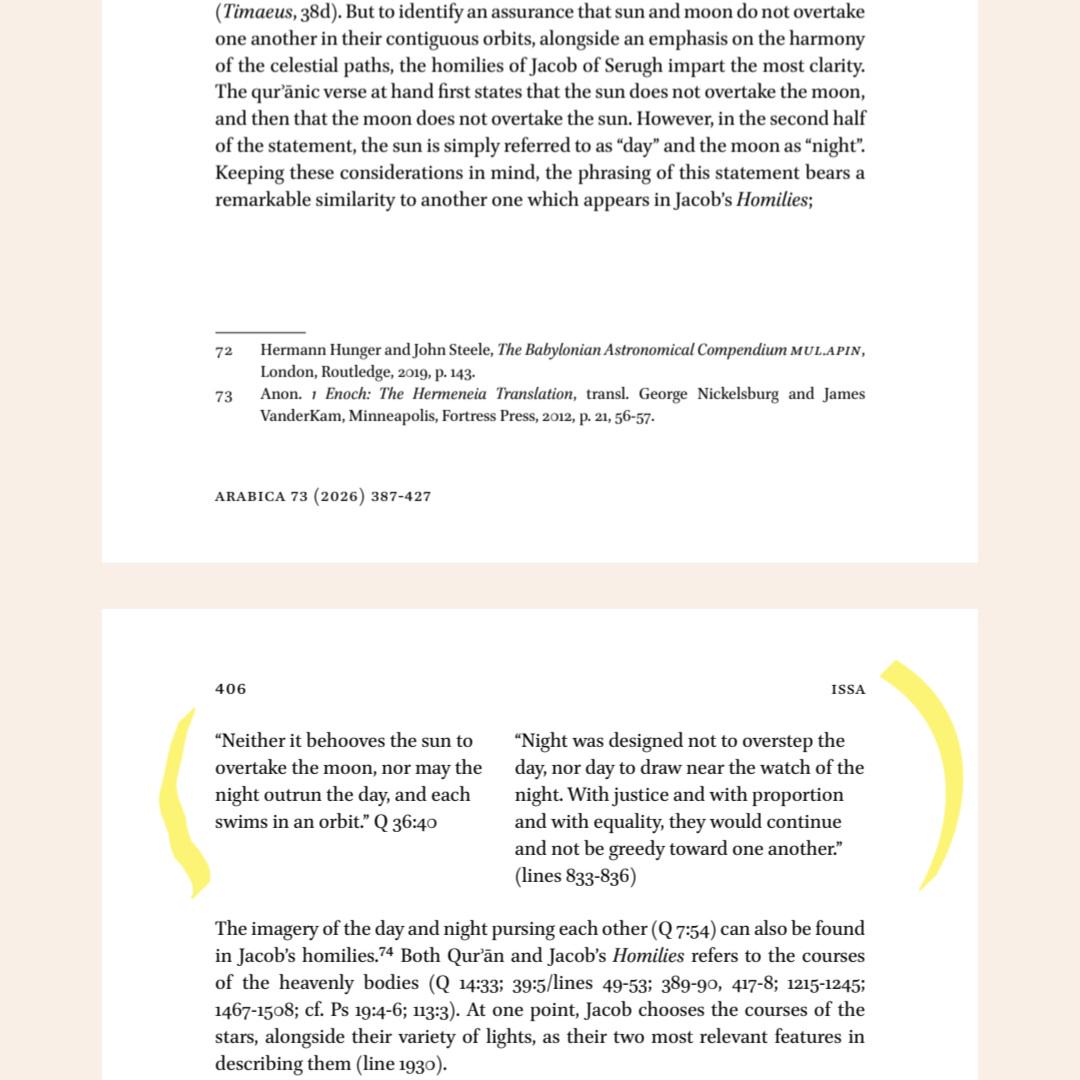
Source: Stabilizing Mountains and the Origins of the Heavens: Exploring Late Antique and Biblical Influences on Qurʾānic Cosmology pages:405-406 ( Author:James Issa)
r/AcademicQuran • u/mat68676867 • 4d ago
I saw a video claiming that the Quran had to be revealed by god because it is linguistic masterpiece that could not have been written by a merchant with little writing experience. In the video he cited this study which claims that the stylometry listed above points to one author. I looked into it and found this twitter reply claiming that a text with 50,000 authors was analyzed with the Sadeghi's stylometry and came back with the results that it came from one author.
Does anyone know what exact study the twitter user is talking about?
Thank you.
r/AcademicQuran • u/not_AQ • 4d ago
I've noticed a recurring pattern in Islamic scriptures where whiteness is associated with righteousness, mercy and goodness, while blackness is associated with evil, punishment and humiliation.
For example:
In the hadith describing what happens after death, believers are greeted by white-faced angels, whereas disbelievers are greeted by black-faced angels.
Quran 3:106–107 describes some faces turning white and others turning black on the Day of Judgement, with contrasting outcomes.
Quran 39:60 describes the faces of those who lied about Allah as blackened.
I'm aware that Islam explicitly condemns racial superiority and that the Quran acknowledges diversity in skin colour as one of Allah's signs. I'm also aware of the traditional explanation that these descriptions are symbolic rather than racial.
However, why is physical blackness, particularly in reference to faces, repeatedly used to convey something negative? Even if the intention isn't racist, couldn't such imagery implicitly reinforce colourism or negative associations with darker skin?
Furthermore, if the intended symbolism is simply light versus darkness, why does it extend to the colour of faces?
I'm genuinely curious about how Islamic scholars and Muslims, particularly Black Muslims, understand these passages. Is there a linguistic, historical or theological explanation that adequately addresses this concern?
I'm asking in good faith and would appreciate thoughtful responses rather than simply being told that Islam prohibits racism, as that doesn't necessarily address the specific concern about the imagery itself.
r/AcademicQuran • u/Cool_Plantain_7742 • 4d ago
Q30:2-6 reads: (2) The Romans have been defeated; (3) in a nearby land. Yet following their defeat, they will triumph; (4) within three to nine years. The ˹whole˺ matter rests with Allah before and after ˹victory˺. And on that day the believers will rejoice; (5) at the victory willed by Allah. He gives victory to whoever He wills. For He is the Almighty, Most Merciful.; (6) ˹This is˺ the promise of Allah. ˹And˺ Allah never fails in His promise. But most people do not know.
Does this verse pre-date the event, or is it possible that it was produced later? Do we have any evidence for it pre-dating the event or post-dating it?
r/AcademicQuran • u/TheMuslimHistorian27 • 4d ago
In the same year that the Kaaba was sacked by Abu Tahir al-Jannabi (317 AH/930 CE), the Abbasid Caliph al-Muqtadir Billah sent a strongly worded letter to Abu Tahir, threatening him and condemning his actions.
Abu Tahir al-Jannabi personally responded to the caliph's message. His reply is recorded by Abu Abdullah Muhammad ibn Malik ibn Abi al-Fada'il al-Hamadi al-Ma'afiri al-Yemeni in his work Uncovering the Secrets of the Batinites and the History of the Qarmatians. Al-Yemeni, who reportedly served as an Abbasid informant in the territories of the Qarmatians and Sulayhids, was also a contemporary of the events surrounding the sack of Mecca, as noted by the historian al-Mas'udi in his Meadows of Gold.
Al-Yemeni records Abu Tahir's Letter as follows:
In the name of Allah, the Most Gracious, the Most Merciful.
All praise is due to Allah, Lord of all worlds, and the ultimate outcome belongs to the righteous.
From Abu al-Hasan al-Jannabi (Abu Tahir al-Jannabi), the caller to piety, the upholder of Allah's command, and the follower of the traditions of the Messenger of Allah (peace and blessings be upon him), to the leader of the impure, known as the son of Abbas.
To proceed:
May Allah guide you to the right course in your affairs and keep you from clinging to the rope of delusion. Your letter has reached me, containing threats and warnings. You have boasted of the eloquence of your words and the grandeur of your claims, while clinging to falsehoods and lending an ear to the obscene accusations of those who turn people away from the right path. So give them tidings of a painful punishment, when your dynasty comes to an end, your ambitions reach their limit, and the allies of Allah gain power over you. They will storm the strongholds of your territories in humiliation, take your women captive by force, and slaughter your troops with endurance. Those are the party of Allah; indeed, the party of Allah are the successful, and the soldiers of Allah are the victors.
Behold, the Awaited Imam has risen against you like a mighty lion, clothed in the garments of victory and bearing the sword of wrath. He has no need of the support of the Arabs, nor does he fear the reproach of any critic in the cause of Allah. That is the grace of Allah, which He bestows upon whomever He wills, and Allah is All-Encompassing, All-Knowing.
Glory surrounds him on every side, awe marches before him, and sovereignty has pitched its pavilion over him, casting upon him the veil of its calamities. The thick darkness of ignorance has dispersed, the gloom of misguidance has lifted, and the seas of ignorance have receded, so that truth may be established and falsehood abolished, even if the criminals detest it.
By Allah, your own soul has deceived you, making you desire what you shall never attain and tempting you with what you shall never reach. You wrote to me with what your scribes had collectively devised, reminding me of shameful faults and hurling vile accusations against me. By Allah, you shall surely be questioned about what you used to do.
As for what you mentioned concerning the killing of pilgrims, the destruction of cities, and the burning of mosques, by Allah, I did not do so except after the proof had become as clear as the sun, after groups among them claimed to be righteous, while I witnessed in them the conduct of the wicked. I judged them according to the judgment of Allah: "And whoever does not judge by what Allah has revealed—it is they who are the disbelievers" (Qur'an 5:44).
Tell me, O you who defend them and argue on their behalf: In which verse of the Book of Allah, or in which report from the Messenger of Allah (peace and blessings be upon him), has permission been granted for drinking wine, playing the tambourine, listening to singing slave girls, and embracing young boys? They accumulated wealth by exploiting orphans and appropriated it through unlawful means.
As for your accusation that I burned the mosques of the righteous, which mosques are more deserving of destruction than those in which, when you enter them, you hear lies attributed to Allah Almighty and His Messenger (peace and blessings be upon him), supported by chains of transmission from corrupt religious elders, based on the misguidance they collectively embraced and the innovations of ignorance they introduced?
As for your attempt to frighten me with Allah and your command that I remain mindful of Him, I can only marvel at your audacity and the hardness of your gaze. Do you imagine that I know less about Allah than you do? You divert the wealth of the Muslims to eunuchs and sodomites, while withholding it from those entitled to receive it. Someone is appointed to call out against young boys, while sermons are delivered in the name of eunuchs. Has Allah permitted you to do this, or are you fabricating lies against Allah? (Qur'an 10:59).
As for your accusation that I have assumed a title through aggression, this is no worse than your calling yourself al-Muqtadir Billah, Commander of the Faithful. What army have you confronted and overcome that made you al-Muqtadir? What enemy have you hastened to confront? You are more deserving of the title Commander of the Immoral than Commander of the Faithful.
Indeed, you entrust some of your affairs to certain servants, and then nobles and dignitaries address them in their correspondence as al-Sayyid and al-Mawla (Master and Patron). Which of these two situations is closer to piety? Do you not know that whoever has a group of his tribesmen, a band of his cousins, and members of his family submit to him has thereby become their master and risen above them?
Finally, what business have you with threats, intimidation, and menacing words? Resolve to do what you have already determined to do, and proceed with what you are preparing to undertake. Allah is my supporter, and He is the best of patrons and the best of helpers.
All praise is due to Allah, and may blessings and peace be upon the best of His creation, his family, and his descendants.
"بسم الله الرحمن الرحيم والحمد الله رب العالمين والعاقبة للمتقين، من أبي الحسن الجنابي الداعي إلى تقوى الله القائم بأمر الله والآخذ بآثار رسول الله - صلى الله عليه وسلم - إلى قائد الأرجاس المسمى بولد العباس. أما بعد، عرفك الله مراشد الأمور وجنبك التمسك بحبل الغرور، فإنه وصل كتابك بوعيد وتهديدك وذكرك ما وضعته من نظم كلامك ونمت به من فخامة أعظامك من التعلق بالأباطيل والإصغاء إلى فحش الأقاويل من الذين يصدون عن السبيل فبشرهم بعذاب أليم على حين زوال دولتك ونفاذ منتهى طلبتك وتمكن أولياء الله من رقبتك وهجومهم على معاقل أوطانك صغرا وسبيهم حرمك قسرا وقتل مجموعتك صبرا أولئك حزب الله إلا أن حزب الله هم المفلحون وجند الله هم الغالبون، هذا قد خرج عليك الإمام المنتظر كالأسد الغضنفر في سرابيل الظفر متقلدا سيف الغضب مستغنيا عن نصر العرب لا يأخذه في الله لومة لائم ذلك فضل الله يؤتيه من يشاء والله واسع عليم قد اكتنفه العز من حواليه وسارت الهيبة بين يديه وضربت الدولة عليه سرادقا وألقت عليه قناعها بوائقها وانقشعت طخاء الظلمة ودجنة الضلالة وغاضت بحار الجهالة ليحق الحق ويبطل الباطل ولو كره المجرمون.
تالله غرتك نفسك، وأطمعتك فيما لست نائله، وسولت لك ما لست واصله، فكتبت لي بما أجمعت عليه أذهان كتابك، ذكرتني بالعيوب الشنيعة، وقذفتني بالمثالب السمجة، تالله (لتسألن عما كنتم تعملون).
فأما ما ذكرت من قتل الحجيج، وإخراب الأمصار، وإحراق المساجد " فواللة ما فعلت ذلك إلّا بعد وضوح الحجة كإيضاح الشمس، وادعاء طوائف منهم أنهم أبرار، ومعاينتي منهم أخلاق الفجار، فحكمت عليهم بحكم الله: (ومن لم يحكم بما أنزل الله فأولئك هم الكافرون).
خبرني أيها المحتج لهم، والمناظر عنهم، في أي آية من كتاب الله، أو أيما خبر عن رسول الله - صلى الله عليه وسلم - إباحة شرب الخمور، وضرب الطنبور، وعزف القيان، ومعانقة الغلمان، وقد جمعوا الأموال من ظهور الأيتام، واحتووها من وجوه الحرام.
وأما ما ذكرت من إحراق مساجد الأبرار، فأي مساجد أحق بالخراب من مساجد إذا توسطتها، سمعت فيها الكذب على الله تعالى، وعلى رسوله - صلى الله عليه وسلم - بأسانيد عن مشايخ فجرة، بما أجمعوا عليه من الضلالة، وابتدعوا من الجهالة.
وأما تخويفك لي بالله، وأمرك بمراقبته، فالعجب من بهتك، وصلابة حدقتك، أترى أني أجهل بالله منك، وصرفك أموال المسلمين للخصيان والضراطين، ومنعها عن مستحقيها، يدعى على النابر للصبيان ويخطب للخصيان: (ءالله أذن لكم أم على الله تفترون).
وأما ما ذكرت أني تسميت بسمة عدوان، فليس بأعظم من تسميك بالمقتدر بالله أمير المؤمنين، أي جيش صدمك، فاقتدرت عليه؟! أم أى عدو ساقك فابتدرت إليه؟! لأنت أمير الفاسقين أولى بك من أمير المؤمنين، وانك لتقلد بعض خدمك شيئاً من أمرك، فيكاتبه الشريف والرئيس بالسيد والمولى، فأي الأمرين أقرب للتقوى؟ أوما علمت أنه من انقاد له نفر من عشيرته، وعصابة من بني عمه وأسرته فقد سادهم وعلا فيهم.
وبعد: فما لك وللوعيد والِإبراق والتهديد، اعزم على ما أنت عليه عازم واقدم على ما أنت عليه قادم، والله من ورائي ظهير، وهو نعم المولى ونعم النصير، والحمد لله وصلى الله على خير بريته وآله وعترته ".