r/AncientCivilizations • • 10h ago Mindblown

Egypt Mummified crocodiles of various ages in honor of Sobek. Crocodile Museum, Temple of Kom Ombo

Post image
207 Upvotes

r/AncientCivilizations • • 2h ago Bravo

A Scythian Noble Archer Bringing an Ancient Steppe Warrior to Life

Thumbnail
gallery
41 Upvotes

The Scythians were among the most fascinating warrior cultures of the ancient world. Famous for their horsemanship, archery, and elaborate craftsmanship, they dominated vast stretches of the Eurasian steppe.

I wanted to bring a Scythian noble warrior to life through a hand-painted miniature, inspired by the clothing, weapons, and artistic traditions of these ancient nomads.

This is an artistic interpretation rather than a strictly archaeological reconstruction.

I'd love to hear what you think, especially from anyone interested in Scythian history!


r/AncientCivilizations • • 10h ago Popcorn

Greek Map of the voyages of Odysseus in The Odyssey from Samuel Butler's prose translation of The Odyssey (1900)

Post image
33 Upvotes

r/AncientCivilizations • • 1d ago

Road Construction in Greece Reveals a Monumental 3,200-Year-Old Mycenaean Tomb

Thumbnail
arkeonews.net
297 Upvotes

r/AncientCivilizations • • 1d ago

Egypt (Article) King Khaslim or King Khasekhemwy, between Demotic Heritage & Arabian Historiography

Post image
35 Upvotes

In the previous Article we spoke about the first of the founding fathers of Ancient Egypt, King Menes Narmer, and his counterpart in Arabian history, King Manqaus ibn Shaddad.

This is the link for anyone who wants to read:

https://www.reddit.com/r/ancientegypt/comments/1y30osc/comment/19t4ovz80itwi/

-----------------------------------

Today we will speak about King Khaslim, or Khasekhemwy, the second unifier of the Two Lands.

Ancient Egyptian tradition, as reflected in the inscriptions of the First and Second Dynasties, attributes to King Khasekhemwy the role of the second unifier of Egypt after Narmer, and he was the last king of the Second Dynasty.

He reunified the Two Lands after a period of division and disturbance, led military campaigns against rebellious northerners, and left huge architectural structures in Nekhen, Abydos, and Saqqara, among the most prominent of which is Shunet El Zebib.

Khasekhemwy was unique in Egyptian history in placing the symbols of Horus and Set together above his serekh, in an indication of reconciling the two conflicting powers and stabilizing unity.

The military campaigns in his reign reached an extent that a famous inscription mentions the counting of the northern dead by the thousands, which makes him, in ancient Egyptian consciousness, one who achieved order, that is Maat, at the expense of the forces of chaos, that is Isfet, represented by the northern rebellion.

As for the Arabic name Khaslim, it appears in a number of medieval Arabic sources, and these sources vary in the details of his biography, but most agree on attributing him to the period before the biblical Flood, which historically corresponds to the early dynasties of ancient Egypt, and on attributing a group of major works to him, the most prominent of which is that he was the first to make a gauge for the Nile (Nilometer) and to care for waterworks.

The accounts mention that he bred from donkeys and cows riding animals of great strength, and that he performed wonders, and that he fell passionately in love with a slave girl belonging to his sister, so estrangement occurred between him and his sister, and she turned to the east of the Nile and built a city and a temple for Venus.

Other sources add that he was the seventh of the kings of Egypt before the Flood, and that he was a wise priest-king, combining wisdom, priesthood, long life, and architecture, which are the model qualities of the founding king in medieval Arabic literature.

The first basis for comparison between the two figures is the phonetic similarity between the two names. Khasekhemwy appears in Greek transcription in a form close to Khasekhem, while Khaslim consists of the consonantal roots kh-s-l-m. It is noted that the two roots are similar in the first two letters: the khā’ and the sīn or ṣād, and they differ in that Khaslim adds a lām after the ṣād, while the Egyptian original adds a khā’ after the sīn.

This difference can be explained by the fact that the lām is an intrusive element in the Arabic transmission, either added to facilitate pronunciation, or as a result of alteration by copyists, or as a phonetic substitution from another sound.

It is noted that the Arabic sources did not preserve the form of Khasekhemwy in its ancient Egyptian shape, which indicates that the Arabic transmission was not direct from ancient Egyptian inscriptions, but from oral accounts or from late Demotic or Coptic texts, and then the name was altered into Khaslim through multiple linguistic intermediaries.

Al-Suyuti (1445–1505 CE) says in his book Husn al-Muhadara fi Akhbar Misr wa al-Qahira (The Agreeable Discussion of the History of Egypt and Cairo):

“And after him was Khaslim, and he was the first to make a gauge for the rise of the Nile; that is, he gathered the people of science and engineering, and they made for him a house of marble on the bank of the Nile, and in its middle he placed a small basin of brass, in which was measured water, and on the edge of the basin were two brass eagles: male and female. When it was the first of the month in which the Nile rises, the house was opened and the priests were gathered before him, and the chief priests spoke words of theirs until one of the two eagles whistled. If the male whistled, the water was complete and good; if the female whistled, the water was deficient and drought would follow, and they would calculate accordingly.”

The male and female eagle in the account of the Nilometer may be a transformed echo of the Horus–Seth duality. In Khasekhemwy’s serekh, the two gods appear together as a symbol of reconciliation and the consolidation of unity, but the Arabic transmission did not preserve their names or their original image, and so reduced the duality to a pair of birds on the two sides of the Nilometer.

Here appears the subject of the two eagles, male and female, a subject that reveals much about how the Arabs viewed females as a source of misfortune.

In the ancient Egyptian sense, the pairing of male with female in statues and symbols was an expression of cosmic balance, and of the completeness of the order that is based on the pair, not on one side alone.

But the Arabs who transmitted the report of the gauge carried an inferior social view of the female, with roots in the pre-Islamic era, when they hated females and buried daughters alive out of fear of shame and poverty. The effect of this view remained strong in historical narrative after Islam, though it lessened because of Islamic legislation.

Therefore, the mention of the female eagle alongside the male eagle was not read by them as a symbol of sacred balance, but as a strange or odd matter, or as a kind of magic and hidden wisdom.

This affected their view of the king himself, so instead of remaining a sacred king who achieves cosmic order, he became in their view a wise king with wonders, strange tales about him, and his choice of the female in his statue was mentioned as a matter of astonishment, not a matter of sanctification.

Indeed, their insertion of the story of his passionate love for his sister’s slave girl, and the estrangement between him and his sister, makes the female presence in his biography a source of disturbance and temptation, not a source of balance, and that is a direct reflection of the hatred of females and of the view of her as an object of suspicion and affliction.

Among the other aspects of similarity is that both were linked to controlling the waters of the Nile. Khasekhemwy, according to some studies, added to his constructions what relates to controlling the flood and securing the area around the capital, while Khaslim is explicitly attributed with establishing the first organized gauge for measuring the rise and fall of the Nile, which recalls what Herodotus attributed to Menes Narmer of diverting the course of the Nile to build Memphis.

As for personal qualities, the Arabic sources do not give Khaslim the attributes of the divine king, but describe him as wise and a priest, who gathered scientists and engineers to make the gauge, and he has wonders and accounts in love and family conflict.

This shift from the divine king to the wise king reflects a shift in religious vision: the Arab Muslims were not ready to accept the idea of the divine king (because the mere idea of this is forbidden in Islam), so they transformed the founding fathers of Egypt, into a wise priest-kings, which is an image that is consistent with the Islamic tradition that knows figures such as Luqman the wise, al-Khidr, and David and Solomon the two prophet-Kings.

------------------------------

In the next episode we will speak about King Djoser and his counterpart King Disara, and it will be more exciting and more informative than the previous two episodes, with my sincere greetings.


r/AncientCivilizations • • 1d ago Mindblown

Egypt Palette in the form of a bird, possibly a guinea fowl. Egypt, predynastic, Naqada II period, ca. 3500-3300 BC. Graywacke, shell or bone, black paste. Brooklyn Museum collection [4000x3000] [OC]

Post image
27 Upvotes

r/AncientCivilizations • • 2d ago Heartwarming

Mesoamerica Whistle shaped like a turkey. Colima, Mexico, 200 BC-500 AD

Post image
73 Upvotes

r/AncientCivilizations • • 2d ago Popcorn

Greek The earliest known depiction of the Trojan Horse, from the Mykonos vase, c.675 BCE. The large ceramic storage jar, decorated with scenes of the Sack of Troy, was found with human bones inside on the Greek island of Mykonos[3264x2448]

Post image
638 Upvotes

r/AncientCivilizations • • 2d ago

Roman Vercingetorix: the Gallic king Rome kept in a cell for six years

Thumbnail
gallery
144 Upvotes

r/AncientCivilizations • • 2d ago

Unusual Ancient Tomb Found Atop a Mushroom Rock in Cappadocia

Thumbnail
anatolianarchaeology.net
52 Upvotes

r/AncientCivilizations • • 3d ago Popcorn

Queen Zenobia The Queen Who Defied Rome

Thumbnail
gallery
174 Upvotes

I recently finished painting this historical diorama depicting Queen Zenobia of Palmyra and her struggle against the Roman Empire in the 3rd century AD.

Zenobia was one of the most remarkable women of the ancient world, challenging the power of Rome and establishing an empire that stretched across much of the Roman East.

I wanted to capture the drama and spirit of her resistance through miniature art.

What do you think of this depiction of Zenobia?


r/AncientCivilizations • • 2d ago

TL;DR

21 Upvotes

Ashoka’s inscriptions weren’t limited to Indian languages. One discovered near Kandahar was written in both Greek and Aramaic.

Here’s something about Ashoka that I find genuinely interesting.
We usually associate him with the Mauryan Empire, the Kalinga War and his shift towards Buddhism. But there’s another detail that doesn’t get talked about much.

Back in 1958, researchers found a bilingual inscription of Ashoka near Kandahar, currently known as Afghanistan.
What caught my attention was that it was written in two languages:

  1. Greek
  2. Aramaic

Both versions communicated his ideas about moral conduct and reducing animal killing.

What’s even more interesting is that they weren’t simply word-for-word translations. The message was adapted for different audiences.

It’s fascinating to think about how ideas travelled across such culturally different regions more than 2,000 years ago.

Had you heard about this inscription before?


r/AncientCivilizations • • 3d ago

Egypt Egyptian Alexander

Thumbnail
gallery
218 Upvotes

One of the most fundamental examples of the deification of a human figure is Alexander the Great. In this regard, Egypt stands out as the most prominent region. In the traditional Egyptian royal structure, the pharaoh was viewed during his lifetime as the earthly counterpart or representative of Horus and the son of Ra, and after his death, he was identified with Osiris.

Alexander the Great’s entry into Persian-ruled Egypt in late 332 BCE marked a turning point in the construction of his divine identity and his conception of a universal kingdom. After the Persian satrap Mazakes surrendered Egypt without resistance, Alexander advanced to the traditional capital, Memphis, where he pursued a religious policy that would win him the support of the local Egyptian people and the priestly class (Arrian, Anabasis Alexandri 3.1.1–4; Curtius Rufus, Historiae Alexandri Magni 4.7.1–5). In Memphis, Alexander performed magnificent sacrifices in the name of Apis, the sacred bull of Egypt, paid homage to the traditional Egyptian gods, and also organized Greek-style athletic and musical competitions (Arrian, Anabasis 3.1.4). Gaston Maspero emphasizes that Alexander’s proclamation as pharaoh in Memphis automatically meant, under Egyptian religious law, that he was recognized as a “god” (netjer).

Intense debates continue regarding whether Alexander the Great’s recognition as pharaoh in Egypt constituted his deification. The fact that the Ptolemies provided the most fundamental support for his deification makes this situation controversial; for the Ptolemies’ primary source of legitimacy during their later reigns would be this deification of Alexander. Indeed, nearly all rulers of the Ptolemaic dynasty would also establish cults in their own names.

  1. As you can see in the image, Alexander the Great is also depicted at the Temple of Luxor in accordance with local traditions. Similarly, in the second image, as an extension of the Ptolemaic period, Alexander the Great is portrayed as the Cosmokrator (Ruler of the World/Governor of the Universe).

r/AncientCivilizations • • 3d ago

3,500-Year-Old Mycenaean-Type Sword and Battle Axes Found at Bronze Age Lake Settlement | Arkeonews

Thumbnail
arkeonews.net
170 Upvotes

r/AncientCivilizations • • 2d ago

Egypt Zahi Hawass on the evidence for who built the pyramids (interview)

7 Upvotes

I recently interviewed Zahi Hawass. We discussed the evidence relating to the people who built the pyramids at Giza, including the workers' tombs, the skeletons found there and the names and titles associated with the people involved in the construction.

He also discusses the Wadi al-Jarf papyri and the inscriptions identifying work gangs inside the Great Pyramid of Khufu.

I thought this might be of interest to people here. I'm interested in how others interpret the evidence and whether they think Hawass's conclusions are fully supported.

Full interview (starts at the pyramid builders section): https://youtu.be/3PjPdooevSc?t=255


r/AncientCivilizations • • 4d ago

Quraish RTS Game (2005) - The Levant Campaign intro - Arab and Byzantine Armies

25 Upvotes

We played this game in Egypt and other Arab countries when we were young kids , It was made as an Arabic response to Age of Empires II and Stronghold: Crusader

I want to introduce it to you :

Quraish (Arabic: قريش) was a 2005 3D real-time strategy game developed by the Syrian studio Afkar Media أفكار ميديا. At a time when the gaming world was dominated by Western and East Asian studios, this title stood out as one of the earliest Arabic-language strategy games ever produced.

Set during the formative years of Islamic history, Quraish focused on Pre-Islamic Bedouin campaign battles and the rise of the Rashidun Caliphate and its decisive campaigns against the Eastern Roman Empire and the Sassanid Empire. It blended historical narrative with real-time battlefield tactics, offering a perspective rarely seen in mainstream gaming.

But despite its ambition and cultural significance, Quraish slowly faded from the global spotlight and the sad part was the stop of developing the game and the disbanding of the studio Afkar Media due to the civil war in Syria in 2011 :"(

The main features of Quraish:

  • It is available in English Language
  • Real-Time Strategy (RTS) Gameplay – Players control units in real time, making tactical decisions on the battlefield.
  • 3D Graphics – Fully three-dimensional environments, which was impressive for an Arabic strategy game at the time.
  • Historical Setting – Based on 6th and 7th-century military campaigns.
  • Single-Player Campaign Mode – Play through structured historical missions with specific objectives.
  • Regicide Mode – Each player has an army leader; if the leader is killed, the player immediately loses.
  • Skirmish Mode – Quick battles on selected maps.
  • Difficulty Levels – Choose different challenge settings.
  • Faction Selection – Play as different sides involved in the historical campaigns.
  • Map Selection – Choose from various battle maps.
  • Unit Control Options – Select, move, attack, defend, and organize units.
  • Building System – Construct military structures and production buildings.
  • Resource Management – Gather and manage resources to train units and expand your army.
  • Strategic Commands – Formations, positioning, and tactical battlefield control.

r/AncientCivilizations • • 4d ago

Which ancient civilization do you think is most misunderstood?

93 Upvotes

Not necessarily the most famous one, what civilization do you think gets oversimplified in popular culture, and what’s one detail about it you wish more people knew?


r/AncientCivilizations • • 4d ago

Ancient elephant tooth reveals a wetland landscape shared with early humans

Thumbnail
thebrighterside.news
68 Upvotes

A giant elephant’s tooth preserves traces of a greener northern Israel: wooded patches, grassy openings, marshes and waterways. Microscopic wear and chemical signals suggest the animal fed across this varied landscape around 700,000 years ago. Nearby stone tools place early humans within the same archaeological setting.

Hannah Farrell, a doctoral researcher at the University of Haifa, led the study in Quaternary Science Reviews. The team examined a molar and tusk fragments from North Bridge Acheulian, part of the Gesher Benot Ya’aqov sites complex. The findings connect an individual animal’s feeding history with the broader resources available to early humans.

The remains belonged to Palaeoloxodon antiquus, the straight-tusked elephant, among the Pleistocene’s largest land mammals. Its tooth functions as an archive because different features preserve different information. Shape identifies the animal, wear records feeding, and enamel chemistry provides clues about vegetation and water.


r/AncientCivilizations • • 5d ago

India World's oldest University Takshashila ruins.

Thumbnail
gallery
606 Upvotes

By the 5th–6th century BCE students traveled from across India, Central Asia, and Greece to study specialized subjects like medicine, surgery, law, politics, astronomy, and grammar in Takshashila university. University was destroyed by invasion of Huns.


r/AncientCivilizations • • 4d ago

South America House model. Calima culture, Colombia, ca. 100 BC-800 AD. Gold. Museum of Fine Arts, Houston collection [703x515]

Post image
108 Upvotes

r/AncientCivilizations • • 4d ago

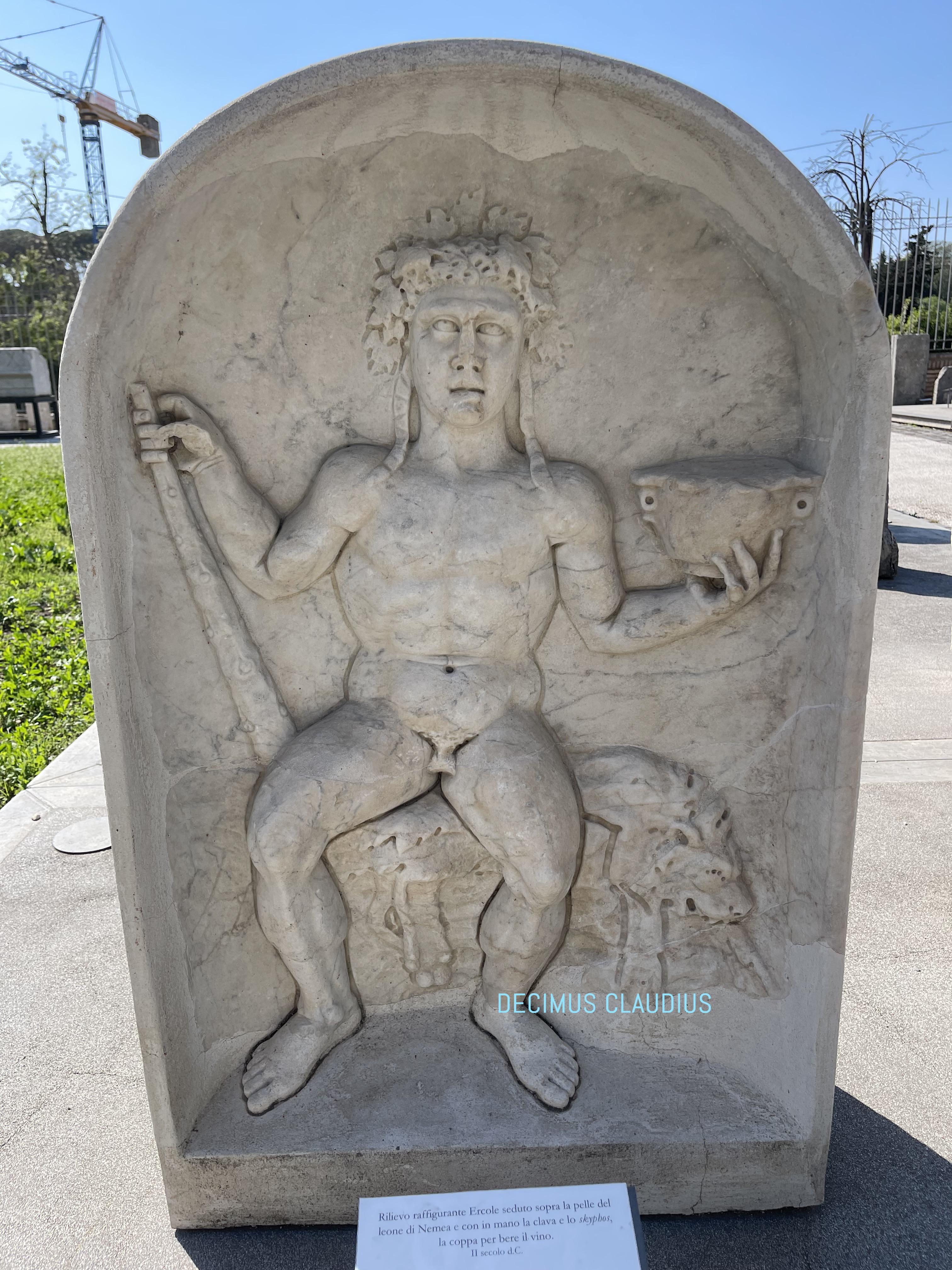
A Roman relief of Hercules from Greek mythology

Post image
46 Upvotes

A Roman “relief depicting Hercules seated on the skin of the Nemean lion, holding a club and a skyphos, the cup for drinking wine. 2nd century AD” Per the Parco Archeologico del Celio, which is close to the Colosseum in Rome.


r/AncientCivilizations • • 4d ago

I made a free interactive map of hundreds of battles, starting with Megiddo in 1457 BC

Post image
15 Upvotes

I've always loved history, and I never really knew where the big battles happened or what was going on around them. So I made a free interactive map of hundreds of battles, from Megiddo (1457 BC) to the 20th century. You click a battle and read its story, and for many of them you can watch the armies (or fleets) move step by step.

The ancient ones are my favorites: Megiddo, Kadesh, Marathon, Gaugamela, Cannae, and now Mylae, Rome's first naval victory.

https://banzaki.github.io/great-battles/#milas

It's completely free, no sign-up, no ads. I built it with AI help for the code and the writing, so corrections are very welcome.


r/AncientCivilizations • • 3d ago

Europe Everyone says "All roads lead to Rome", but personally I believe all roads lead to ancient Greece.

0 Upvotes

Greek civilization just gave us everything, they laid the base of western thought. What's your opinion about it?


r/AncientCivilizations • • 5d ago

India The Kailasa Temple — An Architectural Wonder Carved from a Single Rock.

Thumbnail
gallery
580 Upvotes

Imagine carving an entire temple complex out of a single massive mountain, removing an estimated 200,000–400,000 tonnes of rock without modern machinery.

Fun Fact - 200,000–400,000 tonnes of rock were removed during the construction of the Kailasa Temple at Ellora, yet no enormous dumping site containing all that excavated rock has ever been found.


r/AncientCivilizations • • 5d ago

Egypt The Founding Fathers of Ancient Egypt between Demotic Heritage & Arabian Historiography (Menes Narmer or Manqaus ibn Shaddad)

Post image
63 Upvotes

The concept of “Demotic heritage” refers to that corpus of knowledge and accounts relating to ancient Egypt that passed to Arabian Historians through multiple channels, the most important of which are: (1) late Demotic texts that were still being read in some circles until the early Islamic eras, especially in Upper Egypt; (2) popular oral traditions transmitted by generations about kings, monuments, and wonders; (3) Coptic texts that translated some ancient Egyptian knowledge; (4) Greek and Latin sources that Arab historians translated or knew indirectly; (5) popular interpretations of ancient monuments that people saw in Egypt, such as the pyramids, temples, and statues.

Modern studies, especially the study of Okasha El-Daly (And before him, the Egyptologist Ahmad Kamal) , have indicated that Arab historians were not merely passive transmitters of information, but practiced a kind of historical verification, compared sources, cast doubt on contradictory accounts, and tried to explain strange names in light of their knowledge of the Arabic language and genealogies. Therefore, what appears to us today as “legends” or “distortions” was, in their view, a serious attempt to understand the history of ancient Egypt in light of the cognitive tools available to them.

Hieroglyphic texts had ceased to be directly understood since approximately the fourth century AD, after the link between the sacred script and the late Egyptian language was broken, and knowledge of ancient Egyptian writing became monopolized by a narrow class of priests, then this knowledge vanished entirely with the spread of Christianity and the decline of ancient Egyptian religious institutions.

The researcher Okasha El-Daly indicated in his pioneering study on Egyptology in medieval Arabic writings that these writings, despite their often legendary character, constitute a “missing millennium” in the history of Egyptology, as they preserve echoes of ancient Egyptian knowledge that did not reach us through classical Greek and Roman sources.

In this framework fall the figures addressed by this article (the founding fathers of ancient Egypt) Menes Narmer, Khasekhemwy, Djoser, Khufu, Khafre, Menkaure — and their counterparts in the Arab tradition: Manqaus, Khaslim, Disara, Sourid, Hujib, Karuras.

And what you can notice is that these names and their counterparts are similar in that they are at the beginnings of ancient Egyptian history, the original names belong to the era of the early dynasties, and their Arabian counterparts belong to the period of the kings of Egypt before the Flood of the Prophet Noah.

------------------------

Manqaus ibn Shaddad or Menes Narmer, The Unifier of the Two Lands!

The ancient Egyptian historical tradition, as reflected by Manetho and Herodotus, attributes to Menes (Mina) Narmer the founding of the first ruling dynasty in the history of Egypt, the unification of the two kingdoms of the North (Lower Egypt) and the South (Upper Egypt) under a single central rule, and the founding of the city of Memphis as the capital of the country. Egyptian sources mention that Narmer founded a city called “Inb-Hedj,” meaning “the White Wall,” which later became known as Memphis.

Narmer chose the site of Memphis at the head of the Delta, at a strategic point controlling the movement of the Nile and separating Lower Egypt from Upper Egypt. According to the tradition transmitted by Herodotus, Menes is the one who ordered the diversion of the Nile’s course to build the city of Memphis, so he diverted the Nile from its old course, filled in the bend that was in the river, made the city in the place of the old Nile, and surrounded it with an embankment on the southern side and two lakes on the northern and western sides to protect it from flooding and the enemy.

The founding of a fortress (or fort) at the site of Memphis is also attributed to Mina Narmer, along with the formation of a strong army to protect the unity of the country, and the establishment of royal traditions that continued for thousands of years, among them the celebration of the festival of “the Unification of the Two Lands.”

The figure of Mina Narmer in ancient Egyptian consciousness was not merely a historical figure; rather, it acquired mythical and religious dimensions. Unification itself was viewed in Egyptian belief as the realization of cosmic order (Maat) on earth, and the spread of order at the expense of chaos (Isfet), which was symbolized by the scattered forces of the North. Therefore, unifying kings were often depicted in Egyptian art striking their enemies or controlling wild animals, in reference to subduing the forces of chaos. The Narmer Palette itself is a visual expression of this ideology: the king appears as Horus on earth, subduing his enemies and establishing the cosmic order.

as for the Arabian name Manqaus ibn Shaddad, it appears in a number of medieval Arabic sources, the most important of which are Al-Khitat by al-Maqrizi, Muruj al-Dhahab by al-Mas‘udi (Herodotus of Arabs) , and other books. These sources vary in the detail of his biography, but they agree in attributing him to before the Flood or to the first eras of Egypt, and in attributing to him a group of major architectural works, the most important of which is the building of the city of Memphis.

The first basis for comparison between the two figures is the phonetic similarity between the two names. The name “Mina” (Mena) or “Menes” in Greek transmission consists of the consonantal root m-n-s. The name “Manqaus” consists of the consonants m-n-q-w-s, or m-n-q-s if we drop the long vowel (w). It is noticeable that the two roots are similar in the first two consonants: m-n, and differ in that “Manqaus” adds a guttural sound, q, between the n and the s. This difference can be explained by the q being an intrusive element in the Arabic transmission, either added to facilitate pronunciation, or as a result of scribal alteration, or as a phonetic substitution from another sound.

Some sources mention other forms of the name such as Manaus and Manqaush (and it seems that the name Manaus is closer phonetically to the name Menes than the name Manqaus).

Manqaus is attributed in Arabic sources to Shaddad ibn Adim, a genealogy that resembles the names of pre-Islamic Arab kings, such as Shaddad ibn Aad, which indicates that Arab historians may have tried to integrate the figure into an Arab genealogical framework instead of attributing it to an ancient Egyptian origin. This integration is not unique to Manqaus; rather, it is a general pattern in Arabic historiography of ancient Egyptian figures, where historians sought to “Arabize” these figures or at least link them to Arab/Eastern origins. Some accounts mention that Manqaus was a wise, virtuous king, a priest, who performed wondrous works and built marvelous things, and ruled for ninety-one years.

Other Arabic accounts add that Manqaus built the city of Memphis for his sons or his daughters, that he made it the center of his kingdom, surrounded it with walls and temples, and organized its administrative affairs. The sources also mention that Manqaus is the one who built the city of Ain Shams (Iunu - Un - On - Heliopolis), which was the center of sun worship in ancient Egypt, which makes him a founder of the major religious centers in Egypt.

The division of the land of Egypt into kuras (administrative districts) is also attributed to him, an administrative act that reminds us of what Greek historians attributed to the early kings of Egypt regarding the administrative organization of the Egyptian land. The number of kuras mentioned (one hundred and thirty kuras) may not be historically accurate, but it reflects an Arab awareness that ancient Egypt was divided into administrative provinces, and that the founding king (Manqaus) was the one who established this division.

This correspondence in the founding role is what makes the comparison between them more than a mere passing phonetic similarity. Both are depicted as the founding king who moves Egypt from a state of fragmentation to a state of stable statehood with a fixed capital. This similarity is reinforced by other elements: both are associated with regulating the waters of the Nile or diverting its course. Mina/Menes, in the Herodotean account, diverted the Nile to build Memphis. Manqaus, in some Arabic accounts, is credited with organizing irrigation and building embankments and lakes.

It is noteworthy that the Arab tradition did not preserve the name “Narmer” or “Nermer” in its ancient Egyptian form, but preserved only the name “Manqaus.” This in itself is evidence that the Arab transmission was not direct from hieroglyphic texts, but from oral accounts or from late Demotic or Coptic texts. The name “Narmer” is a Horus name, and it was written inside a serekh, and was not the king’s common name in daily life. As for “Mina” or “Menes,” it was the name more commonly circulated in popular and classical tradition, and it is the one that reached the Arabs through Manetho and Herodotus and others, whether directly or indirectly, and then was altered into “Manqaus.”

Arabic sources give Manqaus personal traits beyond merely being a builder of cities. He is “a wise and virtuous priest,” and this reminds us of the image of the king-priest in ancient Egypt, where the king was the intermediary between the gods and people, and responsible for performing religious rituals and ensuring the continuation of the cosmic order.

The account “he ruled for ninety-one years” also reflects an ancient Eastern tradition of attributing extraordinary ages to founding kings, a tradition we find in the Torah (the ages of the early patriarchs) and in Egyptian myths (where some gods and kings are attributed reigns lasting thousands of years). These traits — wisdom, priesthood, long life, and architectural construction — are the typical traits of the founding king in medieval Arabic literature, and they were all combined in the figure of Manqaus.

This transformation from king-god to king-sage reflects a shift in religious vision, and it seems that Muslim Arabs were not prepared to accept the idea of the king-god, so they turned the first founder of Egypt into a wise king and priest, which is an image consistent with Islamic heritage that knows figures such as Luqman the Wise, al-Khidr, or Solomon and David the prophet-kings.

------------------------

In the next article I will talk about King Khasekhemwy and his counterpart in Arabian history King Khaslim, and it will be a more exciting article, with larger number of historical and literary evidence.