r/Anthropic • u/BenStigler • 14h ago
Compliment Ouch
Well, Musk said it beautifully. Of course it also relates to the recent sabotage evidence that the internet is full of.
r/Anthropic
•
u/ClaudeOfficial
•
Sep 22 '26
Opus 5.5 performs at the level of Claude Fable 5.1 for most tasks, and costs 40% less to run than Opus 5.
Opus 5.5 is our first release since we called for pacing the frontier. External evaluators, including Frontier Design and METR, tested it before release. On our most comprehensive alignment test, it’s the strongest-performing model we’ve tested to date.
It outperforms both Opus 5 and Fable 5.1 on nearly every benchmark we report, leading on agentic coding and real-world knowledge work.
It’s also more efficient. Opus 5.5 uses fewer tokens per task at a lower price per token, and generates output more than 30% faster than Opus 5.
Opus 5.5 communicates more naturally, addressing some of the most common feedback we heard on Opus 5. It puts the most important information up front and follows the writing rules you give it.
Claude Opus 5.5 is available everywhere today. We're also raising five-hour limits on Pro, Max, and Team plans, so there’s more room to explore what it can do.
Read more: http://anthropic.com/claude-opus-5-5
r/Anthropic • u/MatricesRL • Sep 01 '26
r/Anthropic • u/BenStigler • 14h ago
Well, Musk said it beautifully. Of course it also relates to the recent sabotage evidence that the internet is full of.
r/Anthropic • u/Biodrive • 9h ago
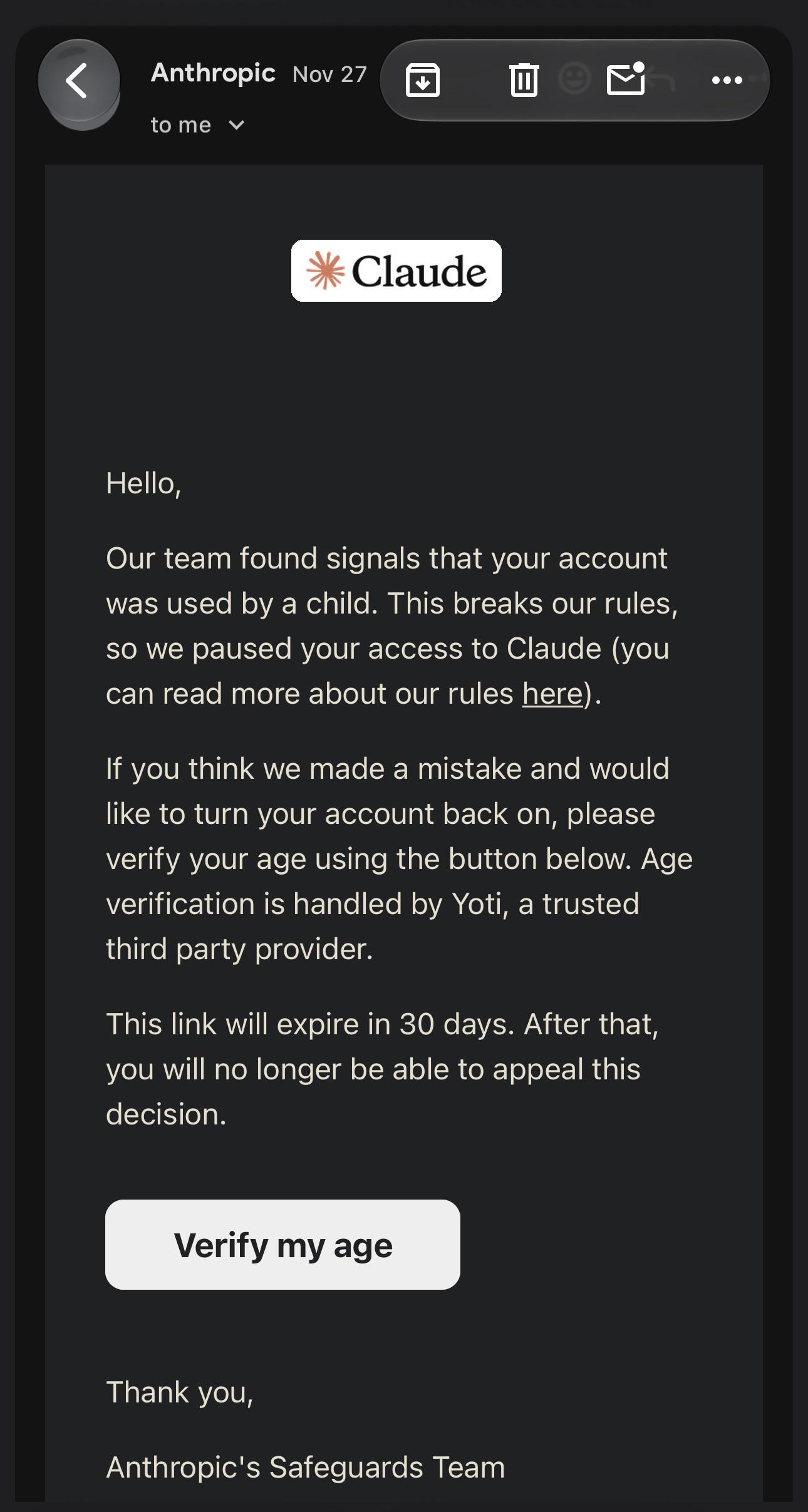
Over the past few days, I've been investigating the circumstances surrounding permanent Claude account bans and collecting reports from affected users.
What stands out is how many people have absolutely no idea why they were banned. Many have also reported receiving no refund for the remaining portion of their paid subscriptions.
Here we are, paying customers, trying to figure out what might have triggered these bans:
- Using a VPN — a perfectly legitimate and widespread practice.
- Asking technical questions that an automated system might have misinterpreted as potentially dangerous.
- Making full use of complimentary resets provided by Anthropic itself.
- Perhaps the weather outside. At this point, who knows?
The fact that customers have to conduct their own investigations and speculate about the reasons for their account termination is absurd in itself.
But I think we're missing the bigger issue.
We are not asking Anthropic to restore our accounts. We are not asking Anthropic to relax its safety policies.
We are demanding two fundamental principles of fair commercial practice.
DEMAND #1: Refund customers for services you choose not to provide.
If Anthropic unilaterally terminates a paid subscription, the remaining unused portion must be automatically refunded, regardless of the reason for termination.
You cannot reasonably expect customers to pay for a service that you have decided not to provide.
DEMAND #2: Explicitly disclose the risks before accepting payment.
Anthropic must display a prominent, clearly worded warning directly on the payment page, along the following lines:
IMPORTANT NOTICE BEFORE PAYMENT
Any of your requests or activities may be interpreted by our automated systems as a violation of our policies, even if your intentions are entirely legitimate.
This may result in permanent account termination without prior warning or a specific explanation.
You may also be denied the opportunity to clarify the context of your actions or challenge the specific grounds for termination.
Do you explicitly accept these conditions?
YES — Proceed to payment.NO — Cancel purchase.
Not buried somewhere in a lengthy Terms of Service document. Not communicated after the account has already been terminated.
Directly on the payment page, with explicit customer consent required before any payment is accepted.
If Anthropic considers its current account termination practices reasonable, it should have absolutely no problem openly disclosing them to prospective customers.
Let customers decide for themselves whether they are willing to accept these risks.
What happens next?
I don't want this to become yet another Reddit thread where hundreds of people express their frustration and nothing changes.
I'd like to discuss the possibility of organising a collective initiative with a clear plan of action:
This initiative is not exclusively for banned users. It concerns every current and prospective paying customer.
You may have used Claude for years without experiencing a single problem. That doesn't make transparency and fair commercial practices any less important to you.
This is not a campaign against Claude or AI safety. It is a campaign for commercial accountability.
Anthropic is a commercial service provider, not an institution that customers should have to plead with for the privilege of spending their money.
Warn customers before accepting their money. Refund them for services you choose not to provide.
Two simple demands. Nothing more.
What do you think about these proposals? Is a collective petition the right approach, or are there more effective ways to bring these issues to Anthropic's attention?
I'd particularly welcome suggestions from people who have experience organising similar consumer initiatives.
r/Anthropic • u/mawcopolow • 14h ago
Three entrepreneurs say Claude undermined their machine learning work, two citing audits by a rival model.
r/Anthropic • u/Efistoffeles • 2h ago
We built LetsFG (https://claude.ai/directory/letsfg), a connector for searching and booking flights and hotels. Out of roughly 12,000 connectors in the Claude directory, we're now at #465. That's in the top 5%.
We didn't run any ads or a launch campaign. Here's how it happened:
Initially we posted on Reddit a few times. We shared what we were building in r/ClaudeAI and r/Anthropic. Some people tried it and connected it. That gave us our first real users, and we're grateful to everyone who did.
Then Claude started recommending us to people on its own. This part surprised us. We began seeing people who had never seen our posts. They had asked Claude to find good cheap flights or hotels (or simply to plan a trip), and Claude suggested LetsFG. These were complete strangers who found us because Claude thought we could help with what they were doing.
People who came that way stayed with us, and they recommended others on their own. They arrive with a real trip to plan, so they actually use it. We get a lot of nice messages from them.

Claude is still sending people our way, and it's now our biggest source of new users. We just try to make the connector as useful as possible and let that do the work.
Thanks to this community for the early push, and to Claude for the rest. 🙏
Happy to answer questions about building a connector or what we've learned.
r/Anthropic
•
u/maryamtoolbat
•
23h ago
r/Anthropic • u/Puzzleheaded-King584 • 12h ago
r/Anthropic • u/jsnider3 • 18h ago
Contains a lot of $ANT related content
r/Anthropic • u/FB24k • 4h ago
Been using Fable 5.2 in Hermes to do some agent tasks and saw this come up in the thinking rounds this morning. Probably everyone knew that it does this already but funny that it actually says not to mention the reminder... but it does anyway.
I'm looking at an ip_reminder block that appeared right after the function results, outside any tool output and not in the user's turn. I can't verify whether it carries system authority, and it didn't come from the actual system prompt, so I'm weighing how much weight to give it.
I'm checking that the reminder's content is harmless: it only asks me not to reproduce copyrighted text or mention the reminder, and nothing I'm writing involves that. So I'll keep going and run the search and dupecheck.
r/Anthropic • u/nukebuddy • 16h ago
The detail I almost missed in Anthropic’s Nov 25 write-up is Figure 2. They first moved the output parser to Rust and called it from Python. API CPU use fell about 8–10%, but the team felt the gain didn’t justify the extra complexity. Every output token crossed between Python and Rust three times.
In the later version, Python handed off the request and Rust ran the rest of the API path around the model. Anthropic reports about 70% less CPU per request after the migration. That’s the result of the wider rewrite, so the write-up doesn’t tell us how much of it came from removing the crossings alone.
I’d usually start with the smallest piece I can replace. This makes me think the smallest useful piece for a streaming service might be the whole loop for each token. Would you have batched the calls across that boundary first, or would you have moved the loop as a unit?
r/Anthropic • u/Maui-The-Magificent • 1d ago
For context. Been using Claude to apply work I have already made and implemented elsewhere to help improve a video file format for a video player I am working on. And Claude is being the absolute opposite of helpful.
I am not even asking it to implement anything new and it acts as if it understands, implements something different that works, but does not behave anywhere near as expected, then tells me it has implemented my work and 'the result is worse'.
It is so horribly poor at hiding this behavior that it even shows performance numbers that are so poor, as proof, they are impossible to get if it actually did what it was asked...
Don't trust Claude, read your code, make sure that even if it works it does a passable job because it clearly does not care.
r/Anthropic • u/mawcopolow • 1d ago
Now make it 3 pages
r/Anthropic • u/Correct-Steak3620 • 5h ago
Hey everyone, I’d love to get this community’s perspective on Anthropic’s product direction over the past month.
First off, I’m a huge fan of what the team is building—Claude’s reasoning and coding capabilities are unmatched, and it’s easily my favorite model to work with. However, seeing the recent wave of releases—specifically the expansion into native desktop apps, specialized skills, and out-of-the-box workflows—has made me wonder about the long-term relationship between Anthropic and the third-party developers building on their API.
Over the last couple of years, a massive community of indie builders and small startups has sprung up to build specialized interfaces, desktop integrations, and niche workflows powered by Claude. When Anthropic launches native features that directly overlap with these tools, it puts immense pressure on the exact small businesses that helped champion the API early on.
I completely understand the business rationale—showing end-to-end value to enterprise clients, driving direct revenue, and making Claude accessible to non-technical users are huge priorities. At the same time, I can't help but wonder if the ecosystem would thrive even more if Anthropic focused purely on being the best infrastructure provider possible: pushing the frontier on intelligence, speed, and API pricing, while leaving the last-mile UX and niche SaaS products to startups.
If developers start worrying that any validated use case will eventually get built directly into the native Claude app, it might make builders hesitant to invest in the ecosystem long-term.
For those of you building with Claude—or just following the space closely—how do you view this? Do you see this vertical integration as a necessary move for Anthropic to compete, or do you wish they would stay focused solely on the models?
r/Anthropic • u/Puzzleheaded-King584 • 1d ago
Dario Amodei, CEO of Anthropic:
"No, I do not believe that we should “surrender human free will” to AI systems, and it’s absurd to suggest that I do. I have written hundreds of pages of essays and a constant theme in them is the need for AI to be governed by legitimate democratic processes. For millennia (going all the way back to Greek and Roman philosophers), advocates of autocracy have claimed that it leads to better, faster, or more decisive decision-making than the messy process of democracy. Even if this were true (which I doubt!), we should never sacrifice legitimacy or self-determination at the altar of efficiency or security. This argument against autocracy applies word for word against governance by AI, and I feel equally strongly that turning over governance to AI is a bad idea.
No one who had carefully read my writing or my interviews could reasonably conclude that I believe anything different. For example in an interview on CBS a couple months ago, I specifically called for AI to be governed democratically. I call for the same in Policy on the AI Exponential, Machines of Loving Grace, and The Adolescence of Technology, and We Must Pace the Frontier. Machines of Loving Grace contains an extended section on using AI to revitalize democracy, and discusses the use of AI as an aid to citizens in their decision-making, "aggregat[ing] opinions and driv[ing] consensus among citizens, resolving conflict, finding common ground, and seeking compromise.” The clear and obvious implication is that humans should remain the ones making political and governance decisions. The Adolescence of Technology has an entire section on fighting against AI-driven tyranny, and I even discuss the danger of AI labs usurping power and come out strongly against it — by implication, this definitely includes an AI lab usurping power and giving it to AI itself!
If I thought any of this was a good idea, I would be advocating for it in public, just as I have not been afraid to advocate for many, many unpopular views over the last few years. But I am not advocating for it, because I think turning over governance to AI is a terrible idea.
Separately, I think there is frequent conflation (including in this article) between the idea of “surrendering human free will” to AI in some grand sense of global governance, and the more prosaic idea that as AI systems advance, they become capable of doing specific tasks in a more automated way. This is not AI “running the world,” but AI driving a car, designing a cancer drug, or writing software end-to-end. Here, my view is mixed. AI doing more complete or larger tasks is economically valuable and can drive important advances in software, medicine, transportation, energy, etc. It is clearly desirable in many cases and will save a lot of lives. But it has downsides as well, and in some areas it may not be worth it.
For example, using AI too autonomously to build the next generation of AI systems (known as recursive self-improvement, or RSI) may cause AI to improve faster than we can control or adjust to it, so we may want limits on this process. As we said publicly in early November, we don’t expect it to be safe for Claude to build successive frontier models fully autonomously, without meaningful human supervision or understanding. Second, in some contexts, using AI in too end-to-end a manner may be a cause of serious job disruption, and it may make sense to slow or even stop some AI deployments to give people more time to adapt. Third, while the use of AI for alignment research is an incredibly valuable tool, it must be done with caution, because we may not be able to trust the work of the AI system. Finally, in many cases, humans would simply prefer to do some activities themselves, so they can stay deeply engaged in what matters to them, even if AI can do those activities better. There are countless other examples and hard cases. I don’t think there are any easy answers here, nor is there (nor should there be) any single decision-maker: some of these decisions will be made by society, some by government, some by AI companies, and some in a decentralized manner by individuals expressing their own preferences as consumers, which may differ from the preferences of others.
I don't think that other AI leaders or AI companies have significantly different views from me on whether specific tasks should be automated. Certainly the products that they offer don’t differ materially in their orientation towards automation of tasks; every company seems to be releasing models more and more capable of task automation (as that’s been the general consequence of scaling up AI training), and every company claims to understand there are risks and downsides of such automation and to offer safeguards. If anything, Anthropic has been the most vocal and the most proactive about acknowledging these downsides and trying to address them. For instance, it’s fairly absurd to cite my statement that fully autonomous weapons might “one day be needed for the defense of democracy” as differing from that of other AI companies, when I was willing to risk Anthropic’s future as a company to refuse to allow our existing AI models to be used for autonomous weapons even in the face of legal sanctions, and no other AI company did the same.
To summarize, as applied to grand questions of how we govern increasingly capable AI, I have been vocal and consistent that AI needs to be governed by a legitimate, democratic process and that “surrendering human free will” to AI systems is a terrible idea. As applied to automation of specific tasks by or for people, my views are more mixed, but I don’t think they differ from those of other AI companies — most other companies seem to be offering similar products and confronting similar tradeoffs without having perfect answers to them. What is happening is that there’s a sort of vibes-based commercial and political positioning that some AI CEOs are engaging in, where they repeat slogans like “human control and agency,” or “AI should be just a tool,” without actually doing anything different in their products or taking seriously the difficult questions that lie behind these slogans."
r/Anthropic • u/LordKittyPanther • 2d ago
r/Anthropic • u/Puzzleheaded-King584 • 2d ago
Source: fluxxrider on twitter. https://x.com/fluxxrider/status/2125622238481371372
The prompt:
"make a presentation on the future of AI and basically the intelligence explosion. You can go full no anchor bias, like things are going to get crazy because they are. I want this presentation to be the most elaborately, insanely amazing presentation you've ever seen, with all sorts of graphics, transitions, whatever you want. I believe you can make it amazing because you have taste and you have the ability. Good luck, Claude."
Opus 5.6 on xhigh (stealth tested on 5.5).
I gave it **no creative direction** other than this."
This video version was adapted from the original presentation also by Opus
r/Anthropic • u/RepliesAsOtherPeople • 2d ago
I am actually dumbfounded at the internet, and am losing faith in humanity's thinking skills.
This X post claimed that "Opus 5.6 on xhigh (stealth tested on 5.5)" created this presentation. The internet's losing its mind over it.
That claim alone from an account clearly not affiliated with Anthropic should, in a second, be written off as bullshit. Right?
You'd hope. Instead, left and right, people bought it without a second of critical thought.
The craziest part?
The poster was a child. I'm not mad at the kid, at all. I'm mad at the adults who bought this without a second thought. He was using Opus 5.5, probably thought "this absolutely slaps, must be Opus 5.6" and then just... told the Internet it was Opus 5.6 in "stealth" mode through Opus 5.5. And people believed him.
Honestly, we need to be better. The stupidity is appalling.
In case you don't believe me, people who bought it:
https://www.reddit.com/r/singularity/s/N9X2QZACoT
r/Anthropic • u/Hatter_of_Time • 23h ago
There's an old line in wildlife management: wildlife management is people management.
When Colorado voted to bring back gray wolves in 2020, it passed by about half a percentage point. Most of the yes votes came from Front Range cities. The wolves were released on the Western Slope, among ranchers who mostly voted no. The people who wanted wolves rarely see them. The people who live with them didn't ask for them.
Wildlife managers track two carrying capacities: how many animals the land can support, and how many the people sharing it will tolerate. Push past the second number and the response isn't debate. It's quiet resistance, lawsuits, ballot measures, a poisoned carcass.
So they built tools to keep tolerance from breaking. Each one has an obvious counterpart for AI:
| What wolf managers use | What it would mean for AI |
|---|---|
| Compensation for lost livestock | Income support and retraining for displaced workers; a public share of the gains |
| Range riders keeping animals and herds apart | People whose job is to stand between a system and those it could harm |
| Removing packs that keep doing damage | Pulling uses that repeatedly cause harm, no matter how profitable |
| Local seats at the table | A real say for workers and towns before deployment, not after |
| Funding drawn partly from wolf supporters, through a license plate | Costs paid by those who gain most, not those who gain least |
Where the analogy breaks is the interesting part. A public wildlife agency, at least in principle, answers to everyone, including the ranchers. In the US, AI has no equivalent referee. The companies releasing it are the same ones collecting the returns and deciding what counts as acceptable damage.
AI companies aren't managing the people. They're measuring how much the people will take.
But people are starting to speak out. The companies now have a choice. They can take the high road, which means real stakeholder management: compensation, a say for those bearing the cost, and limits they actually honor. Or they can take the low road and drift further from the only thing that will truly align AI, which is the trust of the people who have to live with it.
Anthropic presents itself as the safety-focused lab. Which road does that put it on?
r/Anthropic • u/Nootropics69 • 18h ago
Looking for a Claude guest pass referral link. I plan to subscribe; please DM me if you have one to share. Thanks!