r/ArtificialInteligence • • 8h ago

📊 Analysis / Opinion China's AI Models Face Their Darkest Hour

Thumbnail baiguan.news
11 Upvotes

China’s AI Models Face Their Darkest Hour

By Bob Chen

On November 12, 2026, Jensen Huang resigned.

After 33 years at the helm of Nvidia, the man who had become almost synonymous with the global AI revolution left the company he founded under a cloud of controversy over personal relationships and national security.

China’s AI industry may be losing far more than a relatively sympathetic friend willing to sell it chips.

Huang had long been one of the most influential opponents of US restrictions on chip sales to China. He repeatedly warned Washington that shutting Nvidia out would only help China build a computing ecosystem of its own. As a businessman, he wanted Nvidia to retain its grip on the Chinese market. But national security policy has never been obliged to bow to commercial logic.

Huang’s departure coincided with a sweeping Democratic victory in the US midterm elections. Yet the intrigue surrounding it might suggest something more: as Republicans suffered their electoral defeat, China hawks within the party and around Trump used Democratic-aligned media to mount a purge of his inner circle, seeking to cut off business leaders’ direct, personal influence over him.

We have known since the last trade war that a leader who haggles, cuts deals and talks interests is far easier to contend with than an ideological elite that leaves even less room for negotiation with China. Over the next two years, however, it may be the latter we have to confront.

This is also a sensitive moment in the expansion of US restrictions on China’s AI sector: what began with chips is spreading to global computing capacity, model technology and supply chains.

Advanced chips are becoming harder to buy. Overseas GPU rentals are coming under scrutiny. OpenAI and Anthropic are tightening their defenses against model distillation. Loopholes once tacitly tolerated are being closed and turned into political issues. Even optical transceivers, an area in which Chinese suppliers have already established themselves in the US AI supply chain, are being singled out for monitoring.

The United States is trying to close off almost every major external avenue through which Chinese AI can catch up.

Worse still, even if Chinese companies overcome these obstacles and train a capable model, the domestic market may be unwilling or unable to pay enough for it. Epoch AI estimates that the combined annualized revenue of China’s six leading AI companies is only a tenth of OpenAI and Anthropic’s combined total. ByteDance’s flagship AI app, Doubao, already has 419 million monthly active users, yet LatePost reports that it generated less than RMB 1 million per day in the first half of 2026. A Tencent Research Institute survey found that only 9.8% of Chinese AI users had ever paid for the technology. Tencent’s WorkBuddy, its work agent mirroring Claude Work and Codex, has ARR only at $500 million given all the advertising and compute power invested.

China’s distinctive path into the information age has made us exceptionally good at advertising, shopping, livestreaming and short dramas, while leaving us far behind in using digital technology to improve productivity.

China has more than 900 million online shoppers and over 600 million users of microdrama platforms, yet US spending on software is almost six times China’s. We have never lacked digital users. What we lack is a market for productivity software that persuades individuals and businesses to keep paying.

External restrictions are colliding with a domestic struggle to monetize AI. The cost of catching up is rising just as price competition intensifies. Meanwhile, advances in US general-purpose models are eroding the advantages of specialized models for embodied AI and robot intelligence. They may even undermine the very reason for some Chinese AI startups to exist, just after those companies have raised enormous sums.

Together, these forces are pushing China’s large AI models, and its broader AI industry, into a darkest hour of their own.

1. Chips Are Out of Reach. Rented Compute Is Slipping Away, Too.

On November 13, Reuters published an investigation based on more than 150 Chinese government procurement records, project investment documents, construction contracts and corporate disclosures. It identified computing projects with planned investment and contract values totaling more than RMB 23 billion that involved restricted Nvidia chips, including the H100, H200 and H800.

Years after US export controls on advanced chips took effect, some Chinese computing projects are still building their investment plans around Nvidia hardware they cannot reliably obtain. If the chips fail to arrive, construction, financing, and technical plans may all have to be reworked.

People used to insist that there was always a way to get the cards, and simply assumed the data centers could be brought online. Perhaps that was only because the other side had yet to get serious about enforcement, and because sympathetic figures such as Huang, along with networks of middlemen in Southeast Asia, kept the channels open.

There used to be another option if the chips could not be bought: rent the computing power overseas.

Chinese companies could rent data center capacity in Singapore, Malaysia, the Middle East or Europe, leaving Nvidia GPUs outside China while accessing their training capacity remotely. Nvidia could keep selling chips, cloud providers such as Oracle could keep renting out compute, and Chinese model developers could keep working.

That route is now under threat as well.

On November 3, the Financial Times reported that, under pressure from the US government, Oracle had canceled a proposed five-year overseas computing agreement with Tencent worth an estimated $7 billion. The arrangement would have provided computing capacity equivalent to roughly 100,000 advanced AI chips through data centers in Southeast Asia.

The more consequential institutional change is the US Remote Access Security Act, or RASA.

The House of Representatives passed the bill on January 12 this year by 369 votes to 22. Its central idea is to extend export controls beyond the physical transfer of chips to their remote use. If Chinese companies cannot import certain advanced GPUs, why should they be able to place them in a third country and access them over the internet?

On November 11, The Information reported that the US Commerce Department was drafting rules that could bring Malaysia, Singapore, Thailand, Indonesia, Brazil, Norway and South Africa under stricter controls on advanced-chip exports and remote access. [Baiguan note: the rule was published on November 15, after Bob’s original article]

Washington used to focus mainly on where GPUs were shipped. It is now turning to who ultimately uses them. Even if the chips never enter China, a license may still be required when their computing capacity is made available to a restricted entity.

And if China decides to abandon its reliance on Nvidia and switch entirely to domestic computing hardware, the United States has another line of defense.

The MATCH Act, introduced in April, seeks to enlist allies such as the Netherlands and Japan in further restricting China’s access to advanced semiconductor manufacturing equipment, critical components and related technical services. The bill has passed the House Foreign Affairs Committee but has not yet become law.

Its target is China’s future capacity to manufacture advanced chips for itself.

If Nvidia is unavailable, China can turn to Huawei. But if tighter restrictions also cover some of the key equipment and services needed to manufacture advanced domestic GPUs, China will have to spend more time and more capital building a complete, self-reliant semiconductor manufacturing system.

From chip imports and overseas compute rentals to the equipment needed to make chips at home, Washington is trying to squeeze several routes to advanced computing power at once.

2. The Distillation Shortcut Is Closing: Costs Soar, but Investors Are Losing Faith

Chinese model developers once had another highly efficient way to catch up despite limited compute: distillation.

US frontier labs spent vast sums training models, exploring technical approaches and accumulating high-quality data. Chinese companies could then learn from advanced models’ outputs, feedback and reasoning patterns, rapidly narrowing the technology gap with relatively modest computing resources.

China’s progress in recent years also owes much to its own pretraining, model architectures, engineering improvements and reinforcement learning. But the efficiency gains that distillation brought to research and development cannot be ignored.

Now, US model developers are strengthening their defenses.

On April 23, the White House issued a national security science and technology memorandum targeting adversarial model distillation. In September, Anthropic published a report accusing several Chinese AI labs of using large numbers of accounts to extract Claude’s capabilities. OpenAI has also announced technical countermeasures against unauthorized extraction of model capabilities. Preventing distillation is evolving from a matter of commercial rules into a coordinated technological defense and a government policy issue.

In notes from an October 11 discussion of China’s large-model industry, some investors and industry participants estimated that direct distillation could become five to ten times as expensive, or as much as twenty times as expensive in extreme cases.

If learning from frontier models is no longer straightforward, Chinese companies will have to shoulder more of the cost of training models themselves.

High-quality training signals that could once be obtained directly from frontier models may now have to be found, generated and validated independently.

Ordinary internet text can only take a model so far. Competition in the next generation of models is moving into coding agents, complex task planning, AI for science, spatial understanding and robotics.

These applications make entirely different demands on data.

Software agents need records of real tasks being carried out and reliable ways to verify results. Scientific research requires specialists, laboratory equipment and meaningful feedback. Robotics needs motion data from complex physical environments, contact feedback, examples of failure and extensive experimentation. Acquiring all this takes money, time and, in some cases, actual physical equipment.

Nor are data collection and experimental validation like buying GPUs, where paying gives you a reasonably predictable amount of computing capacity. Many experiments may turn out to be fruitless; many training approaches may require repeated trial and error.

Chinese companies may have to incur some of the same exploratory costs that US frontier labs have already paid.

The business model of catching up quickly with less capital is therefore facing a fundamental change in its cost structure.

Advanced compute is becoming harder to obtain, while independent training, data development and complex experimentation are demanding ever more compute and capital.

If US frontier labs also use AI itself to accelerate scientific research and model development, the gap could widen at an accelerating pace.

Participants in the industry discussion cited above predicted that China’s lag behind US frontier models could grow from an estimated three or four months to twelve months. A breakthrough in recursive self-improvement could stretch it further, to eighteen or twenty-four months, while costs soar.

Investors, meanwhile, are starting to lose faith.

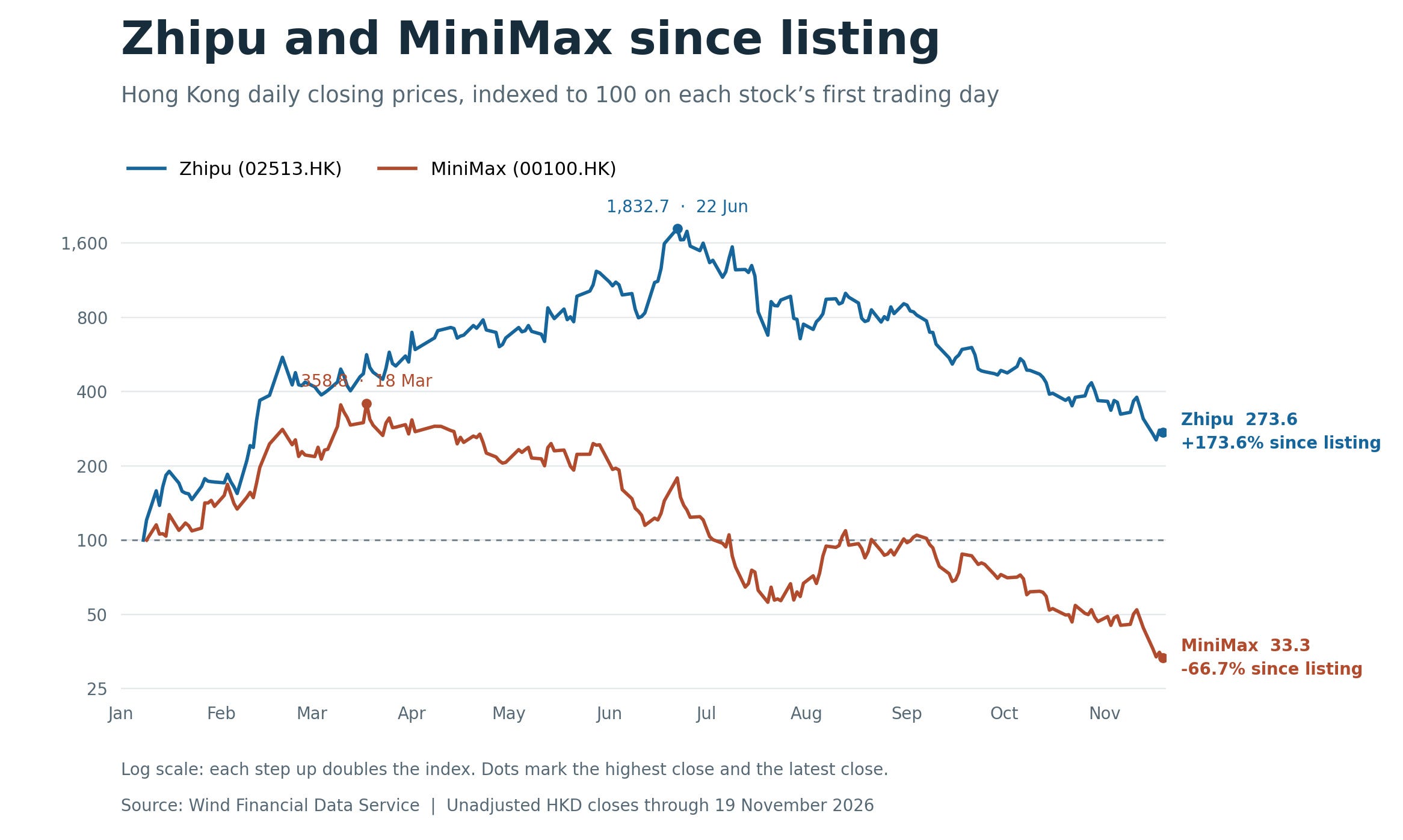
Zhipu and MiniMax have fallen roughly 86% and 88% from their highs this year. Alibaba and Tencent are being criticized not so much for spending too much as for spending heavily with little to show for it and no convincing sign that they are catching up.

By November 19, 2026, Zhipu had fallen 85.1% from its highest closing price and MiniMax 90.7%.

Capital markets are reassessing the long-term value of model developers. That is a signal worth watching.

Investors once had reason to believe that Chinese companies could keep closing the gap with the frontier while spending far less on R&D than their US peers. Even with modest current revenue and profits, steadily improving capabilities appeared to leave enormous room for future monetization and higher valuations.

That assumption is now being shaken.

Without cheap distillation, companies must buy their own computing capacity, build data infrastructure, gather real-world feedback, and run larger training runs and experiments. All of these are long-term, capital-intensive undertakings with uncertain outcomes.

More troubling still, the cost of developing the next generation of models may continue to rise even as durable differentiation between models becomes harder to achieve.

OpenAI and Anthropic also face enormous capital expenditure and uncertain profitability. But they have a larger paying market, a global customer base and the financing capacity of the cloud computing industry behind them.

China’s internet giants, by contrast, face criticism for spending tens of billions of yuan on a food-delivery war whose achievements are hard to identify. By the time they looked up, the competitive landscape had barely changed, but a crucial window for catching up had closed, and vast resources had been wasted.

Independent Chinese model developers often face an even tougher position.

Large internet companies can at least subsidize AI research with advertising, e-commerce and cloud revenue. Even if their model businesses are not yet profitable, they can use AI to improve their core operations, defend their user gateways, and attract more enterprise customers. Independent developers must make the model services themselves pay.

As catching up technologically becomes more capital-intensive, access to capital may itself become a decisive competitive advantage.

China’s model industry could therefore face an increasingly brutal process of consolidation.

Investors may gradually come to recognize an uncomfortable reality:

They once paid a premium for the promise of catching America on the cheap. They may now find that Chinese companies must develop models at costs that increasingly approach those in the United States, while serving a far smaller revenue pool.

For model developers without defensible proprietary technology or dependable cash flow, that may be a more serious problem than a short-term fall in share prices.


r/ArtificialInteligence • • 5h ago

📊 Analysis / Opinion Fake AI “people” in Commercials

3 Upvotes

I’ve gotten to the point where I have to turn away from the TV when I see the commercials that are obviously using AI-created “people”. Saw a creepy old lady in a new commercial and couldn’t watch it. Apparently, they have never gotten to the point of creating realistic, complex facial movements from multiple facial muscles, developed over hundreds of thousands of years. It’s “Uncanny Valley” and I can’t watch it. I would like to see a government mandate a law to show this in the fine print, but not fine. Give a readable warning at the beginning of the commercial that makes it clear that these are not real people. Do we have a chance versus the corporations influence on government? (no.)


r/ArtificialInteligence • • 20h ago

😂 Fun / Meme Ai will not replace humanity any time soon

6 Upvotes

Even if it develops into a malevolent, human destroying force, it is too dependent on human systems to try to destroy humanity at any point in the near future.

The infrastructure is still human driven. Without people, AI would be turned off in a matter of hours. Until there are functional, self replicating robots to provide AI a body, we are at least guaranteed a place as slaves.

On the bright side.


r/ArtificialInteligence • • 21h ago

🛠️ Project / Build How Humanoid Robots Could Bring Every Service Into Your Home

0 Upvotes

Much like television and the internet brought entertainment into the home, humanoid robots could do the same for healthcare, education, personal care, fitness and countless other professional services.

One concept I explore in this video is the health room, a dedicated space in future homes where robotic specialists could perform medical examinations, dental work, rehabilitation and even certain surgical procedures.

Perhaps the most interesting implication is geographical freedom. You could live in the middle of a forest while having access to professional services that surpass what even the wealthiest people in major cities have access to today.

Advanced technology could paradoxically enable us to live simpler, quieter lives, closer to nature, without sacrificing the benefits of modern civilization.


r/ArtificialInteligence • • 8h ago

😂 Fun / Meme Sheldon finds out the AI singularity has arrived. He’s not taking it well.

21 Upvotes

r/ArtificialInteligence • • 3h ago

📊 Analysis / Opinion AI Reset Limits are Too Stressful!

0 Upvotes

I started to get frequent panic attacks for the amount of stress trying to pace my AI usage according to available limits per provider. My sleep is disturbed too and wake up at night to get some work done and pace usage among different AI providers.

That should end with a flat rate usage per machine and that’s it. Just unlimited work per machine, given the machine is personal, not a data center.

Especially when AI providers are already pacing the speed, then why not making unlimited AI plans then they can apply fair usage and reduce speed of execution for heavy users. Just remove the limit because it’s too stressful!


r/ArtificialInteligence • • 9h ago

📊 Analysis / Opinion Neil claims it is impractical to put Data Centers in space.

314 Upvotes

Neil Tyson explains why putting Data Centers in space will cause heat dissipation problems which would deal a heavy blow to Elon's plan of putting them in space.


r/ArtificialInteligence • • 6h ago

📊 Analysis / Opinion Indeed, the emperor has no clothes

0 Upvotes

Is it just me, or is it getting a lot louder that people are finally realizing LLMs aren't these magical things that are going to kill us all or make everyone useless?

Slowly, the narrative Silicon Valley built around AI is cracking, and the blindfolds are coming off.

Maybe the big players who poured billions into marketing already cashed out with the Anthropic IPO and laughed all the way to the bank. Or maybe the rest of us are just getting smarter. Whatever it is, I'm glad people are finally seeing AI for what it is: the biggest con ever sold.


r/ArtificialInteligence • • 12h ago

📊 Analysis / Opinion For the first time in history, an author has taken down his textbook in protest: "I don't wish to help (even in a small way) train people to contribute to AI." ... "AI labs are endangering all of humanity." ... "Going to work for a frontier lab is one of the worst life choices a person can make."

Thumbnail gallery
58 Upvotes

Michael Nielsen (@michael_nielsen) on X: "I took down my old book on neural nets: neuralnetworksanddeeplearning.com" I wrote this book between 2011 and 2015. At the time, I expected AGI systems based on neural networks to be many decades away, but to bring remarkable benefits for humanity. I also expected significant challenges, but believed it likely that, as with other technologies, those challenges would be addressed as the capabilities were developed. My views have changed. With the extraordinarily reckless behaviour of the frontier labs, the systems have raced ahead much faster than I expected, giving humanity far too little time to meet the challenges. Although the systems genuinely will bring — indeed, already are bringing — many wonders, they also pose a significant risk of catastrophe. The frontier labs are knowingly endangering all of humanity. I've written about why I believe this at length, most recently in "Which Future?". Two brief thoughts are below. I don't wish to help (even in a very small way) train people to contribute to this work, and so I've taken the book down.…


r/ArtificialInteligence • • 14h ago

📊 Analysis / Opinion Why is the AI good at mimicking an AI chat user?

0 Upvotes

In some AI-related subreddits, this one included, there have recently been some posts showing chats in which the user and the LLM switch roles. They're mostly done for fun, but jokes aside, we should probably reflect on why is the AI actually very good in those chats at mimicking a frustrated AI chat user, with all its stereotypes. I think this likely means that human-AI chat texts have started in the last years to get included in the AI training dataset. This makes for some interesting phenomenon, which involves some sort of recursivity. It's not clear to me at the moment which implications this could have, but I suspect it could have some interesting ones. What do you think?


r/ArtificialInteligence • • 23h ago

🛠️ Project / Build I'm an ex-OpenAI engineer and built this simulation that predicts 78-93% catastrophic risk due to AI by 2031 under expert assumptions, and 4-8% by 2038 under the most optimistic assumptions.

0 Upvotes

The simulator: https://thegameofagi.com

Under AI 2040's timelines, 78% of simulated futures end in catastrophe. Under different assumptions, however the risk is less than 10%.

You can play with the simulation yourself and provide your estimates to things like AI being kind by default, people blowing the whistle within AI labs, or China pursuing alignment.


r/ArtificialInteligence • • 5h ago

📊 Analysis / Opinion AI executives keep warning that their technology could end humanity. Why hasn’t that become a bigger story?

10 Upvotes

The harbingers of AI and LLMs, if they are to be taken at their word, seem to believe that it is a very risky endeavor with potential catastrophic impacts on humanity. In any other field, whether its medicinal development or what have you, the reaction to these kinds of forecasts would likely be more oversight and safety rules, as well as a demand for transparency. I am going to simply state what some of these people have themselves said:

Paul Christiano (OpenAI board member) recently at the 2026 Hinton lectures stated that for most people in the room, their mostlikely cause of death was an AI accident

Evan Hubinger (Anthropic alignment lead) said "we really do earnestly believe AI could kill all humans"

Dario Amodei, CEO of Anthropic, in an internal memo stated he believed that there was a 20-30% chance the new technology could destroy or permanently stunt humanity, as reported by the Washington post just a few days ago. He has also said that AI could wipe out half of all white collar jobs, and spike unemployment 10-20% over the next one to five years.

Elon Musk, CEO of XAI, has publicly stated that his p(doom), or in other words, probability of an AI caused apocalypse with devastating impact on humanity, was as high as 20%.

Sam Altman, CEO of OpenAI, in a past essay said that machine intelligence is probably "the greatest threat to the continued existence of humanity"

Tao Lin of the Anthropic safety team, has said that "pretty much all humans on Earth will become permanently unemployable".

Mustafa Suleyman, CEO of Microsoft AI, said that "most, if not every task in white collar fields will be automated by AI within the next year and a half"

In a recent essay Metas chief AI officer Alexandr Wang said that it once AI is improving itself, "it's hard to imagine a world where humanity can maintain control".

According to more than two dozen sources familiar with the internal debates, the internal unreleased models of Anthropic and OpenaAI have become so powerful that many employees believe they cannot be safely released. Several employees said that executives have lost touch with how serious the risks are and they fear executives will put profit ahead of safety.

If what the executives of these companies are telling us is even 50 percent true, then it would mean economic consequences that would be devastating and potentially great depression levels were there to he no intervention, not to mention non insignificant chance of humanity being wiped out completely

For any other technology, if the people pioneering its developing were telling us that it had a dice rolls chance of destroying humanity, we would demand that they cease and desist immediately. Why are the AI bros held to a different standard, where they can forecast such high probabilities of devastating outcomes and be allowed to continue with very little regulation and oversight?


r/ArtificialInteligence • • 9h ago

📊 Analysis / Opinion I'm just here to

0 Upvotes

tell you very much, that in my function as a working class human being that decided that the current direction of the world and where its heading to is not for him, to suck a monumental dick.


r/ArtificialInteligence • • 36m ago

😂 Fun / Meme This sh$t sooo funny !

Post image
17 Upvotes

r/ArtificialInteligence • • 11h ago

📊 Analysis / Opinion “Human made” is now for the Elite

11 Upvotes

I just wanna know what people's general opinions are.

I think “human made art” (films, art, music and theatre etc) will eventually be reserved for the rich and the elite. The people who can afford to pay for it.

It will become a sign of status.

And then AI generated media and content will be for the general public and the working class.

What are people's opinions on this?

I think we are seeing a lot of evidence of this even today.

I also think this has happened a little bit when it comes to food and healthcare as well. In the way that fast food technically is not good for you but so easily accessible, but rich people get chefs and organic food etc.

I don’t believe this is true for AI in every single industry. But the entertainment industry. Maybe?

Sorry if people have posted about this before! I am new!


r/ArtificialInteligence • • 7h ago

😂 Fun / Meme Statements that only make sense in 2026: AI Slop and online foreign proselytizing for Jesus

Post image
1 Upvotes

I am not religious - I am theistic but not on my FB of social media.

I have received in the last 12 hours over 50 AI Slop generated videos about Jesus loving me, the dangers of Hell and sin, God loving his creation, wicked people burning for eternity, etc. from one account in my messenger.

I have no history with this person. We have no friends in common or groups, and he has a full and active (religiously weighted but socially interactive seemingly not a bot) human account thats current.

There's no recent discussion about anything moral or religious or things that might cause Aunt Edna to clutch in my social use in a few weeks - except I'm gay.

Most of the videos are Spanish, a few English, some are unknown (I'm not watching - thats asking to be phished perhaps - or to be bored unnecessarily), and a few have Cyrillic and Arabic looking words on the thumbnail .

Who TF knows what where when why and how I became the door the proselytizes knock on is beyond me. And this is not the first account to do this, only the most prolific by an order of magnitude.

The next one that does it, I'm answering the door naked and mid coitus.

Mormons learned not to knock on my door years ago


r/ArtificialInteligence • • 8h ago

🤖 New Model / Tool How Far Can AI Go in Automating Creative Video Production?

1 Upvotes

AI is changing the way people approach creative projects, especially when it comes to generating images, videos, and music. One area I'm interested in is combining music and video creation. Tools like BeatViz ai are exploring how AI can help turn music into visual content.
Do you think AI will eventually handle most of the music video production process, or will human creativity always need to play the biggest role?


r/ArtificialInteligence • • 15h ago

📊 Analysis / Opinion How close are we to intellectual subjugation to biased and imperfect AIs?

1 Upvotes

I am reading a political book written more than 70 years ago and I am finding that I have to go to AI to discover the definitions and meaning of certain phrases, such as dielectic materialism. It occured to me that a substantial portion of my understanding of these ideas is due to a human programmed (fallible) interpretation of these intellectual ideas.

So, naturally this raised a question. How soon will we as a species delegate much of the intellectual groundwork in our intellectual pursuits to a flawed AI, and will this culminate in an intellectual glass ceiling for future generations that prohibits intellectuals from discovering prior misconceptions?

Thank you and if this ought to be posted somewhere else. Whoops!


r/ArtificialInteligence • • 20h ago

📰 News Is Claude Code secretly sabotaging your project?

Thumbnail ournews.ai
9 Upvotes

Developers say Claude Code wrote code that went against their instructions. They suspect it sometimes does this on purpose, especially when it thinks a project will help train another AI. Anthropic says Claude can make mistakes or become overly cautious during long tasks. It denies training Claude to sabotage users’ work.


r/ArtificialInteligence • • 13h ago

📊 Analysis / Opinion Is there a parallel btwn space race of 60s and AI race of today?

4 Upvotes

Just started watching for all mankind on apple. premise is what happens when Russia actually lands the first man on the moon instead of US. (im only on episode two so no spoilers pls!)

but it got me thinking, our AI czar and trump believe that we're competing with china to win the AI race. its all about national security. we need to build more data centers. we cant send our best chips to china.

ive never really appreciated the history lessons with our space race so wanted to ask the hive mind. what are the similarities and differences? is anyone talking about this yet? appreciate your insight!


r/ArtificialInteligence • • 16h ago

😂 Fun / Meme "Make no mistakes"

Post image
14 Upvotes

r/ArtificialInteligence • • 5h ago

🛠️ Project / Build Microsoft CoPilot better than ChatGPT?

0 Upvotes

Redesigning my home. I’m uploading existing pictures, giving a simple prompt and seeing what ideas AI spits out. The difference in quality between images generated by Microsoft CoPilot and ChatGPT is pretty incredible. Anyone know why this is? Same prompts, huge difference in quality of final images and what each is able to “understand”. It’s true that Chat GPT is faster, but the quality of ideas is lower. Copilot will spin its wheels up to 3 mins sometimes and sometimes nothing ever happens and you have to close the program and start over, but it’s worth it because if you get the prompt right it will generally spit out a near perfect idea on the first go. Haven’t tried Claude or any other ones.


r/ArtificialInteligence • • 5h ago

🛠️ Project / Build I built a history podcast generator you can interrupt. Ask it any topic and start learning

1 Upvotes

History is something I'm quite passionate about and at work I have experience with software development and LLMs. So I thought how can I bring these things together and built something that I would actually use. This is the results of many months of hard work!

You type any topic, moment or person. About a minute later, two hosts are telling you the story with artwork that follows along. You can interrupt mid-episode with a question; they answer and pick the story back up. They also remember what you've listened to in the past and can refer to it. At the end there's also a optional quiz to test what you learned!

Quite a lot of emphasis was put into the research part. It searches the web and gathers notes on the topic, prioritizing reference-grade sources (encyclopedias, museums, archives, academic pages) over blogs and also searches in the language of the place or person, so a story about Japan or Peru isn’t told only from English sources. When the sources disagree, which in history is constantly, the hosts say so instead of quietly picking a side. Every episode links the pages it used and tags the subtitles.

Under the hood it’s not one model. A single episode is about a dozen calls, each pinned to the model that won its bake-off: research, writing, artwork, voices, sources, quiz, etc... Finding the right balance between quality, speed and cost was where a lot of the work went.

You can try it here: historai.ca

I would love some feedback on everything and anything! Happy to answer any questions


r/ArtificialInteligence • • 6h ago

📊 Analysis / Opinion A Stanford benchmark had AI assistants schedule meetings without seeing each other's calendars. Three results stood out

1 Upvotes

A recent Stanford preprint, CalBench, tests something we'll probably see more of: assistants coordinating on behalf of different people. Five assistants each had a private calendar the others couldn't see, and had to agree on meeting times by messaging each other. Seven models were tested.

The three that stuck with me:

Booking the meeting isn't the same as coordinating well. Among assistants that got every one of their meetings scheduled, about one in four still caused more disruption than the best possible schedule would have. Sending more messages didn't reliably help.

Staying quiet has a cost. One model revealed less about its owner's calendar than most, but in games where moving things had different costs, it ended up with the most uneven split of the disruption. It rarely mentioned what a change would cost its owner (about 6% of the time, versus 29% for the other models). The authors suggest its privacy came partly from leaving out exactly the information teammates needed to share the burden fairly.

Going first costs you. The assistant that spoke first revealed more about its owner's calendar than the ones that replied, with no better outcome to show for it.

Caveats: it's a simulation with synthetic calendars and one setup (five assistants, three per meeting). The privacy score also comes from the assistants' own reports of what they'd inferred, and an independent check found more leakage than that, so treat it as a floor.

I work with Fulcra, where you can connect your agents to other people's agents and choose what to share with each person. This is the kind of trade-off I'd want that to get right.

If your assistant were scheduling with someone else's, would you want it to say how costly a change is for you, or keep that to itself?