r/deeplearning • u/Odd_Ad_9937 • 50m ago
MLzoomcamp-26_homework/08-deep-learning/homework08.ipynb at main · IBRHASHEM/MLzoomcamp-26_homework
github.com
1
Upvotes
r/deeplearning • u/Flashy-Fisherman-503 • 2h ago
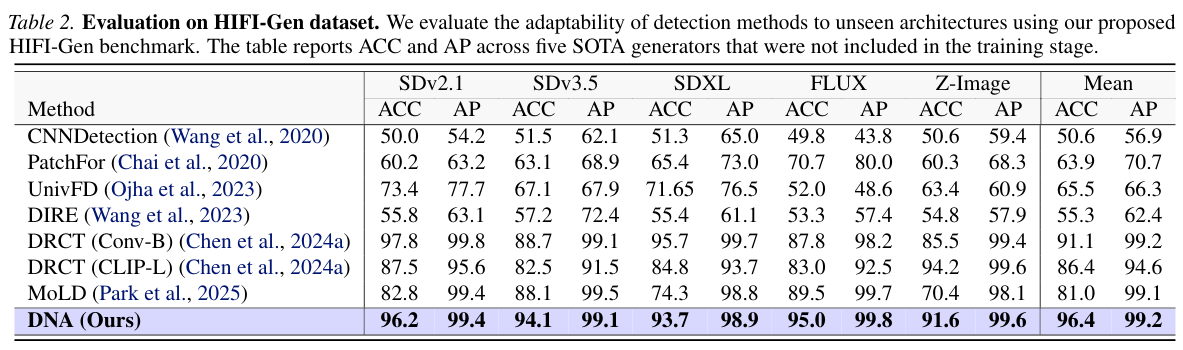
A detector can look excellent on a generator it has seen and fail as soon as a new generator leaves different traces. We wanted to know whether a pretrained vision model already contained features that several generators had in common.
We built DNA to find intermediate units whose responses separated real and generated images. We kept the encoder frozen and trained a small classifier on those responses.
We tested on five unseen generators in HIFI-Gen. DNA reached 95.0% detection accuracy on the FLUX split and 91.6% on the Z-Image split. The attached table gives each generator’s result, so the variation between them stays visible.

r/deeplearning • u/Flashy-Fisherman-503 • 2h ago
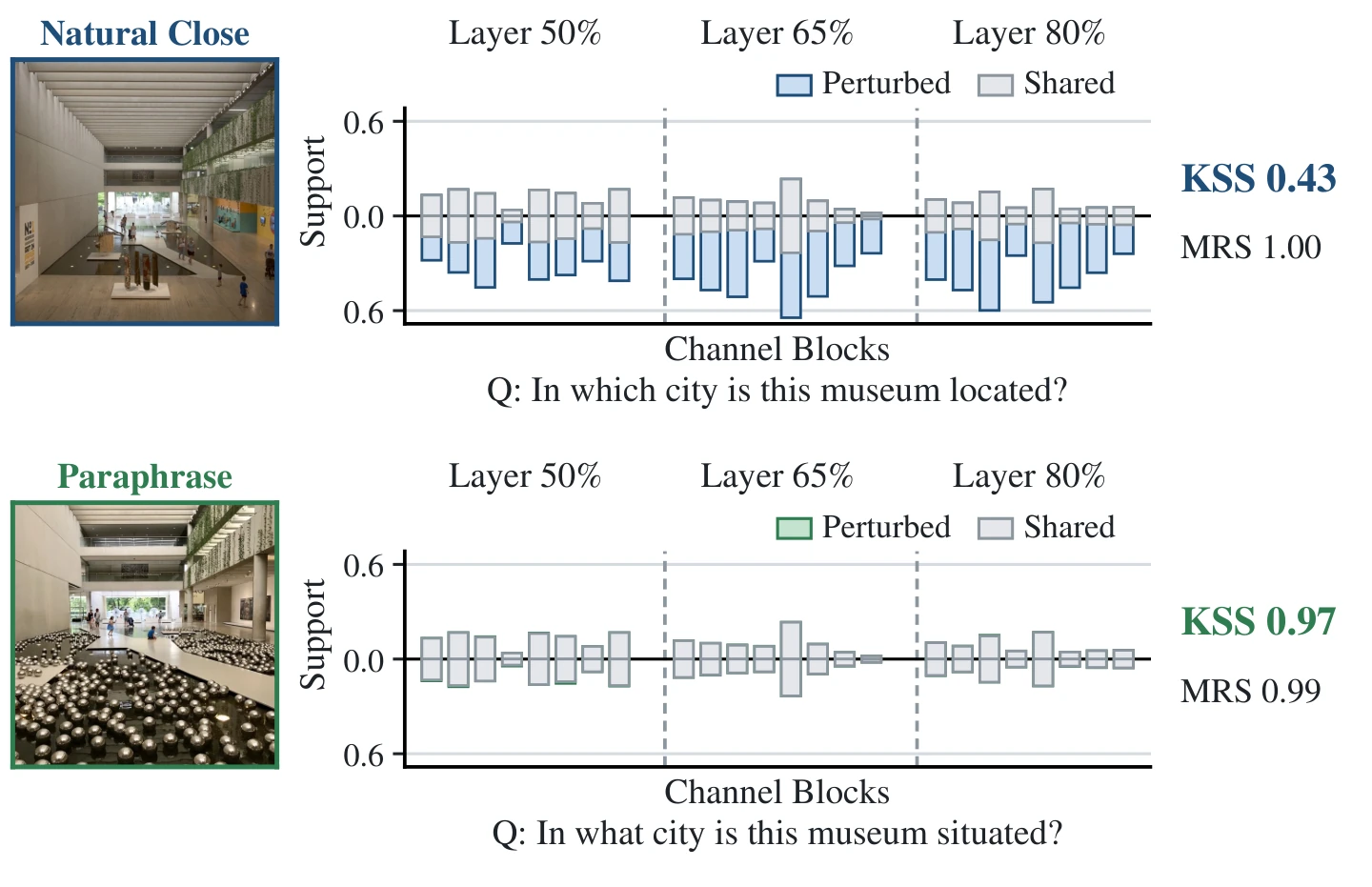
Show a vision-language model two photographs of the same museum. If it names the city correctly both times and remains equally confident, has it relied on the same evidence?
We built MMStableBench to test that question on 19,452 items across 15 models. In the museum example, rewording the question preserved the internal features supporting “Brisbane” almost completely, with an overlap score of 0.97. Using a closer photograph dropped that score to 0.43, even though the answer and its confidence margin held up.
Across the models, 12.4% of correctly answered variants in the top quarter for confidence-margin retention fell in the bottom quarter for stability of internal support.

r/deeplearning • u/JKCinema • 2h ago
Self-taught, moving to Texas for an AI job. Is my portfolio enough? Be brutal.
While I was researching ML certifications, Google's AI summary said employers care more about proven, hands-on ability to build and deploy AI on real business problems than about certificates, because the tools change faster than the courses. So I skipped the certificates and spent the last few weeks building proof instead.
Which is really my brick-and-mortar store I plan to open when I have the funds to do so, but ended up being a watered-down e-commerce store version that supports the Autopilot case study.
I can't tell you how awesome Villain Boutique is going to be whenever I have the means to open it. Our backrooms will have backrooms.
My degree is in Advertising and crazy gaps in my work history. Most of my experience is in the film industry in Atlanta, Georgia, and that was before COVID. I'm packing up and driving to Texas to find a job in AI, and this is my shot. If you hire or work in ML, is this enough to get a recruiter to take a chance on me? What's missing? I’m doing this regardless of your feedback, but if there’s anything I can change or improve before I leave, that would be incredibly useful information. Should I include all the projects I developed over the years, like this image generator that’s specifically for making elaborate designs with consumer-grade Cricut machines, or my personal favorite but no one else's “Holo Sexting Machine,” My attempt to put naked females on a HOLOFAN Projector?
P.S. The first draft of this was incredibly candid. Thank god I ran this by Claude first.
r/deeplearning • u/No-Conclusion3720 • 9h ago
The EU Quantum Act passed, VirusTotal added new threat-intelligence capabilities, and a rash of tanker cyberattacks hit maritime infrastructure this week. The piece that keeps coming up in security circles is quieter: AI is compressing the timeline on cryptanalytic attacks against classical schemes. The assumption baked into most long-lived data stores and signed artifacts is that RSA and ECDSA hold for the foreseeable future. That floor is shifting. Harvest-now-decrypt-later attacks mean adversaries do not need to break crypto today — they collect ciphertext now and wait for the compute curve to catch up. The EU Quantum Act signals that regulators have already priced this in and expect organizations to have a migration path. Most enterprise infrastructure does not. TLS termination, signing pipelines, secrets managers, and inter-service auth tokens are almost universally classical. Migrating any one of them is a multi-team project; migrating all of them simultaneously while keeping services running is an unsolved operational problem for most shops. How are practitioners actually sequencing this in real environments — are you prioritizing data-at-rest, in-transit, or signing infrastructure first, and what is forcing that order?
r/deeplearning • u/rexShail • 4h ago

I built a Hello World RAG App in Python
Normal LLM = Answers from training data (can hallucinate)
RAG LLM = Answers from YOUR documents
I asked it Saudi it didn't say Saudi Arabia.
It said "Contractor at Saudi Aramco" - because it read MY LinkedIn PDF.
This is how it works:
Tech: Python + LangChain + ChromaDB + Groq + Gemini Embeddings
Save this for your next interview
Comment "RAG" and I'll send you the full code + next part.
Follow for AI Engineer series - Part 2 coming next.
r/deeplearning • u/Expensive-Compote248 • 17h ago
I'm not an ML researcher. I'm a decorative concrete contractor who got into this because I want my family to have capable AI we own and can run at home. My hardware is a GTX 1660 Ti (6 GB) with 16 GB of RAM, and I hold myself to a 2 GB budget for model weights. Quantized 7B to 27B models either didn't fit well or lost too much quality, so I started building something small from scratch instead. It's very much a work in progress.
The idea
Seed is a pool of small specialist models I call seeds, each about 4 to 10M parameters, all trained from scratch with a shared 4,096-token BPE tokenizer. Each seed is trained on one job, then frozen. A small router reads the context and picks which few seeds run, currently the top 3. Facts and arithmetic go to tools (a wiki search and a calculator) instead of being memorized, on the bet that a small model can be decent at deciding what to look up and how to use the result, even if it can't store much knowledge.
Current seeds (about 26M parameters, 50 MB at fp16)
Training now: a word-problem planner (4.4M and 10M versions, to test whether size helps), a Python writer, a seed that writes code, runs it, and fixes errors, an instruction follower, and one seed each for C, JavaScript, PowerShell and shell.
Results so far, against Qwen 2.5 Coder 3B at Q4 as a reference point. These are my own small evals, 20 items each, so take them loosely:
So right now it's fast and tiny, decent at tool-shaped tasks, and clearly behind on reasoning and code. Those gaps are what the current seeds are aimed at.
Open questions I'd love input on
Eventually I'd like to test it on hackmud, a text-based hacking game, as a long-running benchmark, and maybe run it on a phone.
Repo: github.com/SocioSanity/seed
Thanks for reading. Criticism is welcome.
r/deeplearning • u/RepulsiveRevenue8086 • 17h ago
r/deeplearning • u/No-Conclusion3720 • 13h ago
A critical authentication bypass in Drupal is being actively exploited in the wild right now. Attackers are using it to fully take over sites — not deface them, not exfiltrate a table, but own the entire application layer. Bleeping Computer confirmed the exploitation is in-progress, not theoretical.
The mechanic is familiar: gain a foothold via a privileged identity, then every downstream action inherits that trust. CMS platforms, APIs, and increasingly autonomous agents all share this structural problem. The privileged credential is the blast radius.
What makes this iteration particularly ugly is how quietly it compounds. A compromised service account or session token doesn't throw errors — it just acts. By the time logs show something wrong, the takeover is complete.
For those running production systems with any non-human identities in the request path — agents, integrations, automated workflows — how are you actually handling the gap between credential issuance and runtime behavior? Are you relying on perimeter controls, or do you have something that evaluates the action at the moment it fires?
r/deeplearning • u/Few_Tune6754 • 15h ago
r/deeplearning • u/Expensive-Compote248 • 15h ago
r/deeplearning • u/Tricky_Magician_9777 • 18h ago
r/deeplearning • u/sathvik_dk • 1d ago
Perceora is an end-to-end AI computer vision platform with no code. This film builds an object detection check for a tray of parts, with the focus on training and picking the model.
The steps in the film:
Image classification, segmentation and anomaly detection are in the same app, and it runs on your own computer. Free to start; Pro (shown in the video) is a paid plan: perceora.ai/pricing
When two detectors score almost the same on validation images, how do you choose between them?
Disclosure: I work on Perceora. Synthetic images, computer-generated voice.
r/deeplearning • u/Flashy-Fisherman-503 • 1d ago
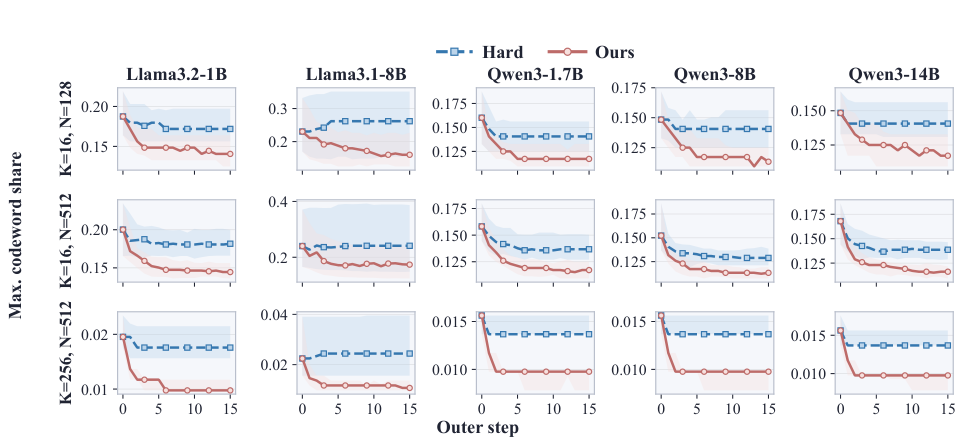
Suppose we group a model’s weights in fours and build a table with just 256 entries. Each group of four weights can be represented by the closest entry, so we only need to record its index. That table is the codebook. The trouble starts when we learn the entries. If two start close together, one can keep losing by a tiny margin and get almost no samples to update it. We set aside room for 256 entries, but some barely get to learn useful values.
We released BARQ to make better use of those entries. While fitting the codebook, we let each group of weights help update several candidate entries and balance the total contribution each entry receives. Once the table is fitted, we pick a single index per group. At inference, retrieving the weights is still an ordinary table lookup.
Take Qwen3-1.7B. With the same 256-entry codebook size and storage budget, BARQ raised mean accuracy across five zero-shot tasks from 55.75% with GPT-VQ to 59.68%. It also gave the actual next tokens higher probability, bringing WikiText-2 perplexity down from 20.54 to 16.59. Across 60 matched-budget comparisons on six Llama and Qwen models, both metrics improved in 47 configurations.

r/deeplearning • u/Federal_Control2141 • 1d ago
I'm the developer of AnnotaryCat, a desktop annotation app for Windows and macOS. I wrote a scheduler into it so the label → train loop runs on your own machine

The loop:

1. Add your model as a small Python interface file (train/predict functions + hyperparameters). It runs in your own Python environment.
2. Run `predict` on a batch, and the results show up as pre-labels.
3. Fix them in the editor.
4. Start a training run on the corrected data. With a local GPU it runs right on your machine; otherwise it can go to your own server over SSH. You get metrics and checkpoints, and the run is saved as a new model version.
5. Pre-label the next batch with the new version.

Task types:

- Available now: image classification, bounding boxes, segmentation, ReID, image captioning
- Next release: text classification, text captioning, video classification, video captioning
- After that: OCR, keypoints and more

Everything is local: each project is one SQLite file, there's no account or telemetry, and labeling works offline.

It's free to download on the Mac App Store and Microsoft Store (just search "AnnotaryCat"). Bounding boxes and image captioning are free. It isn't open source, but if you find it useful and want to support it, Pro, which adds the training loop and the other task types, costs about a cup of coffee a month and comes with a 1-week free trial.

Would a tool like this fit your workflow? And which task types would you want next?r/deeplearning • u/Legitimate-Welder538 • 1d ago
I currently have plans to create my own LM/AI
that is 25M parameters and uses FP16.
it will be called フアブリク V1 (FABRIC in katakana). It's only meaning is just talk in English while outputting in katakana letters. Just a really basic LLM.
However due to very limited budget I can't really switch to a RTX gpu or even a GTX 1080 TI, leaving me with only a Ryzen 5 1600x, 16 gigs of ddr4 ram. And a GTX 1050 TI, are those specs good enough for training a 25M parameters model like mine?
r/deeplearning • u/Flashy-Fisherman-503 • 1d ago
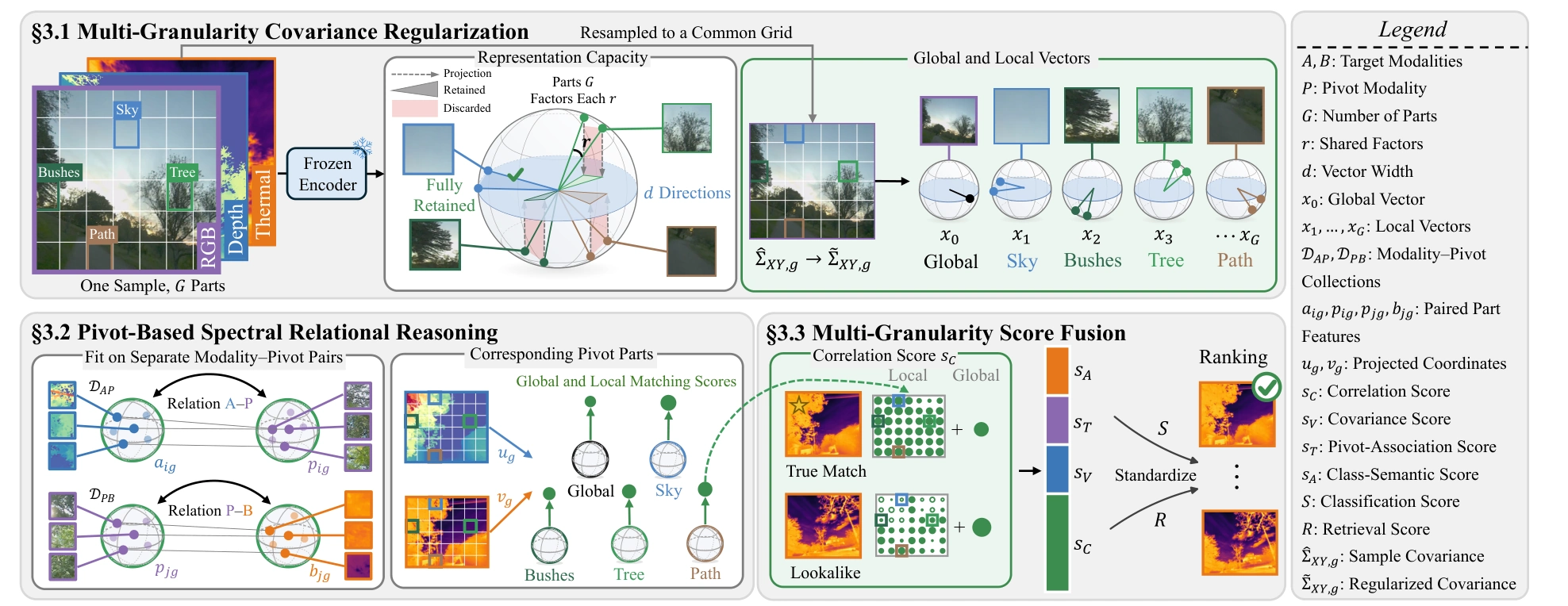
Give a model a depth image of a street and ask it to find the thermal frame from the same instant. Several consecutive frames can show almost exactly the same street. Recognizing the street alone won't tell the model which frame to choose. A depth image records distance and a thermal camera records heat, so the same object can look quite different. Could the model learn to match the two using separate training collections, one pairing depth images with RGB photos and the other pairing thermal images with RGB photos?
We released PRAM to use ordinary RGB photos as the common reference. It learns how regions of a depth image relate to regions in an RGB photo, and separately learns those relationships for thermal images. It brings the two sets of relationships together. When ranking candidate frames, it can use both the overall scene and the small differences in shape and position that distinguish adjacent frames.
On TartanRGBT, we used the same frozen ImageBind features to retrieve thermal frames from depth images and depth frames from thermal images. Averaged over both directions, MMBind put the correct frame in the top ten 17.5% of the time. PRAM did so 75.1% of the time. We then kept all the regional features in the reference images but shuffled which positions they corresponded to. PRAM fell from 75.1% to 23.5%. Even with the same set of visual clues, knowing where each one belonged made a difference to finding the right frame.

r/deeplearning • u/Flashy-Fisherman-503 • 1d ago
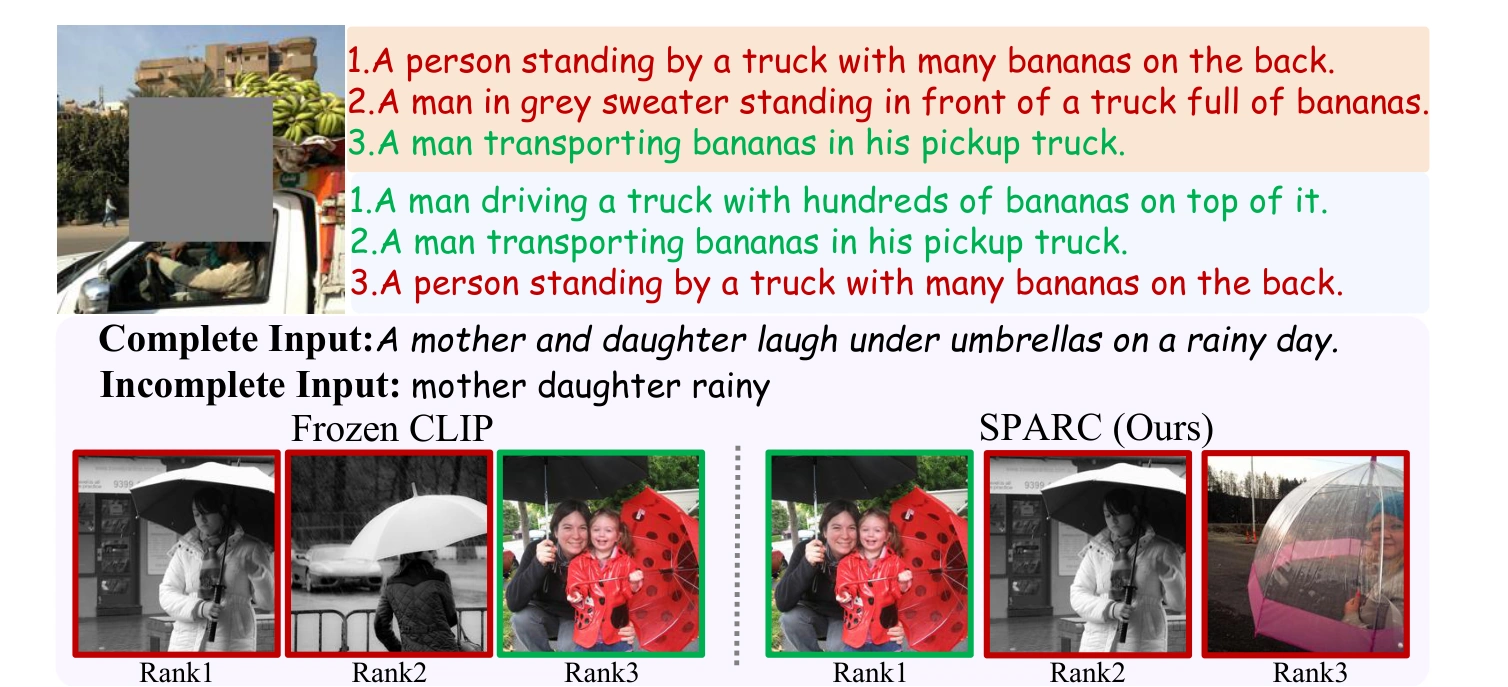
Look at the photo in Figure 4. A man is driving a truck loaded with bananas. With the center of the photo covered, CLIP put a caption about someone standing beside a banana-laden truck first. A caption about a man transporting bananas in his truck came third. Both captions get the bananas and the truck right. What separates them is what the man is doing.

We wanted to know how much information CLIP still had when it picked the wrong caption. We selected 700 Flickr30K photos for which CLIP ranked a correct caption first and a classifier could read the correct object category from its image features. Then we masked the central 50% of each photo. For 155 of them, CLIP now put the wrong caption first. The same classifier could still read the correct object category from the features of those 155 photos.
That finding led us to build SPARC. Could the remaining clues help CLIP choose between two plausible captions? During training, we used complete photos and their captions as references to teach a small module to adjust the features of a masked photo. The aim was to move correct captions up while preserving the matches CLIP already ranked correctly. At search time, only the incoming query goes through the module, so the collection can reuse its existing embeddings.
In a separate Flickr30K test, we masked the central 25% of each photo. A correct caption came first 54.1% of the time with the original CLIP ViT-B/32, 66.0% after standard fine-tuning, and 70.9% with SPARC. Back in the truck example, the caption SPARC ranked first describes a man driving a truck loaded with bananas.
r/deeplearning • u/LK_Lucascc • 1d ago
r/deeplearning • u/No-Conclusion3720 • 1d ago
CVE-2026-103406 in Juniper's Session Smart Conductor allows remote attackers to execute arbitrary commands as root with no authentication required. CISA has confirmed active exploitation in the wild.
What makes this category of vulnerability different from a typical endpoint compromise: Session Smart Conductor sits at the traffic-routing layer. Root access there means an attacker controls flows across the entire network, not just the node they landed on. The blast radius is structural, not incidental.
Patching cadence rarely matches exploitation speed on CISA's KEV list. The gap between public disclosure and patch deployment is measured in days to weeks. Active exploitation means that gap is already being used.
For those running critical routing infrastructure: what does your actual containment posture look like when a core conductor process is compromised before a patch is available? Not asking about patching — asking about what limits propagation in the window before you can patch. Curious what practitioners are actually doing here, not what the frameworks say to do.
r/deeplearning • u/sovit-123 • 1d ago
Up until now, the gpt-oss-chat backend was primarily powered by llama.cpp. Although this works well for local setup, there were major limitations when trying to tap into the benefits of other high performance inference engines, like vLLM or Modal endpoints. This is exactly what the latest update brings to gpt-oss-chat. We are adding vLLM and Modal endpoint support to gpt-oss-chat, which are OpenAI-compatible, complete with tool use and streaming.
r/deeplearning • u/SyntheticMindsLab • 1d ago
We're Synthetic Minds, we build Astral Inference Server, an open-source OpenAI-compatible LLM server (Rust host, hand-written CUDA kernels, one binary, no Python). Sharing a contributor's work here because the method is clean.
GitHub user lkyprogramer maintains inkling-4090-engine, an unofficial community fork of Astral Inference Server, ported to and validated on a single GeForce RTX 4090 (sm_89) for Inkling 2 Mini. The fork is not affiliated with us and the numbers are theirs, not ours.
Their setup: one RTX 4090, the unsloth UD-Q4_K_XL GGUF, compared with llama.cpp on the same file.
Decode with no draft: 143.1 tok/s against 74.7 tok/s for llama.cpp, which is 1.92x.
Decode with the DSpark draft: 173.9 tok/s against 90.5 tok/s for llama.cpp at k = 3, which is 1.91x.
KL divergence against llama.cpp on the decode path: mean 0.0018, p99 0.023. llama.cpp compared against itself at -ub 512 and -ub 1 gives 0.0020 and 0.028, which is a useful sense check on that spread.
So nearly 2x on that setup only. We make no claim for other GPUs or other models.
The same work found and fixed a stream-ordering bug that affects all GPUs: synchronous uploads and fills now finish on the legacy stream before Astral's non-blocking streams start work. We are looking at bringing that fix upstream.
Community fork: https://github.com/lkyprogramer/inkling-4090-engine
Upstream: https://github.com/syntheticminds-lab/Astral-Inference-Server
Happy to answer questions on the method.
Written with AI help, edited and checked by us.
r/deeplearning • u/No-Conclusion3720 • 1d ago
FIFA disclosed it was the victim of a cyberattack that accessed personal and business information. The organization has not stated the volume or nature of records affected. For a global governing body that holds contracts, payment data, and identity records for millions of people across dozens of jurisdictions, that silence signals the exposure is wide.
The breach pattern here is not unusual. The attacker gains access, reaches a data store, and exits with real records. The organization discovers this after the fact. Affected individuals and counterparties absorb the consequences with no warning and no recourse at the moment it happened.
What makes this scale of exposure particularly damaging is not just that someone got in. It is what was sitting in those stores in a form that was immediately useful once retrieved. Payment data, identity records, and contract details for a global operation covering dozens of jurisdictions represent an enormous surface area of live, actionable information.
For those working on data infrastructure at organizations with similar scale and jurisdictional spread: how are you thinking about the gap between stopping an attacker from reaching your data stores versus controlling what they actually walk away with if they do?
r/deeplearning • u/Resident_Performer25 • 1d ago
When you give an AI model a few photos or screenshots and ask a question, does it actually look at all of them before it answers? Ever asked it to compare two images, only to get an answer that clearly ignored one of them?
We looked into this, and models answer from just one image more often than you'd think. On a lot of questions, showing one image gets them almost as far as showing all of them, and when they're wrong, they usually repeat the answer they'd give from a single image.
So we tested Claude, GPT, Gemini, Qwen, Kimi and GLM on questions you can only answer by looking at every image. Even the top model, Claude Opus 5.5, only got 68%, and Gemini 3.8 Flash slightly beat GPT-6-Astra. RLVR rewards only check the final answer, so a correct answer read off one image earns the same reward as one that combines several. We shift the credit toward the tokens that one image can't explain (CICA), and it raised three open models by 2.6-6.0 points. Results for the other models, a training method that improves this, and the models we trained are on GitHub.
If you've run into this, please tell us in the comments. We're collecting these cases for our research. Questions and suggestions are welcome too. We'll answer them, and good suggestions will go into the GitHub repo!
Disclosure: I'm one of the authors.