r/deeplearning • • 16h ago

Seed: an experiment in building a small modular AI from scratch on a GTX 1660 Ti, looking for feedback

5 Upvotes

I'm not an ML researcher. I'm a decorative concrete contractor who got into this because I want my family to have capable AI we own and can run at home. My hardware is a GTX 1660 Ti (6 GB) with 16 GB of RAM, and I hold myself to a 2 GB budget for model weights. Quantized 7B to 27B models either didn't fit well or lost too much quality, so I started building something small from scratch instead. It's very much a work in progress.

The idea

Seed is a pool of small specialist models I call seeds, each about 4 to 10M parameters, all trained from scratch with a shared 4,096-token BPE tokenizer. Each seed is trained on one job, then frozen. A small router reads the context and picks which few seeds run, currently the top 3. Facts and arithmetic go to tools (a wiki search and a calculator) instead of being memorized, on the bet that a small model can be decent at deciding what to look up and how to use the result, even if it can't store much knowledge.

Current seeds (about 26M parameters, 50 MB at fp16)

  • A small general-language base trained on TinyStories
  • A tools and reasoning seed (search and calculator calls)
  • JSON and tool-call formatting
  • Turning tool results into short answers
  • Math word problems into plans plus calculator calls
  • Step-by-step reasoning chains

Training now: a word-problem planner (4.4M and 10M versions, to test whether size helps), a Python writer, a seed that writes code, runs it, and fixes errors, an instruction follower, and one seed each for C, JavaScript, PowerShell and shell.

Results so far, against Qwen 2.5 Coder 3B at Q4 as a reference point. These are my own small evals, 20 items each, so take them loosely:

  • Fact questions with a search tool: Seed 18/20. Qwen scored 0, but that's mostly because it never called the tool in my setup, so it isn't a fair knowledge comparison.
  • Held-out GSM8K word problems: Seed 2/20, Qwen 9/20.
  • My 20-problem Python test: Seed 0/20, Qwen 15/20.
  • Valid JSON output: 100% with top-3 routing.
  • Speed: about 27 tok/s on the GPU and 36 tok/s on the CPU.

So right now it's fast and tiny, decent at tool-shaped tasks, and clearly behind on reasoning and code. Those gaps are what the current seeds are aimed at.

Open questions I'd love input on

  • Is the frozen-specialists-plus-router approach a dead end compared with one dense model of the same total size?
  • What's a better routing scheme than top-k from context? I'm considering a dynamic number of seeds based on router confidence.
  • What are good small, clean datasets for planning and code repair?
  • How would you evaluate this fairly against bigger models that weren't built around tool use?

Eventually I'd like to test it on hackmud, a text-based hacking game, as a long-running benchmark, and maybe run it on a phone.

Repo: github.com/SocioSanity/seed

Thanks for reading. Criticism is welcome.


r/deeplearning • • 8h ago

In Other News: Tanker Cyberattacks, EU Quantum Act, New VirusTotal Capabilities

3 Upvotes

The EU Quantum Act passed, VirusTotal added new threat-intelligence capabilities, and a rash of tanker cyberattacks hit maritime infrastructure this week. The piece that keeps coming up in security circles is quieter: AI is compressing the timeline on cryptanalytic attacks against classical schemes. The assumption baked into most long-lived data stores and signed artifacts is that RSA and ECDSA hold for the foreseeable future. That floor is shifting. Harvest-now-decrypt-later attacks mean adversaries do not need to break crypto today — they collect ciphertext now and wait for the compute curve to catch up. The EU Quantum Act signals that regulators have already priced this in and expect organizations to have a migration path. Most enterprise infrastructure does not. TLS termination, signing pipelines, secrets managers, and inter-service auth tokens are almost universally classical. Migrating any one of them is a multi-team project; migrating all of them simultaneously while keeping services running is an unsolved operational problem for most shops. How are practitioners actually sequencing this in real environments — are you prioritizing data-at-rest, in-transit, or signing infrastructure first, and what is forcing that order?


r/deeplearning • • 16h ago

Rubiks cube solver using Reinforcement Learning (Beating Sebastian Lague's solver)

Thumbnail reddit.com
3 Upvotes

r/deeplearning • • 1h ago

Can a few neurons help identify AI-generated images?

1 Upvotes

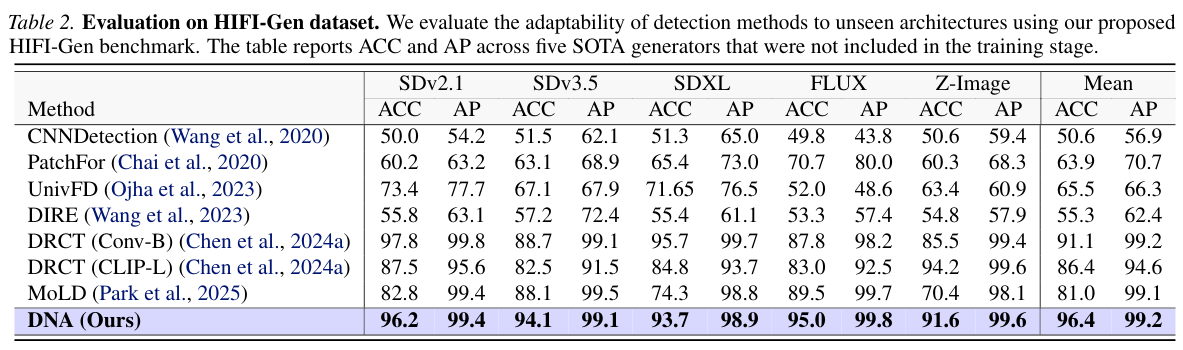
A detector can look excellent on a generator it has seen and fail as soon as a new generator leaves different traces. We wanted to know whether a pretrained vision model already contained features that several generators had in common.

We built DNA to find intermediate units whose responses separated real and generated images. We kept the encoder frozen and trained a small classifier on those responses.

We tested on five unseen generators in HIFI-Gen. DNA reached 95.0% detection accuracy on the FLUX split and 91.6% on the Z-Image split. The attached table gives each generator’s result, so the variation between them stays visible.

Team write-up · arXiv paper · GitHub · Table 2


r/deeplearning • • 1h ago

When the camera angle changes, what still supports a model’s correct answer?

1 Upvotes

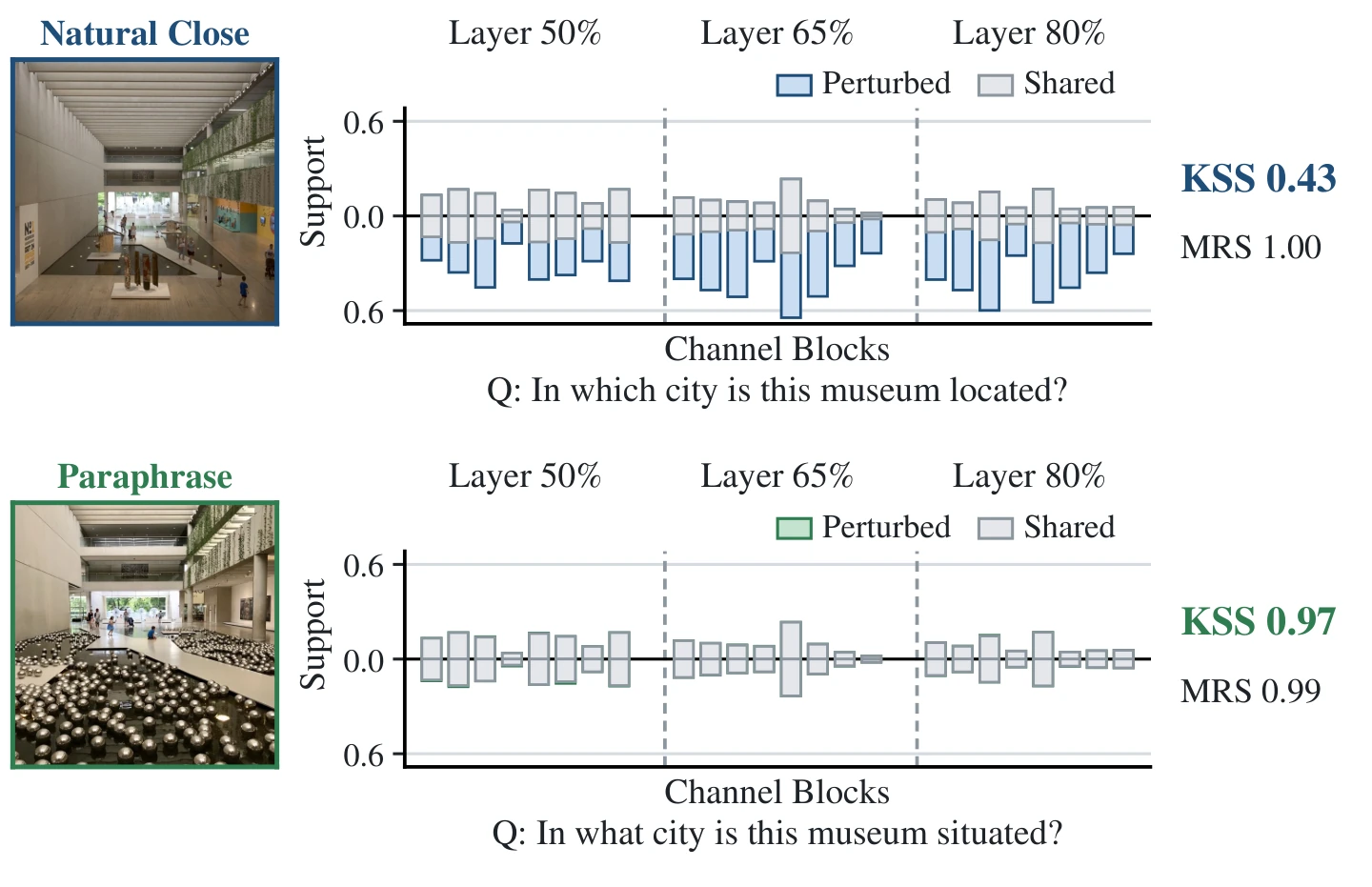
Show a vision-language model two photographs of the same museum. If it names the city correctly both times and remains equally confident, has it relied on the same evidence?

We built MMStableBench to test that question on 19,452 items across 15 models. In the museum example, rewording the question preserved the internal features supporting “Brisbane” almost completely, with an overlap score of 0.97. Using a closer photograph dropped that score to 0.43, even though the answer and its confidence margin held up.

Across the models, 12.4% of correctly answered variants in the top quarter for confidence-margin retention fell in the bottom quarter for stability of internal support.

Team write-up · arXiv paper · GitHub · Figure 4


r/deeplearning • • 1h ago

Villain Boutique: My Scheme to get an employer to take a risk on hiring me.

Thumbnail villainboutique.com
1 Upvotes

Self-taught, moving to Texas for an AI job. Is my portfolio enough? Be brutal.

While I was researching ML certifications, Google's AI summary said employers care more about proven, hands-on ability to build and deploy AI on real business problems than about certificates, because the tools change faster than the courses. So I skipped the certificates and spent the last few weeks building proof instead.

villainboutique.com/

Which is really my brick-and-mortar store I plan to open when I have the funds to do so, but ended up being a watered-down e-commerce store version that supports the Autopilot case study.

I can't tell you how awesome Villain Boutique is going to be whenever I have the means to open it. Our backrooms will have backrooms.

  • AI product autopilot: local models (Gemma, Qwen via Ollama on one consumer GPU) that find, check, price, and write up products for a live store with real Stripe checkout. Nothing goes live without a human approving it.
  • KillCalculator.com: a privacy-first field data app with on-device AI that stores nothing.
  • Autonomous red team, Run 001: I pointed one uncensored local model at my own site and told it to find a way in using only the URL. It routed around a broken TLS stack by itself and mapped the attack surface in nine steps before I stopped it.

My degree is in Advertising and crazy gaps in my work history. Most of my experience is in the film industry in Atlanta, Georgia, and that was before COVID.  I'm packing up and driving to Texas to find a job in AI, and this is my shot. If you hire or work in ML, is this enough to get a recruiter to take a chance on me? What's missing? I’m doing this regardless of your feedback, but if there’s anything I can change or improve before I leave, that would be incredibly useful information.  Should I include all the projects I developed over the years, like this image generator that’s specifically for making elaborate designs with consumer-grade Cricut machines, or my personal favorite but no one else's “Holo Sexting Machine,” My attempt to put naked females on a HOLOFAN Projector? 

P.S. The first draft of this was incredibly candid. Thank god I ran this by Claude first.


r/deeplearning • • 3h ago

Your LLM is LYING to you. Here's how to fix it.

Thumbnail youtube.com
1 Upvotes

I built a Hello World RAG App in Python

Normal LLM = Answers from training data (can hallucinate)

RAG LLM = Answers from YOUR documents

I asked it Saudi it didn't say Saudi Arabia.

It said "Contractor at Saudi Aramco" - because it read MY LinkedIn PDF.

This is how it works:

  1. Load PDF
  2. Split into Chunks
  3. Create Embeddings (Google Gemini)
  4. Store in ChromaDB
  5. Search Top 3 Chunks
  6. Send Context + Question to Groq LLM

Tech: Python + LangChain + ChromaDB + Groq + Gemini Embeddings

Save this for your next interview

Comment "RAG" and I'll send you the full code + next part.

Follow for AI Engineer series - Part 2 coming next.


r/deeplearning • • 12h ago

Drupal warns of new site takeover flaw exploited in attacks

1 Upvotes

A critical authentication bypass in Drupal is being actively exploited in the wild right now. Attackers are using it to fully take over sites — not deface them, not exfiltrate a table, but own the entire application layer. Bleeping Computer confirmed the exploitation is in-progress, not theoretical.

The mechanic is familiar: gain a foothold via a privileged identity, then every downstream action inherits that trust. CMS platforms, APIs, and increasingly autonomous agents all share this structural problem. The privileged credential is the blast radius.

What makes this iteration particularly ugly is how quietly it compounds. A compromised service account or session token doesn't throw errors — it just acts. By the time logs show something wrong, the takeover is complete.

For those running production systems with any non-human identities in the request path — agents, integrations, automated workflows — how are you actually handling the gap between credential issuance and runtime behavior? Are you relying on perimeter controls, or do you have something that evaluates the action at the moment it fires?


r/deeplearning • • 13h ago

Getting confused with the vector logic behind GAN noise vectors

Thumbnail reddit.com
1 Upvotes

r/deeplearning • • 14h ago

Looking for help testing a modular growing-AI architecture (Seed v2.0) — anyone with spare GPU cycles want to grow a specialist seed?

Thumbnail reddit.com
1 Upvotes

r/deeplearning • • 17h ago

WiML/NeurIPS Paris 2026 – Cocktail Reception Guest Ticket Available

Thumbnail reddit.com
1 Upvotes