r/Defeat_Project_2025 • • Oct 04 '25

Activism r/Defeat_Project_2025 Weekly Protest Organization/Information Thread

18 Upvotes

Please use this thread for info on upcoming protests, planning new ones or brainstorming ideas along those lines. The post refreshes every Saturday around noon.


r/Defeat_Project_2025 • • Feb 03 '25

Resource Litigation Tracker: Legal Challenges to Trump Administration Actions

Thumbnail
justsecurity.org
486 Upvotes

This public resource tracks legal challenges to Trump administration actions.

Currently at 24 legal actions since Day 1 and counting.


r/Defeat_Project_2025 • • 3h ago

News New wave of Democratic attorneys general may reshape the justice system

Thumbnail
npr.org
61 Upvotes

The nation's legal landscape is set for a major shift after voters elected Democrats to serve as attorney general in five formerly Republican-led states. That means** **a majority of states will soon have a Democrat serving as the top law enforcement officer.

- Democratic candidates flipped attorneys general offices in Georgia, Iowa, Kansas, Ohio and Texas–and in Alaska, the incoming Democratic governor announced his pick for attorney general in a state previously run by Republicans.

- The Democratic victories could have major effects for what alleged crimes are investigated, lawsuits filed and court cases heard across the U.S. State attorneys general typically have sweeping discretion in what legal challenges to bring or drop on behalf of their state's residents.

- And with roughly seven in ten Americans set to live in a state with a Democratic attorney general, Democrats will be able to bring many more cases across the country that.argue for their positions on the economy, environment, abortion, civil rights, and crime, rather than the Republican perspective

- "Voters picked AGs who will stand up and fight for them, whether that's taking on rising costs, pushing back against a lawless administration, or holding bad actors accountable. It's a time to celebrate, and also to get to work,"** **Democratic Attorneys General Association President Sean Rankin said in a statement to NPR.

- Conversely, the midterm election defeats for Republicans attorneys general candidates left the conservative legal movement reeling – and planning a comeback.

- "There's no sugarcoating it, this was the worst election for Republicans since 1974," said Adam Piper, executive director of the Republican Attorneys General Association.

- In an interview with NPR, Piper contended that Republican attorneys generals' policies are still broadly supported by voters, but were overshadowed by the unpopularity of the rest of the GOP. He noted that Republican attorneys general candidates ran ahead of GOP candidates for governor and U.S.

- Senate in some states.
Following the midterm results, Republican attorneys general convened for their fall meeting in Dallas, Texas, where the outgoing attorney general, Ken Paxton, lost his bid for Senate. He will soon be replaced by a Democrat, Nathan Johnson.

- Piper said attendees grimly reflected on their challenges while also strategizing how to position Republican attorneys general to support the GOP as 2028 approaches. He added that the Republican Attorneys General Association are watching for potential "lawfare" by Democrats, including changing the number of Supreme Court justices or welcoming new states into the Union.

- "We have to have better quality of candidates at the top of the ticket," Piper said. "We have to have better message discipline, and we need other committees in Washington to focus on what RAGA has done, and that is making sure we're good stewards of resources."

- Democratic attorneys general held their own conference in Chicago, which some attendees said was both a celebration of the Democratic victories and an orientation for the incoming Democratic attorneys general.

- "While a lot of the focus turns to what's next in Washington, we understand and we're not naive to the fact that we will continue to have a critical role in protecting our republic," said Illinois Attorney General Kwame Raoul during a Nov. 19 press briefing with other Democratic attorneys general.

- Johnson, the incoming Texas attorney general, said at the same briefing that the wins for Democrats in the state house and governor's mansion could prompt Republicans to cooperate on a "cleansing" anti-corruption agenda. But he also signaled he'd support legislation and legal challenges to President Donald Trump's efforts to build a wall in Big Bend National Park on Texas' border with Mexico.

- The Texas attorney general has traditionally brought cases on behalf conservative legal causes that had wide-ranging impacts across the country. The office also served as a training ground for Republican legal talent. U.S. Sen. John Cornyn and Texas Gov. Greg Abbott both served as attorney general before seeking higher office, while Sen. Ted Cruz served as solicitor general in the office before running for Congress. Other** staffers **have gone on to serve as judges, law clerks and prosecutors.

- "Texas was a major intellectual force for the Republican attorneys general, and that's not going to be easily replaced," said James Tierney, a professor at Harvard Law School who has advised more than thirty attorneys general** **from both parties on staffing and legal philosophy.

- "There are a lot of very smart, good lawyers in various AG offices who are very conservative," said Tierney. "But they don't have the heft and the size and the number of attorneys that Texas brings, and so for them, it's a very significant loss."

- For Democrats, the recent wins could transform how the states enforce laws, bring legal cases, and support or hinder the Trump administration.

- "These new attorneys general are not going to be particularly favorable towards the Trump administration, and will take an oppositional position in a number of different cases," said Anthony Michael Kreis, a constitutional law professor at Georgia State University. That may mean direct lawsuits against the administration in coalition with other attorneys general, Kreis said.

- Many incoming Democratic attorneys general campaigned on bringing cases against alleged price gouging and digital surveillance by companies, as well as a tougher approach to antitrust concerns. But they will also face pressure to listen to their local business communities–including major multinational corporations.

- "I think it's actually likely to increase bipartisan coalitions, particularly on economic issues," said Swain Wood, a partner at the law firm WilmerHale who now co-chairs the firm's practice advising clients on state attorneys general. Wood, who served as assistant attorney general to North Carolina Democratic Attorney General Josh Stein, cited past landmark settlements against tobacco and opioid distributors as cases where bipartisan groups of attorneys general found common ground.

- Attorneys general from both parties have also banded together in recent years on cases about regulating social media platforms. Democrats elected in newly-minted swing states may already face pressure to choose popular or bipartisan legal actions. That's one way to maintain voters' support, as they're likely to face stiff reelection challenges.


r/Defeat_Project_2025 • • 1d ago

News Trump spends Thanksgiving at golf club, accuses Commerce Department of releasing "fake economic numbers"

Thumbnail
cbsnews.com
92 Upvotes

President Trump is spending Thanksgiving in Florida, where he had a policy meeting early Thursday morning and then headed to his golf club nearby. 

- He and first lady Melania Trump, who are staying at Mar-a-Lago, called U.S. service members on Thursday evening, including members of a unit that was involved in Operation Epic Fury, saying Iran "will never have a nuclear weapon."

- On Thursday morning, Mr. Trump posted a holiday message on social media, wishing a happy Thanksgiving to the "American patriots who have worked so hard to make our country great!" He continued in the lengthy post to wish a happy Thanksgiving to several others with whom he has grievances, including the Commerce Department, immigrants, "the radical far left" and more.

- Mr. Trump claimed that before the midterm elections where Republicans suffered heavy losses, there were "fake Economic Numbers" released. Mr. Trump cited the Commerce Department on Wednesday revising the gross domestic product in the third quarter to 4.3% on an annual basis, up from a prior estimate of 3.4%. The Commerce Department regularly updates its monthly economic data to improve its accuracy, including not just the GDP but also the monthly employment data. 

- Although he did not present any evidence, the president demanded an investigation. 

- Mr. Trump also wished a happy holiday to "all of those people that have worked so hard to bring our Country to the Radical Far Left, those that are looking to change our Court System to that of Sharia, those who want to redistribute Property, so that all of the hardworking people that have built up, over a lifetime, a certain Wealth, will now be forced to distribute it throughout the Country, even to those who refuse to work." 

- The president continued his post with messages about the Somali community, deported immigrants and those who he believes do not appreciate the White House ballroom he is constructing. 

- Overnight, Mr. Trump praised the Army's controlled detonation of about five tons of degraded lead azide in Iowa, blaming former President Barack Obama for the situation and writing that no "carcinogens were released into beautiful Iowa air." Although Mr. Trump and other administration officials have praised the detonation, sources familiar with the matter told CBS News on Wednesday that prior to it, there was a chaotic lead-up inside the Trump administration about what went wrong and who was to blame for not elevating the matter to senior officials sooner. 

- On Wednesday night, Mr. Trump met with NATO Secretary General Mark Rutte, and the pair issued a joint statement describing the meeting as "very impactful" and focused on Russia, Ukraine and Iran. The statement said they discussed "the importance of Russia avoiding any actions that intentionally, or unintentionally, expand the war."


r/Defeat_Project_2025 • • 2d ago

News Trump, FCC illegally sought to punish ABC in free speech case, judge rules

Thumbnail
latimes.com
215 Upvotes

A federal court judge has temporarily blocked a Federal Communications Commission probe into Walt Disney Co.-owned ABC, finding evidence that President Trump and his FCC chief had illegally targeted the network and violated its free speech rights.

- U.S. District Judge Loren L. AliKhan late Wednesday granted ABC’s request for a preliminary injunction blocking any further FCC action amid its high-stakes review of ABC’s licenses to operate eight television stations it owns, including KABC-TV Channel 7 in Los Angeles.

- The ruling is a major victory for Disney, which became one of the first broadcasters to challenge Trump, who has made no secret of his disdain for ABC, its late night talk show host Jimmy Kimmel and the daytime talk show “The View.”

- AliKhan found that Trump repeatedly threatened to have ABC’s broadcast licenses revoked despite the company’s protected free speech rights. Trump’s pick to lead the FCC — Chairman Brendan Carr — “has taken President Trump’s rhetoric as his marching orders” to go after the Burbank entertainment giant.

- “Today’s decision is an important victory for the 1st Amendment,” ABC said in a statement. “We thank the court for its careful consideration.”

- In her 45-page order, AliKhan outlined numerous occasions when Trump had lashed out at the network. The judge found that Trump’s posts and Carr’s statements provided “robust circumstantial evidence [that] strongly supports” Disney’s argument that it was a target of a retaliation campaign by the president and the FCC.

- “President Trump has set his sights on Plaintiff ABC for several years now,” AliKhan wrote. “What started in 2020 as questions about how ABC ‘can keep getting a license’ ... has crescendoed into repeated calls for the Commission to strip ABC’s broadcast licenses for their editorial decisions.”

- The judge wrote that ABC has never had a station license revoked, and that the FCC review was exceedingly rare because the licenses were not set to expire for several years. She declined the FCC’s motion to dismiss the case.

- An FCC spokesperson, in a statement, said the agency disagreed with the judge’s reasoning.

- “Granting Disney’s motion is wrong on the facts and wrong on the law—as controlling Supreme Court precedent makes clear,” an FCC spokesperson said. “The FCC looks forward to prevailing in full on this matter. We will continue to use our lawful authority to hold broadcasters accountable to their public interest obligations.”

- The FCC launched its license review in late April, one day after Trump complained about a joke on “Jimmy Kimmel Live!” that took a jab at the first lady.

- “It is no coincidence that President Trump criticized Mr. Kimmel’s skit on social media and the very next day Defendants initiated the early license renewal proceedings,” AliKhan wrote.

- The FCC license review posed a significant threat to Disney because the loss of licenses would hobble the ABC network by forcing its largest stations off the air. Other ABC stations at risk include those in San Francisco, Fresno, Houston, Philadelphia and New York.

- ABC soon enlisted prominent elected officials, community organizations and seasoned litigators for the 1st Amendment showdown that some theorized could ultimately reach the U.S. Supreme Court.

- ABC filed the 1st Amendment lawsuit against the FCC in August. The agency countered that the lawsuit was premature because FCC regulators had not reached a determination.

- But ABC lawyers argued that the FCC review alone had caused a deep chilling effect.

- Disney representatives testified that ABC had made some programming decisions based on fears that Trump and Carr might retaliate further. Since early this year, when the FCC began an investigation into “The View,” the show’s producers stopped inviting political candidates as guests in what turned out to be a newsworthy election season. The network also took steps to broadcast a Trump address from the White House on a streaming platform rather than the TV network — a move that Trump also blasted.

- The judge noted the FCC hadn’t given any indication when the review might end.

- “As a result, Plaintiffs could very well have to cower under the cloud of the existential threat of non-renewal—and whatever fresh demands and resulting chill may ensue,” the judge wrote.

- “This decision shows that this FCC is a paper tiger whose threats crumble when challenged by those willing to defend their rights,” the lone Democrat on the commission, Anna M. Gomez, said in a statement.

- “For nearly two years, the agency has weaponized its licensing authority to retaliate against broadcasters for exercising their right to free expression, and now a federal court has stepped in to put a check on that conduct,” Gomez said.

- The court order prevents the FCC from taking action on the station license review while the case proceeds but AliKhan denied ABC’s second request to block the FCC from taking “any actions ... to coerce or threaten plaintiffs with sanctions in an effort to alter their exercise of editorial discretion.”

- The judge said she could not issue a blanket injunction covering future actions by the FCC.

- “We appreciate the district court denying in part Disney’s request for preliminary injunctive relief,” the FCC spokesperson said.


r/Defeat_Project_2025 • • 4d ago

News Texas drops lawsuits that accused doctors of illegally providing transgender youth care

Thumbnail apnews.com
229 Upvotes

Outgoing Texas Attorney General Ken Paxton is ending efforts to punish two doctors who were among the first in the U.S. to face accusations of violating bans on providing care to transgender youth, dropping the cases as the Republican prepares to leave office following a failed Senate run.

- The lawsuits against the doctors, which were filed in 2024, were among a spate of high-profile cases that helped Paxton burnish his image as a conservative fighter but are now winding down as Democrats prepare to retake power in Texas for the first time in decades.

- The state’s lawsuits against May Lau and M. Brett Cooper were dismissed Friday, according to attorneys for the doctors. They were among three doctors who Paxton called “scofflaws” and “radical gender activists” in lawsuits that threatened to impose steep fines and revoke their medical licenses.

- “Dr. Lau did nothing wrong, but she was a convenient scapegoat for the Attorney General’s Office, which issued press release after press release about its case — a case that has now collapsed,” Nicole LeBoeuf, an attorney for Lau, said in a statement.

- LeBoeuf said the timing of the dismissal after Paxton’s loss “validates that this case against Dr. Lau was political from beginning to end.” Lau moved her medical practice from Dallas to Oregon during the lawsuit.

- Paxton’s office did not immediately return a request for comment Monday.


r/Defeat_Project_2025 • • 5d ago

U.S. Attorney in Texas warns Democratic lawmakers about investigating Trump associates, faces pushback

Thumbnail
cbsnews.com
271 Upvotes

The United States Attorney for the Southern District of Texas is making national headlines after he sent letters to three Democratic U.S. Senators and a member of Congress about the comments they made about investigating associates of President Trump. Those who received letters from Aaron Reitz include Senator Elissa Slotkin, D-Michigan, Elizabeth Warren, D-Massachusetts, Richard Blumenthal, D-Connecticut, and Representative Robert Garcia, D-California. Reitz was nominated by President Trump and approved by the U.S. Senate earlier this year after he ran unsuccessfully in the Republican primary for Texas Attorney General. 

In an interview with CBS News Texas, Reitz said, "All we had to do was look at the repeated statements of each of these individuals that received a letter committing not merely to conduct legitimate congressional oversight, which of course is the prerogative of Article 1 of the U.S. Constitution, both the House and the Senate, but commitments to go far above and beyond what the Supreme Court calls a legitimate legislative purpose, which is the basis for any legislative committee activity." 

Reitz said he has opened a preliminary inquiry into the matter. 

"Given what these individuals have said, we have reason to believe, although we are not yet alleging, we have reason to believe that 18 U.S.C. 241 and 242, which combined is, in summary, a conspiracy to deprive Americans of their First Amendment freedom of association rights. In other words, punishing people through the criminalization of the hearing process, congressional hearing process, to go after private individuals and entities. That is not only an illegal use, potentially an illegal use of a congressional committee, but is, in and of itself, potentially violating federal law," he said.

In a post on X last week, Senator Blumenthal wrote, "No question about our oversight and investigation - uncovering corruption. It will continue, with undiminished determination, despite Trump DOJ threats designed to deter or intimidate us. Watch what we do." Senator Slotkin made a similar post on X saying, "No matter how many times President Trump and his Department of Justice threaten me, I will not back down from fighting for the country I love."

The group known as Campaign For Accountability filed a complaint against Reitz with the State Bar of Texas, asking to investigate him for violating the Texas Disciplinary Rules of Professional Conduct. The group says the Democratic lawmakers have a right to conduct oversight of the Trump administration. In response, Reitz rejected the group's complaint. 

"Their complaint, I've read it in full. It's over a dozen pages. I think it's entirely baseless, but it's what the donors of the Campaign For Accountability want them to do, which, like some of the Senators that I've sent a letter to, they are seeking scouts. So, they're welcome to try to come after my bar license. I stand by what I've done. I've acted with the highest degree of professionalism," Reitz said.

Former Congressman and now Congressman-elect Colin Allred, D-Dallas, criticized Reitz's letters to the Democratic lawmakers. He told CBS News Texas, "This is an ongoing theme that we've seen, which is that this administration thinks that it cannot be held accountable. It's been completely lawless, and part of what we saw in the election just a couple of weeks ago was a rejection of that idea. I think this guy should spend his time doing what I know U.S. Attorneys should be doing because I worked in the U.S. Attorney's Office, which is going after crime, rooting out corruption, dealing with the cartels, human trafficking, instead of trying to violate the Constitution and step way out of his depth into an area that he knows nothing about."

Allred is returning to Congress in January to represent the newly drawn 33rd Congressional District in Dallas County. He left Congress in 2024 after running unsuccessfully for U.S. Senate against Republican Ted Cruz. Allred said Democrats in Congress need to exercise their constitutional duty to oversee the executive branch while also fighting for policies to help people who remain concerned about the cost of living.


r/Defeat_Project_2025 • • 6d ago

News Trump orders federal contractors to coordinate with White House on congressional inquiries

Thumbnail
abcnews.com
80 Upvotes

President Donald Trump signed an executive order requiring federal contractors to inform the administration of congressional inquiries into their work with the executive branch as the White House seeks to limit oversight by Democrats.

- The order, signed Friday, comes after White House Counsel Will Scharf previously instructed all executive agencies to obtain explicit permission from the White House before allowing employees to testify before Congress, according to a memo obtained by ABC News on Monday.

- Federal contractors and subcontractors will now be required to immediately notify the White House and their contracting agencies of "any pending or future congressional request respecting the contractors' communications or work with the executive branch," the order states. All contractors must follow orders from the administration with regard to withholding communications it deems protected by executive privilege.

- According to the order, contractors who fail to notify the White House of requests from Congress or refuse to follow the administration's instructions face potential contract termination, as well as suspension or debarment, which would prevent a contractor from winning future federal contracts.

- "The ability of the Congress to seek executive branch information is limited; it cannot seek information from executive branch departments and agencies (agencies), employees, or Federal contractors without a valid legislative purpose that does not intrude on core Executive functions," the order signed by Trump states.

- The executive order does not name a specific contractor, but covers "all federal contractors," and extends that coverage to "subcontractors working for a federal contractor on a federal contract."

- There are roughly 100,000 companies that hold federal contracts, plus the subcontractors, according to Bloomberg Government.

- The order argues that a "lack of coordination" between the administration and its contractors undermines efficiency and claims that "contractors also may be unaware of the executive branch's interests and positions, resulting in duplicative and wasteful efforts."

- "It is therefore the policy of the United States to protect confidential information and enhance economy and efficiency in Federal contracting by preventing and prohibiting uncoordinated disclosures of information pursuant to congressional requests," the order states.

- The White House's Office of Management and Budget will develop guidelines to ensure compliance and "adequate coordination between the contracting agencies, contractors, and White House," the order said.

- In a fact sheet released on Friday by the White House, the administration argued that it "must be able to work closely with its employees and contractors on sensitive matters without concern that confidential information may be released to unauthorized third parties, even by federal contractors from a congressional request."

- "If the Executive Branch cannot be assured that communications with contractors will remain confidential, federal agencies will be deterred from safely and freely sharing sensitive information with them, which will deadlock critical government programs," it added.

- The order marks yet another attempt to push back on potential oversight of the White House, as Congressional Democrats have warned that they are preparing to launch new investigations.

- Incoming House Oversight Committee Chair Robert Garcia warned the administration to "lawyer up" in the wake of November's elections.

- In a letter sent to the California Democratic lawmaker last week, Scharf warned that Democrats could be criminally probed over their threats of exercising Congress's oversight powers, claiming that "abusive threats and public statements about the indiscriminate issuance of subpoenas ... make it abundantly clear that any forthcoming investigative processes will be deployed to harass and aggrandize, rather than to advance any legitimate legislative end."

- Garcia responded to the letter last week, saying in a statement that "Congress has wide latitude to conduct investigations and oversight, an authority inherent in the power to legislate."

- "We are a co-equal branch of government and will not be deterred by baseless threats from a weaponized DOJ or from the President’s lawyers," he added.


r/Defeat_Project_2025 • • 6d ago

News Time is running out for Trump’s unconfirmed nominees. Some GOP senators say they haven’t heard a peep.

Thumbnail politico.com
75 Upvotes

Republican senators are pushing to unstick as many of President Donald Trump’s nominees as possible before Democrats take control next year — but say they’re working without much guidance from the White House as the clock ticks.

- “Nothing. Nothing at all,” Sen. Bill Cassidy (R-La.) said when asked what he’s heard from the West Wing about how to help confirm Trump’s picks. Sen. Rand Paul (R-Ky.) said he hasn’t had “any conversation” with the White House about the issue.

- Nearly 100 of the roughly 300 Senate-confirmed leadership positions across 15 Cabinet departments, from deputy secretaries to agency heads, are vacant — and only 29 of those vacancies have a pending nominee, according to the Partnership for Public Service, a nonpartisan government research group. And that figure will likely grow in the last two years of a lame-duck administration facing substantial — and hostile — Democratic majorities in both chambers.

- That would leave a skeleton crew of Trump loyalists to run much of the federal government, placing additional strain on agencies and adding another hurdle for a president already facing a shrinking runway to advance his agenda.

- Some high-profile posts remain without a nominee. Trump hasn’t named a replacement atop the IRS since Treasury Secretary Scott Bessent’s term as acting head expired in March. The FDA is also without a confirmed leader — the latest Trump pick, Heidi Overton, was pulledTuesday.

- The White House said it has been pushing hard for its nominees that have been sent to the Senate to move forward, there has been consistent contact with Senate leadership over the matter and that Republicans have been making progress on nominees.

- In another statement about its strategy for confirming nominees, the White House referred to the president’s post on Truth Social last weekend. Trump, in the post, said it’s “very important” for the Senate to confirm all “pending 161 Nominations, including 25 Federal Judges,” which includes leadership across Cabinet agencies as well as positions such as ambassadors, inspectors general and judges.

- Just before the Senate left for September recess, it cleared a 74-person bloc of Trump’s civilian nominees, which was the fifth round of group confirmations to Trump’s team.

- Republican leadership is also eyeing another en bloc confirmation package for December. Republicans changed the Senate rules last year to confirm slates of civilian posts at once by a simple majority vote but, federal judges and members of the Cabinet still must be confirmed individually.

- An administration official, granted anonymity to discuss internal strategy, said there’s no “panic” to get nominees confirmed this year because of how difficult it’s already been. But, the person said, the Trump administration has gone through this before and is good at operating without confirmed leaders in place.

- During Trump’s first term it wasn’t unusual to see departments missing Senate-confirmed leaders. Republicans also point to Joe Biden’s presidency as precedent for extended acting officials, citing the example of Julie Su, who served as acting Labor secretary for nearly two years.

- But lawmakers — especially institutionalists — argue that acting heads are weaker without the upper chamber’s approval.

- Senate Majority Leader John Thune(R-S.D.) said Wednesday that “there is no substitute for Senate confirmation” and that “Democrats would stand in the way of George Washington himself if President Trump nominated him to serve in his administration.”

- Thune’s office has been in regular contact with the White House about nominees, and it’s the leader’s main priority in the lame duck, said a Senate aide, granted anonymity to discuss private conversations between the White House and Thune’s office.

- Still, those efforts may not be enough to offset the wave of departures that will likely go unfilled before the end of the year. Sen. Cynthia Lummis (R-Wyo.) said Democrats, come January, will “shut off nominees.”

- “It’s just irresponsible to leave agencies rudderless for two years,” she said.

- Some Democrats reason it’s better to leave jobs unfilled than confirm someone they find anathema. But such a move may end up consolidating power under those Cabinet officials who’ve already made it through the Senate.

- “An incompetent or corrupt permanent appointee is more dangerous than an acting nominee,” said Sen. Richard Blumenthal (D-Conn.) when asked about open positions at the Pentagon, where the senior positions at the Navy and Army remain unfilled.

- But the openings also mean that sitting officials, such as Defense Secretary Pete Hegseth and Health Secretary Robert F. Kennedy Jr., may have greater leeway to press their agendas.

- “The Senate no longer has any leverage over me, and you know, and that’s a big deal,” Kennedy said last week at an event hosted by MAHA Action, an advocacy group that supports his agenda.

- David Lewis, a political science professor at Vanderbilt University, said there are potential upsides for the White House in not bothering to push for some confirmations.

- “Not having Senate-confirmed people in place can reduce some barriers from the White House’s perspective,” Lewis said. “There’s no competition for authority, so the White House, if they want to drive policy from the White House, can do that.”

- The vacancy issue is especially acute at some vital agencies including the departments of Defense and Justice.
Trump has sent his picks for the Navy, Army and other senior posts to the Senate hoping they’ll be confirmed this year. But some of his marquee nominees are in trouble, even with his own party running the show.

- Senate Armed Services Committee members on Tuesday held a confirmation hearing for Hung Cao, Trump’s controversial selection to serve as the next Navy secretary. The White House this week also formally nominated Gen. Chris LaNeve — who one year ago was a senior military aide to Hegseth — to serve as the Army’s top uniformed officer.

- Neither of the nominees have clear paths to Senate confirmation.

- Sen. Roger Wicker (R-Miss.), chair of the Senate Armed Services Committee, said he hopes to fill all of the posts before the end of the year but, “there is a lot of work to be done on that still,” and lawmakers face “a time crunch.”

- The Pentagon said in a statement that it “looks forward to working with Congress to confirm the President’s nominees.”

- A wave of recent departures at the Justice Department means just three of its 11 top spots heading up offices and divisions will have permanent, Senate-confirmed leaders if announced exits proceed and no more officials are confirmed. DOJ’s No. 2 job, deputy attorney general, is also currently filled by an acting official with no nominee announced for the post.

- “It is the consistent position of the Department of Justice and the courts that an acting official holds all the authorities of the Senate-confirmed officeholder, unless Congress clearly provides otherwise,” Justice Department spokesperson Kiersten Pels said Wednesday.

- A spokesperson for Sen. Chuck Grassley, chair of the Senate Judiciary Committee, said one of Trump’s pending DOJ nominees for assistant attorney general, Arthur Kleinschmidt, is expected to get a vote in early December. A hearing on Trump’s other pending assistant attorney general nominee, Adam Gustafson, hasn’t been held yet because his paperwork is not complete, Grassley spokesperson Clare Slattery said Thursday.

- Attorney General Todd Blanche in public comments seemed to brush the department’s latest departures aside, saying “this happens in every administration” especially after midterm elections.

- “People leave at the time that’s right for them and their families and the work they’ve done,” Blanche told reporters at an event in Jackson, Mississippi earlier this month.

- Cassidy said it shouldn’t be difficult to fill many of the existing vacancies, giving as an example the National Science Foundation. Cassidy canceled a planned committee vote this week on Trump’s nominee to lead the science foundation, Jim O’Neill, amid concerns from Democrats and science advocacy groups about his lack of a scientific or engineering background and his record at the Health Department and the CDC.

- “They should be able to find somebody who’s acceptable to Democrats and acceptable to Republicans,” he said.

- Asked if he’s concerned about agencies running without a confirmed leader, Cassidy said “of course,” because “the title tells it all. So you want to have strong leadership, right?”


r/Defeat_Project_2025 • • 7d ago

News Texas drops abortion pill lawsuits against out-of-state medical providers

Thumbnail
texastribune.org
536 Upvotes

Attorney General Ken Paxton on Friday dropped two lawsuits that were filed against out-of-state doctors for sending abortion medication to Texas — a practice his successor, Nathan Johnson, has vowed not to upkeep.

- In January and February, Paxton sued two doctors in California and nurse practitioner Debra Lynch in Delaware for mailing abortion pills to Texas residents and operating services that help do so. But on Friday, Paxton filed notices of nonsuit in both cases, part of a wave of withdrawals his office has filed as he prepares to leave office in January.

- It is illegal for Texas doctors to mail abortion medication within the state — but Paxton has also sued doctors in other states who prescribe the medication. Other states’ “shield laws,” which protect physicians who send abortion medications, have complicated Paxton’s efforts to seek damages against the doctors.

- The end of the two suits was celebrated by abortion advocates, including Nancy Northup, president and CEO of the Center for Reproductive Rights, who also highlighted Attorney General-elect Johnson’s pledge to not to sue out-of-state doctors who mail abortion pills to Texas.

- “The incoming Attorney General agrees with most Americans that doctors shouldn’t be treated like criminals,” Northup said. ”These cases were baseless from the start and designed to intimidate doctors nationwide.”

- Less than a day after winning his election, Johnson told The Texas Tribune he would “cease using Texas abortion laws as an instrument of persecution and intimidation” and described challenges to other states’ shield laws as “judicially absurd.”
One of the California doctors, Dr. Remy Coeytaux, is also being sued by a Galveston County man who accused Coeytaux of providing his girlfriend with abortion pills at the direction of her ex-husband.

- That suit and Paxton’s suit against Coeytaux and Dr. Rebecca Gomperts were brought under House Bill 7, described by opponents as a “bounty hunter law” which allows private citizens to sue those who distribute or mail abortion medication to or from Texas.


r/Defeat_Project_2025 • • 7d ago

News Ohio Attorney General seat just flipped.

Thumbnail
apnews.com
371 Upvotes

r/Defeat_Project_2025 • • 8d ago

News Religious messages US agriculture secretary emailed to staff deemed unconstitutional

Thumbnail
theguardian.com
255 Upvotes

Religious messages that US agriculture secretary Brooke Rollins emailed to the agency’s 100,000 employees were unconstitutional, and she must be careful to avoid proselytizing when communicating with workers, a federal judge ruled Thursday.

- Rollins sent the messages, which included Christian messages and images, from her official email account on holidays such as Independence Day, Thanksgiving, Christmas and Easter. She did not send messages commemorating holidays from other religions.

- “And so, like the very first disciples to encounter our risen Lord in the Upper Room almost two thousand years ago, this Easter let us too be alive with hope, full of Paschal joy, and confident in the mission each of us has been called for,” Rollins wrote in a 5 April email, marking Easter.

- US district judge Trina Thompson in San Francisco said the emails violated the first amendment’s establishment clause, pointing to her position of authority, her use of an official email account and the messages suggesting that Christianity is the shared faith of Department of Agriculture (USDA) workers.

- The USDA did not respond to a request for comment.

- Employees cannot realistically opt out of reading emails from their agency director, and the messages could coerce them to hide their own faith or feel pressure to adopt Rollins’ Christian faith, Thompson ruled.

- When disseminating religious messages, Rollins must stop if a colleague asks her to. “Cannot create a hostile work environment through persistent unwelcome advances” and “cannot use official authority to pressure subordinates” are commands that were quoted directly from a USDA policy on workplace religious expression that Rollins herself adopted.

- Rollins may discuss her faith with interested colleagues, share why her faith is meaningful to her, politely invite co-workers to religious events and express her views in appropriate conversations, Thompson ruled, again quoting directly from Rollins’ policy.

- Six USDA employees and the National Federation of Federal Employees, a labor union representing 19,000 USDA workers, brought the suit in May.


r/Defeat_Project_2025 • • 8d ago

News Trump’s pick to lead an agency protecting US elections says Jan. 6 wasn’t an ‘attack

Thumbnail
apnews.com
110 Upvotes

President Donald Trump’s pick to lead an agency with a key role in protecting U.S. elections told senators during a confirmation hearing Thursday that he wouldn’t characterize the Jan. 6, 2021, U.S. Capitol insurrection as an “attack.”

- The response by Michael LoSapio, nominated to head the Cybersecurity and Infrastructure Security Agency, came as part of an exchange with U.S. Sen. Richard Blumenthal, D-Conn., who has made inquiries about the violence and the 2020 election part of his line of questioning for a number of Trump nominees.

- It’s also part of Republicans’ rush to confirm Trump’s picks before Democrats take power in Congress early next year.

- “No, I don’t believe it was an attack,” LoSapio told Blumenthal. “I wasn’t involved in politics. I know what I saw on the news.”

- The White House did not immediately return a request seeking comment on the remark by LoSapio, who if confirmed would inherit an agency mired in partisan tensions over the role it should play in combating false claims about voting or election fraud.

- He also isn’t the first Trump nominee to answer the Jan. 6 question similarly.

- During his own June confirmation hearing for the post of Department of Justice inspector general, Don R. Berthiaume — also during questioning from Blumenthal — acknowledged “violence on the Capitol grounds” on Jan. 6, 2021, but also said, “I don’t know if I would use the term attack.”

- Several of Trump’s judicial nominees have also shied away from characterizing the violence as an “attack” during their own confirmation hearings.

- On Thursday, Blumenthal also asked LoSapio, currently chief information security officer at artificial intelligence firm Palantir, who won the popular vote in the 2020 presidential election, which Trump has falsely claimed that he won.

- “I’m not going to answer the question about an election six years ago,” LoSapio said, later adding that his “only involvement” in that election was voting for Trump.

- CISA — formed in 2018 during the first Trump administration and nested within the Department of Homeland Security — is charged with protecting the nation’s critical infrastructure, from dams and nuclear power plants to banks and voting systems.

- It’s received bipartisan praise from many state and local election officials, but Trump and his allies remain angry over its efforts to counter misinformation about the 2020 presidential election and the coronavirus pandemic.

- The agency’s first director, Chris Krebs, was fired by Trump after highlighting election officials’ statement calling the 2020 election the " most secure in American history.”

- CISA has also been without a Senate-confirmed director for nearly two years. Jen Easterly left the agency as Trump returned to office last year, and Nick Andersen has led the agency in an acting capacity since February. Sean Plankey withdrew in April when his nomination stalled.


r/Defeat_Project_2025 • • 8d ago

News Scoop: Trump names Kirsten Davies as new national cyber director

Thumbnail axios.com
36 Upvotes

The White House named Kirsten A. Davies to be its new national cyber director Thursday as President Trump overhauls his AI team, Axios has learned.

- Why it matters: Davies, who currently serves as the Pentagon's chief information officer, has more experience in the field than the outgoing director, Sean Cairncross.

- Cairncross' departure was described as amicable by two sources.

- But two White House officials said President Trump's new chief of staff, Stephen Miller, sought the change and pushed out Cairncross because, one said, he "lacked the strong cyber credentials to perform the job."

- Zoom out: The Office of the National Cyber Director coordinates cybersecurity policy and strategy across the federal government.

- The position requires Senate confirmation. Davies previously was cleared by the Senate as the Defense Department's chief information officer.

- "Kirsten has the credentials to excel in this position and has already been Senate-confirmed," an administration official said.

- At the Pentagon, Davies has been the top adviser to Defense Secretary Pete Hegseth "on all matters relating to information management, information technology, cybersecurity, and information assurance," according to her bio.

- Before serving in the Trump administration, Davies worked for Unilever and "led global cyber resilience for one of the world's largest consumer goods enterprises," her bio says.

- Davies' career also has included technology and cyber roles at Estée Lauder, Barclays-Africa Group, Hewlett Packard and Siemens. She founded the Institute for Cyber, a nonprofit organization dedicated to citizen safety and security in the digital universe.

- State of play: The administration's AI team has taken shape on the fly, but Cairncross was involved in key decisions.

- He held technical meetings with Anthropic leaders over the summer after Commerce Department export controls effectively scrubbed the company's models from the internet.

- Cairncross brought experience in Republican politics and national security, having worked with the intelligence community and dealt with cyber threats at the Republican National Committee.

- During Trump's first term, Cairncross represented the White House chief of staff on National Security Council committees before leading the Millennium Challenge Corporation, a federal foreign aid agency.

- Cairncross' head of policy and senior adviser Thomas Lind left in June and joined OpenAI in October, further depleting the Trump administration of technical expertise.

- The big picture: The latest turnover in cyber personnel comes as the country grapples with critical infrastructure outages and increasingly powerful AI poised to empower cyber defenders and hackers alike.

- Democrats have criticized the administration's response to outages and warned that U.S. cyber defenses are falling behind AI-fueled threats.

- What we're watching: Trump is also filling other key cyber positions.

- His pick for the top job at the Cybersecurity and Infrastructure Security Agency, which helps defend federal civilian networks and critical infrastructure, Palantir executive Michael LoSapio, faced a combative confirmation hearing Thursday.

- What they're saying: In a written statement, Cairncross said, "it has been the honor of a lifetime to serve President Donald J. Trump. I leave my role as Director of Cyber incredibly proud of our work to strengthen America's cybersecurity, protect our critical infrastructure, confront foreign threats, and position America to lead the world in Super Intelligence."


r/Defeat_Project_2025 • • 8d ago

Call these senators and express your desire to have Schumer replaced by Van Hollen before the vote on Dec 1.

234 Upvotes

Call these senators and express your desire to have Schumer replaced by Van Hollen before the vote on Dec 1.

Here are the direct Washington, D.C. office phone numbers for all 47 members of the Senate Democratic Caucus (45 Democrats and 2 Independents who caucus with them):

  • Angela Alsobrooks (D-MD): (202) 224-4524
  • Tammy Baldwin (D-WI): (202) 224-5653
  • Michael Bennet (D-CO): (202) 224-5852
  • Richard Blumenthal (D-CT): (202) 224-2823
  • Lisa Blunt Rochester (D-DE): (202) 224-2441
  • Cory Booker (D-NJ): (202) 224-3224
  • Maria Cantwell (D-WA): (202) 224-3441
  • Chris Coons (D-DE): (202) 224-5042
  • Catherine Cortez Masto (D-NV): (202) 224-3542
  • Tammy Duckworth (D-IL): (202) 224-2854
  • Dick Durbin (D-IL): (202) 224-2152
  • John Fetterman (D-PA): (202) 224-4254
  • Ruben Gallego (D-AZ): (202) 224-4521
  • Kirsten Gillibrand (D-NY): (202) 224-4451
  • Maggie Hassan (D-NH): (202) 224-3324
  • Martin Heinrich (D-NM): (202) 224-5521
  • John Hickenlooper (D-CO): (202) 224-5941
  • Mazie Hirono (D-HI): (202) 224-6361
  • Tim Kaine (D-VA): (202) 224-4024
  • Mark Kelly (D-AZ): (202) 224-2235
  • Andy Kim (D-NJ): (202) 224-4744
  • Angus King (I-ME): (202) 224-5344
  • Amy Klobuchar (D-MN): (202) 224-3244
  • Ben Ray Luján (D-NM): (202) 224-6621
  • Ed Markey (D-MA): (202) 224-2742
  • Jeff Merkley (D-OR): (202) 224-3753
  • Chris Murphy (D-CT): (202) 224-4041
  • Patty Murray (D-WA): (202) 224-2621
  • Jon Ossoff (D-GA): (202) 224-3521
  • Alex Padilla (D-CA): (202) 224-3553
  • Gary Peters (D-MI): (202) 224-6221
  • Jack Reed (D-RI): (202) 224-4642
  • Jacky Rosen (D-NV): (202) 224-6244
  • Bernie Sanders (I-VT): (202) 224-5141
  • Brian Schatz (D-HI): (202) 224-3934
  • Adam Schiff (D-CA): (202) 224-3841
  • Chuck Schumer (D-NY): (202) 224-6542
  • Jeanne Shaheen (D-NH): (202) 224-2841
  • Elissa Slotkin (D-MI): (202) 224-4822
  • Tina Smith (D-MN): (202) 224-5641
  • Chris Van Hollen (D-MD): (202) 224-4654
  • Mark Warner (D-VA): (202) 224-2023
  • Raphael Warnock (D-GA): (202) 224-3643
  • Elizabeth Warren (D-MA): (202) 224-4543
  • Peter Welch (D-VT): (202) 224-4242
  • Sheldon Whitehouse (D-RI): (202) 224-2921
  • Ron Wyden (D-OR): (202) 224-5244

r/Defeat_Project_2025 • • 9d ago

News House Democrat warns 13 Trump allies to save their records for upcoming investigations

Thumbnail
npr.org
231 Upvotes

The highest-ranking Democrat on the House Oversight Committee sent document preservation letters to over a dozen of President Trump's allies and family members, laying the groundwork for incoming investigations come January.

- "Oversight Democrats are fighting to put an end to this Administration's self-dealing, misconduct, and abuse," said Rep. Robert Garcia, who is poised to become the chair of the committee.

- "These investigations will lay the groundwork for legislation which helps all Americans. This is just the beginning."

- The California Democrat's targets fall into four broad categories: "Trump family corruption, corporate corruption, DHS misconduct, and the White House Epstein cover-up."

- "Americans should be secure in the knowledge that their government is focused on their best interests—not on making the President's family richer," many of the letters read.

- The Trump administration has previously rejected accusations of misconduct and has warned Garcia that overly zealous investigations could constitute a crime — a claim legal experts have broadly pushed back against, citing Congress' oversight authorities.

- In a letter dated Nov. 9, White House Counsel Will Scharf told Garcia the administration was "monitoring" the speech of Democrats in Congress as they mapped out investigative targets into the Trump administration. The letter warned that efforts by Democrats to investigate the administration "may cross the line into blatant criminality."

- "As the President has said, he's willing to work with anyone to continue delivering victories for hardworking Americans," White House spokeswoman Lauren Bis said in a statement on Wednesday in response to Garcia's letters. "If Democrats choose to pursue sham investigations and radical left policies, they are choosing to work against the American people."

- Here's a closer look at the letters Garcia sent:

- Donald Trump Jr. — "pay to play" allegations and potential conflicts of interest, his stake in World Liberty Financial, and the financing of his wedding after-party by a Russian businessman with ties to the Kremlin.

- President Trump later told reporters the costs for the wedding celebration was later paid back. "You have engaged in business pursuits that appear to have allowed you to personally profit from your father's presidency on a massive scale and at the expense of the American people," the letter reads.

- Eric Trump — "pay to play" allegations and potential conflicts of interest, his stake in World Liberty Financial, the Trump family's cryptocurrency venture. "Oversight Democrats have found that your roles as a co-founder of World Liberty Financial and a key player in the Trump family's pay-to-play schemes have raked in billions of dollars for the Trump family over the past several years," said the letter.

- Jared Kushner, Trump's son-in-law — allegations of conflicts of interest, his investment firm Affinity Partners, and using his government role to enrich himself and his companies. "Directly or indirectly, you have received billions of dollars in fees and investments with particularly troubling ties to Middle East states where you also have a government role," the letter reads.

- "This raises urgent questions about transparency, conflicts of interest, and the abuse of what appears to clearly be a government position—with influence over war, peace, and nuclear proliferation as well as direct access to President Trump—for personal profit."

- Former Ambassador to Greece Kimberly Guilfoyle. She was previously engaged to Trump Jr., and was contacted by Garcia over allegations of pay-to-play schemes. "As ambassador, you appear to have been intent on leveraging your position to cash-in," said the letter.

- Trust for the National Mall CEO Catherine Townsend — construction and donations for the White House ballroom, financed in part via private donations to the Trust.

- White House Chief of Staff Stephen Miller — allegations of abuses by Immigration and Customs Enforcement under his direction. "Members of the Trump Administration have described you as the 'linchpin' and 'architect' of the Trump Administration's most extreme policies, advocating for the widespread abuse of civil liberties," reads the letter. "We have documented, and will continue to document, your role in orchestrating, overseeing, and defending these abuses."

Former Department of Homeland Security Secretary Kristi Noem and former DHS senior advisor Corey Lewandowski — allegations of abuse of DHS funds, corruption and self-dealing.

- Vice President J.D. Vance— allegations of secret meetings inside the White House Situation Room about the administration's handling of the Epstein files. "Reportedly, you were even the first to suggest that Ghislaine Maxwell be interviewed in hopes of using her testimony to distance President Trump from Epstein, despite President Trump's well-documented decades-long friendship with the notorious abuser and sex-trafficker," the letter reads. "These discussions appear to be directly linked to an apparent quid pro quo in which Maxwell was moved to a minimum-security prison camp after she made favorable statements about President Trump in a highly unusual prison interview conducted by then-Deputy Attorney General Todd Blanche."

- Former White House Chief of Staff Susie Wiles— allegations of secret White House meetings surrounding the Epstein investigation. "Reporting describes you as refusing to release documents concerning allegations against President Trump to the public," the letter said.

- Attorney General Todd Blanche — allegations of a cover-up of the Epstein files, failure to comply with the Epstein Files Transparency Act, and the decision to transfer Maxwell to a minimum-security prison. "You have refused to cooperate with our investigation, or to fulfill your legal responsibilities to be transparent with the Committee and the American people," the letter said. "This obstruction is even more concerning given your direct involvement in the broader cover-up, as well as your history as President Trump's personal attorney."

- Federal Bureau of Prisons Director William K. Marshall III and Federal Prison Camp Bryan Warden Tanisha Hall — regarding Maxwell's transfer to a minimum-security prison camp days after she was questioned about Trump and his relationship to Epstein. "Committee Democrats will not tolerate the Administration's refusal to respond to our inquiries and, in the future, will not hesitate to compel information from individuals enabling the cover-up of Maxwell's and Epstein's crimes," the letter said.


r/Defeat_Project_2025 • • 10d ago

News Democrat Mary Peltola wins US Senate race in Alaska, beating incumbent Republican Dan Sullivan

Thumbnail
apnews.com
372 Upvotes

Democrat Mary Peltola defeated two-term Republican Sen. Dan Sullivan in Alaska, overcoming allegations that members of her campaign helped recruit a candidate who shares the incumbent’s name and completing a political comeback in a state President Donald Trump repeatedly won by wide margins.

- The Alaska race was the last U.S. Senate contest to be resolved in this year’s midterm elections and gave Democrats a 56-44 majority after they flipped nine GOP-held seats to retake the chamber. The party also won campaigns in other conservative states, including South Carolina, Texas, Kansas and Mississippi.

- In a statement, Peltola said voters sent a clear message that “the status quo in D.C. is not working for Alaska.”
“Over the course of this campaign I’ve spoken with elders in tears about empty fish racks; families struggling to find housing they can afford; and parents in the Bush faced with the impossible choice of heating their homes or putting food on the table,” she said. “Today we take a monumental step forward in addressing those issues and putting Alaska first.”

- Sullivan spokesperson Nate Adams did not respond to a request for comment. Adams had said Monday that the campaign would let the process “run its course until every legal vote is counted and certified.” A spokesperson for the National Republican Senatorial Committee also did not respond.

- As part of the Nov. 3 general election, Alaskans also elected a Democrat as governor for the first time since 1998, as former state lawmaker Jonathan Kreiss-Tomkins defeated three Republicans, including one endorsed by Trump. The Associated Press has not yet called the U.S. House race, where independent candidate Bill Hill is challenging Republican Rep. Nick Begich.

- Flipping Alaska’s seat was pivotal to Democrats’ plans to retake the Senate

- Peltola previously held the state’s lone House seat, making her the first Alaska Native to serve in Congress. She lost her bid for a second full term to Begich in 2024, but she became central to Democrats’ plans to retake the Senate in 2026.

- In the campaign’s final stretch, however, she faced allegations that her team helped recruit a retired teacher named Dan J. Sullivan to run in order to siphon votes from the incumbent.

- Trump called for Peltola’s prosecution after The New York Times first reported the allegation less than a week before the Nov. 3 election. Peltola denied any involvement.

- “I knew nothing about any other candidates on the ballot except for me and the incumbent,” Peltola told supporters in Juneau days before the election.

- Dan J. Sullivan has denied any contact with Peltola’s campaign or running at the Democrats’ behest. He has not responded to messages from The Associated Press since The Times’ article was published.

- Candidacy of second Dan Sullivan roiled the race

- The Times report was based partly on text messages and other documents and interviews with a former Peltola campaign manager, who was fired shortly before this year’s open primary and later sought to recant her statements. But the second Sullivan had already been on Trump’s mind. He referred to him multiple times during a rally in support of the senator in mid-October.

- The Department of Justice filed a lawsuit that Trump said he ordered. It sought to block certification of the race if the incumbent were to lose, pending an investigation into possible voter confusion. Peltola called the lawsuit “flagrant corruption.”

- The case was dismissed by a federal judge, but the Justice Department appealed. Attorneys for the state sought dismissal, saying officials should be able to conduct the election “without unwarranted interference by the United States.” They also argued the ballot was designed to distinguish the two Sullivans as much as possible and that Alaska’s ranked choice voting process would allow any voters who might be confused to rank them.

- The Justice Department also confirmed the existence of a criminal investigation, but Alaska’s U.S. attorney would not say what potential crimes authorities were looking into.

- Peltola finished first in the primary with 49.5% of the vote, followed by the incumbent with 41.4%.

- Dan J. Sullivan finished a distant third with about 2.5%, but he advanced to the general election as one of the top four finishers. He was listed on both ballots as Daniel J. Sullivan Jr., with no party affiliation, while the senator was listed as Dan S. Sullivan, Republican and incumbent.

- Peltola played up her rural roots during the campaign

- During the campaign, Peltola tapped into Alaskans’ frustrations with high fuel prices and other costs. Those concerns hit especially hard in remote communities that rely on diesel for electricity and heat and are generally only accessible by air or water.

- Her campaign peppered social media with photos of her travels around the state as she sought to separate herself from national Democrats and build a coalition of support around a platform of “Alaska first.”

- “Alaskans who know me know that I’m not liberal or radical,” Peltola said. “I am only interested in working for Alaska and working for the best interest of Alaskans, in as nonpartisan of a way as I possibly can.”

- The strategy resonated with voters who felt they could relate to Peltola, who is Yup’ik and often spoke about growing up in western Alaska.

- “People across the country don’t understand what it means to grow up in a place where there isn’t running water, where there’s only one store, where gas costs $17 a gallon, where heating fuel is not a guaranteed thing, which means that your house isn’t necessarily going to be warm when it’s 50 below zero,” Sam Schimmel, who is Alaska Native, said in Anchorage after Peltola’s win.

- “Having somebody who really understands what that means in D.C., representing us in the Senate, is an enormous achievement,” he added and also noted the significance of Peltola’s election as the first Alaska Native in the Senate.

- Michael Dunn, also in Anchorage, said he voted for Sullivan but hopes Peltola does well.

- “She put in the effort,” he said of her campaign. “So hopefully she puts in the effort in D.C. for us.”

- Peltola emphasized affordability issues

- “Lower 48” became something of an insult bandied by both sides. Sullivan tried to align Peltola with “Lower 48 liberals” who want to restrict oil and gas drilling, mining and other resource development in the state. Peltola said that while she would work with Trump to get things done for Alaska, “I will never put any Lower 48 politician before Alaskans. That’s the difference between Dan and me.”

- Emphasizing her Alaska roots, she spoke about fishing for salmon on the Kuskokwim River with her father and spending parts of the summer at fish camp with her children and late husband, who died in September 2023.

- She said the fish and wildlife Alaskans long relied on to fill their freezers for the winter were becoming harder to find. The changes were forcing people to buy more food and other staples at the store — supplies that must be barged or flown in — and deal with “crushing prices,” she said.

- Peltola also said she saw members of Congress who were “more focused on their stock portfolios” than helping ease those costs and vowed to push back against the billionaire class.

- She will be just the fifth Democrat since statehood to represent Alaska in the Senate. The most recent was Mark Begich, whom Sullivan defeated in 2014.


r/Defeat_Project_2025 • • 10d ago

This Cancer Kills Children in a Year. Research Has Been Stalled for a Year.

Thumbnail
nytimes.com
133 Upvotes

Welcome to Russ Vought's America.

Gift article from NYT.


r/Defeat_Project_2025 • • 10d ago

This week, volunteer for local and runoff elections in Georgia! Updated 11-18-26

Thumbnail
reddit.com
3 Upvotes

r/Defeat_Project_2025 • • 11d ago

Reasons

Post image
665 Upvotes

r/Defeat_Project_2025 • • 11d ago

News Supreme Court rebuffs Trump administration appeal over DEI funding cuts

Thumbnail
apnews.com
115 Upvotes

The Supreme Court on Monday rejected a Trump administration appeal on DEI funding cuts to academic research even as some conservative justices raised questions about implicit bias training in a separate case.

- The justices’ first decision left in place lower court rulings that the Trump administration likely ran afoul of the First Amendment when it terminated millions of dollars in grants to University of California researchers.

- The cuts came after an executive order issued in January 2025 telling the government to end programs linked to DEI, which stands for diversity, equity and inclusion. The Trump administration argued that the government is not obligated to continue funding research that no longer fits its priorities.

- The lawsuit, which involves only a portion of the Trump administration’s research funding cuts, will continue to play out.

- No justices publicly dissented from the brief order declining to hear the case.

- The Supreme Court also declined Monday to hear a challenge to California’s requirement for continuing medical education courses to include discussion of how unconscious bias can affect healthcare outcomes.

- In that case, though, three conservative justices voiced an interest in the claims. Justices Clarence Thomas and Samuel Alito dissented, saying the requirement raises questions about state regulation of private speech.

- Justice Neil Gorsuch also noted briefly that he would have heard the case.


r/Defeat_Project_2025 • • 12d ago

News U.S. attorney warns Sen. Elizabeth Warren against investigating Trump associates

Thumbnail
nbcnews.com
526 Upvotes

A Justice Department official on Sunday accused Sen. Elizabeth Warren, D-Mass., of intending to target private individuals close to President Donald Trump with investigations. The allegation came in a letter similar to others sent to congressional Democrats.

- U.S. Attorney for the Southern District of Texas Aaron Reitz sent a letter to Warren — who is likely the incoming chairwoman of the Senate Banking Committee — calling on her to preserve documents related to investigations of Trump allies. Reitz noted that Warren appears “eager to wield your future gavel like a tomahawk, hunting for the scalps of President Trump’s private associates.”

- Reitz referenced a Nov. 11 letter in which Warren, Sen. Richard Blumenthal, D-Conn., and Rep. Robert Garcia, D-Calif., asked Meredith O’Rourke, a National Park Foundation board member and top fundraiser for Trump, to retain documents related to funding for the White House ballroom and other projects.

- Reitz accused the three lawmakers of “demanding sweeping information about her and other private citizens and entities who associate with President Trump.”

- The letter to Warren signals an expansion of Reitz’s inquiry into congressional Democrats tasked with government oversight. When Democrats take control of Congress next year, Garcia is likely to take the gavel of the House Oversight Committee, while Blumenthal is expected to lead the Senate Committee on Homeland Security and Governmental Affairs’ Permanent Subcommittee on Investigations.

- Last week, the White House issued a threat to congressional Democrats against probes into the administration.

- Since their midterm victories, Democrats have said Trump family businesses and immigration enforcement are some of their top targets for investigation.

- Reitz’s letter referenced an op-ed from Warren earlier this month in Time magazine, in which the senator wrote, “With astonishing brazenness, Trump has attempted to reengineer the federal government into a corruption machine designed to rake in profits for himself, his family, and his cronies.”

- Reitz also accused Warren of planning to target businesses that associate with Trump, referencing an appearance on CBS’ “Face the Nation” in which Warren said tech CEOs, Wall Street executives and giant corporations who have broken the law “better get ready for some investigations — serious ones.”

- “The context sends a strong smoke signal: you intend to target private individuals close to President Trump,” Reitz said.

- A spokesperson for Warren did not immediately respond to a request for comment Sunday night.

- Reitz, a former chief of staff to Sen. Ted Cruz, R-Texas, has sent similar letters to Blumenthal and Sen. Elissa Slotkin, D-Mich., warning them against investigating Trump associates and calling on them to preserve documents.

- Reitz posted his letter to Warren on X, and Trump reposted it to Truth Social later Sunday.

- The letter to Warren also contained numerous references to Native Americans, such as “scalps,” “war cries” and “tomahawk,” a dig at Warren over her past claims of Native American descent.


r/Defeat_Project_2025 • • 11d ago

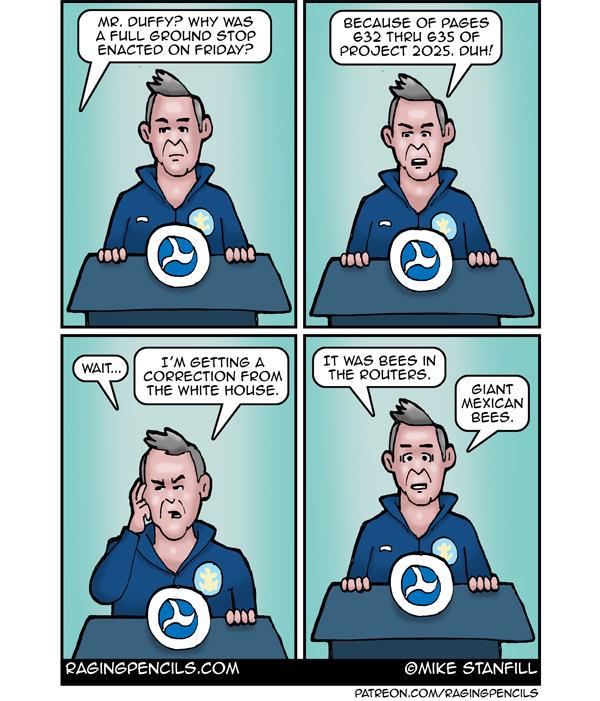
Discussion After a nationwide ground stop, US faces aviation infrastructure questions | Aviation News

Thumbnail
aljazeera.com
28 Upvotes

In other news:

[Project 2025] Strips Oversight from the Federal Aviation Administration:

"The Trump Project 2025 agenda says that the next president should “require the FAA to operate more like a business,” separate the FAA from the Department of Transportation, break up the FAA into several different agencies and “completely restructure” the FAA’s funding system. 54 These reckless changes would jeopardize the FAA’s ability to regulate civil aviation and aviation safety."

(Source: https://betterinaunion.org/project-2025)

So, what's really going on with this 'sudden failure' in the system?


r/Defeat_Project_2025 • • 13d ago

News The U.S. has lost measles elimination status. Here's what that means and who is most at risk.

Thumbnail
cbsnews.com
356 Upvotes

The United States has lost its measles elimination status, researchers with knowledge of the decision confirmed to CBS News partner KFF Health News on Saturday. 

- The decision from the Pan American Health Organization came after the U.S. recorded over 5,400 measles cases so far this year — more than double last year's total. The Pan American Health Organization is a regional office for the World Health Organization, covering North and South America. The agency is set to hold a news conference on Tuesday. 

- A country is considered as having eliminated the measles if there are "no locally transmitted measles infections or outbreaks lasting 12 months or longer," according to the World Health Organization.

- The United States did not meet that standard for the first time since 2000. According to data from the Centers for Disease Control and Prevention, about a third of this year's measles cases are linked to outbreaks that began in 2025 and continue to spread. 

- After a 30-year record of 2,242 cases last year, the CDC has tallied 5,412 cases to date in 2026, resulting in more than 590 hospitalizations and at least six measles-related deaths, with some states reporting additional fatalities. 

- The biggest outbreak has been in Pennsylvania, where state health officials have reported more than 1,500 cases and seven deaths associated with the disease this year. New York and Wisconsin have each reported one death. 

- Measles cases have been confirmed so far this year in 45 states and Washington, D.C. 

- What does it mean to lose measles elimination status? 

- A country or region loses its measles elimination status once its population immunity lowers enough that the disease's spread can be sustained, CBS News medical correspondent Dr. Céline Gounder explained. When a country has measles elimination status and a high rate of vaccination, a case of measles or small outbreak will soon fizzle out. But when there are this many gaps in the population's immunity, there can be "ongoing chains of transmission," Gounder said. 

- "It means that we're at risk of being exposed to measles and getting measles if we're not vaccinated," Gounder said. "It means ERs and pediatricians need to consider measles in anyone with a fever and rash, whether they've traveled overseas or not. And we may now become an exporter of measles to other countries." 

- Dr. Omer Awan**,** a trained epidemiologist and senior public health contributor for Forbes**,** said that the loss of measles elimination status is a setback to the nation's public health infrastructure. 

- "It's frustrating and heartbreaking ... because we have the tools to fight this. The tool is the MMR vaccine, which we know is 97% effective at preventing the onset of measles," Awan said. "It'd be one thing if we didn't have the tools to fight this, but the tools are at our disposal, we just aren't using the tools that can help us mitigate the spread and beat measles." 

- How can the U.S. regain measles elimination status? 

- A country earns measles elimination status by ensuring there is no local spread of the disease or outbreaks that last for more than a year.  

- PAHO says that the best way to maintain the elimination of measles is maintaining a vaccination rate of 95% or higher. Countries should also have sensitive surveillance systems to detect cases quickly, laboratory capacity and a guaranteed rapid response to outbreaks. Data about these trends must be submitted to and verified by the organization. 

- For the U.S. to curb outbreaks and regain measles elimination status, it needs to return to higher rates of vaccination, Awan said. He said battling misinformation and ramping up vaccination campaigns would be key to that effort. 

- Data shows childhood vaccination rates have declined in many communities around the U.S. in recent years, often below the threshhold needed to help ward off measles outbreaks.

- Gounder also noted that lawmakers can create policies that lead to increased vaccination rates. 

- "States set the school vaccine rules. Nine states made opting out of vaccination easier in 2025. States ending nonmedical exemptions saw kindergarten vaccination rise 2 to 4 points," Gounder said. "Most legislatures reconvene in January. Your state lawmakers will write next year's exemption rules." 

- Measles in the U.S. 

- The United States started collecting national data on measles in 1912, according to the Centers for Disease Control and Prevention. About 6,000 measles-related deaths were reported each year in the first decade of that data collection. 

- In the decade between 1953 and 1963, nearly all children in the U.S. caught measles before they turned 15, with an estimated 3 to 4 million people infected each year and tens of thousands hospitalized, according to the CDC. In those years, 400 to 500 people, mostly children, died of measles annually.

- Then in 1963, the measles vaccine first became widely available. The numbers began a sharp decline and several generations of Americans grew up without ever encountering measles.

- By 1981, reported measles cases had dropped by 80% compared to the previous year, the CDC said. The country was officially declared as having eliminated measles in 2000. 

- The U.S. maintained its elimination status for over 25 years. That didn't mean there were no cases at all — in 2015, an outbreak that spread among unvaccinated people was traced back to overseas visitors at Disneyland in Southern California, and a 2018-19 outbreak in New York was eventually contained by public health measures including curtailing vaccine exemptions. But those spikes were just a fraction of the spread now being seen in the U.S.

- The nation recorded 2,242 measles cases in 2025, according to CDC data, linked to 48 separate outbreaks. The CDC reported 245 hospitalizations, mostly in children, and three measles deaths last year. Infections were confirmed in at least 44 states. It was the most cases the country had seen in over three decades. 

- That record was shattered in 2026, when the U.S. recorded more than double that number of cases by October — a total that topped 5,000 earlier this month. 

- Almost all of the cases have been in people who were not vaccinated. Measles-related deaths have been reported in Pennsylvania, New York and Wisconsin. 

- The CDC said 43 new outbreaks — defined as three or more related cases — have been reported so far in 2026, while about a third of the cases reported this year are tied to outbreaks that have been ongoing since 2025.   

- Who is at risk from measles? 

- Measles is one of the most contagious infectious diseases. Those who are unvaccinated for the disease are most at risk of getting it. CDC data shows that 96% of people infected with measles in 2026 did not get vaccinated for measles or were unsure of their vaccination status; only 2% of cases were in people who'd been fully vaccinated.

- While many people recover, measles can cause severe infections in the lungs and brain that can lead to cognitive issues, deafness or death. 
Medical research has shown that two doses of the measles, mumps and rubella (MMR) vaccine is extremely safe and effective at protecting against measles. 

- Some people — including babies, pregnant women or people with weakened immune systems — cannot get vaccinated for measles, so they rely on population immunity to keep the disease from spreading. Awan** **said that these groups of people will bear "the brunt of the consequences" of increased measles spread. 

- "They will be the ones that are most vulnerable to getting infected and experiencing the complications," such as pneumonia or encephalitis, Awan said. 


r/Defeat_Project_2025 • • 13d ago

News Midterm voters ended the long-running GOP dominance in state legislatures

Thumbnail
npr.org
145 Upvotes

The midterm elections saw historic changes in state legislatures.

- Pennsylvania voters elected a Democratic majority in the state Senate for the first time since Jimmy Carter was president. Democrats in Texas will run the state House there for the first time in 24 years. The Georgia House will have a Democratic majority for the first time in more than 20 years.

- The results reversed a GOP dominance in legislatures that began in 2010 and had solidified since.
Going into the midterms, Republicans controlled legislatures in 28 states and Democrats held 18. The remaining few were divided. Now, with some votes still being counted, it looks likely the Democrats will hold a 24-to-22 lead with others divided.

- So far, Democrats have picked up seats in nearly every state that held legislative elections, according to data compiled by NPR. Democrats gained significant ground in unexpected, reliably Republican states, like Texas, Utah and Florida.

- The shift could mean real change in people's lives as legislatures rewrite laws on taxes, reproductive rights, access to health care, school funding and other issues. Legislatures have also been important in promoting or blocking President Trump's agenda.

- New Democratic 'trifectas,'  controlling the legislature and governor's office

- The Republican State Legislative Committee, which coordinates support for GOP candidates, blamed the losses on the national anti-incumbent mood and heavy spending for Democrats.

- "Ultimately, the results of this cycle underscore both the challenges Republicans face and the importance of maintaining a strong, sustained presence in the states," the group's president. Edith Jorge-Tuñón, wrote.

- The president of their rival organization, Heather Williams of the Democratic Legislative Campaign Committee, said their wins "proved what is possible when you put statehouses at the center of a national strategy."

- Some of the biggest changes could come in states where Democrats now control both chambers of the legislature and the governor's office. They gained six new "trifectas."
In Arizona, Democrats will have the majorities in the state House and Senate and hold the governor's office — a trifecta — for the first time since 1966.

- One possible policy change could be on school vouchers. Gov. Katie Hobbs has repeatedly tried to reform and limit the state's billion-dollar voucher program, which provides public money for private school tuition regardless of family income. But the Republican-run legislature had blocked her. Arizona Democrats have said they also hope to provide financial relief on rent, utilities and childcare.

- In Pennsylvania, Democratic Gov. Josh Shapiro has promised to work with a newly Democratic legislature to raise the minimum wage to $15 an hour, strengthen abortion rights and increase affordable housing.

- Democrats also won trifectas in Michigan, Minnesota, Wisconsin and in Nevada, where they won the governor's office. They broke Republican trifectas in Georgia, Iowa, New Hampshire, Ohio and Texas.

- Going into the midterms, Republicans had a few more trifectas than the Democrats. Now Democrats will likely have 22 and the Republicans 17, with 10 other states divided, according to the National Conference of State Legislatures. (That doesn't include Nebraska, with a Republican governor and a unicameral legislature controlled by Republicans.)

- Democrats can break Republican momentum in some states

- In some states, including Georgia, North Carolina and Texas, Democrats have turned Republican-controlled legislatures into divided legislatures.

- Georgia Democrats won the House and came close in the Senate. On their agenda, they could try to win over a few GOP lawmakers and pass Medicaid expansion to provide health care to more low income residents. There could also be an effort by House Democrats to repeal that state's six-week abortion ban, but that could be a tough sell in the Senate.

- Democrats won control the North Carolina state House. As for the state Senate, a Republican is leading the race for one seat by just over a couple hundred votes and it is likely headed to a recount. It will determine if Republicans have a one-seat majority or if the chamber will be tied. If it is tied, the Democratic lieutenant governor would be the tie-breaker.

- North Carolina Democrats are expected to try and roll back some abortion restrictions. And Democratic Gov. Josh Stein has called on both parties to work on addressing affordability concerns once the legislature convenes.

- In several states, Democrats fell short of flipping some Republican-held chambers but won enough seats to end Republican supermajorities. The Multistate government relations firm says that happened in six states that had GOP, veto-proof supermajorities.

- That will matter most where there are Democratic governors, who now have leverage to veto GOP initiatives, like in North Carolina, Ohio and Kansas.