r/EasternPhilosophy • • 4h ago

Discussion Tradition vs First Principles

Thumbnail
youtu.be
7 Upvotes

In this conversation between Rupert Spira and Acharya Prashant. Rupert seemed to be explaining non duality through a more traditional approach of peeling away the false identifications until you reach the pure self. Acharya prashant objects that even this pure self is to the ego and hence a subtle form of attachment itself. That non duality is about seeing things in reflection to the phenomenonal experience, while Spira says that all experience is contingent on ego except that of the pure self.

But both speakers didn't really flesh out or enquire into each other's disagreement and just kept talking past each other in response to the questions brought forth by the questioneer.

Looks like Rupert is kind of taking a more traditional interpretation of Non dual understanding while Prashant's approach is more first principle based and has no regards for taxonomy. Which path has more utility for the suffering self?


r/EasternPhilosophy • • 1d ago

Discussion Japanese Philosophy (with insights from Hegel and Heidegger) — An online reading & discussion group starting Dec 6, all welcome

Thumbnail
reddit.com
1 Upvotes

r/EasternPhilosophy • • 2d ago

What if the search for God, life after death, and the Self begins with questioning the 'I'?

Thumbnail
youtu.be
45 Upvotes

I recently came across a conversation between Acharya Prashant, an Indian philosopher and author, and Robert Lawrence Kuhn, a philosopher who explores questions about religion, metaphysics, and the nature of reality.

What I found interesting about this conversation is how seemingly complex questions that often leave us confused are explained in simple words, bringing us back to something very basic: the human ego and our everyday lives.

The conversation revolved around several philosophical questions, and here is what I understood from it:

God and truth: In Advaita, God is not necessarily an external creator or a separate being. Truth is about the gradual dissolution of the ego. It is not about becoming something extraordinary but about seeing what is false within us.

The Self: We usually treat the ego as our identity. But is that really who we are? Ideas like Atman, Brahman, and Shunyata point toward something that cannot simply be understood as intellectual information or possessed as a belief. They invite us to question the “I” that is doing the questioning.

Life After Death: The ego arises from the physical body’s configuration. When the body loses that configuration, the individual ego ceases to exist. The elements return to nature and become part of other forms. But we still want to believe that something personal will continue after death.

Free Will: How free are we when most of our choices are driven by our fears, desires and conditioning? Maybe freedom begins when we start questioning these compulsions.

Religion and Compassion: Religion, at its deepest, is about self-inquiry rather than blind beliefs, or rituals. Similarly, as the ego becomes less dominant, our relationship with animals and nature can also change.

What made me reflect the most was how much time we spend looking for answers outside ourselves, whether through God, an afterlife, religious beliefs or philosophical theories, while rarely questioning the one who is asking these questions.

So, Instead of being so occupied with what happens after death, we should pay more attention to how we are living right now.

Who am I, and what is happening within me?


r/EasternPhilosophy • • 3d ago

When all becomes one: A non-dual reading of Sant Soyarabai's Abhang

3 Upvotes

r/EasternPhilosophy • • 5d ago

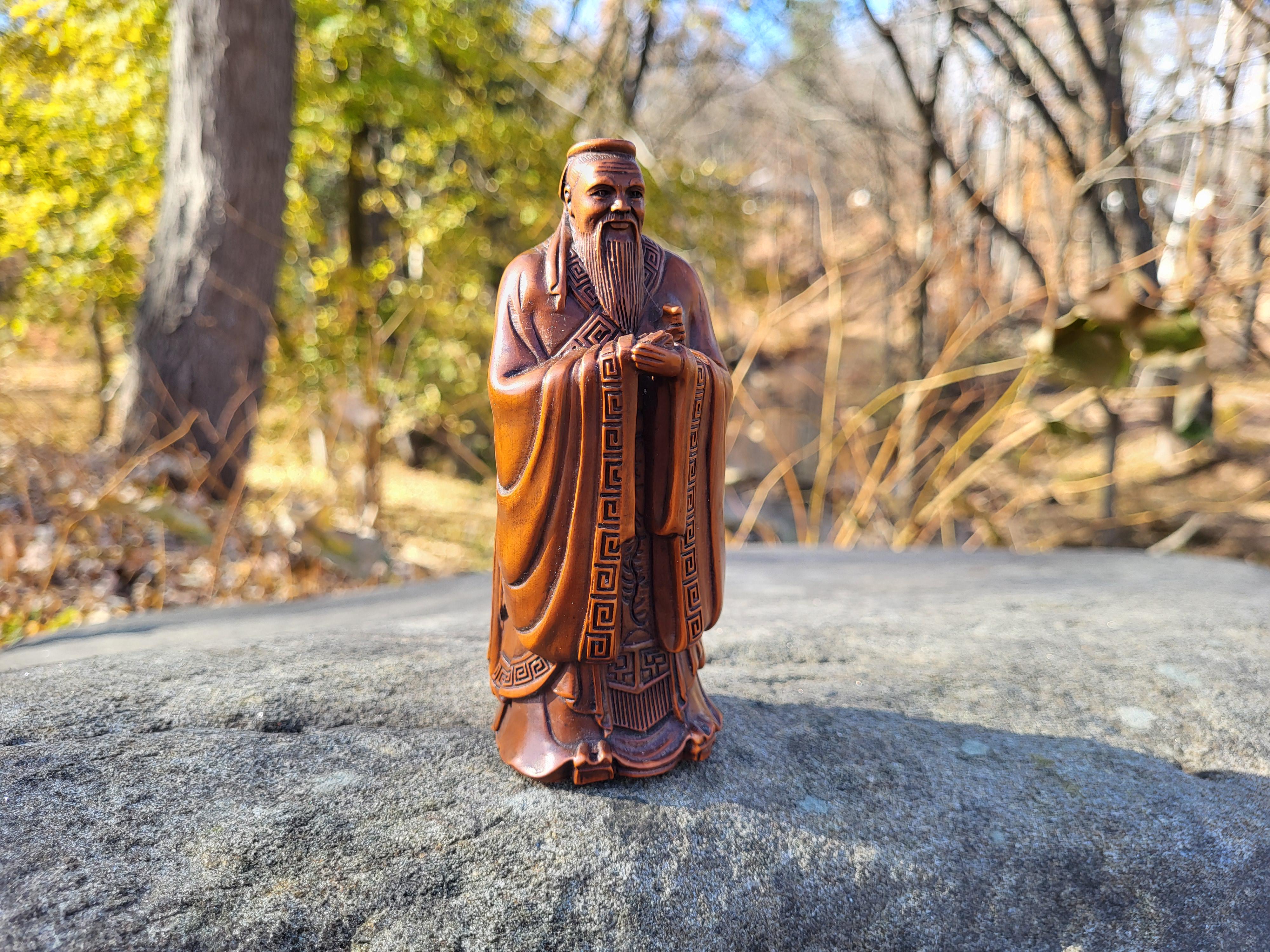
Discussion Confucianism: Philosophy or Religion

Post image
1 Upvotes

r/EasternPhilosophy • • 6d ago

Discussion If Xiang (image/configuration) cannot be visually observed, how is it different from Xing (inner nature)?

1 Upvotes

In the logic of "Humanity is Heaven" (人乃天), numbers like 1, 3, 5, 7, and 9 are called Heavenly Numbers, while 2, 4, 6, and 8 are called Earthly Numbers. Since 1 is Heaven, 2 is Earth, and 3 is Humanity, it is argued that Humanity is Heaven. Is this not wordplay? Explaining things that even today's prominent mathematicians and philosophers do not know merely through the triad of "Heaven, Earth, and Humanity": is this scholarly reverence, or is it the stagnation of research?

When numbers are placed on counting rods or an abacus, a visual shape emerges. Modern things like equations or matrices also reveal a shape when arranged on counting rods or written down on paper. Then, to explain natural phenomena, do we say they only acquire formal structure (Ge, 格) when we "write them in text," or does "Nature" itself replace counting rods, abacuses, and letters as the Xiang (象, visible image or configuration)?

If Nature replaces Xiang, why can some things not be visually observed? If Xiang encompasses things that are not visual, why are the concepts of Xiang (象, image/appearance) and Xing (性, inner nature/essence) treated as different terms? Furthermore, if formal structure (Ge) and Xiang are different, can an invisible Xiang still be called Xiang? Does the character 象 (originally a pictograph of an elephant) even hold such a non-visual meaning?

In classical texts, there is an argument that one looks at the bones of a dead elephant and imagines the living creature. Yet can the bones of an elephant be called an elephant? And did the elephant imagined from those bones truly obtain a proper Xiang? We looked at old fossilized bones long ago and first called them dragons. However, as their appearance changed, we renamed them dinosaurs. As more time passed, their appearance changed, and their scales and tails changed. None of us still know what the Xiang of a dragon is, yet culturally, very many Xiang are drawn, are they not? Among them, what is illusion and what is reality (Shi, 實)? Where do we obtain the method (Fa, 法) to attach flesh onto those bones?

Then, if we fail to obtain reality (Shi) due to our dim perception, can we still say that Xiang truly exists? Conversely, did Xiang not exist and instead vanish? Going further, if we notate things related to sound using mathematical formulas or counting rods, should we say we obtained the Xiang (image) of sound, or the Xing (nature) of sound?

In traditional East Asian mathematics, an operation is valid if we can derive a table relating rules and empirical values (Fashibiao, 法實表). Yet for a dragon, do we not merely "fabricate" such a table rather than "make" it? Also, if Xiang acquires a certain formal structure (Ge), what is its authority? Ancient mathematical treatises that could not even properly follow the standard positional rod-placement rules (Zonghengfa, established since the 5th-century Sunzi Suanjing) broke the canonical Xiang of notation, yet do they not still serve as the soil of scholarship?

Therefore, would it not be right to say that Xiang (image/configuration) exists yet cannot be obtained, and Shi (empirical reality) can be obtained yet cannot serve as the foundational root (Ben, 本)?


r/EasternPhilosophy • • 6d ago

Talk "Our greatest glory is not in never falling, but in rising every time we fall." - Confucius

Post image
2 Upvotes

r/EasternPhilosophy • • 7d ago

Video New Consciousness Argument for God

Thumbnail
youtube.com
1 Upvotes

This video explores the meta problem of consciousness proposed by David Chalmers and argues that naturalistic processes couldn’t have given us knowledge of consciousness


r/EasternPhilosophy • • 12d ago

Is doing good any closer to Truth than chasing money? || Ashtavakra Gita 10.7

Post image
4 Upvotes

r/EasternPhilosophy • • 17d ago

I made a video essay on wu wei vs the 'locked in' grindset: Laozi, Zhuangzi's butcher and swimmer, and the dao that does nothing

Thumbnail
youtube.com
0 Upvotes

r/EasternPhilosophy • • 17d ago

Finding A True Guru

1 Upvotes

why is it difficult to find a true teacher or guruji, oddly enough i see some foreign travelers coming to India and being able to easily find saints , sadhus and even sometimes enlightened guru's . Is it karma or destiny or is it a mindset thing also or is it just being able to give one's absolute total effort to find their path. <guru>


r/EasternPhilosophy • • 28d ago

Discussion Gita in a Church: Is the Ego Already Its Own Punishment?

Thumbnail
youtu.be
20 Upvotes

Pop religion usually tells us that we will be punished for our bad actions in the future, through the popular lens of standard linear Karma, or an afterlife like heaven and hell.

But in a recent Bhagavad Gita session held at a church in London, Acharya Prashant offered a much tighter, tighter realization on verse 3.32: the ego doesn't face punishment in the future; it is its own punishment right now.

The Gita implies we are punished by what we are, not just for what we do. The moment we choose self-preservation and surface-level comforts over truth, our deepest desire for freedom goes unfulfilled. That unfulfillment is the immediate sentence.

Two psychological traps from the talk really stand out for discussion:

The Claim to Knowledge:
We admit we don't know specialised things like neuroscience, but proudly claim we completely know our relationships, our partners, and ourselves. This false confidence keeps us trapped in our habits because we refuse a deeper internal look.

The Portrait Trap:
When we ask what an "awakened person" looks like, it's often a classic ego move. We want a blueprint to copy externally (the look, the style, the words) or a "trailer" to judge and dismiss, rather than holding a mirror to our current state.

How do you view this immediate restructuring of Karma vs. the popular linear concept?

Does seeing the ego as an active, living punishment change how you approach self-observation?


r/EasternPhilosophy • • Oct 25 '26

Acharya Prashant on Closer To Truth: "Free Will Equals No Will" – Thoughts?

Thumbnail
youtu.be
29 Upvotes

I just watched Part 2 of Acharya Prashant’s conversation with Robert Lawrence Kuhn on Closer To Truth and wanted to get this community's take on his approach to Advaita Vedanta.

His perspective on Free Will really stood out to me. Instead of the usual Western debate over standard determinism, he argues:
- Will is exercised entirely by the ego.
- The ego itself is fundamentally unfree and bound by its own compulsions (self-preservation, security, identity).
- Therefore, the only true instance of "free will" occurs when the ego consciously chooses its own reduction and self-dissolution.

Essentially, true free will equates to having no egoic will at all.

He applies a similar via negativa (negation) approach to everything else in the session, dismantling conventional notions of God, the soul, and life after death as literal ontological realities, treating them instead as pointers toward the absence of the ego.

For those who have studied classical Advaita or Madhyamaka Buddhism (he heavily references Nagarjuna’s views on dependent existence, how do you feel about this highly psychological, non-metaphysical framing of Eastern philosophy?

Does defining free will strictly as "the choice to dissolve the ego" hold up, or does it oversimplify the traditional framework?


r/EasternPhilosophy • • Oct 22 '26

What is this tattoo of?

Post image
10 Upvotes

Does anyone know what this is a tattoo of?


r/EasternPhilosophy • • Oct 08 '26

Discussion Bhagavad Gita verse 2.8 | The Nakedness That Made the Gita Possible

Post image
19 Upvotes

r/EasternPhilosophy • • Oct 07 '26

Why did Confucius have such trust in authority despite the awful examples in front of him?

2 Upvotes

r/EasternPhilosophy • • Oct 05 '26

Discussion [Mandukya Upanishad] Knowledge can be helpful but it can become a burden.

Post image
11 Upvotes

Mandukya Upanishad, Verse 7

नान्तःप्रज्ञं न बहिष्प्रज्ञं नोभयतःप्रज्ञं न प्रज्ञानघनं न प्रज्ञं नाप्रज्ञम्‌।

अदृष्टमव्यवहार्यमग्राह्यमलक्षणमचिन्त्यमव्यपदेश्यमेकात्मप्रत्ययसारं प्रपञ्चोपशमं शान्तं शिवमद्वैतं चतुर्थं मन्यन्ते स आत्मा स विज्ञेयः ॥

Construe: The fourth is thought of as that which is not conscious of the internal world, nor conscious of the external world, nor conscious of both the worlds, nor dense with consciousness, nor simple consciousness, nor unconsciousness, which is unseen, actionless, incomprehensible, not inferable, unthinkable indescribable, whose proof consists in the identity of the Self (in all states), in which all phenomena come to a cessation, and which is unchanging , auspicious, and non-dual. That is the Self; that is the to be known.

What is being talked of here is the knowing (of the Self) which transcends all the dualistic knowing in which there is a knower and the known object. The knower knows all about the object but does not know themselves. The 'Self' in the verse in itself can not be known directly but what is accessible to know is the self which accumulates all the knowledge.

The dualistic knowing creates a separation between the knower and the known object- because they are seen as different entities. The knower ignorant of him/herself do not know that they are made of exactly the same fundamental entities as the object under knowing albeit in different unique combinations giving the illusion of something essentially different.

When the dualistic knowledge drops because it seen as rooted in the ignorance of the knower, the knower is able to spontaneously know and respond. The response is not coming from memory and concepts but spontaneous knowing.

It is not to assert that all practical knowledge is useless but the sage in this verse is merely warning against identification with specific knowledge. To protect the knower from being dominated by the knowledge. Because the greater the knowledge, the greater the chance of being dominated. And thus self-knowledge which is knowing the knower becomes even more necessary. However, this spiritual knowledge should not become a replacement for the worldly dualistic knowledge but should remain a continuous practice.

This is the crux of spiritual knowledge. It keeps the dualistic knowledge at its place.

Have you read this verse of Mandukya Upanishad? What do you learn from this verse of Mandukya Upanishad?

Source: https://acharyaprashant.org/en/books/book-mandukya-upanishad-english


r/EasternPhilosophy • • Oct 01 '26

Discussion Is Final Enlightenment Just a Fantasy of the Ego?

Thumbnail
youtu.be
34 Upvotes

I wanted to share this dialogue between scientist Rupert Sheldrake and philosopher Acharya Prashant, filmed in London. It’s a genuine, two-hour exchange where they actually push into points of disagreement rather than just exchanging pleasantries.

While Western popular culture often focuses on avoiding the "spiritual ego," Acharya Prashant makes a much more structural argument rooted in core Advaita Vedanta principles: the ego is physiological and bound to the physical body. Because it accompanies the body's configuration, a final, permanent "destination" called enlightenment is impossible in principle. It can only be a continuous direction of self-reduction and thinning down. He beautifully calls any claim of final arrival "the ego issuing itself a death certificate."

Sheldrake challenges this from a different angle, recalling a conversation he had with Jiddu Krishnamurti. Krishnamurti believed that the enlightenment of one individual could spontaneously enlighten all of humanity. Sheldrake pointed out that given the terrible state of the world, it suggests no one has actually achieved it yet. When pressed on exactly how many enlightened people it would take to shift the world, Krishnamurti’s response became completely indeterminate.

This leaves us with a compelling philosophical dilemma:
If claiming enlightenment is the very thing that disqualifies you from being enlightened, does the concept become entirely unfalsifiable? Or is this strict Vedantic refusal to validate a "he who has arrived" the only true defense against spiritual self-deception?

Curious to hear how this sub views the concept of enlightenment as a never-ending journey versus a permanent state.


r/EasternPhilosophy • • Sep 27 '26

John Rawls' Veil of Ignorance reflects indigenous Tibetan norms

Thumbnail journals.openedition.org
2 Upvotes

The latest episode, 654, of the podcast No Such thing as a Fish mentions a Tibetan custom for ensuring a fair division of meat that employs clever Game Theory. It is described in a 2019 paper published in Études mongoles et sibériennes, centrasiatiques et tibétaines at the link.

It also sounds like an early expression Rawls' Veil of Ignorance spelled out in practical tribal norms. Would love to learn of other examples, or thoughts on whether or not it is a valid example as I suggest.

Podcast at the timestamp where Anna Ptaszynski begins describing it: https://youtu.be/IHttQ1ttN4I?t=3280

PDF: https://journals.openedition.org/emscat/pdf/3969


r/EasternPhilosophy • • Sep 25 '26

Acharya Prashant and Robert Lawrence Kuhn discuss consciousness, ego, and Advaita Vedanta

Thumbnail
youtu.be
39 Upvotes

Came across this beautiful extended conversation about whether consciousness is fundamental and whether the ego should be treated as the true self or as a construction that produces attachment and suffering. Acharya Prashant presents a Vedantic approach based on self-inquiry, while Robert Lawrence Kuhn raises questions from the perspective of Western philosophy, science, and philosophy of the mind. The discussion also touches on karma, reincarnation, free choice, and AI consciousness (something I had been reflecting on).

Thought it could lead to an interesting discussion about how these ideas compare with Buddhist anatta, Sankhya, or other Eastern philosophies of the Self.


r/EasternPhilosophy • • Sep 23 '26

Video Daoism is the Basis for Free-Market Capitalism

Thumbnail
youtu.be
2 Upvotes

I thought this was super interesting when I found out so I made a video of it. The story of how it happened is pretty wild too imo


r/EasternPhilosophy • • Sep 19 '26

Can loving certain animals while consuming others be considered a form of hypocrisy or spiritual ignorance?

7 Upvotes

I've been pondering this paradox in the context of Eastern philosophies that emphasize compassion and interconnectedness. The idea that we can form deep emotional bonds with certain animals while simultaneously participating in their exploitation seems to contradict the principles of ahimsa and non-duality. I'd love to hear how others navigate this complex issue. Does our relationship with animals reveal a deeper truth about our own nature and the nature of reality? I came across this video that explores it further if you're curious: https://www.youtube.com/watch?v=Z2UZWwuoEaw


r/EasternPhilosophy • • Sep 17 '26

The Question: Transforming Grief: A Path to Renewed Purpose

Thumbnail
youtube.com
2 Upvotes