r/LearnJapaneseNovice • • 13h ago

[JLPT N5 Grammar] 田中さんは ぼうしを ____ います。— English has one word for "wear." Japanese has several.

Post image
11 Upvotes

Eight days to the JLPT — day two of one question a day. Today is a word English speakers use for everything.

A:田中さんは どの 人ですか。

B:あの ぼうしを ____ いる 人です。

1 — 着て

2 — はいて

3 — かぶって

4 — かけて

1 — 着て ✗ 着る is for clothes on your body: シャツを 着ています。

2 — はいて ✗ はく is for things below the waist: くつを はいています。 ズボンを はいています。

3 — かぶって ✓ This is the answer. かぶる is for things on your head: ぼうしを かぶっています。

4 — かけて ✗ かける is for glasses: めがねを かけています。

Rule to keep:

body → 着る (シャツ, セーター)

below the waist → はく (くつ, ズボン, スカート)

head → かぶる (ぼうし)

glasses → かける (めがね)

Why this stays hard: English uses "wear" for everything. Japanese asks first: where on your body does it go? And to say someone is wearing it now, use ています.

Your turn: Tanaka-san is the one wearing glasses. How do you say it? Write it below and I'll check it.

A free 10-question N5 set, built the same way as this post, is linked in my comment below.


r/LearnJapaneseNovice • • 9h ago

English to Japanese Translator.

4 Upvotes

Okay so i want (and am trying) to learn Japanese on my own. i have no teachers only the internet.

oh the terror.

and a problem ive come across is that all the translators i can find are not very good. (Mostly ai which i would prefer not to use as well)

until now ive mostly been using Duolingo (yes i know) but i wanted to be a bit more independent about being able to look up words and translate them from English to Japanese and vice versa but i have not been able to find a website or a translator or anything that i can say i like or fully trust since it would be a pain in my crack to learn things that are wrong by whatever means.

So oh beautiful Reddit people please if you have anything that might help i am all ears.


r/LearnJapaneseNovice • • 6h ago

college student who wants to study abroad in japan

Thumbnail
reddit.com
1 Upvotes

r/LearnJapaneseNovice • • 15h ago

Sentence Structure

3 Upvotes

Hi all - I have been using Mango to learn Japanese and while it’s a great tool, I am struggling with sentence structure now that I’m getting into longer, more complex sentences. Once adverbs, adjectives, etc are added into the sentence, I have no idea where to put them compared to the simple ‘subject (unless omitted)- object - verb’ logic. I had to take a step back from Mango because I’m hitting the ‘memorize instead of understand’ point with the phrases I’m learning.

Does anyone know of other supplemental resources I can use to help me understand sentence structuring logic?


r/LearnJapaneseNovice • • 16h ago

Quick handwriting check

Thumbnail
gallery
3 Upvotes

Just a few quick hiragana exercises to keep my proficiency while I move on to Kanji learning. This is my "quick" writing, like I wrote in my notebooks. Any help is welcome. I do have trouble with せ and え in particular.

My English/Spanish handwriting isn't very good btw haha.


r/LearnJapaneseNovice • • 1d ago

I extended my YouTube-audio Japanese deck to 5,000 words, as a separate deck

Post image
14 Upvotes

Two weeks ago I shared a deck of the 2,000 words said most in Japanese YouTube videos.

This is the sequel: the next 3,000, for when you're past the basics and keep running into words like 羨ましい, 職人 or うっかり.

It's a separate deck, so nothing in your 2k changes, and no word is repeated. If you learned your first 2,000 somewhere else, you can start here and suspend what you know.

  • 3,000 words, most common first, in six subdecks of 500. Counted across 5,662 videos, and ranked by how many kinds of channels say them.
  • Up to three real lines per card, each with audio cut from the video. Tap a line to hear it. Everything is on the card, so it works offline.
  • Furigana and an English translation on the main line, plus audio for the word.
  • The main lines come from 1,043 videos on 115 channels. About three quarters are channels for learners (Easy Japanese, Teppei, にほんごのじかん, Ayano…); the rest are native creators: cooking, travel, ramen, vlogs.

At 20 new cards a day it takes about five months. 10 a day alongside watching things is fine too.

Sentences were translated and reviewed with AI models. If one reads wrong, tell me the word and I'll fix it in the next version; importing an update keeps your review history.

Download (free, no account, 136 MB; Anki, AnkiMobile, AnkiDroid)

Tapping a thumbnail opens the video on LingoDew at that line. The line from your card always shows; full interactive subtitles are free on some videos and paid on others. You never need to open a link to use the deck.


r/LearnJapaneseNovice • • 1d ago

Name legibility

5 Upvotes

Quick question about a name for a japanese character

明空  血先

It’s meant to be read as Akira Chisaki.

I’m not heartbroken if i have to change it, i know nothing about Japanese, and i know the pronunciation isn’t traditional given the characters used.

i’ve heard of kanji names with pronunciation written above in one of the other written systems, could i do that?


r/LearnJapaneseNovice • • 1d ago

[JLPT N5 Grammar] かばんの 中に なにか 入っていますか。いいえ、____ 入っていません。— how to say "nothing"

Post image
19 Upvotes

Nine days to the JLPT, so I'm posting one question a day until Monday. Today: a small word English speakers often get backwards.

A:かばんの 中に なにか 入っていますか。

B:いいえ、____ 入っていません。

1 — なにか

2 — なにも

3 — なにが

4 — なんでも

1 — なにか ✗ なにか means "something." It works in questions and positive sentences: なにか 入っていますか。 But not in a "no" answer.

2 — なにも ✓ This is the answer. なにも + negative = "nothing." なにも 入っていません。 — There is nothing in it.

3 — なにが ✗ This is a question word: なにが 入っていますか。 means "What is in it?" It asks for a thing, so it cannot be the answer.

4 — なんでも ✗ なんでも means "anything at all," and it goes with positive sentences: なんでも いいです。 — Anything is fine.

Rule to keep:

なにか + question: なにか 入っていますか。 — Is there something in it?

なにも + negative: なにも 入っていません。 — There is nothing in it.

The same pattern works for people: だれか いますか。 — だれも いません。

Why this stays hard: English has one word for it — "nothing." Japanese splits it in two: なにも at the start, and the negative at the very end. Like あまり on Wednesday, なにも waits for a negative.

Your turn: someone asks you へやに だれか いますか。 and the room is empty. How do you answer? Write it below and I'll check it.

A free 10-question N5 set, built the same way as this post, is linked in my comment below.


r/LearnJapaneseNovice • • 23h ago

Kanji learning game

Post image
1 Upvotes

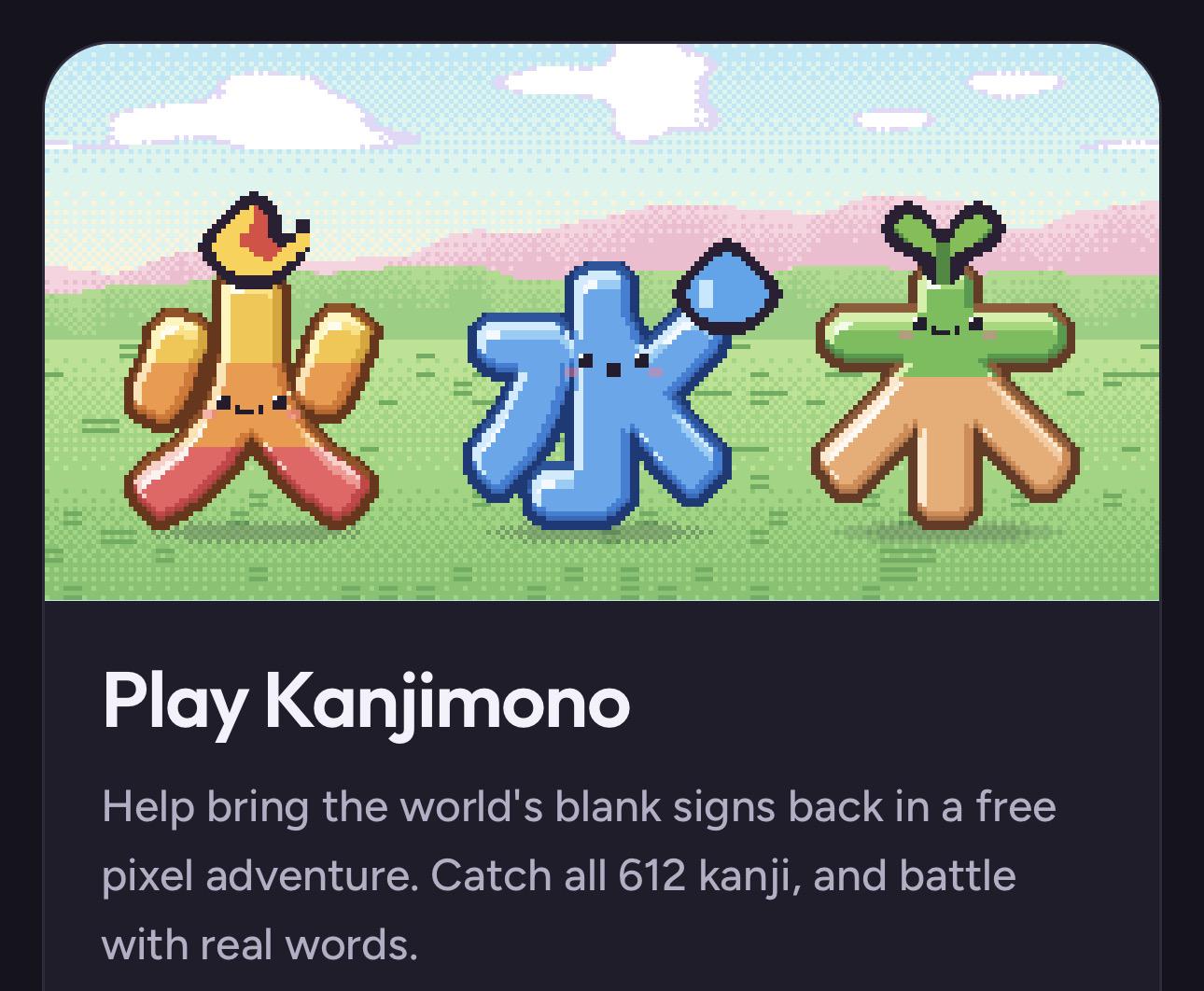
Hi there! I built a kanji learning game for my daughter to encourage her to learn Kanji and would like to share it here :) The idea is you can catch Kanji by guessing their meaning and collect them as you understand them. It’s free and it starts pretty easy and kids friendly and it covers N5 to N3 JLPT kanji, let me know your feedback!

https://www.sonnakanji.com/kanjimono/


r/LearnJapaneseNovice • • 1d ago

Grammar took recommendations

0 Upvotes

Hi,

Learning Japanese is going well. The hardest part I'm finding when trying to under basic sentences is the grammar. Is there any good books or video serious out there to better understand all the uses of particles, etc.

I've start Tae Kim's complete guide to Japanese. Was thinking of just doing the Grammar one but I'm quite new so thought that might be too much for me at the moment

Thanks in advance


r/LearnJapaneseNovice • • 1d ago

Currency reading CNY

Thumbnail reddit.com
1 Upvotes

r/LearnJapaneseNovice • • 1d ago

When should I start immersion?

3 Upvotes

I've been studying Japanese for about 8-9 weeks (not long I know), and was wondering when I should start immersion? I already watch anime, but I want to play (listen/read) visual novels as well, since I heard that is amazing for practice, and the most fun.


r/LearnJapaneseNovice • • 1d ago

Best alternative to Duolingo?

8 Upvotes

I quit when they fired a lot of their staff and switched to AI. I do some self study with books, but I really need the guided structure of an app. Recommendations please?


r/LearnJapaneseNovice • • 1d ago

Learn Japanese Online! Beginner - Advanced Courses begin week of 11/30!

Thumbnail gallery
1 Upvotes

r/LearnJapaneseNovice • • 1d ago

10 days until N5!

1 Upvotes

Answer in the comments!


r/LearnJapaneseNovice • • 1d ago

how to learn grammar

0 Upvotes

i know a couple hundred words through kaishi 1.5k anki deck but ive been struggling to learn the grammar at all, i tried reading yakubi but none of it stuck in the slightest, and the yt vids ive watched are quite hard to imagine myself sitting through for 10s of hours, thanks for any advice


r/LearnJapaneseNovice • • 2d ago

How I got back on track with Japanese learning after wasting 4 years on Duolingo

157 Upvotes

I paid for Duolingo for 4 years and got kana and some vocab out of it. I didnt realize how bad my Japanese was until I went to Japan and couldnt even ask the guy at the konbini to warm up my meal. Four years and I couldnt get my lunch heated up. I felt a little betrayed by that damn owl.

A lot of people get into Japanese through anime. Im an ebook person. I wanted to read light novels and manga, so of course I brought a whole suitcase of books home from Japan.

I figured I’d start with kids books and work my way up. Turns out kids books sneak in plenty of grammar way past my abysmal level. I knew some words from Duo but still couldnt figure out what the sentence meant. And buying more kids books got expensive fast, especially when I was bored two pages in.

So I went through a ton of graded readers online. Thats what got the spark back. I started making it through actual sentences and wanting to read the next one.

These last 6 months have made a bigger difference than I expected. My Japanese is still terrible. Its just a whole lot less terrible now, and these are the resources that helped.

For the basics, I’d use a free kana quiz, Yokubi for grammar and Anki with Kaishi 1.5k for vocab. Learn kanji in actual words, then go read something before flashcards become a second job. Kana quiz · Yokubi · Anki · Kaishi 1.5k

ReadNihongo has actual graded stories from Pre-N5 through N3 and most of the reading is free. Tap a word right in the story to see what it means and how to read it, then save it for review. Theres furigana, English translations and guided lessons too. If youre still sounding out kana, start with Pre-N5. ReadNihongo · Pre-N5 stories

Tadoku has free illustrated readers. Start at Level 0 and let the pictures help. Hirogaru and NHK Easy News have short articles when you want something besides stories. Tadoku · Hirogaru · NHK Easy News

When youre ready for longer stuff, Kakuyomu has free web novels and BookWalker has free manga and light novel samples. Yomitan makes it easier to look up words on the web as you go. Kakuyomu · BookWalker · Yomitan

Read a sentence, look up what you need, keep going. If youre looking up nine words in a ten word sentence, drop a level. The book will still be there. Mine are. I brought a whole damn suitcase.


r/LearnJapaneseNovice • • 1d ago

Learn Japanese by watching Japanese TV shows on Lingopie!

0 Upvotes

Hi, fellow Japanese learners! We're Lingopie. We teach languages through TV shows and films, and Japanese is one of 17 we support!

It's an amazing place to start for a begginer! What you get:

Dual subtitles — Japanese and English at the same time.
Click any word for an instant translation, no pausing. It saves to your vocab list.
Flashcards and quizzes built from the words you clicked.
Grammar Index colour-codes parts of speech, so you can see the suffixes doing their work.
Explain Sentence breaks down any line's grammar on one click.
Playback speed from 0.65x to full, plus auto-pause after each subtitle.
Say It! scores your pronunciation.
Browser extension brings all of it to Crunchyroll, Netflix, and Disney+.

Seven-day trial, full catalogue open during it. Click here!

Be sure to ask us anything in the comments below!


r/LearnJapaneseNovice • • 2d ago

Why does お腹が減る mean "to be hungry"? What's the logic behind 減る?

Post image
16 Upvotes

I've been watching a Japanese immersion video and came across this expression:

お腹が減ってるんでね。

I understand that this means something like "I'm hungry" or "because I'm hungry." But what's the underlying logic or metaphor behind using 減る to express hunger?

Like I know that 減る(へる)generally means to decrease, diminish, or become less. So when I see お腹が減る, my instinct is to interpret it literally as "the stomach is decreasing."

I understand お腹が空く(おなかがすく)a little more intuitively, since 空く conveys the idea of something becoming empty.

Is any meaningful difference in nuance between お腹が減る and お腹が空く in everyday conversation.


r/LearnJapaneseNovice • • 2d ago

How do you guys read?

1 Upvotes

Let me rephrase.

When you read articles, do you just scan the words and hope to get the gist? Are you taking notes on the side? Are you reading it out loud?

What are reading strategies that have been working for you so far?


r/LearnJapaneseNovice • • 2d ago

What are the best apps for getting better at speaking Japanese?

7 Upvotes

I’ve been learning Japanese on my own for about a year and I’ve learned around 1,400 words so far. I want to put more time into speaking and pronunciation. I do some shadowing every day and read aloud, and at this point half my apartment is covered in sticky notes. I write the Japanese word for an object along with a short description of what it is or what it does, then say it out loud whenever I walk past. It’s helped a lot, although I’d love to be able to talk about my kitchen with someone other than my fridge.

I’ve been digging through Reddit and browsing the web for ideas. I came across an italki article comparing apps for spoken Japanese. Here’s their full list, with the prices they gave:

AppBest forSpeaking practice formatTypical price
italkiImproving spoken Japanese with personalized tutor lessonsLive one-on-one video lessons with a teacherFrom $4 per lesson
Pimsleur JapaneseSpeaking practice on the go30-minute interactive audio lessons with spoken prompts$19.95/month
JapanesePod101Podcast-style lessons with a voice recorderAudio and video lessons with a voice recording toolFree or $25/month for Premium
Rocket JapaneseA structured course with pronunciation scoringInteractive audio lessons plus recordings scored by speech recognition$149.95 one-time
Rosetta Stone JapaneseImmersion lessons with speech recognitionJapanese-only lessons with pronunciation feedback and conversation practice$19.99/month
SpeakAI conversation practiceConversations with an AI tutor that gives feedback on what you say$17.99/month
TeuidaPractising replies in video scenesVideo conversation scenes with speech recognition$14.99/month
HelloTalkLanguage exchange with native Japanese speakersText, voice messages, calls, and group voice roomsFree or $12.99/month for VIP

What do you think of the list? It’s italki’s article, so seeing themselves at the top wasn’t exactly a surprise. I haven’t tried italki yet. If you’ve taken lessons there, was the pronunciation feedback worth paying for? I’d also love to hear from anyone who’s used the other apps. Which one helped you say something off the cuff the next time you had a conversation in Japanese?


r/LearnJapaneseNovice • • 2d ago

I need a study mate

3 Upvotes

Hey, I'm Milagros living in Argentina. I recently started learning Japanese, and I'm looking for a partner who needs English or Spanish. Also I'm attorney so we can talk about different topics


r/LearnJapaneseNovice • • 2d ago

KOTOBA - Free vocabulary japanese gamified app

1 Upvotes

[Dont run away your wallet is safe!]
Hi I'm Sarah, Ive been studying japanese for a while now by myself. I used many apps but things get expensive fast, and its rare to see new content. I wanted more, various and new vocabulary. I mean, I couldn't find a vocabulary list about insects names or video games lingo..just an exemple of course.
But i really wanted to dig in and learn much more vocabulary than whats usually served. Thats why with my husband we decided to create an app/game. This is a vocabulary gamified learning app called Kotoba where you can both practice and progress further in the game by testing your skills at exams.
Im the artist and he ́s the dev. At first it was just for me (he made lot of stuff just for me) but i realized many would enjoy it too. Its easier to learn new vocabulary this way. I will add more and more categories with time.
You can see a trailer of what it will be even if some things might change. You can also tell us what you'd like to see in it (category-wise). You get to learn kana and kanji too.
Its available in english/french/italian/german/spanish. The app is totally FREE and UNLIMITED no need to subscribe monthly or any bs. BUT there will be ads , not during practices (we're not that evil) It should be coming in a month but we ll keep you updated in our Discord (join channel kotoba). We really hope you will enjoy it as much as we do! https://discord.gg/nQ4RWg6aNB

PS : Only on Android (for the moment)


r/LearnJapaneseNovice • • 3d ago

How do I best learn Japanese?

6 Upvotes

Hello, I am planning a trip to Japan for early 2028. I have decided that for this trip I would be trying to become at least somewhat conversational with japanese. The problem is, I don't really know how to start and don't have much of a budget to learn. On top of those issues, I have Autism, Adhd, Dyslexia, and whenever I try to read something for more than 30 minutes I get a splitting headache. I know a couple words and phrases I've picked up randomly but that's really it. I will greatly appreciate any advice or assistance. If you have other tips for Japan trips those are also welcome.


r/LearnJapaneseNovice • • 3d ago

[JLPT N5 Grammar] さしみは 好きですか。いいえ、あまり ____ 。— how to say "not really"

Post image
23 Upvotes

On Monday: how to invite someone politely. Today: how to say "not really" politely — about food, the question every visitor to Japan hears.

A:さしみは 好きですか。

B:いいえ、あまり ____ 。

1 — 好きです

2 — 好きじゃ ありません

3 — きらいです

4 — 好きでした

1 — 好きです ✗ This is the one English speakers build. あまり feels like "not very," so the sentence already sounds negative. But あまり only works with a negative ending.

2 — 好きじゃ ありません ✓ This is the answer. あまり + negative = "not very much." Polite, soft, and very natural.

3 — きらいです ✗ あまり cannot go with きらいです. And even without あまり, saying きらいです about food feels strong in Japanese — especially to the person who asked.

4 — 好きでした ✗ Past, and not negative. It does not answer the question.

Rule to keep:

とても + positive: とても 好きです。 — I like it a lot.

あまり + negative: あまり 好きじゃ ありません。 — I don't like it very much.

Why this stays hard: In English, "not" comes early. In Japanese, the negative waits at the very end of the sentence — so after あまり, you have to remember to finish with a negative.

And about culture: Japanese people rarely say きらいです about food to someone's face. あまり 好きじゃ ありません says no, kindly.

Your turn: someone asks you なっとうは 好きですか。 and you don't really like it. How do you answer politely? Write it below and I'll check it.

A free 10-question N5 set, built the same way as this post, is linked in my comment below.