r/Quenya • u/holalla65 • 17h ago
Quenya in Rings of Power
1
Upvotes
Do we have a full transcript for season 3?
r/Quenya • u/Nyarnamaitar • 29d ago
r/Quenya • u/Roandil • Aug 24 '20
Aiya’r maitúlië! Elen síla lúmenn’ omentielvo.
Hello and welcome! A star shines on the hour of our meeting.
Welcome to the Quenya subreddit! Here you can request translations, post your own for expert review, and ask any questions you may have about Tolkien’s High Elvish language. Please take some time to read through the following FAQ (written by Elaran and graciously shared from the Sindarin subreddit) and explore the sidebar widgets for resources and other links of interest.
What is Elvish?
In the context of Tolkien’s works, the term “Elvish” usually refers to the two main Elvish languages of Middle-earth, Quenya and Sindarin. Less-developed varieties such as Nandorin may also be included. In a broader sense, it would encompass the internal (archaic forms) and external (earlier drafts) ancestors of the languages as well.
What is Quenya?
Ai! laurië lantar lassi súrinen, yéni únótimë ve rámar aldaron!
Quenya is the language of the Elves of the Blessed Realm, and it was brought to Middle-earth by the exiled Ñoldor. After its ban in the First Age, Quenya became a language of lore that was used for solemn ceremonies and spoken by few. It has the greatest amount of published linguistic material of all Tolkienian languages, despite the fact that the books present Sindarin as the common speech of the Elves and educated Men.
What is Sindarin?
A Elbereth Gilthoniel, silivren penna míriel o menel aglar elenath!
Sindarin is the language of the Elves of Beleriand, whose speech was greatly affected by the changefulness of Middle-earth while its ancestor Telerin mostly endured in the Blessed Realm. After its adoption by the Ñoldorin Elves and the Edain, it became the most spoken language in Middle-earth. However, Sindarin is only the second most developed Tolkienian language following Quenya.
What is Tengwar?
Commonly known as the “Elvish alphabet,” Tengwar is one of the writing systems that Tolkien developed alongside his languages. It has three main (and numerous other) “modes” in which Quenya and Sindarin can be written: the Classical Mode (for Quenya), the Mode of Beleriand (for Sindarin), and the General Mode (for both). The modes determine the sounds the letters represent (not the vowel order); the tengwa (Quenya for “letter” ) named ampa is the Classical Mode’s [mp] but the General Mode’s [v]. Many other languages, including English, can be written with the General Mode. In fact, most Tengwar writings on the internet are in English.
What is Neo-Elvish?
Neo-Elvish refers to the utilisation and further development of Elvish languages by the enthusiasts of Tolkien’s linguistic works. Most often the term applies to neologisms, whose validity varies from one enthusiast’s opinion to another. But even phrases that strictly adhere to the attested vocabulary and grammar are considered Neo-Elvish, simply because there is no way of knowing with certainty whether Tolkien would have used the same or created new elements. And so any use of Elvish, besides quoting Tolkien directly, would be Neo-Elvish.
What are Qenya and Noldorin?
Qenya and Noldorin refer to the earlier versions of Quenya and Sindarin respectively. It must be emphasised that Noldorin (alongside its own draft Goldogrin, a.k.a. Gnomish) was Sindarin’s draft and is not a dialect of Quenya. Since the Legendarium and its languages were developed over the course of about 60 years, most of Tolkien’s earliest ideas were changed in time, but some lingered. Thus the drafts provide an opportunity for additions to the vocabularies of Quenya and Sindarin by analysing the remnants and applying their logic to the analogous draft words.
Is it possible to speak Elvish fluently?
Both Quenya and Sindarin are in essence incomplete. So much so that even neologisms are rarely enough for a full conversation, and it is naturally difficult to think carefully on how to paraphrase and/or to create new and proper words on the fly. Consequently, until more of Tolkien’s notes and essays are published, and more neologisms are formed and accepted by the linguistic communities, fluency would remain unachievable. As for fluency in writing, some advanced enthusiasts are capable of typing almost as quickly as they would type in their native languages.
Where can I study Elvish?
Interest in Tolkienian linguistics mostly faded after the early 2000s. In the meantime, some of Tolkien’s most informative notes and essays (not lessons) on his languages were published. As a consequence of both, most of what one can find on the internet is now outdated; Tolkien’s later works either debunked our theories or replaced his own older works. There are currently a few courses which employ these new findings in their lessons, but they are yet to reach their final stage. Thus we recommend practising often in the group (linked in the sidebar/"About" tab on mobile), regardless of which source you use for your studies, so that our experts can make corrections on what they offer.
Can you translate for me?
Tolkien’s works have one of the largest fandoms out there, but few fans dive deeply into his linguistic works. And so most of our advanced members are constantly bombarded with questions or translation requests. This can naturally become a nuisance after a while, especially when the requests concern a single Elvish word that can be found in multiple dictionaries. So even though we are happy to help, we would rather avoid such redundant questions.
Can you check if my translation is correct?
Certainly! Unless you do not actually study Elvish but simply wish to translate a quote for a tattoo. Neither Quenya nor Sindarin are easy enough for coming up with a proper translation in your first attempt, to the point that you need not bother if you are not trying to learn. If you only need a translation, simply ask for it (without abusing our willingness to help), otherwise we tend to overexplain things which serves neither you nor us.
r/Quenya • u/holalla65 • 17h ago
Do we have a full transcript for season 3?
r/Quenya • u/ElectricalPoint5334 • 2d ago

Hello! I've received feedback on my Quenya translation, and I would now like to verify the Tengwar transcription before getting it tattooed.
The phrase is “I cala termarë mi ni,” meaning “The light endures within me.”
I used Tecendil with Quenya mode and the Artano font. Is this transcription correct?
Thank you so much for your help! ❤️
r/Quenya • u/D4ni3lkur3r • 2d ago
Quenya translation request for a handcrafted wizard's staff
I am handcrafting a wooden wizard's staff and would like to permanently relief-carve the following original inscription in Quenya, using Tengwar:
Let go of what was.
Let be what is.
Imagine what may become.
The three lines represent acceptance of the past, embracing the present, and imagining the possibilities of the future.
I would particularly love to incorporate the word Ëa, if linguistically appropriate, because of its connection to existence and creation.
Could someone kindly provide a translation that is as faithful as possible to Tolkien's language, distinguishing documented vocabulary from reconstructed words or grammar?
Thank you for sharing your time and knowledge.
r/Quenya • u/Future-Community-150 • 2d ago
That should Mean:
Inside each of us, two wolves are constantly at war. One is good, the other is evil. The one we feed wins.
r/Quenya • u/ElectricalPoint5334 • 2d ago
Hello! I'm a Tolkien fan, and I'm planning to incorporate a Quenya inscription into my phoenix tattoo.
The intended meaning is “The light remains within me” (La luz permanece en mí).
My proposed translation is:
I cala termarë mi ni.
Could someone please verify the vocabulary and grammar, and let me know if there is a more accurate or natural translation?
I would really appreciate your help. Thank you! ❤️
r/Quenya • u/Future-Community-150 • 3d ago
r/Quenya • u/Square_Peace_8788 • 3d ago
Hello everyone!
My partner and I are planning to engrave a short phrase on our wedding rings, and we would love to have it written in Tolkien's Quenya. The phrase we want to express in Polish is:
"Jesteś moim Skarbem"
("You are my treasure" / "You are my precious treasure")
Our current tentative translation is:
nátyë harmanya
However, we want to make sure this is linguistically correct before engraving it permanently. This inscription means a lot to us, and we want to get it right. Thank you so much!
r/Quenya • u/Educational-Scar7596 • 4d ago
Hi everyone! ♡ I'm Danielle, 24, and I really want to learn Quenya, but I struggle a lot with studying on my own. Because of that, I'm looking for someone who might be willing to act as an actual teacher/mentor (informally/for free)—someone to assign me lessons, give me little homework tasks, check my progress, and keep me accountable so I stay on track.
I'm starting completely from scratch, though I'm super eager to learn and dedicate time to it in my free hours. If anyone here has the patience, time, and enjoys teaching, I'd be so happy and grateful. Thanks so much! ✨
r/Quenya • u/sethyboy96 • 7d ago
Hi all,
I'm looking for Parma Eldalamberon issues 1 to 7, ideally as digital PDF copies. These early issues are hard to find, and I'd love to complete my reference set. I have 8-22 at the moment.
If you have any of 6-7 and are open to a swap or a conversation, please send me a DM.
Thanks very much!
r/Quenya • u/An_n_m__5 • 9d ago
I am so confused. In the LOTR appendix it says that the letter i is always pronounced like the i in machine, which means a name like fingolfin should be pronounced: feen-GOL-feen, but in the Lay of Leithan, he rhymes the name with a word that uses the short i as in shin. If this were to work, the pronunciation would be more like the English word fin, but that doesn’t track with the pronunciation in the appendix. I’m so confused. Please help
r/Quenya • u/Daeslon • 10d ago
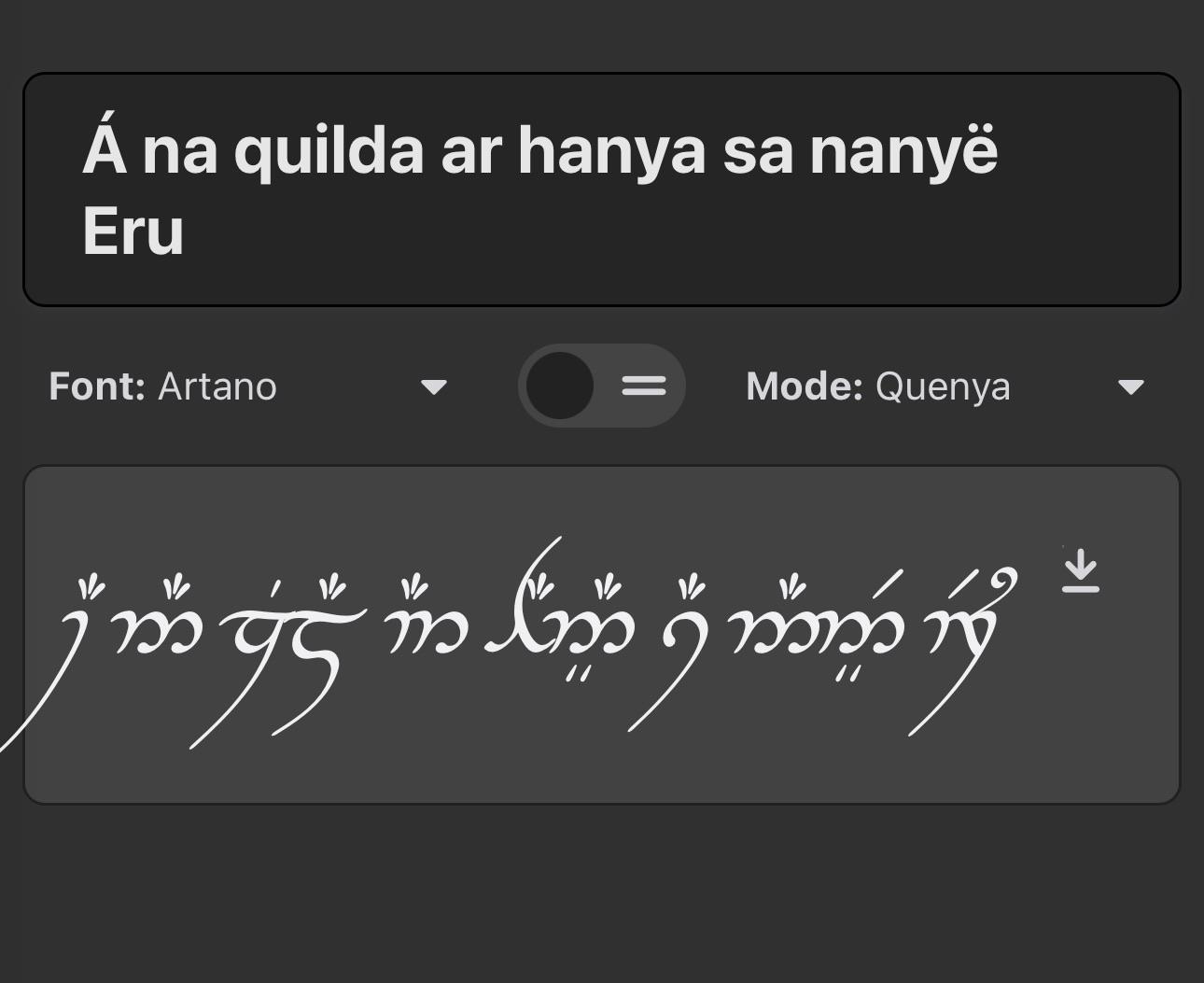
Hey guys. So I’ve been wanting to paint a bible verse in quenya on a wall in my house and went with Psalm 46:10 “Be still and know(understand) that I am God” is this translation good enough?
r/Quenya • u/External_Article3180 • 10d ago
Ahoy - so i have a quote i want translated into Quenya if anyone can help please.
"In Winter here no heard could mourn for summer or for spring"
r/Quenya • u/Dry-Profession-8146 • 11d ago

Planning to get “you have all of my love” on a wedding ring but nervous this might not be the right translation. Can anyone validate this for me?
r/Quenya • u/Mathilda24290 • 15d ago
Bonjour je souhaiterais traduire la devise suivante en Quenya:
" Gardiens de ce qui fût, Libres de ce qui sera".
J'aimerais une traduction avec des mots confirmés si possible, quite à modifier légèrement les mots, tant que le sens reste le même. Précision, la devise a pour objectif d'exprimer l'observation/conservation du passé et de l'histoire, et le respect du Destin (sans le modifier)
J'espère être clair.
Merci par avance
r/Quenya • u/Albertokings • 16d ago
Me gustaría tatuarme la frase “La vida es una cadena”. Creo que es Coivië ná limil. ¿Es correcto?
Gracias de antemano.
r/Quenya • u/Velanire • 17d ago
''To Jupiter's moons and back."
Thank you.
r/Quenya • u/TheThousandMinds • 17d ago
I've gotten really into making pins for my friends recently, and I thought it'd be fun to make some in Elvish for my friends who like LotR
I thought it'd be funny to make a pin that says "I can't speak Elvish" in Elvish/Quenya/Sindarin (I don't know the difference). Could someone please help me with the translation? I tried to work it out myself but I just confused myself lol
r/Quenya • u/Camdogga • 18d ago
text being translated: more today than yesterday.
The outputs across a variety of sources:
OR.... is there an even better alternate to any of these?
TYSM
r/Quenya • u/ahangryhoe • 19d ago
My fiancée loved her engagement band with a unique Quenya engraving so much that she asked for our Wedding Bands to have their own engravings as well! Any help that you can give would be immensely appreciated!! Thank you very much.
For hers looking to translate, "Led by Grace..."
For mine looking to translate, "...Bound by Light."
r/Quenya • u/Ahmosis_Belserion • 20d ago
Hello everyone!
I’m currently working on a custom piece of Elven-inspired jewelry, and I’d love some help ensuring that its name and poetic designation are as linguistically faithful to Tolkien’s Quenya as possible.
For context, I’ve chosen Silmarion as my personal Quenya-inspired name, with the intended poetic interpretation of “One in whom the light of the stars dwells.” I understand that this is a personal interpretation rather than an attested or literal Quenya translation.
The piece is a ring featuring a white Australian opal with multicolored flashes. The opal symbolizes the starlight that dwells within Silmarion, making the ring a tangible expression of the meaning behind my Elven name.
I’m considering giving the ring a proper name and a longer poetic designation:
I’m particularly interested in Tolkien’s later Quenya, though I’d be happy to learn about relevant differences between earlier and later linguistic conceptions.
I’m also open to alternative names that preserve the themes of starlight, precious gems, and the manifestation of an inner light.
I would like to have it sorted out and clear before taking the project to my gem supplier and jeweller.
Thank you very much for your help!
r/Quenya • u/syncra_rar • 21d ago
Hello!
I’m designing a large Tolkien-inspired back tattoo and would like to commission or request a careful linguistic review of four philosophical phrases.
The intended languages are:
Quenya: “I embody instinct and consciousness simultaneously.”
Classical Black Speech: “I am contradiction transformed into wholeness.”
Sindarin: “My essence belongs to me.”
Classical Black Speech: “From chaos, form arises.”
I am looking for the closest linguistically defensible translations, not merely English transliterations into Tengwar.
Could you please:
Translate or reconstruct the phrases as accurately as possible.
Explain which words or grammatical structures are attested and which are reconstructed.
Suggest alternatives if the original wording cannot be expressed faithfully.
Verify the appropriate Tengwar transcription and writing mode for each phrase.
This is intended for a permanent tattoo, so linguistic accuracy is much more important to me than a quick or purely aesthetic result.
I understand that some of these concepts may not have direct canonical equivalents, especially in Classical Black Speech.
Thank you!
r/Quenya • u/Ahmosis_Belserion • 25d ago
Hello everyone!
I’m working on a personal jewellery project called Titania, an Elven-inspired.
Its central jewel (a diamond) is meant to evoke the ancient silver light of Telperion, while the surrounding diamonds represent the stars of Varda (Elentári).
As part of its fictional lore, I’ve imagined a short invocation, spoken only once by its bearer to “awaken the ring” and establish a bond with it. It might be engraved inside the ring.
I’d love some help translating it into grammatically sound, natural-sounding Neo-Quenya.
Original English:
“O light of Telperion of old, beneath the stars of Elentári, awaken, and let thy light be one with mine.”
My current Neo-Quenya draft:
“A yára cala Telperiono, nu i eleni Elentário, á cuita, ar nai calalya ar calanya nauvar er cala.”
Intended meaning:
“O ancient light of Telperion, beneath the stars of Elentári, awaken, and may your light and mine become one.”
There are several constructions I’m particularly uncertain about:
• A yára cala Telperiono: Is this a natural way to address the ancient light of Telperion? Would a different word order or construction better convey “the light of Telperion of old”?
• Nu i eleni Elentário: Is the genitive Elentário appropriate here, and does the phrase naturally mean “beneath the stars of Elentári”?
• Á cuita: I found the reconstructed verb cuita- (“to waken, rouse; to live”) on Eldamo, with á cuita listed as an automatically generated imperative. Would it work intransitively as “awaken!”, or would another verb or a reflexive construction be preferable?
• Ar nai calalya ar calanya nauvar er cala: This is the part I’m most uncertain about. I’m trying to express “and let thy light be one with mine”, implying a voluntary union of two lights rather than one dominating or absorbing the other.
I’ve revised my initial construction to include nauvar, a reconstructed plural future form of the verb “to be”.
My intended grammatical breakdown is:
• Nai — “may”, introducing a wish.
• Calalya — “thy light”.
• Ar calanya — “and my light”.
• Nauvar — “will be”, plural future.
• Er cala — “one single light”.
The intended meaning is approximately: “And may thy light and mine become one light.”
However, I’m unsure whether nai can naturally be combined with nauvar in this context, whether the future tense is appropriate, and whether er cala is an idiomatic way to express the union of two lights.
Would a different verbal construction or a more natural Neo-Quenya phrasing better convey this meaning?
I’m happy to adjust the English wording slightly if it allows for a more natural and elegant Quenya translation, provided the central imagery and meaning remain intact.
My priority is linguistic accuracy and a poetic, solemn tone, rather than simply making something sound Elvish. I understand that a complete translation may require Neo-Quenya reconstructions.
Any corrections, alternative phrasings, or references to Tolkien’s attested vocabulary and grammar would be greatly appreciated.
Thank you in advance!