r/RTLSDR • u/zsellera • 1h ago
Repurpose a ~$10 LTE modem as an SDR receiver (OpenStick)

5
Upvotes
r/RTLSDR • u/ihar_bild • 21h ago

TL;DR — Free (GPL-2.0) Windows scanner that turns an RTL-SDR Blog V4 into a frequency-coordination tool for wireless mics and in-ears. It scans 25–1766 MHz, removes the dongle's own spurs, and exports a calibrated scan as .sdb2/.sdb3/CSV for Shure Wireless Workbench or CSV for Sennheiser WSM. One point per 25 kHz (the WWB grid), gaps stay gaps. 470–800 MHz in ~35 s.
Every show at the rental company I work with starts the same way: find the holes for 20–40 channels of wireless, then get that into Wireless Workbench before anyone starts assigning frequencies. The dongle nails the first and is useless at the second, so I forked nocarryr's rtlsdr-wwb-scanner, put a V4 on my desk, and spent a few weeks making the two get along.
Wireless Workbench (WWB) is Shure's frequency-planning app for racks of wireless; Sennheiser WSM is the Sennheiser equivalent. Both are pro-audio tools, not SDR software — which is why the output is a file, not a picture. Aim the scan at 470–700 MHz and WWB opens it directly, no more holding a phone up to the screen and typing frequencies by hand.
~78 ms per 2.4 MHz tile: 470–800 MHz in ~35 s, 31–1766 MHz in ~2.5 min. Band presets for most Shure and Sennheiser systems, plus PMSE rules for 27 EU countries and the UK, Norway, Switzerland, Ukraine and a few neighbours — planning help, not a legal document.
wwb_scanner.exe --selftest checks the window, QML, dongle library and data folder without scanning.data folder next to the exe, so a USB stick carries them between PCs.python drivers\rtlsdr-scanner-v8\install_dll.py for the dongle library. Published numbers used PySide6 6.12.0 and numpy 2.5.4.Receiver, and the RTL-SDR is one implementation.Free, GPL-2.0, nothing for sale, not affiliated with Shure or Sennheiser — I'm the maintainer. Two questions: what wireless rig are you running (Shure, Sennheiser, something else)? And the one thing I can't test from one desk in Warsaw — if you open a scan in WWB 7.9 or WSM 4.9 and the import looks off, that report is genuinely worth gold to me. Bugs and logs on GitHub are best, but comments here are welcome too.
r/RTLSDR • u/KyleGarcia12 • 15h ago
I was just messing around when I picked up a signal in the 24MHz range that seemed to have four carriers. At first, it was silent, but then someone walked into my office and I could hear them chatting away. It looked like the signal was coming from my other laptop, not the one connected to my SDR, and it was pretty weak. I had my cheap antenna, the standard one that comes with the dongle, stuck to a metal stapler right next to the HP laptop. Check out this picture.
I noticed that both built-in mics were transmitting separately; in the photo, I rubbed one of the mics to show how the signal mirrored.
When I tapped on the mic or made a loud sound that caused clipping, the signal would drift away but then gradually return to its original frequency. You can see it here, only one mic shifted, but if I hit it harder or clipped both, they both drifted.
I have a hunch that if I built a good high-gain antenna tailored for 24MHz, I could pick up the audio from a good distance away. The laptop in question is an EliteBook 8460p, and I checked some similar models, but they don’t transmit at this frequency. I couldn’t scan the whole spectrum since I was short on time.
I suspect the preamp is pretty low quality and is unintentionally sending out FM signals at HF frequencies.
Does anyone have thoughts on this? I work in a highly secure environment, and the idea of laptops broadcasting audio from offices or meeting rooms is a serious concern. I doubt it’s an intentional listening device because of the strange frequency drifting. For now, I think I’ll just disconnect the mic preamp PCB.
r/RTLSDR • u/notchapplezMC • 16h ago
So I recently thought of extending the capabilities of my existing RTL-SDR a bit, and I found this PlutoSDR clone from opensourcesdrlab. Is there anything I should note or know before buying it? It comes with a small whip, and I also have the dipole from the rtl-sdr v3 kit.
r/RTLSDR • u/ExplorerNo6392 • 14h ago
Can anyone show me the new version of SDR trunk ? Like phots i would like to know what it looks like compared to the standard version.
Can someone please show me what there system look like i am not looking for unpleasant comments
r/RTLSDR • u/theoddsock • 1d ago
Inspired by the recent ESP-SDR work on the ESP32, I wanted to see if the Raspberry Pi 5's onboard Broadcom (BCM43455c0) Wi-Fi chip could be turned into an experimental, receive-only software-defined radio, with zero external SDR hardware attached.
(AI disclaimer, my personal reverse engineering knowledge is limited, so Sol and Gemini were heavily used to achieve this!)
It turns out the BCM43455c0 has an internal diagnostic collector (sample_collect) meant for recording short one-shot baseband captures into shared chip RAM before Wi-Fi frame decoding happens. By reverse-engineering the firmware and driver paths, I got two different I/Q capture modes working:
- 1 - Continuous I/Q Streaming (Patched Firmware + Modified brcmfmac SDIO Driver)
Normally, sample_collect stops as soon as one buffer fills. By patching the firmware to use a weighted 6-input selection operation and modifying the Linux 'brcmfmac' driver to drain ring buffers continuously over SDIO to debugfs while collection keeps running, the chip streams framed 1,024-sample IQFR blocks to user space.
2.4 GHz continuous stream: 833.33 kSPS on 2,412 MHz, verified across a 1-hour continuous run with contiguous sequence numbers and verified 32-bit FNV payload checksums.
5 GHz continuous stream: 769.23 kSPS on 5,200 MHz (10.904 s / 8,192 consecutive frames).
- 2 - High-Rate 20 MSPS & 80 MSPS Snapshots (Stock Linux Driver)
Using the stock Linux brcmfmac driver with manufacturing-test firmware, the collector records a single 16,000-sample complex I/Q buffer (800 µs at 20 MSPS or 200 µs at 80 MSPS, signed 16-bit I/Q pairs) before halting for readout.
- 3 - Out-of-Band PLL Synthesizer Sweeps (2.22–3.00 GHz & 4.75–6.47 GHz)
By overriding the BCM20691 RF synthesizer lookup tables in RAM during 20 MSPS snapshots, I tested whether the local oscillator could lock outside standard Wi-Fi channels against an external MAX2871 signal generator (+1 MHz differential LO step test):
Low band: 6 tested LO pairs tracked the test tone (2,220 to 3,001 MHz).
High band: 7 tested LO pairs tracked the test tone (4,748 to 6,474 MHz, reaching into the 6 GHz Wi-Fi 6E band).
Honest limitations:
It is an experimental, uncalibrated diagnostic path, not a replacement for a dedicated wideband SDR.
While in continuous capture mode, normal wlan0 Wi-Fi traffic is suspended (use Ethernet or local console, and reload the stock module when finished).
The continuous stream rate is capped by SDIO bus throughput (~833 kSPS on 2.4 GHz / ~769 kSPS on 5 GHz), whereas 20/80 MSPS modes are 16,000-sample (800 µs / 200 µs) burst snapshots.
Links:
GitHub Repo (code, build recipes, offline verification & demos): https://github.com/TheOddSock/pi5-wifi-sdr
Full Technical Report (PDF): https://github.com/TheOddSock/pi5-wifi-sdr/blob/main/pi5-receive-stream.pdf
r/RTLSDR • u/ProSilicium-32768 • 20h ago

r/RTLSDR • u/throwaway007zz • 21h ago
I am on Windows 11 and use a RTL-SDR Blog V4c Stick.
Installed the driver by downloading sdrsharp, executing "install-rtlsdr.bat" and "zadig.exe". Chosing "Bulk-In, Interface (Interface 0).
Now in windows device manager I still see "Bulk-In, Interface" as I saw prior to driver install. Shouldn't it show "Blog V4" in windows device manager?
r/RTLSDR • u/CriminalVegetables • 2d ago
Hi all, im super new to RTL-SDRs. Was exploring through FM radio and found a signal on 96.05 MHz. After listening to it its BBC world from what I can tell. Could this be a pirate radio rebroadcasting BBC world? Any other ideas on what it could be from? Just seems odd to be offset from other FM radio broadcasts
r/RTLSDR • u/LazyRepublic9893 • 1d ago

I have published a new version of the Guglielmo DAB and FM software define radio tuner.
Version 0.8 adds an EPG viewer for those ensembles that support it.
I have appimages for x86 and RPI linuxes, and installers of x86 MacOS and Windows.
Find it at https://github.com/marcogrecopriolo/guglielmo.
Enjoy.
r/RTLSDR • u/Magic_Man_11007 • 2d ago

I am borrowing an rtl-sdr. I have all the pieces for the antenna kit, except for the actual antennae that connect to the pivoting center piece. Does anyone know where I can get just the extendable pieces?
r/RTLSDR • u/BlueBirdTechUA • 2d ago
I've seen people compare signal levels from two different SDRs based on what they see in the waterfall, but I'm not sure how useful that comparison really is.
even with the same signal, different gain settings or AGC can give you very different readings. And the FFT settings can affect what you're actually looking at.
If you're trying to compare received power between two setups, do you calibrate both receivers with a known signal first? Or just stick to relative measurements with fixed settings?
r/RTLSDR • u/Infinite-Ad6663 • 3d ago
r/RTLSDR • u/ScamSchoolBrian • 3d ago
Following up on colsto's video combining public ADS-B flight logs with faint background airplane Doppler curves to narrow down where an unedited recording was made, we wanted to test what actually breaks the technique for livestreamers broadcasting continuous live audio.
My audio engineer Brandt Hughes and I did a Modern Rogue episode on this, and recorded 30 minutes outdoors with 3 real prop-plane flyovers (fundamentals near ~100 Hz shifting ~20 Hz, with strong harmonics cutting right through speech), then ran our tracks through an early open-source matcher plus 5 acoustic defenses. Right now those early vibe-coded public scripts still throw a ton of false positives on human speech, though another open-source build reportedly landed within ~240m on colsto's reference audio.
The coolest takeaway for the ADS-B / RF side is how much the geolocation solver leans on negative space (silence gaps ruling out busy flight corridors and airports) alongside positive flyover timestamps:
Full 38-minute breakdown with spectrograms and audio A/Bs is here if you want to check out the tests: https://youtu.be/9A8WlXG7SK4
Thanks to the mods for letting us share this here. 73!

Hi everyone!
Over the past months I’ve been building OmniSDR, an open-source desktop SDR receiver written in Python (PySide6 + PyQtGraph + OpenGL + NumPy/SciPy), and today I’m releasing the full source code under the MIT License along with a standalone Windows build (v1.0.0).
Whenever I wanted to monitor HF or VHF/UHF bands—either using a local RTL-SDR dongle over rtl_tcp or hopping across remote KiwiSDR / OpenWebRX / PA3FWM WebSDR receivers—I ended up juggling half a dozen tools at once: browser tabs, Virtual Audio Cables (VAC), external digital mode software, QRZ/HamQTH lookup tabs, a DX cluster window, and separate recording utilities.
OmniSDR brings the entire receiving station workflow into one native, low-latency desktop interface—including a built-in synthetic multi-signal I/Q simulator so you can test every filter and feature immediately even without hardware plugged in.
rtl_tcp (local/LAN RTL-SDR dongles), KiwiSDR, OpenWebRX, PA3FWM WebSDR, Airspy SpyServer, and a built-in Synthetic Multi-Signal I/Q Simulator. Includes a SQLite-backed Global Server Directory with public sync, live TCP ping checks, and favorites.48 kHz sounddevice audio output. Demodulates AM, SAM (Synchronous AM), LSB, USB, CW, NFM, WFM Stereo, and RAW, with draggable passband filter edges, AGC, spectral DNR, Auto-Notch, Noise Blanker, Squelch, IARU band markers, and 1-click WAV Audio / Raw I/Q recording.ONNX Runtime) + Faster-Whisper (CTranslate2) running locally to transcribe and simultaneously translate voice QSOs across 30+ languages (via local Whisper or optional Gemini / OpenAI-compatible / DeepL APIs).SP/LP) and distance over a dark map, alongside live dxfuncluster.com / Telnet spots with one-click VFO tuning.v1.0.0 - OmniSDR.exe): https://github.com/ea2eoe-cmd/OmniSDR/releases/tag/v1.0.0To run from source on Windows, Linux, or macOS (Python 3.11+):
I’d love to hear your feedback, bug reports, or ideas for additional SDR protocols and decoders!
73 de EA2EOE!
r/RTLSDR • u/likessiberianvodka • 3d ago
I saw that Metop-C is passing over and I recorded the samples at 465.9 MHz. Look4Sat app says that its "ARGOS-3 A-DCS (BPSK PMT-A3/--)".
How do I decode this? Is there a satdump pipeline to decode it? I searched online and Gemini suggested me to use OnAir. I tried it but it is playing the cf32 file from the start and I don't understand what's going in OnAir because of information overload in the UI.
If anyone know how to decode this signal, please let me know how to do it.
r/RTLSDR • u/Really_Mid • 3d ago
Hi! I unfortunately don't have much space for an antenna cause my mom would probably want to trow away and I mostly use SDR indoors close to a window.
I plan to solder an "I" dualband dipole to the magnet base of the stock DVB-T dongle's antenna, something like one 50cm leg and on the top an 17cm leg. Just search for "2m, 70cm band dipole" for a better ideia.
Someone can give me some assistance?
r/RTLSDR • u/Slow-Face-1537 • 3d ago

Hi, is anybody using this new app? I've just been trying for days. This looks good for general use and sounds perfect.
r/RTLSDR • u/Prestigious_Yak8551 • 5d ago
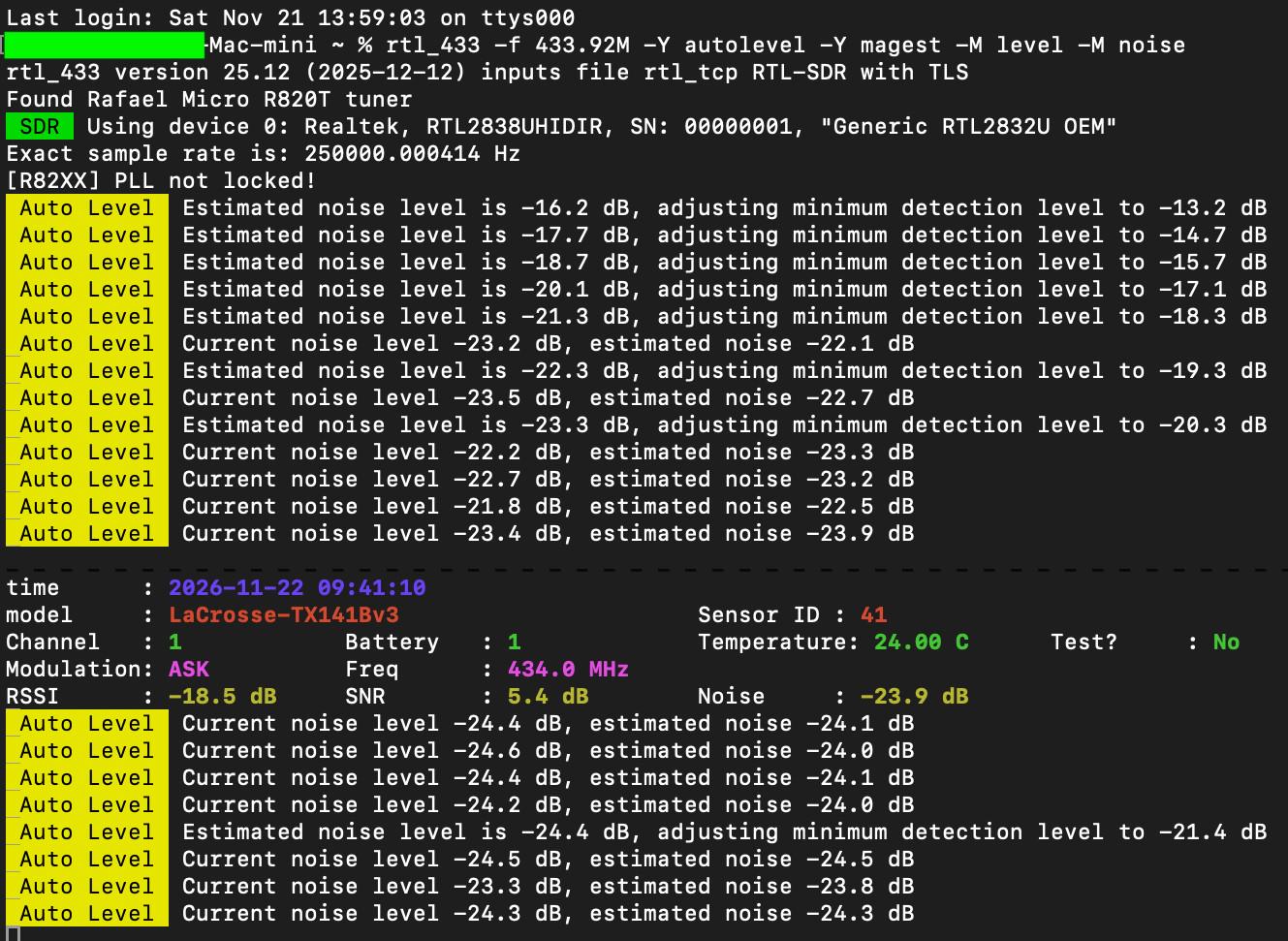
Here is the command line I used on my Mac
rtl_433 -f 433.92M -Y autolevel -Y magest -M level -M noise


