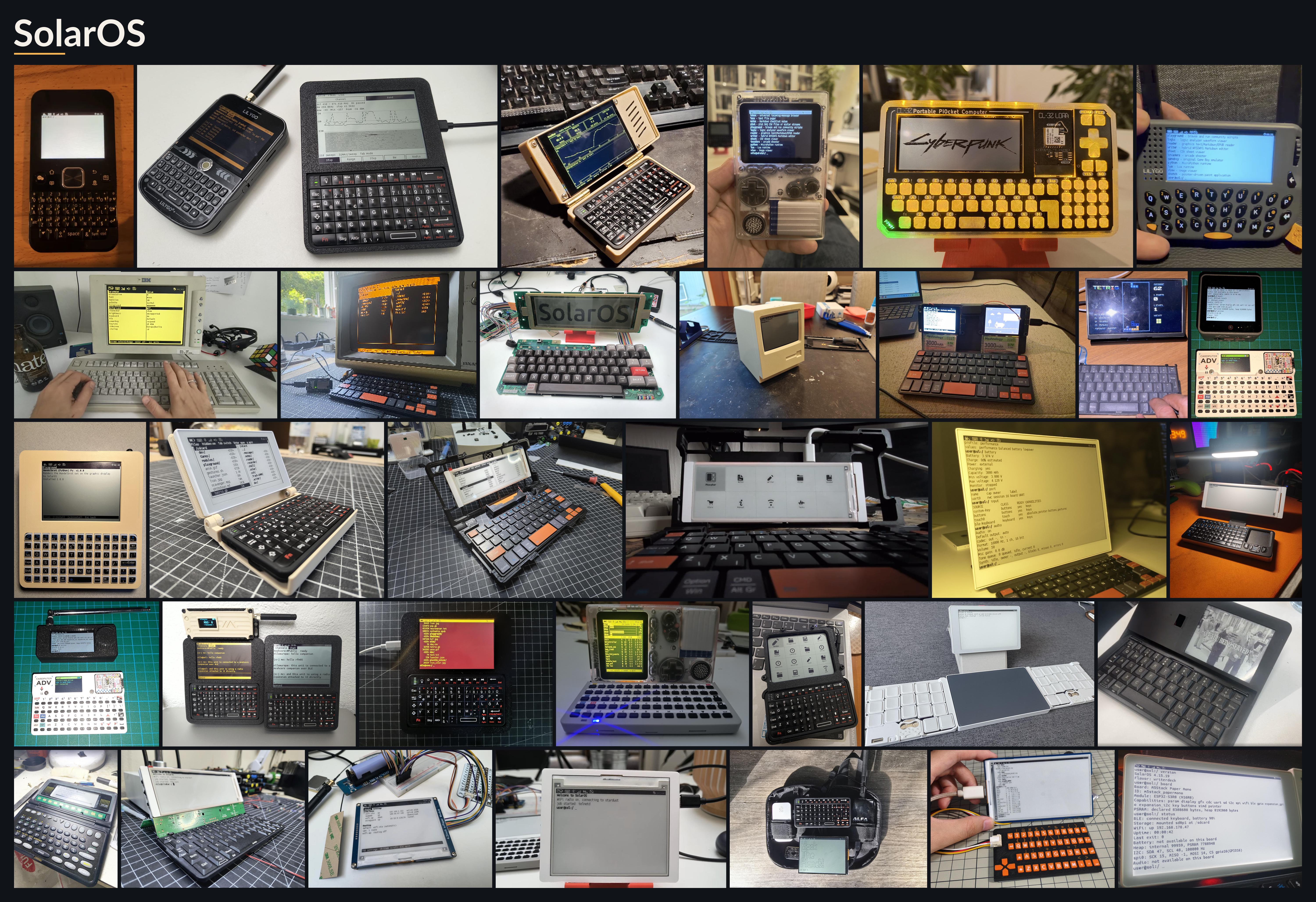
Added pkg update and pkg upgrade for checking and updating installed native modules.
Added ILI9488 SPI display and XPT2046 resistive touch support.
Fixed expansion touch polling and terminal colors on attached displays, with clearer errors for missing display targets.
Added separate monochrome and RGB565 color QEMU profiles with desktop zoom.
Synth now has touch and pointer controls, an on-screen tab selector, and a live oscilloscope.
Files, FTP and SFTP now use Midnight Commander-style filename quick search.
Improved split-display speed, enabled Game Boy in split panes, and fixed keyboard focus switching and focus labels that remained visible after releasing Alt.
mproved Web with an editable address bar, Back, Forward, Reload/Stop and Go controls, touch and pointer navigation, and Ctrl++/Ctrl+- text zoom while editing fields. Web can now open without a URL.
Added compact battery reports, detailed discharge statistics, saved runtime estimates, and charging detection from voltage changes when hardware status is unavailable.
Improved reTerminal E1003 display speed and IT8951 sleep handling; added an optional two-level monochrome mode and reduced display video memory use.
Fixed delayed or broken telnet navigation keys.
Expanded the C SDK headers supplied with installed native libraries, including Robot, Emotion, ESP-DL and Himax.
while we are waiting for the final iteration of the I/O expansion board, I wanted to share the 3D design files for the internals of the Solar Writer in the hopes of inspiring talented designers to come up with the coolest cases.
I have deliberately not fixed the type of the keyboard - as SolarOS supports I2C, PS/2, USB and BLE input devices - however the Doohoeek Dual BLE keyboard ( visible on the photo ) is a pretty good match.
As for the solar panels, I'll be using 2x QUARKZMAN 0.375W 3V (52x52mm) panels connected in series; exact type and use of panels are also optional. ( Input requires to be between 4.2-6V in order to charge. )
Remember the I/O board has a speaker connector that can be also left unconnected, as there is a jack headphone connector too.
Battery can be of any size single cell LiPo. I am currently running my device off of a tiny 400mAh battery; that gives me around 5 hours of active runtime without solar charging.
My dream enclosure would contain the speaker and be a slim double-clam-shell with flip out solar panels (Z); that contains a larger ~1000mAh battery under the keyboard to distribute weight; 🦄
I just bought a ELECROW ESP32 E-Ink Display 5.79 and successfully flashed SolarOS to it but got stuck after that. Tried to use Arduino IDE and Puffy as serial monitor to type commands to it but it has not worked.
I have no previous experience with similar devices.
Is there a good video tutorial on how to install it?
My next step would be to connect the elecrow to a keyboard.
Added headless and display QEMU targets for running SolarOS on a computer, with a serial console, shared host-directory storage, and audio playback. The display target adds keyboard, touch and mouse input, and networking. ( Thank you u/FreXxXenstein ! )
Added a Commodore 64 native app, including built-in BASIC ROMs, PRG loading, joystick controls, and SID audio.
Fixed the default ST7789 display size to 320x240.
Battery monitoring now uses hardware power-source status when available and avoids low-voltage sleep or shutdown while external power is present.
u/FreXxXenstein improved NTP synchronization when packets are lost.
u/nickolas23 added Ukrainian, French and Romanian keyboard layouts, dead-key composition as well as loadable Cyrillic and extended Latin font packs for characters missing from the built-in fonts.
Ctrl+Space switches between keyboard layouts, with the active layout shown in the status bar.
Improved UTF-8 text input and rendering in Writer and the display shell.
Improved T-Deck Plus startup, documentation catalog loading, and message history restoration speed.
Fixed numbered list rendering and preservation in Writer and Reader.
Added the optional AOgmaNeo online learning library with C, Python and Lua APIs for sequence prediction, reinforcement learning, and image encoding and reconstruction.
Added on-device C compilation, including multi-file projects, installed library headers, SDK browsing and header export. The compiler is included in the full flavor and available as an optional firmware feature or installable package.
The editor now highlights C source files and headers.
Added Seeed Studio SenseCAP Watcher support with its round touchscreen, wheel, Himax camera, microphone and speaker, microSD, RTC, and battery monitoring.
You have been asking about the performance on the 10.3" E1003, so here is a short demo.
Display refresh is still through the native path. Hopefully with the help of Seeed Studio we can introduce custom waveforms and make the screen draw faster.
It is pretty good for text editing and shell work as it is. I am already thinking of a retro upcycle build using it.
I have my usb psion5mx keyboard but I am Looking for advice for a ble keyboard. If you can give me some of you favorite and where you bought them. 1000 excuses if this question has already been asked.
Added Seeed Studio reTerminal E1003 support with its 10.3-inch grayscale e-paper display, touch, microSD, microphone, buzzer, battery and charger monitoring, RTC, and temperature/humidity sensor.
Added M5Stack Paper Mono support with e-paper, touch, frontlight, LoRa, NFC, RTC, IMU, microSD, microphone, buzzer, battery and charger. ( beta release )
Improved Fastwave e-paper responsiveness with automatic refresh pacing, black and white redrive controls, and optional timed cleanup.
Added TLS 1.3 support for HTTPS clients.
Fixed saved profiles and history not loading from built-in SPI microSD cards at startup. Storage now clearly identifies unrecognized internal flash filesystems.
Fixed SX1262 LoRa low-data-rate optimization and reception after fast tuning; added a manual low-data-rate optimization setting.
PDM microphones with power control now power down when idle.
Added USB hub support, report-protocol keyboards, and
USB serial connections for CDC-ACM, (Espressif native USB, CP210x, and CH340/CH341 devices.)
Flash can now program ESP boards over USB serial and cache firmware on mounted SD cards or USB drives;
Enabled the Freenove 4.0-inch onboard RGB LED as pixels0, and expanded the I/O app's Pins view to show onboard pin ownership.
Improved Wi-Fi reliability during video capture on GOOUUU ESP32-S3CAM; cameras no longer remain active after shutdown or a failed start.
Fixed SolarWriter USB host startup and automatic USB peripheral power switching. Reduced internal RAM use on SolarWriter, CrowPanel, SolarTerm and supported color and e-paper display boards, leaving more memory available for apps.
Expanded USB host support to ESP32-S3 targets with accessible native USB data lines.
Added FAT12/16/32 USB flash (or UFI/CBI floppy drive) at /usb0, with automatic mounting, removable-media detection, and safe unmounting.
Shell path completion now includes mounted volume roots such as /usb0/.
VPlay and RTSP add saved playlists, in-app entry management, and Tab navigation;
Player, WebRadio, VPlay, and RTSP now share M3U/M3U8 playlists;
All four players save their own volume on exit; Player and WebRadio also restore their visualization.
Added reusable ICS-43432 audio expansion support and updated SolarWriter for its v0.1 I/O board, including microphone, shared line/speaker output, battery gauge, RTC, and audio power enabled by default.