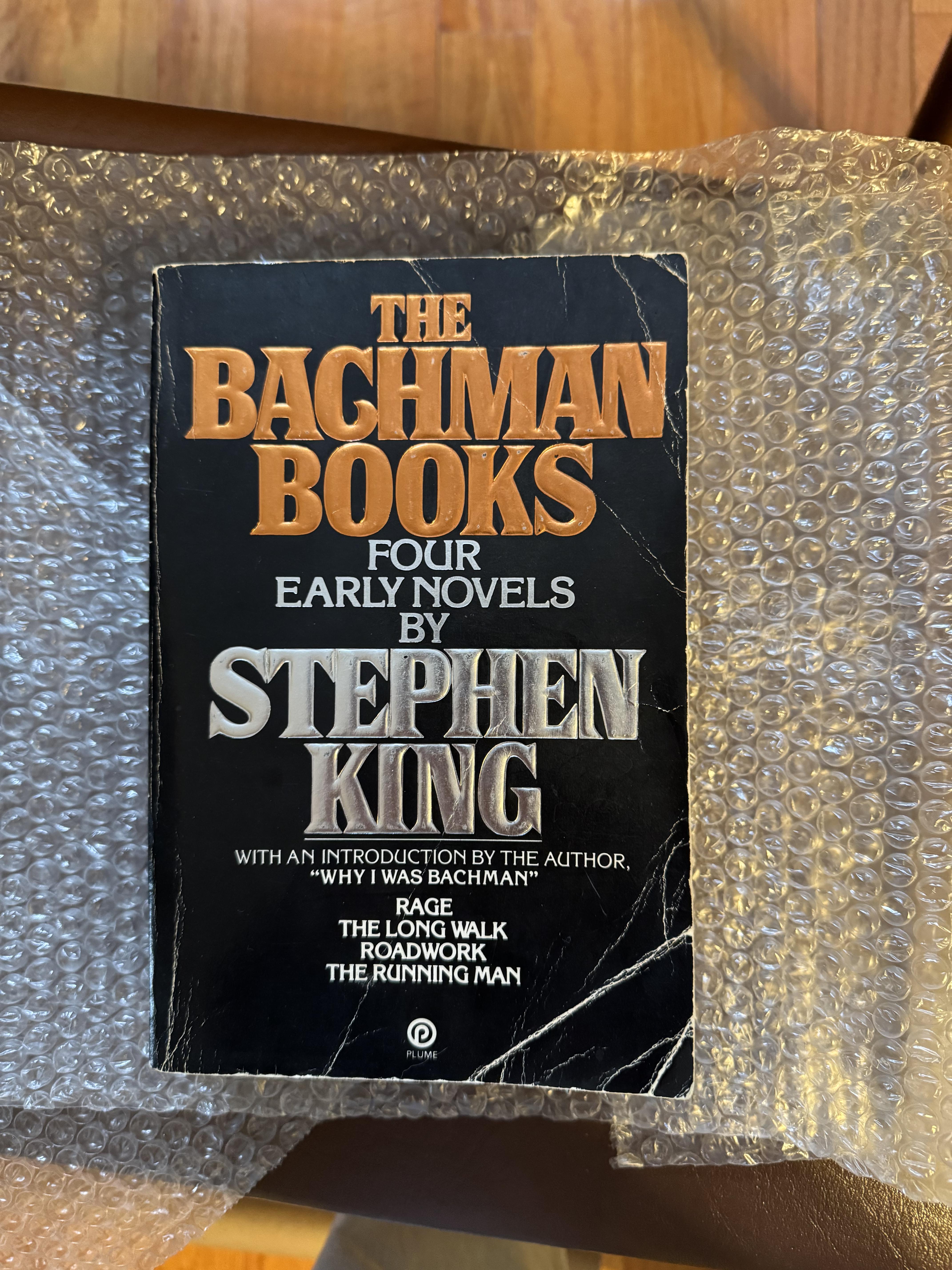
There's nothing particularly new for those who have seen other King interviews about "Carrie" over the years, but it's still interesting, and I imagine there are always people here unfamiliar with the subject.
(Copying and pasting the text here because the image of Carrie covered in blood in the Hollywood Reporter article causes Reddit to block the post:)
In the early 1970s, Stephen King was a struggling and frustrated English teacher in Maine with a wife, two small children and a stack of bills that seemed to be growing much faster than his literary career. During the day, he taught teenagers at Hampden Academy. At night, he’d pound out short stories and quickie tales of terror for lower-tier skin magazines like Cavalier and Adam. The pay wasn’t much, but it kept the lights on … barely. “Two hundred dollars,” says King of his typical fee at the time. “Once in a while, it was $500. That was a huge payday. That bought a lot of groceries.” Things were so tight that the Kings didn’t even have a telephone.
Then, in 1972, King began tinkering with an idea about a painfully awkward teenage girl who is mercilessly bullied by her classmates and terrorized at home by her religiously fanatical mother. When the girl discovers that she possesses telekinetic powers, she finally has a way to strike back. The story would reach its cathartic crescendo at her high school prom, where a horrifically cruel prank involving a bucket of pig’s blood turns what should have been the best night of her young life into an apocalyptic bloodbath. Her name was Carrie White.
Although he had no way of knowing it at the time, the book he had just begun writing would change the course of his life. And not just his. The 1976 movie adaptation of Carrie would turn Sissy Spacek into a bona fide star, give Brian De Palma his first box office hit and pull off something scary movies almost never did, then or now: crash the Oscars. It would also mark the beginning of one of the most prolific — and lucrative — pipelines in movie history, with King’s stories adapted for the screen more than 60 times. Fifty years, several remakes, a notorious Broadway musical and one brand-new Prime Video series later, Carrie White’s bloody fingerprints are still everywhere you look.
The inspiration for the novel that would become Carrie came from several places. Years earlier, while working as a school janitor, King had cleaned the girls’ locker room and noticed the sanitary napkin dispensers mounted on the walls. He began imagining a teenage girl experiencing her first period in the shower with no understanding of what was happening to her while her classmates responded with ridicule. He combined that image with his interest in telekinesis and his memories of two girls he’d known growing up who had been treated as social pariahs. “I wasn’t bullied,” King says. “I think that every kid feels a little bit bullied in school, but I had less of it than others.” The girls, however, weren’t as fortunate. “They were savagely bullied about their clothes, about their hair, just about their lack of social graces. They were country kids and they were really treated poorly.”
What stuck with King was the impossibility of escaping the roles that high school had assigned them. Even when the girls tried to improve their appearance, their tormentors wouldn’t let them. “If they tried to wear new clothes or something like that after Christmas, they were bullied twice as hard,” he says. “Nobody wanted to let them out of the box.” That heartbreaking observation would become the emotional foundation of Carrie. Sometimes the only way out is to burn the whole place down.
At first, King envisioned the story as another quick sale to Cavalier, which he calls his “go-to magazine” at the time. “I thought to myself, ‘Here’s an idea for a story: a girl who gets her first period and she’s telekinetic and she just gets back at these girls.’ ” But almost immediately, he ran into problems. For one thing, he wasn’t convinced he knew enough about the female experience to make the opening believable. “I didn’t know anything about girls’ locker rooms,” he says, beginning to laugh. “I didn’t know if there were coin-op machines for the napkins. I didn’t even know what the napkins were, for God’s sake.” Worse, the story was already growing beyond the magazine’s usual word count, and King feared it would end up being too long for a short story and too short for a novel. So he crumpled up the pages and threw them in the wastebasket.
That might have been the end of Carrie White, except that King’s wife, Tabitha, discovered the discarded manuscript, read it and recognized something that her husband hadn’t. “Tabby fished it out and said, ‘You know, this is really good, so push on with it,’ ” King recalls. He did, and over the next three months, the little story he had abandoned grew into his first publishable novel. Fifty years later, when asked how often he has thanked his wife for retrieving those pages, King doesn’t even pause to think it over: “A lot.”
King’s manuscript eventually landed on the desk of Bill Thompson, an editor at Doubleday who had already read several of King’s earlier, rejected novels. Thompson saw something in Carrie and invited the wannabe author to New York. King could barely afford the trip. His grandmother- in-law gave him the cash for a Greyhound ticket, and he traveled overnight from Maine, with no money for a hotel. Thompson took him to lunch, where several gin and tonics were consumed on the publisher’s dime. “I got pretty much blitzed,” King remembers. Afterward, he became hopelessly lost walking back to the Port Authority bus terminal. When he finally got home, Tabitha asked how the meeting had gone. “I think they might publish the book,” he told her.
In 1973, Doubleday bought Carrie for $2,500. The news arrived by telegram because the Kings still didn’t have a phone. Tabitha received the message through Western Union and had her husband paged to the principal’s office over the school loudspeaker. King immediately imagined two possibilities: Either one of his children had been hurt or he’d sold the book. He still has the telegram, framed on the wall of his office in the much nicer house in Maine he now calls home, bearing Thompson’s wonderfully prophetic message: “The future lies ahead.”
Carrie was published on April 5, 1974, with a modest first printing of 30,000 copies. It wasn’t an immediate sensation in hardcover (it sold about 13,000 copies), but critics were intrigued by the newcomer. The New York Times praised the novel’s assurance and imagination, recognizing that its mixture of supernatural terror and teenage cruelty marked the arrival of a distinctive voice. King, however, felt that Doubleday was too consumed with another one of its titles — Peter Benchley’s Jaws — to promote his book.
Benchley presumably got a much bigger advance as well — King’s $2,500 was barely enough to splurge on a new Pinto. He didn’t exactly rake in a fortune when he sold the film rights, either. Veteran producer Paul Monash, whose credits included Peyton Place and Butch Cassidy and the Sundance Kid, offered a whopping $500 for the story rights. “And Doubleday got half of that,” says King. “So, $250. Big whoop. I could have made more from one of the Cavalier stories.” He took the offer anyway.
Luckily, after the hardcover release there was a windfall when a New American Library editor fell in love with Carrie‘s story and ponied up $400,000 for the paperback rights. Again, Doubleday got half, but it was enough for King to quit teaching and start writing full time. He also used a chunk of the money to help his mother, who was still working even though she was suffering from cancer. “I went to the place where she worked and I said, ‘You’re done,’ ” King recalls. “She cried. That was a great, great moment.”
The film was set up at United Artists with a budget of $1.8 million — a modest figure even by the standards of the mid-1970s. And the director the studio landed on was then-35-year-old Brian De Palma, the New Hollywood movie brat who’d helmed the Hitchcockian 1972 thriller Sisters and the deliriously bonkers 1974 rock-horror musical Phantom of the Paradise. De Palma’s reputation was that of a dazzling visual stylist with a sweet tooth for split-screen trickery, daredevil camerawork and sexual provocation. The director’s drawn-out suspense sequences seemed to delight in torturing the audience. Still, for the most part, box office success had largely eluded him.
De Palma immediately recognized Carrie‘s potential and thought that it might lead to the commercial breakthrough that Jaws had recently given his pal Steven Spielberg. For his part, King was thrilled with the choice. He’d seen Sisters and picked up on a simpatico sensibility. The studio tapped Lawrence D. Cohen, a relative unknown, to adapt King’s novel. Cohen streamlined the book, including its climax. In the novel, Carrie devastates much of her hometown after the prom. But in the movie, the destruction is largely confined to the school gymnasium and back at her house, where she finally confronts her overbearing zealot mother. The adaptation was less sprawling and more intimate.
When it came time to cast the film, De Palma and his friend George Lucas (who was looking for up-and-coming talent for his own in-the-works project, which he was calling Star Wars) decided to pool resources and hold auditions for both films simultaneously. “George and I were both looking for young actors at the same time, so we held our casting sessions together,” De Palma once told me. “We both really wanted Amy Irving. George wanted her for Princess Leia.” William Katt, who eventually snagged the role of Carrie’s handsome prom date, was also considered for Luke Skywalker. The two movies couldn’t have been more different, but for a brief moment, they existed in the same galaxy.
De Palma would eventually cast Irving as Sue Snell, the sympathetic classmate who tries to make amends for Carrie’s humiliation. Nancy Allen played Chris Hargensen, the spoiled, vindictive teenager who orchestrates the prom night prank. John Travolta, already familiar to television audiences as Vinnie Barbarino on Welcome Back, Kotter, played her dim-witted boyfriend. For the part of Carrie’s mother, De Palma recruited Piper Laurie, an Oscar nominee for 1961’s The Hustler who had spent much of the intervening period away from Hollywood. Laurie would approach her character’s religious hysteria with an almost operatic intensity.
The crucial role, however, remained unfilled. Maybe because it seemed unfillable. Sissy Spacek, a 26-year-old Texan who looked at least 10 years younger, had made an indelible impression as a teenage runaway opposite Martin Sheen in Terrence Malick’s Badlands in 1973, but she was hardly a household name.
Her husband, though, production designer Jack Fisk, was working on Carrie and encouraged her to audition for the role. Spacek was supposed to shoot a television commercial on the weekend that De Palma asked her to come in, but she canceled it and showed up for her screen test instead. Spacek arrived looking as though she’d been dragged through the worst day of her life. She had rubbed Vaseline into her hair and wore an old sailor-style dress her mother had made when she was in seventh grade. Rather than try to make herself attractive, she transformed herself into someone almost painfully uncomfortable in her own skin. De Palma was blown away.
Principal photography began in March 1976, with a 50-day schedule and a budget that left little room beyond the barest necessities. The production used an abandoned school in Hermosa Beach for many of its exteriors, while Fisk constructed the gymnasium on a Hollywood soundstage so it could be destroyed during the film’s climax: The sequence of slow-building, screw-tightening suspense set during Carrie’s high school prom — drenched in pig’s blood and supernatural mayhem — is arguably the greatest Hitchcock scene that Hitchcock never directed.
When Carrie opened on Nov. 3, 1976, critics were surprisingly divided on the question of whether De Palma had made a brilliant horror movie or just an exceedingly well-made exploitation picture. In The New York Times, Vincent Canby sniffed at the film’s excesses, arguing that De Palma had encouraged his actors to push their performances beyond plausibility. Yet even Canby couldn’t resist the film’s leading lady. “The marvel, though, is Sissy Spacek,” he wrote, acknowledging that despite the heightened emotions, she made Carrie’s suffering genuinely moving. But others, like the Chicago Sun-Times‘ Roger Ebert, were more enthusiastic. Ebert called the film “an absolutely spellbinding horror movie.”
Audiences sided with Ebert. Carrie earned $33.8 million at the domestic box office — an impressive return on its $1.8 million budget. It marked De Palma’s first real commercial success. It also earned two Academy Award nominations, for Spacek as best actress and Laurie as best supporting actress, an unusual achievement for a horror movie in any era. As for King, he remembers seeing the film for the first time at a preview screening in Boston. He and Tabitha drove down from Maine to an inner-city theater, where Carrie was playing on a double bill with Norman … Is That You?, a comedy starring Redd Foxx.
King recalls the audience being almost entirely Black, and he initially worried that the crowd might have little interest in his story about a white teenage girl’s traumatic adolescence. “I thought to myself, ‘Man, this audience is not going to care about this little white girl with her menstrual problems,’ ” he says. But as the film unspooled, the crowd became increasingly animated, shouting at the screen and really dialing into the film’s white-knuckle suspense.
Then came the final scene. Sitting behind King were two men the size of football players. When Carrie’s hand suddenly burst through the grave, both shrieked and grabbed each other in terror. King recalls one of the men saying, “That’s it, that’s it. She ain’t never gonna be right.” That was when King knew the movie worked. “I thought to myself, ‘Well, we got a hit.’ “
When asked why Carrie still endures, King suspects it’s the primal satisfaction of watching an underdog get payback. “I think that it has something to do with the bullied child striking back,” he says. But the movie’s power is more complicated than just simple revenge. De Palma understood that the audience had to love Carrie before it could fear her.
The movie’s most powerful moment isn’t the prom night massacre or even the final hand reaching from beyond the grave. It’s the expression on Spacek’s face when she realizes she’s been crowned prom queen and believes, for perhaps the first time in her life, that she belongs. For that one brief, beautiful moment, anything and everything seems possible. Then the blood falls, and the dream dies. And half a century later, we still can’t look away.
Source: https://www.hollywoodreporter.com/movies/movie-features/stephen-king-interview-horror-novel-carrie-1236753241/