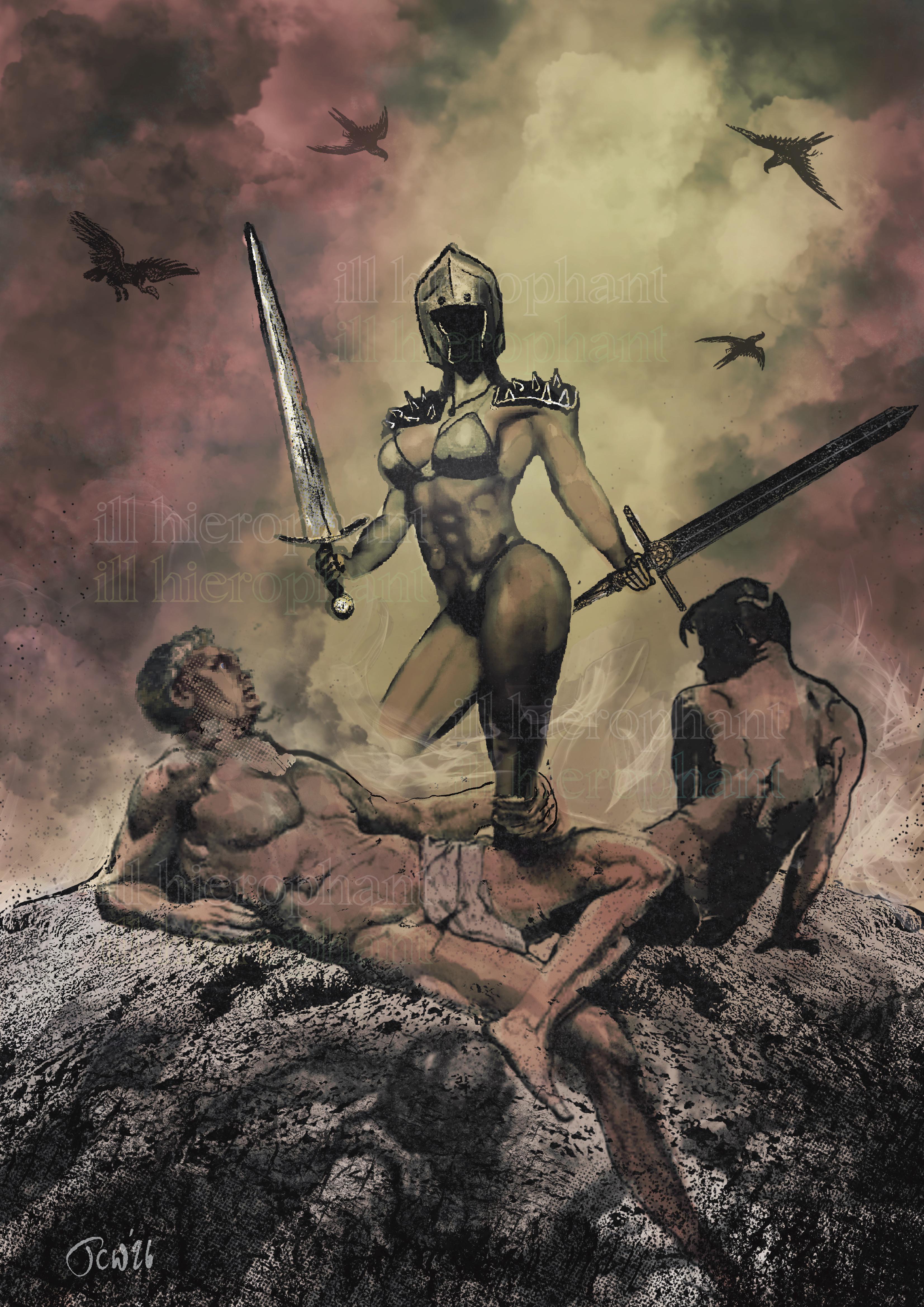
"By all means read Naomi Mitchison's The Corn King and the Spring Queen. It's an enormous volume not much shorter than Anthony Adverse, and deals in the most vivid and convincing detail with a barbarian girl (who incidentally works casual magic now and then), all her family and friends, a Spartan girl et al., and their experiences in Rome, Sparta, Alexandria and the barbarian hinterlands. The thing is as good, almost, as a real tour of the places she tells about. You have the feeling of actually having lived in Sparta and Alexandria...It's well worth reading just for the experience."
- C. L. Moore, Letter to H. P. Lovecraft, 27 May 1935. Quoted in H.P. Lovecraft: Letters to C. L. Moore and Others, edited by S. T. Joshi and David E. Schultz. Hippocampus Press, 2017 ( p.41).
Naomi Mitchison (1897-1999) was a Scottish novelist who wrote over 70 books. She lived an interesting life, being variously a nurse in World War One, an honorary "mother" to a tribe in Botswana and a deep-sea fishing enthusiast. She was friends with both H. G. Wells and J. R. R. Tolkien (and helped proof-read "The Lord of the Rings"). Mitchison's fiction was praised by writers as diverse as Rafael Sabatini and Ursula Le Guin.
Although Mitchison never wrote, AFAIK, any fiction that was full-blown sword and sorcery, I think her work might be of interest to s&s fans for two reasons.
Firstly, many of Mitchison's historical fictions ("The Conquered" (1923) , "Barbarian Stories" (1929), and "The Corn King and the Spring Queen" AKA "The Barbarian" (1931)) feature "outsider" heroes from primitive "barbarian" societies, outside of the "civilized" societies of Ancient Greece and Ancient Rome. These novels also feature these "barbarian" characters going on quests, and sometimes encountering the supernatural. There is thus a thematic similarity between these works of Mitchison and sword and sorcery fictions set in the Classical world which focus on the Barbarian vs. Roman conflict. Such works would include those by Robert E. Howard, (Bran Mak Morn) Adrian Cole (War on Rome) and Richard L. Tierney (Sorcery Against Caesar).
Indeed, in her introduction to her book "When the Bough Breaks", Mitchison expressed the very REH-style sentiment "One always used to take sides with the barbarians against Rome".
Secondly, Mitchison's work was known to at least two writers of sword and sorcery. C. L. Moore was familiar with several of Mitchison's historical books, and praised "The Corn King and the Spring Queen" in a letter to H. P. Lovecraft. Moore later wrote that she had also read Mitchison's "Black Sparta". It may be that Mitchison's use of the supernatural in historical settings helped encourage Moore to write her Jirel of Joiry stories, set in a medieval French province afflicted by the supernatural.
Fletcher Pratt wrote a fantasy novel in 1948, "The Well of the Unicorn", that has been described by reviewer David Pringle as a "swordplay and sorcery" novel. In an article about "The Well of the Unicorn" in the s&s fanzine "Amra", Pratt's friend L. Sprague De Camp wrote about TWotU, "The incident of the slaying of the Vulking deserion [soldier] was unconsciously lifted from one of Naomi Mitchison's stories of classical Greece, as Pratt confessed when I pointed it out to him." This means that Pratt was also familiar with Mitchison's historical work.
So there we have it. Naomi Mitchison, a secret influence on sword and sorcery fiction ?