r/TheScienceofSpeed • • 20h ago

What's a double apex?

Post image
2 Upvotes

Racing Physics Fast Fact – A double apex is basically the opposite of a chicane (the other type of linked corner) because the apexes go in the same direction instead of opposing directions. Rather than optimizing it as two standard corners like in a chicane however, a double apex is treated as one corner except the apex is essentially “spread out” with the driver stuck in an apex limbo where they can neither maximize acceleration nor deceleration.

This image is from The Perfect Corner 2 and shows the Andretti hairpin, a classic double apex at Laguna Seca.

- Adam B.

By sharing these posts, you help move the motorsports community toward a modern understanding of the racing line and driving technique.

r/TheScienceofSpeed • • 2d ago

Linked Corners

Post image
7 Upvotes

Racing Physics Fast Fact – A chicane and a double apex are the two types of linked corners.  Any number of chicanes or double apexes in a row have linked apexes where a change in one directly changes all the others and they must be optimized together.  The image shows a linked sequence at Road Atlanta starting at turn 2 with two chicanes in a row followed by a double apex and then another chicane.  Turn 1 is not linked however because it is a standard corner.

- Adam B.

By sharing these posts, you help move the motorsports community toward a modern understanding of the racing line and driving technique.


r/TheScienceofSpeed • • 4d ago

What's a "faux" chicane

Post image
5 Upvotes

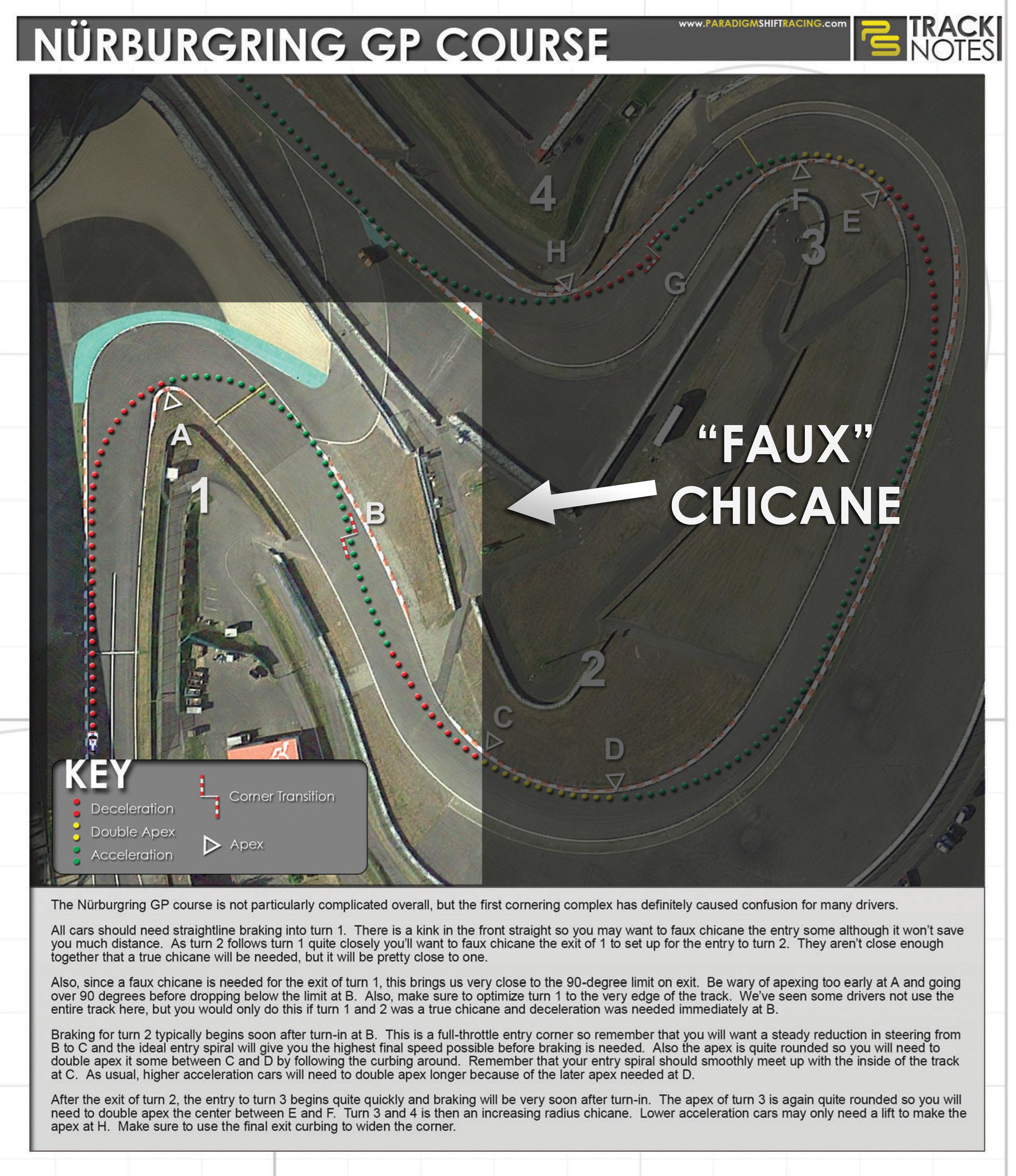
Racing Physics Fast Fact – Turns 1-2 at the Nürburgring GP course is an example of a “faux” chicane.  I started using the term faux chicane to describe a situation where two corners were close enough together that the car or kart’s line looked like a chicane, but were not close enough to actually be one.  Since deceleration is not needed right after the transition, we simply have two standard corners and shouldn’t follow the chicane rule.

- Adam B.

By sharing these posts, you help move the motorsports community toward a modern understanding of the racing line and driving technique.


r/TheScienceofSpeed • • 7d ago

Decreasing Radius Chicane

Post image
3 Upvotes

Racing Physics Fast Fact – Turns 2-3 at Spa is an example of a decreasing radius chicane for cars with a high power to grip ratio.  A decreasing radius chicane is when the radius of the 2nd corner is smaller than the 1st and this makes the transition point closer to the 1st apex.  In some decreasing radius chicanes such as this example, a reduction in brake pressure is all we have time for in the short acceleration portion before the steering crosses over center and we return to hard braking.

- Adam B.

By sharing these posts, you help move the motorsports community toward a modern understanding of the racing line and driving technique.


r/TheScienceofSpeed • • 8d ago

How to draw the racing line accurately?

4 Upvotes

Hi. I need a program for drawing the circles, and the racing line properly. I’ve been using paint.net but it’s not enough (or I don’t know how to use it). What alternatives are there?


r/TheScienceofSpeed • • 8d ago

Increasing radius chicane

Post image
2 Upvotes

Racing Physics Fast Fact – Turns 8-9 at Oulton Park is an example of an increasing radius chicane.  An increasing radius chicane is when the radius of the 2nd corner is larger than the 1st and this makes the transition point closer to the 2nd apex.  For many increasing radius chicanes, a throttle lift is all that is needed for the short deceleration portion from the transition to the 2nd apex.

- Adam B.

By sharing these posts, you help move the motorsports community toward a modern understanding of the racing line and driving technique.


r/TheScienceofSpeed • • 9d ago

What is a Chicane?

Post image
3 Upvotes

Racing Physics Fast Fact – Technically, a chicane is simply two standard corners going in opposite directions where we still follow all the standard corner rules.

What makes it a chicane however, is that the corners are close enough together that we must determine the ideal transition point where the exit of the first corner leads directly into the entry of the second.

Our corner transition symbol represents this fact by showing the imaginary track edges we are optimizing for because the actual track edges between the two apexes are red herrings and don’t matter.

- Adam B.

By sharing these posts, you help move the motorsports community toward a modern understanding of the racing line and driving technique.


r/TheScienceofSpeed • • 10d ago

Chicane Rule Troubleshooting

Post image
3 Upvotes

Racing Physics Fast Fact – To ensure you follow the Chicane Rule and optimize a chicane correctly, use the 1st apex.  If acceleration can continue past the point the steering goes over center toward the 2nd apex, use an earlier, faster 1st apex.  Likewise, if deceleration is needed prior to the steering going past center, use a later, slower 1st apex. 

- Adam B.

By sharing these posts, you help move the motorsports community toward a modern understanding of the racing line and driving technique.


r/TheScienceofSpeed • • 12d ago

The Chicane Rule

Post image
10 Upvotes

Racing Physics Fast Fact – To optimize a chicane, deceleration should need to begin as steering passes over center toward the 2nd apex.  This is “The Chicane Rule.”  It determines the ideal chicane transition point and links the two apex angles so that if an earlier 2nd apex is needed, an earlier 1st apex should be used.  Likewise, if a later 2nd apex is needed, use a later 1st apex.

- Adam B.

By sharing these posts, you help move the motorsports community toward a modern understanding of the racing line and driving technique.


r/TheScienceofSpeed • • 14d ago

Entry speed does not affect the ideal line.

Post image
5 Upvotes

Racing Physics Fast Fact – Entry speed does not affect the ideal line.  A car or kart’s cornering vs acceleration potential determines its ideal apex and line through a corner and entry speed simply determines where along this line deceleration should begin.  For instance, if a driver makes an error in the previous corner and has less speed than normal, they should turn-in along the same ideal line, but use a later braking point. 

- Adam B.

By sharing these posts, you help move the motorsports community toward a modern understanding of the racing line and driving technique.


r/TheScienceofSpeed • • 16d ago

A question about apex angles and the connecting arc

6 Upvotes

Hello. I’m confused about how to choose the 1st and 2nd apexes.

What I’m doing to get the initial guess for the 2nd apex is, I drive a circular path on the limit as close to the inside as I can, and try to achieve max accel on exit (like in a standard corner).

However, even if I clip the 1st apex at close to 90 degrees, the radius of the connecting arc ends up being too big to reach the 2nd apex where I’m imagining it.

The problem I have is that, I can’t find any connecting arc from the 1st to the 2nd apex. I feel like the 2nd apex is “too late” to be reachable, but I may be misunderstanding the rules of the connecting arc or guessing the 2nd apex wrongly.

How does the distance between the apexes affect the connecting arc?

Are the apexes always within 90 degrees of the entry and exit directions?


r/TheScienceofSpeed • • 16d ago

Full throttle shortcut for high-powered car/kart

Post image
7 Upvotes

Racing Physics Fast Fact – For higher-powered cars and karts, if full throttle at the apex causes wheelspin and oversteer then full throttle generally shouldn’t be achieved until the end of the corner when lateral force drops to near zero.  Best checked afterwards with video or data, this principle holds true for any corner type, so if you find you reach full throttle in the middle of corner exit, try an earlier, faster apex.

- Adam B.

By sharing these posts, you help move the motorsports community toward a modern understanding of the racing line and driving technique.


r/TheScienceofSpeed • • 17d ago

Four types of corners

Post image
9 Upvotes

Racing Physics Fast Fact – All racetracks can be broken down into just four types of corners.  Every road course, oval, autocross, kart track, and even rally stage can be split into standard corners, chicanes, double apexes, and full-throttle corners and there are specific physics-based rules to optimize each type.  This illustration is from our Willow Springs Track Notes and it shows turns 3 through 6, which is a complex sequence containing all four corner types.

- Adam B.

By sharing these posts, you help move the motorsports community toward a modern understanding of the racing line and driving technique.


r/TheScienceofSpeed • • 18d ago

Tire squealing vs. Testing for the limit

Thumbnail
youtu.be
3 Upvotes

Racing Physics Fast Fact – While tire squealing can sometimes be a useful way for novice drivers on street tires to know they are approaching the limit, tire noises are not a reliable indicator of when a tire is actually at the limit.  Instead, more advanced drivers learn to subconsciously compare their inputs to the car or kart’s movements in order to more precisely find the limit.  This process is called “testing for the limit.”

- Adam B.

By sharing these posts, you help move the motorsports community toward a modern understanding of the racing line and driving technique.


r/TheScienceofSpeed • • 19d ago

An apex is determined by angle, not position.

Post image
8 Upvotes

Racing Physics Fast Fact – An apex is not defined by its position, but by its angle.  Many times, when a car or kart needs an earlier or later apex, changing the apex angle also changes its position.  When the apex area has a small profile however (such as a cone on an autocross course) as the apex angle changes, the position of the apex stays virtually the same.

- Adam B.

By sharing these posts, you help move the motorsports community toward a modern understanding of the racing line and driving technique.


r/TheScienceofSpeed • • 20d ago

The Sideways Drag Race

Post image
6 Upvotes

Racing Physics Fast Fact – Most cars and karts will actually beat themselves in a drag race if they get to start sideways at speed.  This is because they can typically produce significantly higher lateral cornering force than acceleration force.  Understanding the implications of this seemingly counterintuitive fact can help explain a key principle of racing line physics.

- Adam B.

By sharing these posts, you help move the motorsports community toward a modern understanding of the racing line and driving technique.


r/TheScienceofSpeed • • 22d ago

Creating a False Apex

4 Upvotes

Racing Physics Fast Fact – A useful way to visualize why acceleration should ideally begin at the apex is to understand that when it begins somewhere else, it creates a “false apex” at the point of minimum speed.  This false apex is essentially an imaginary obstacle that the driver is now going around in addition to the actual apex, making the corner tighter and longer than it really is. 

- Adam B.

By sharing these posts, you help move the motorsports community toward a modern understanding of the racing line and driving technique


r/TheScienceofSpeed • • 23d ago

The corner entry spiral

8 Upvotes

Racing Physics Fast Fact – For most cars, the ideal corner entry path to the apex will closely match the beginning of an Euler (pronounced “Oiler”) spiral.  Also used in highway and railroad engineering as transition curves, the Euler spiral is a line that’s curvature increases linearly along its length.  When using the Euler spiral to visualize potential lines, only up to the first 90 degrees should be used.

- Adam B.

By sharing these posts, you help move the motorsports community toward a modern understanding of the racing line and driving technique.


r/TheScienceofSpeed • • 24d ago

The "geometric" line

6 Upvotes

Racing Physics Fast Fact – Despite traditional racing wisdom, a circular or “geometric” line is not the fastest way through a single isolated corner.  This is because it wastes tire force accelerating the vehicle toward the turn center.  Instead, a line of decreasing and then increasing radius is faster because it optimally directs tire forces in the ideal directions.

- Adam B.

By sharing these posts, you help move the motorsports community toward a modern understanding of the racing line and driving technique.


r/TheScienceofSpeed • • 25d ago

The Full Throttle Corner Exit Shortcut

4 Upvotes

Racing Physics Fast Fact – If full throttle can be achieved at the apex, this can be used to help find a good (but not necessarily ideal) apex.  If full throttle causes the vehicle to start running wide, this indicates a later, slower apex (not less throttle) should be used.  On the other hand, if the entire track is not used during corner exit, an earlier, faster apex should be used.

- Adam B.

By sharing these posts, you help move the motorsports community toward a modern understanding of the racing line and driving technique.


r/TheScienceofSpeed • • 28d ago

Straightaway length does not affect the ideal apex and racing line.

3 Upvotes

Racing Physics Fast Fact – Despite traditional racing wisdom, the ideal apex and line through a corner is not affected by straightaway length.  While it is possible to modify the line to increase speed on the straightaway and reduce time there, this will always increase the total time it takes to complete the corner and straightaway combined.

- Adam B.

By sharing these posts, you help move the motorsports community toward a modern understanding of the racing line and driving technique.


r/TheScienceofSpeed • • 29d ago

Racing Physics Fast Fact – The Ideal Apex

3 Upvotes

Racing Physics Fast Fact – The ideal apex is determined by the ratio of a vehicle’s cornering vs acceleration potential.  The greater the acceleration potential compared to cornering potential, the later the apex needed in order to optimize a corner.  In other words, with the same grip but more power, a car would need a later apex.

- Adam B.

By sharing these posts, you help move the motorsports community toward a modern understanding of the racing line and driving technique.


r/TheScienceofSpeed • • Oct 27 '26

Racing Physics Fast Fact - The Apex Spectrum

3 Upvotes

Racing Physics Fast Fact - The apex is a spectrum with a continual tradeoff between speed and angle.  An earlier apex will allow a higher apex speed, but as the apex angle moves later, the maximum possible apex speed drops.  A driver’s goal is to find where on this spectrum the ideal apex is located, because that speed and angle will produce the quickest elapsed time.

- Adam B.

By sharing this post, you help move the motorsports community toward a modern, physics-based understanding of the racing line and driving technique.


r/TheScienceofSpeed • • Oct 20 '26

Racing Physics Fast Fact - Ideal point of minimum speed in a corner.

6 Upvotes

Racing Physics Fast Fact - Minimum speed in a corner should ideally always be achieved at some point along the inside of the track.  Best checked afterwards with video or data, this principle holds true for any corner type, so if you ever reach a minimum speed and begin accelerating somewhere out in the middle of the track, you’ll know there is an opportunity to improve your racing line.

- Adam B.

By sharing this post, you help move the motorsports community toward a modern, physics-based understanding of the racing line and driving technique.


r/TheScienceofSpeed • • Jul 21 '26

Double apex rule for single point cones?

4 Upvotes

Hello. I’m confused about how to do “late” apex cones. A powerful car would need to clip the cone for exit at an angle bigger than 90 degrees, so then, wouldn’t this be a double apex?

The problem I see that there’s no room to do a connecting arc between the 1st and 2nd apexes because the inner obstacle is a “single point”. What is the optimal way to drive such turns?