r/ThisDayInHistory • u/TheExorcist1973 • 16h ago
November 27, 1942 - Vichy France scuttled its fleet at Toulon to prevent Nazi German forces from seizing the warships during World War II
r/ThisDayInHistory
•
u/greenflea3000
•
Aug 19 '25
Hello,
Thank you very much to those of you who have been following the new community rules. Unfortunately, posts related to Israel and Palestine continue to spawn a torrent of bigotry and unhealthy discourse. Beyond the problematic discussion between some users, it is not a great feeling to wake up each morning and be accused of being a Mossad agent by some and antisemitic by others for removing hateful and dehumanizing content.
Because of this, we have locked the post from today about Israel and Palestine and we will be locking and removing future posts about Israel and Palestine for the time being. If you are interested in debating this topic, there are a wide range of subreddits which provide better forums for discussion.
Thanks,
r/ThisDayInHistory • u/greenflea3000 • Aug 12 '25
Hello everyone,
It’s been great to see how much this subreddit has grown, especially over the past few months and years. We’ve had many engaging contributions and discussions, and it’s been a privilege to watch this community take shape.
That said, many of you have probably noticed an increase in posts and comments that have led to hateful conversations, particularly around the ongoing conflict in Israel and Palestine. We want to try and address that, so we have a couple of updates:
New Community Rules: We’re adding four new rules to help keep discussions respectful and on-topic. The goal is to protect the best parts of this subreddit while cutting down (at least somewhat) on toxic exchanges. You’ll find these rules in the sidebar, and we’ve also listed them below. They’re inspired by the guidelines of other great history communities like r/AskHistorians. We’d love to hear your thoughts and feedback here in the comments.
Rule 1. No Hatred - We will not tolerate racism, sexism, homophobia, or any other forms of bigotry such as antisemitism or Islamophobia. Equating entire groups of people (e.g. Israelis or Palestinians) with Nazis, devils, animals, etc… is never acceptable.
Rule 2. Civil Discourse - A wide range of different perspectives are valued, but personal insults and other ad hominem attacks are not.
Rule 3. Proper Post Titles - Posts should begin with either “TDIH” and then the date of the event OR just the date of the event.
Rule 4. No Current Events (<20 years ago) - All posts must relate to an historical event at least 20 years ago. Posts about ongoing current events can (and have) swamped many history-oriented subreddits, and there are numerous other subreddits to discuss current events. The mods at r/askhistorians have a great explanation of why they implemented a similar rule which can be read here.
More Moderators Coming Soon: As the community has grown, so has the need for moderation. I haven't always had the bandwidth in my life to moderate this growing subreddit and I apologize for moments where moderation was inadequate. We’ll be opening applications for new moderators soon, so if you’re interested, keep an eye out for that post.
Lastly, I wanted to take the opportunity to thank you to all of you, whether you post or just read, for making this a place where people can come together to connect with the past.
Your humble moderator,
u/greenflea3000
r/ThisDayInHistory • u/TheExorcist1973 • 16h ago
r/ThisDayInHistory • u/Upstairs_Drive_5602 • 13h ago
r/ThisDayInHistory • u/PublicAdventurous917 • 16h ago
r/ThisDayInHistory • u/TheExorcist1973 • 16h ago
r/ThisDayInHistory
•
u/Upstairs_Drive_5602
•
22h ago
r/ThisDayInHistory • u/Over-Willingness-933 • 14h ago
r/ThisDayInHistory • u/PublicAdventurous917 • 20h ago
r/ThisDayInHistory • u/Over-Willingness-933 • 13h ago
r/ThisDayInHistory • u/TheExorcist1973 • 16h ago
r/ThisDayInHistory • u/Over-Willingness-933 • 1d ago
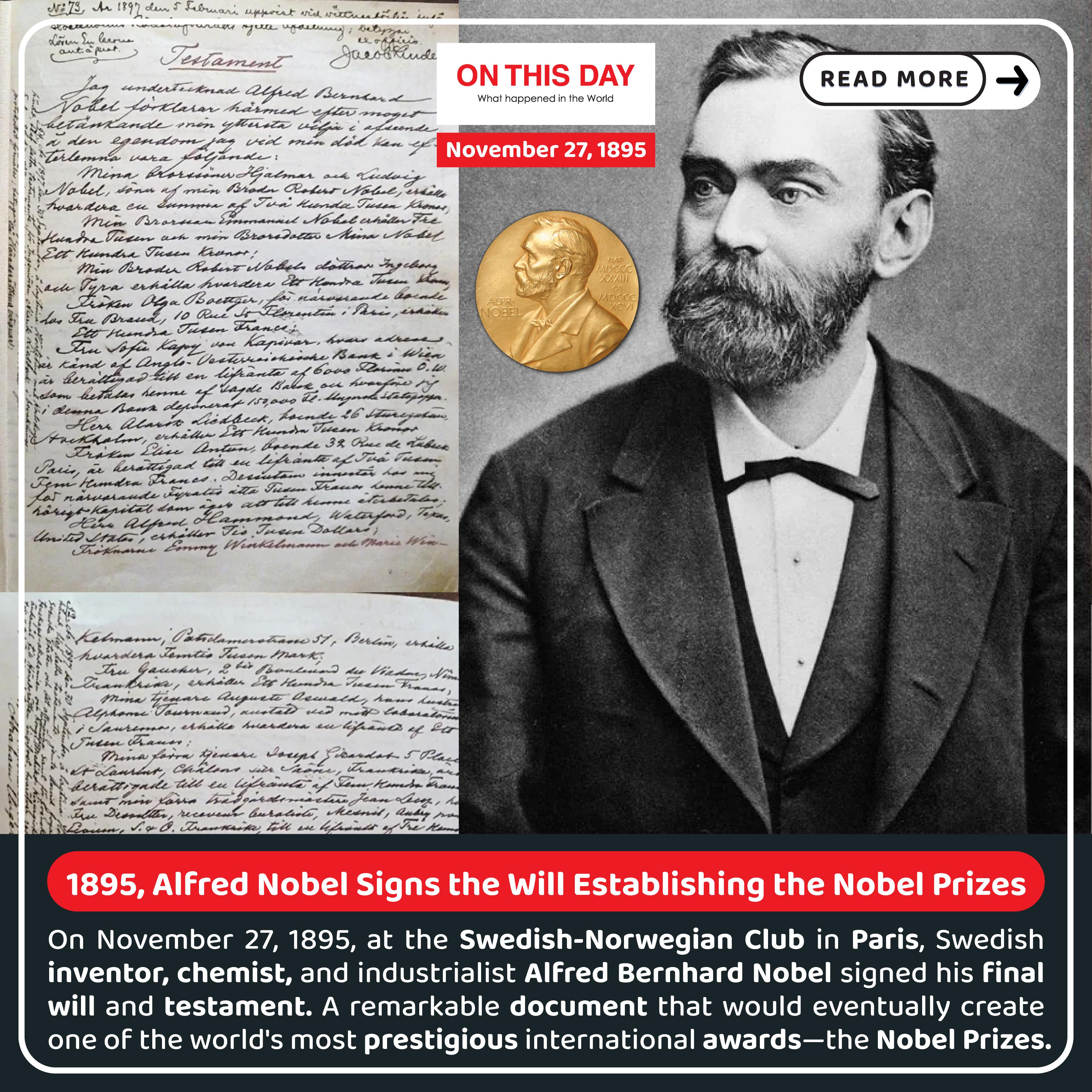
Alfred Nobel signed his last will which called for his estate and fortune that he made as the inventor of dynamite to be used for creating awards for those who contributed to the benefit of mankind. The will created 5 awards - in physics, chemistry, medicine, literature and peace, and was signed in the Swedish–Norwegian Club in Paris.
r/ThisDayInHistory • u/AllAboutHistoryBooks • 23h ago
r/ThisDayInHistory • u/AllAboutHistoryBooks • 1d ago
On 27th November 1944 at eleven minutes past eleven in the morning 4,000 tons of bombs stored 30m down in the old gypsum mines at RAF Fauld, Staffordshire, blew up making a crater 125m deep, and 1.2km wide. The exact death toll is uncertain; it is believed that about 70 people died in the explosion and resulting flood. The crater is still visible just south of Fauld, to the east of Hanbury, Staffordshire. It is now known as the Hanbury Crater. It was one of the largest non-nuclear explosions in history and the largest on UK soil.
Memorial at St Werburgh's Church, Hanbury. Sign at the Cock Inn, Hanbury. Map from Bing.
r/ThisDayInHistory • u/Neil118781 • 1d ago
r/ThisDayInHistory • u/sajiasanka • 1d ago
On November 27, 1895, at the Swedish-Norwegian Club in Paris, Swedish inventor, chemist, and industrialist Alfred Bernhard Nobel signed his final will and testament. A remarkable document that would eventually create one of the world's most prestigious international awards—the Nobel Prizes.
But what made this document extraordinary?
Nobel directed that the majority of his remaining fortune should be invested in a fund, with its annual returns used to reward people whose work had brought the greatest benefit to humanity.
He specified five prize categories:
Physics – For outstanding discoveries and inventions in physics.
Chemistry – For important chemical discoveries and improvements.
Physiology or Medicine – For significant medical and scientific discoveries.
Literature – For outstanding literary contributions.
Peace—For efforts to promote international friendship, reduce standing armies, and advance peace.
He also made an important point: the prizes should be awarded without considering the nationality of the candidates. The most deserving individuals should receive them, regardless of where they came from.
However, his decision was not immediately accepted.
When Nobel died on December 10, 1896, in San Remo, Italy, his will surprised many of his relatives. Some opposed his decision to leave most of his fortune for the prizes, and questions surrounding the will led to lengthy legal and administrative negotiations.
Eventually, the Nobel Foundation was established in 1900 to manage his estate and organize the awards.
On December 10, 1901, the first Nobel Prizes were presented, marking the beginning of a global tradition that continues to recognize extraordinary contributions to science, literature, and peace.
Interestingly, Alfred Nobel was also the inventor of dynamite, patented in 1867. His invention brought him enormous wealth, but his final will ensured that his name would become associated with some of humanity's greatest achievements.
A sixth award, the Sveriges Riksbank Prize in Economic Sciences in Memory of Alfred Nobel, was established in 1968 and first awarded in 1969. It was not one of the five original prizes specified in his will.
More than a century later, Nobel's decision continues to influence science, culture, and international peace.
One signature. Five original prizes. A legacy that continues to inspire the world.
r/ThisDayInHistory • u/Baconkings • 1d ago
r/ThisDayInHistory • u/One-Highlight-9072 • 1d ago
r/ThisDayInHistory • u/TheExorcist1973 • 1d ago
r/ThisDayInHistory • u/Over-Willingness-933 • 2d ago
r/ThisDayInHistory • u/TheExorcist1973 • 1d ago
r/ThisDayInHistory • u/sajiasanka • 2d ago
On This Day, November 26, 1914, one of the Royal Navy's most devastating peacetime disasters unfolded in the waters off Sheerness, England. A massive explosion tore apart the British battleship HMS Bulwark, killing almost everyone aboard.
HMS Bulwark was anchored in the River Medway near Sheerness, Kent. The battleship was part of the Royal Navy's 5th Battle Squadron and was replenishing its ammunition supplies.
At approximately 7:53 a.m., a tremendous explosion ripped through the vessel.
The blast was so powerful that the battleship was practically blown apart. Witnesses aboard nearby ships watched in horror as a towering cloud of smoke and flames rose into the sky. When the smoke cleared, HMS Bulwark had virtually disappeared, leaving only wreckage scattered across the water.
The human cost was devastating.
Of a crew of approximately 750 men, only a small number survived. Historical records commonly report 738 lives lost, including every officer aboard. The survivors were left with the unimaginable experience of witnessing the destruction of their ship and the loss of their fellow sailors.
What caused such a catastrophic explosion?
An official naval inquiry investigated the disaster. The evidence pointed towards an accidental ignition of ammunition, possibly involving cordite charges stored in conditions that allowed them to overheat. However, the precise sequence that triggered the explosion could not be established with certainty.
There was no evidence that an enemy attack had destroyed the ship.
The loss of HMS Bulwark became one of the deadliest accidental explosions in British naval history. Its wreck site is now protected as a military war grave under British law.
More than a century later, the tragedy remains a reminder of the dangers faced by sailors even when they were not fighting in battle.