r/ThisDayInHistory • • 4h ago

29th November 1935 Physicist Erwin Schrödinger publishes his famous thought experiment "Schrödinger's cat", a paradox that illustrates the problem of the Copenhagen interpretation of quantum mechanics

Post image
10 Upvotes

r/ThisDayInHistory • • 5h ago

TDIH November 28th, 153 años después de su fallecimiento, recordamos a Ann Keats Wizner 💐

Post image
2 Upvotes

r/ThisDayInHistory • • 6h ago

Voltaire replies to Frederick the Great’s Nephew: Voltaire to Fredrick William II of Prussia, November 28, 1770

Thumbnail reddit.com
2 Upvotes

r/ThisDayInHistory • • 9h ago

November 28, 1943 - The Tehran Conference opened 83 years ago

Post image
26 Upvotes

On Nov 28, 1943 the Tehran Conference opened: Churchill was 68, Roosevelt 61 and Stalin 64. Churchill turned 69 two days into it, on Nov 30, and had his birthday dinner there.

Although the three leaders arrived in Tehran with differing objectives, the main outcome of the meeting was a British and American commitment to opening a second front against Nazi Germany, thereby forcing it to pull military assets away from the Eastern Front with the Soviets.


r/ThisDayInHistory • • 10h ago

(1788)Friendly Fire: The Battle of Karánsebes

0 Upvotes

r/ThisDayInHistory • • 10h ago

November 28, 1908 - A mine explosion in Marianna, Pennsylvania, kills 154 men, leaving only one survivor.

Post image
19 Upvotes

r/ThisDayInHistory • • 10h ago

November 28, 1895 - The first automobile race in the United States, the Chicago Times-Herald race, is held in Chicago on Thanksgiving Day. J. Frank Duryea won in a gasoline-powered Duryea Motorized Wagon, finishing a snowy 54-mile round-trip course to Evanston in 7 hours and 53 minutes at 7 mph.

Post image
53 Upvotes

r/ThisDayInHistory • • 10h ago

November 28, 1520 - Portuguese navigator Ferdinand Magellan and his remaining three ships emerged from the Strait of Magellan into the Pacific Ocean. Magellan named the expanse Mar Pacífico ("peaceful sea").

Post image
29 Upvotes

r/ThisDayInHistory • • 1d ago

28 November 1893. New Zealand women voted in a general election for the first time, making it the first country in the world to allow women to vote in parliamentary elections.

Post image
97 Upvotes

r/ThisDayInHistory • • 1d ago

Johnson sets the Warren Commission 29th November 1963 to investigate the assassination of John F Kennedy.

Thumbnail
gallery
11 Upvotes

r/ThisDayInHistory • • 1d ago

Thomas Edison demonstrates the Phonograph (later became known as a record player) for the First Time 28th November 1877

Post image
13 Upvotes

r/ThisDayInHistory • • 1d ago

November 27, 1924 - the First Macy's Thanksgiving Parade is held.

Post image
131 Upvotes

r/ThisDayInHistory • • 1d ago

November 27, 1942 - Vichy France scuttled its fleet at Toulon to prevent Nazi German forces from seizing the warships during World War II

Thumbnail
gallery
180 Upvotes

r/ThisDayInHistory • • 1d ago

November 27, 1957 - U.S. Army troops from the 101st Airborne Division withdrew from Little Rock, Arkansas, after guarding the Little Rock Nine at Central High School for roughly two months.

Post image
101 Upvotes

r/ThisDayInHistory • • 1d ago

November 27, 1095 - Pope Urban II calls for the First Crusade at the Council of Clermont.

Post image
18 Upvotes

r/ThisDayInHistory • • 1d ago

November 27, 1942 - Jimi Hendrix is born.

Post image
31 Upvotes

r/ThisDayInHistory • • 1d ago Bravo

27 November 1975. Guinness Book of Records co-founder Ross McWhirter was shot dead outside his home in London, three weeks after offering £50,000 for information on IRA bombers.

Post image
262 Upvotes

Alan Ross McWhirter (12 August 1925 – 27 November 1975) - on the right - was, with his twin brother, Norris, the cofounder of the 1955 Guinness Book of Records.


r/ThisDayInHistory • • 1d ago

1835 Last execution in England for Sodomy

Post image
20 Upvotes

r/ThisDayInHistory • • 1d ago

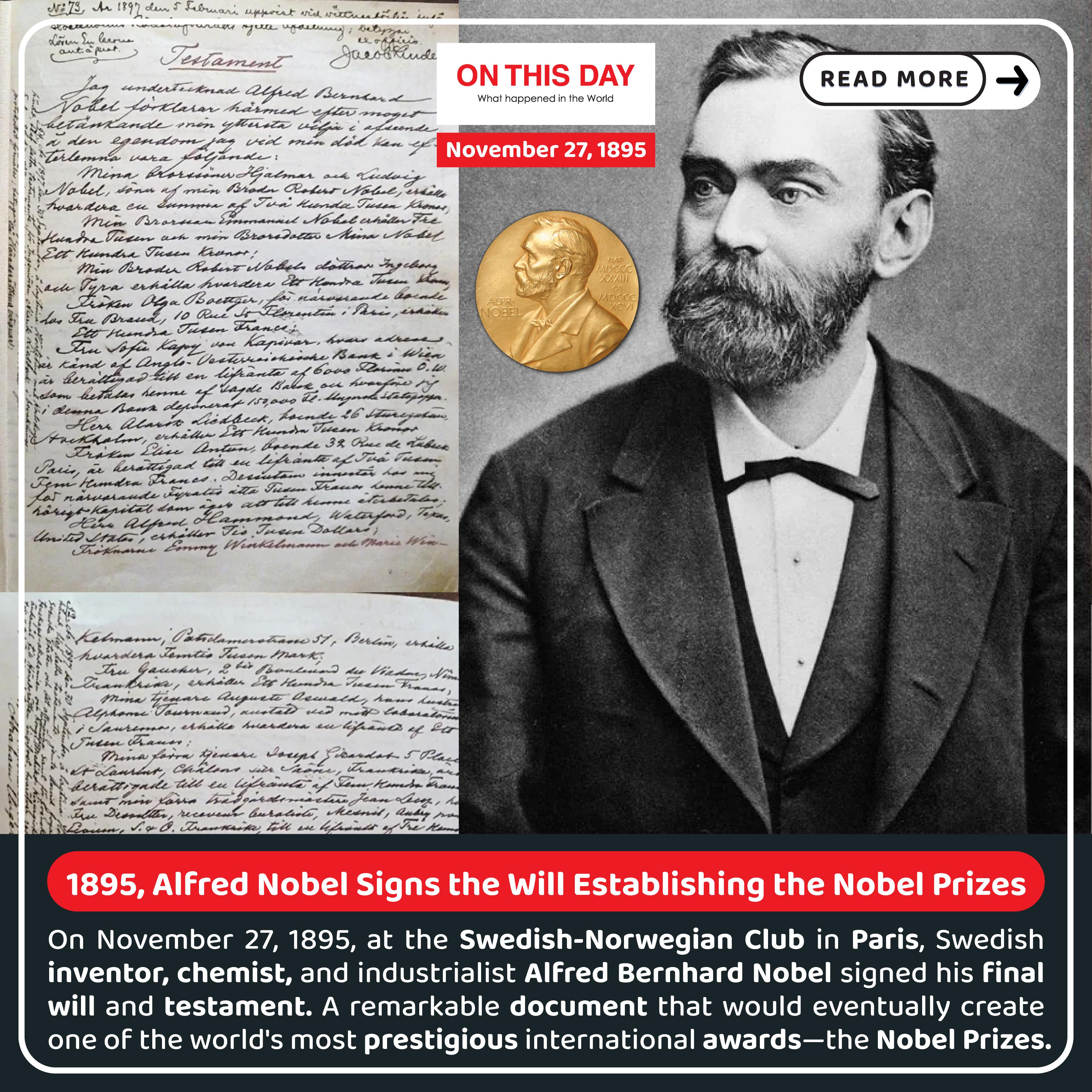
1895, Alfred Nobel Signs the Will Establishing the Nobel Prizes

Post image
4 Upvotes

On November 27, 1895, at the Swedish-Norwegian Club in Paris, Swedish inventor, chemist, and industrialist Alfred Bernhard Nobel signed his final will and testament. A remarkable document that would eventually create one of the world's most prestigious international awards—the Nobel Prizes.

But what made this document extraordinary?

Nobel directed that the majority of his remaining fortune should be invested in a fund, with its annual returns used to reward people whose work had brought the greatest benefit to humanity.

He specified five prize categories:

Physics – For outstanding discoveries and inventions in physics.

Chemistry – For important chemical discoveries and improvements.

Physiology or Medicine – For significant medical and scientific discoveries.

Literature – For outstanding literary contributions.

Peace—For efforts to promote international friendship, reduce standing armies, and advance peace.

He also made an important point: the prizes should be awarded without considering the nationality of the candidates. The most deserving individuals should receive them, regardless of where they came from.

However, his decision was not immediately accepted.

When Nobel died on December 10, 1896, in San Remo, Italy, his will surprised many of his relatives. Some opposed his decision to leave most of his fortune for the prizes, and questions surrounding the will led to lengthy legal and administrative negotiations.

Eventually, the Nobel Foundation was established in 1900 to manage his estate and organize the awards.

On December 10, 1901, the first Nobel Prizes were presented, marking the beginning of a global tradition that continues to recognize extraordinary contributions to science, literature, and peace.

Interestingly, Alfred Nobel was also the inventor of dynamite, patented in 1867. His invention brought him enormous wealth, but his final will ensured that his name would become associated with some of humanity's greatest achievements.

A sixth award, the Sveriges Riksbank Prize in Economic Sciences in Memory of Alfred Nobel, was established in 1968 and first awarded in 1969. It was not one of the five original prizes specified in his will.

More than a century later, Nobel's decision continues to influence science, culture, and international peace.

One signature. Five original prizes. A legacy that continues to inspire the world.


r/ThisDayInHistory • • 1d ago

27th November 1944 Fauld Explosion

Thumbnail
gallery
22 Upvotes

On 27th November 1944 at eleven minutes past eleven in the morning 4,000 tons of bombs stored 30m down in the old gypsum mines at RAF Fauld, Staffordshire, blew up making a crater 125m deep, and 1.2km wide. The exact death toll is uncertain; it is believed that about 70 people died in the explosion and resulting flood. The crater is still visible just south of Fauld, to the east of Hanbury, Staffordshire. It is now known as the Hanbury Crater. It was one of the largest non-nuclear explosions in history and the largest on UK soil.

Memorial at St Werburgh's Church, Hanbury. Sign at the Cock Inn, Hanbury. Map from Bing.


r/ThisDayInHistory • • 1d ago

Alfred Nobel signed his last will, setting up the Nobel Prizes 27th November 1895

Post image
63 Upvotes

Alfred Nobel signed his last will which called for his estate and fortune that he made as the inventor of dynamite to be used for creating awards for those who contributed to the benefit of mankind. The will created 5 awards - in physics, chemistry, medicine, literature and peace, and was signed in the Swedish–Norwegian Club in Paris.


r/ThisDayInHistory • • 2d ago

TDIH — American Soldier’s Thanksgiving on the Frontline WW2

Post image
58 Upvotes

r/ThisDayInHistory • • 2d ago

November 26, 1983 - Armed robbers stole £26 million worth of gold bullion, diamonds, and cash from a Brink's-Mat warehouse at London's Heathrow Airport in one of Britain's largest robberies.

Post image
31 Upvotes

r/ThisDayInHistory • • 2d ago

26 November 1812: Trapped by three Russian armies, Napoleon’s freezing Grande Armée begins a desperate crossing of the Berezina River.

Post image
188 Upvotes

r/ThisDayInHistory • • 2d ago

November 26, 43 BC - Octavian, Mark Antony, and Marcus Aemilius Lepidus met near Bononia (modern Bologna) to form the Second Triumvirate.

Post image
15 Upvotes