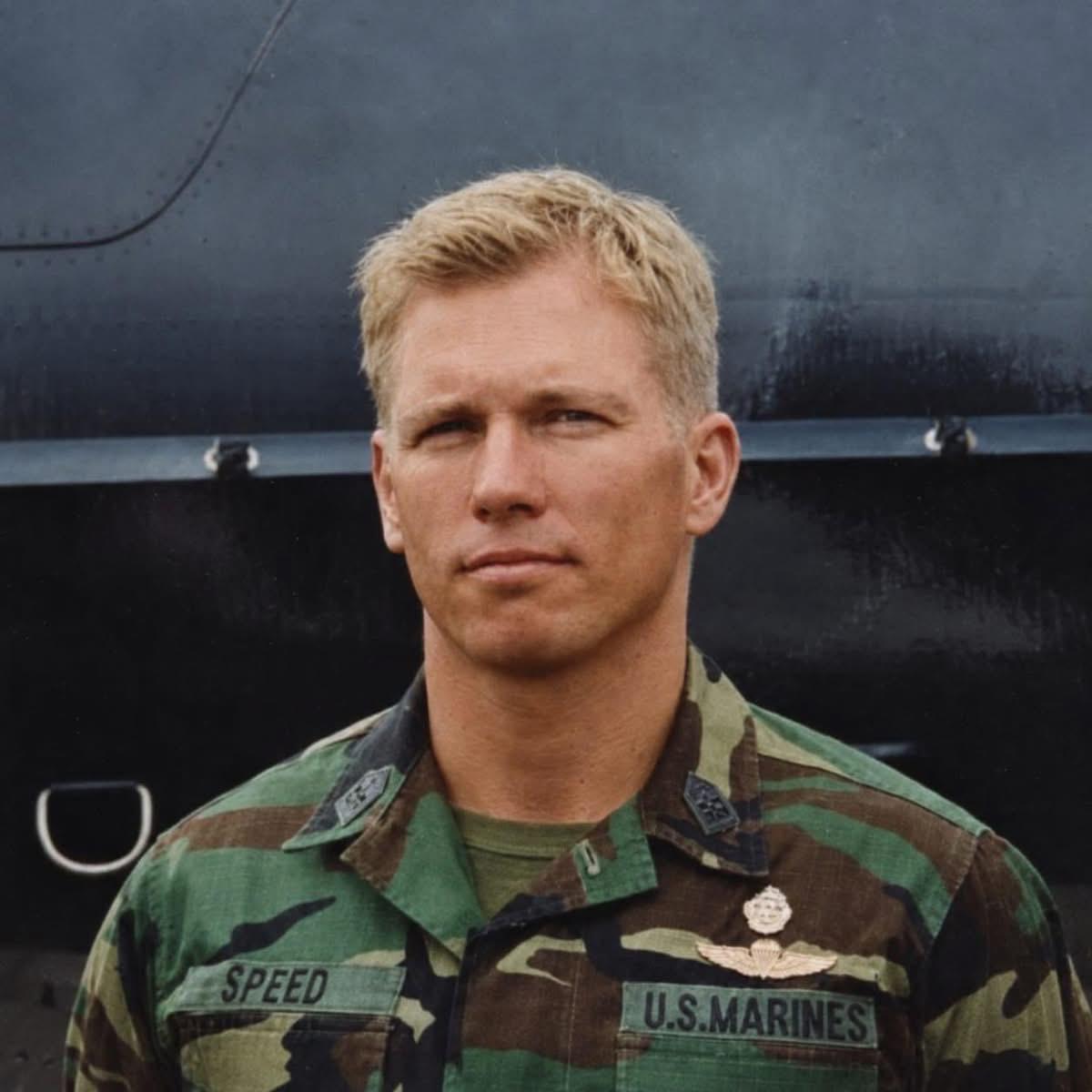
I was a Marine with Echo Company, 2nd Battalion, 9th Marines, from 22 October 1966 to 1 July 1967 \[Record of Service\]. Everything below can be checked against my service record, my service medical file, or my VA rating decision. I put the source in brackets after each fact.
**Six weeks on the road to Cam Lo**
On 19 May 1967 I was hit with shrapnel in the left leg. On 19 June, shrapnel in the left shoulder. On 28 June, walking point at Con Thien, a Chi-Com grenade put shrapnel in my right leg \[Combat History – Expeditions – Awards Record\]. That was three Purple Hearts in six weeks, and I was nineteen.
In the middle of that, on 31 May, I was promoted to corporal \[Promotion Record\]. When I left Vietnam on 1 July, my company marked me 4.7 for conduct and 4.7 for proficiency \[Record of Service\]. I was a good Marine, and the paper says so.
**First try: Okinawa, July 1967**
They sent me to Okinawa as a motor patrolman \[Record of Service\]. Thirty days after the grenade, I went to the base psychiatrist \[service medical file, 28 July 1967\].
On 22 August he wrote that I had been “referred here for vague complaints including anxiety and difficulty in adjustment.” In the same report he wrote that I “now presents no psychiatric complaints.”
His recommendation was “Patient is fully fit for duty with no limitations required.”
That was fifty-five days after my last firefight.
**Second try: Camp Lejeune, October 1967**
Back in the States, I saw a Navy psychiatrist at Camp Lejeune on 6 and 20 October. He made no diagnosis and deferred \[service medical file\]. Five days later I was standing at office hours, and they took my corporal’s stripes \[Offense sheet and Promotion Record, 25 October 1967\].
Over the next nine months they took the rest: PFC on 21 December 1967, Private on 24 July 1968 \[Promotion Record\]. I went over the hill more than once. The longest was sixteen days, 8 to 23 July 1968 \[Offense sheet\].
**Third try: October 1968**
The Division Psychiatrist saw me on 30 October 1968. He wrote: “Psychiatrically fit for duty.” \[service medical file\]
He also wrote: “I believe he would respond well to a counseling session with a SNCO, his XO or CO in which he is shown interest and during which an attempt is made to find him the most useful billet. In no way is this ‘giving in’ to him.”
On 20 November 1968 his note reads: “Has signed waiver to go back to RVN.” They had me on Thorazine, then “Mellaril 25 mg three times a day.” \[service medical file\]
A man with three Purple Hearts can’t be sent back into combat. I signed away that protection and asked to go back to Vietnam. Across the bottom of that page, in my own handwriting, I wrote: “Got so bad I was willing to go back to the Nam.”
**Fourth try**
Another Division Psychiatrist wrote: “HE IS FIT FOR DUTY.” Then he wrote that if it were at all possible administratively, he would “strongly recommend” sending me to some sort of school \[service medical file\].
That was two doctors recommending help in writing, and neither recommendation was carried out.
**The way out**
I was honorably discharged on 9 May 1969 \[Record of Service\]. On my last morning, my company commander handed me one more form: not recommended for reenlistment. My DD-214 carries reenlistment code RE-4, which means not eligible to reenlist \[DD-214\].
That was the only finding against me that made it onto my way out. My discharge papers show no combat stress, no battle fatigue, and no disability from my wounds. There were three Purple Hearts and four psychiatric visits in my file, and I walked out the gate as if none of it had happened.
**What that did to me**
Four times I went to military doctors for help, and four times I was sent back to duty. By the time I walked out the gate, whatever trust I had in the military was gone. The day after I left Camp Lejeune, I burned my uniforms, Dress Blues included.
That distrust didn’t stop at the Marine Corps. To me the VA was the government and the military under another name, and so was any place with “veteran” on the door. I wouldn’t go near any of them.
So I carried it alone. I couldn’t sleep, and when I did, I had nightmares. Loud noises set me off. When a helicopter went over, I hit the deck. In a restaurant I had to sit in the back, facing the door. I drank until I slept. Nobody gave any of it a name, because nobody had written it down.
PTSD didn’t become a medical diagnosis until 1980, eleven years after my discharge. Even then, I stayed away. I went 26 years before I walked into a VA.
In 1999 a flashback put me on the floor at work, unconscious. A VA psychiatrist finally did what the Navy never did. She didn’t just write a recommendation. She filed my claims herself.
**What the VA found**
Exams received 24 July 2024 \[VA rating decision\]:
• **Left shoulder, 20%**: “Flexion and/or abduction limited to 90 degrees.” Painful motion.
• **Right lower extremity, 20%**: peroneal nerve injury, limited right ankle dorsiflexion.
• **Healed scars**: left shoulder, left lower extremity, right lower leg.
(The VA calls these “residuals of gunshot wound,” its rating category for this kind of muscle injury. My service record says shrapnel.)
My PTSD is service-connected. Today the VA rates me **100% disabled**.
It was the same man with the same wounds and the same symptoms. In 1969 my record said nothing was wrong. Today the government says I’m 100% disabled from the same service.
I titled my memoir Fit for Duty for that reason.
If you’re carrying something from your service, don’t let distrust keep you away as long as it kept me. If you’re in a bad place right now, call the Veterans Crisis Line: dial 988, then press 1.
This comes from my Memoir. Fit for Duty. I had help putting it into this post. The experience is mine, and every fact in it is from my own records.
If you take one thing from this, take this. The distrust I carried for 26 years felt like the truth, but it was something my own mind built. If you’re thinking about the VA, go. That’s where the men are who suffered what you’re suffering, and some are still suffering it. Among them, there is healing.
Semper Fi.