r/WW2HolocaustHistory • • 15h ago

November 28, 1941 Holocaust: Transport 12 Departs Vienna for Minsk,

Post image
49 Upvotes

Marking a Pivotal Escalation of the Holocaust in Austria

On this date, Nazi authorities dispatched Transport 12 from Vienna’s Aspangbahnhof station, carrying approximately 1,000 Jewish men, women, and children to occupied Minsk.

It was one of the first major deportations from Austria directly tied to the systematic extermination of European Jewry. To prevent panic and resistance, the deportees were told they were being sent east for labor—a standard Nazi deception.

Upon arriving in Minsk, the Viennese Jews were isolated inside a segregated section of the ghetto known as the Sonderghetto ("Special Ghetto"). Almost none survived; the vast majority perished from deliberate starvation and disease or were murdered in mass shooting operations, including at the nearby Maly Trostenets extermination site.

The arrival of the Viennese transports coincided with a wave of relentless terror already engulfing Minsk's local Jewish population—a brutal campaign of massacres that culminated just months later during the Purim pogrom of March 1942.

"Six thousand Jews were murdered in the ghetto of Minsk, the capital of Belarus, on this date, Purim, in 1942, as the Nazis and their auxiliaries conducted their third major pogrom in the city since conquering it on June 28, 1941.

With rumors of an impending pogrom sweeping the ghetto, the local Jewish Council had refused the Nazis’ demand for 5,000 laborers, and many Jews had gone into hiding. In the aktion that followed, thousands were marched to a ravine at the end of Ratokmskaya Street and shot, and children from the ghetto’s nursery/orphanage were buried alive in sand pits. The Gestapo then hanged all the members of the Jewish Council in the street with signs saying, “Stalin’s Bandits.”

The twelve blocks of the Minsk Ghetto were home to between 80,000 and 100,000 Jews. It was notable for its large resistance organization, which enabled some 10,000 Jews to escape and join Soviet partisan groups in the nearby forests. The rate of killing was much higher, however, and by August, 1942, fewer than 9,000 Jews were left in Minsk.

“Not a single day passed in the ghetto without Nazi gangs breaking into Jewish homes and pilfering everything they could lay their hands on. Infuriated often because they found nothing of value in many of the houses of the impoverished population, the Nazi gangsters took their revenge by torturing and murdering their victims.” https://jewishcurrents.org/march-2-the-minsk-ghetto

March 12–13, 1938 Anschluss: Nazi Germany annexes Austria. Antisemitic violence erupts immediately in Vienna, accompanied by public humiliations, looting, and the rapid imposition of German racial laws.

August 1938 Central Office for Jewish Emigration: Adolf Eichmann establishes the Central Office in Vienna to strip Jews of their property and force mass emigration through terror and bureaucracy. Over 125,000 Austrian Jews flee the country before the borders close.

November 9–10, 1938 Kristallnacht: Pogroms sweep across Austria. Almost all of Vienna’s synagogues are destroyed, thousands of Jewish businesses are ransacked, and roughly 6,500 Viennese Jews are arrested—with nearly 4,000 sent to the Dachau concentration camp.

October 1939 First Deportations to Nisko: Eichmann organizes the first experimental deportations of Viennese Jews to Nisko in occupied Poland, marking an early test phase for territorial expulsion.

February–March 1941 Deportations to the General Government: Systematic mass deportations resume, sending roughly 5,000 Viennese Jews into ghettos in occupied Poland.

October 1941 Ban on Emigration & Mass Transports East: Nazi authorities formally ban Jewish emigration from the Reich and begin large-scale deportations to ghettos and killing sites in occupied Eastern Europe—including Łódź, Riga, Kovno, and Minsk (such as Transport 12 on November 28, 1941).

June–October 1942 Deportations to Theresienstadt & Extermination Camps: Thousands of elderly and prominent Austrian Jews are deported to the Theresienstadt ghetto, while tens of thousands of others are sent directly to extermination camps, primarily Auschwitz-Birkenau, Sobibor, and Treblinka.

November 1942 Dissolution of the Vienna Jewish Community: Having deported nearly the entire remaining population, Nazi authorities officially dissolve the Vienna Jewish Community (Israelitische Kultusgemeinde), leaving only a few thousand Jews in mixed marriages or in hiding.

April 1945 Liberation: Soviet forces liberate Vienna, while Allied troops liberate the Mauthausen concentration camp system in Upper Austria the following month. Out of roughly 200,000 Jews living in Austria prior to the Anschluss, approximately 65,000 were murdered in the Holocaust.

1: 1941 photograph; Jewish women & children marching along a street in Minsk, Belarus, during the Nazi German occupation. Taken by Ernst Herrmann & held in the German Federal Archives (Bundesarchiv, accession number N 1576 Bild-006).


r/WW2HolocaustHistory • • 14h ago

November 28-29 1939 Holocaust: Bureaucracy at Gunpoint in the General Government

Thumbnail
gallery
30 Upvotes

"As Far as the Jews Are Concerned ... They Must Be Done Away with in One Way or Another"

The Nazi Rapist of Occupied Poland "Hans Frank formally ordered the setting up of Jewish Councils in every Jewish community in the General Government.

The Councils were to have twenty-four members in communities of over ten thousand Jews, and twelve members in smaller communities. It was the German intention, as Heydrich had laid down in September, to issue all orders to the Jews through these Councils.

It would then be the responsibility of Council members to ensure that these orders were obeyed. But the Germans retained the power of arbitrary action, in matters large and small.

Walking through a Warsaw street in December 1939, David Wdowinski 'saw a German officer take a fur coat off the back of a Jewish woman and give it to his female companion'.

In Lodz, Mary Berg noted in her diary how their German neighbors, railway workers, were constantly calling on them. 'Every time they come, they ask for something, but their requests are really orders. Last week, for instance, they asked for pillows, pretending they had nothing to sleep on.'

Against such pilfering's there was no redress.

Typical of the work which the Jewish Councils were forced to do, and part of the Nazi plan to isolate and impoverish the Jewish communities of Poland, on the morning of November 29 the German Civil Commissar in Piotrkow, Hans Drexel, presented the Council with a decree, signed by Hans Frank, for the delivery of 350,00 0 zlotys 'to my office by 11 a.m. today'.

If this request were not complied with, Drexel added, 'punitive measures will be taken as ordered by the Governor-General'.

This enormous sum had somehow to be paid. While the Jews searched for the money, the Germans held three hostages. As the search for the money continued, the hostages were so savagely beaten that one of them, Leib Dessau, died.

As soon as the sum of money was collected, it was taken in a sack to the German Commissar. Later the Germans demanded more money, as well as 12,000 eggs, 500 sacks of flour, 300 kilogrammes of butter and 100 sacks of sugar.

The payment of these sums and commodities bankrupted Piotrkow's Jews, as it was intended to do.

All over Poland, the wealth accumulated by generations of hard work and enterprise was seized by the conqueror, leaving the Jews with none of the basic strengths that money can so often provide."

From The Holocaust: A History of the Jews of Europe During the Second World War, by Martin Gilbert

https://encyclopedia.ushmm.org/content/en/article/jewish-councils-judenraete

1: Scene photographed by George Kadish: Jewish prisoners behind a barred window in the Kovno ghetto jail. The Jewish council administered its own jail in the ghetto. Kovno, Lithuania, 1943.

2: Jewish children in an orphanage operated by the Jewish council of the Vilna ghetto. Vilna, 1942.

3: The motto of Mordechai Chaim Rumkowski, chairman of the Lodz ghetto Jewish council: "Our only path [to survival] is [through] work." Lodz, Poland, wartime.

4: A meeting of the Kovno ghetto Jewish council. Chairman Elchanan Elkes sits at the center. Kovno, Lithuania, 1943.

5: Employees of the Jewish council in the Kovno ghetto assemble during roll call, which was taken on a daily basis. Kovno, Lithuania, 1941–43.


r/WW2HolocaustHistory • • 8h ago

November 28, 1945 Nuremberg Tribunal Day-7: Mapping the Road to War

Post image
9 Upvotes

How the Nazis Engineered the Takeover of Austria

“After the tensions of the opening day and the passions of Jackson's speech, the trial now lapsed into several days of humdrum prosecution business. Jackson took a back seat and left it to his team to present the American charge of conspiracy. It was necessary to explain the hierarchy of the Nazi Party and its control over the state machinery; to build up their picture of criminal aims and methods evolving from the very establishment of the Party.

It was important to show the Nazis' aims, their education and propaganda techniques, how they had suppressed opposition, and to present the evidence on the preparations for war. But none of this, however carefully illustrated with charts and diagrams, was the stuff of courtroom drama. The visitors and the Press became restive and bored. More importantly, the vital points the Americans were trying to establish were too often blunted by their inept presentation and bumbling approach.

Sydney Alderman in particular made a poor impression, introducing documents with comments like: 'it is headed with a number of initials the meaning of which I do not know' and prefacing the presentation of Jodl's diary by saying it was 'in German script which I cannot read'.

Much of their documentary evidence would have been of interest, but the American prosecutors relied on making assertions, quoting the reference numbers of the documents that supported them and 'handing over the whole bundle'—all at a pace that no one could follow. . . . .

The Tribunal was far from pleased when it had to rule that relevant sections of evidence would have to be read in court and passed through the translation system since they were unavailable in print. The impact of the evidence might be greater, but it was a ponderous procedure and a profligate use of time. . . . .

The Press quoted the evidence fully. As the New York Herald Tribune put it they had been appalled by this first introduction to the inside story of ruthless planning for war; these documents 'should decisively undermine propaganda myths which hundreds of thousands of Germans and even people of other nations still believe'—that Germany was forced into a war of self-defense.”

From “The Nuremberg Trial”, by Ann and John Tusa

Day-7

U.S. Prosecutor Sidney Alderman presented the case on Nazi Germany's early subversion and absorption of Austria (1933–1937). Drawing heavily on affidavits from U.S. diplomat George S. Messersmith and captured German records, Alderman demonstrated how the Nazis initially used economic penalties, bombings, and the failed 1934 Nazi Putsch—which resulted in the murder of Chancellor Engelbert Dollfuss—to destabilize the Austrian government.

Following the failed coup, Germany shifted to a covert "Fifth Column" strategy led by Franz von Papen, publicly assuring Austrian independence while secretly funding underground Austrian Nazis and infiltrating the government through "respectable" nationalist fronts like Arthur Seyss-Inquart.

Concurrently, Germany isolated Austria diplomatically by utilizing conservative-appearing diplomats to fracture European alliances and neutralize Italy's protection, paving the way for the 1936 Austro-German Accord that forced Austria to grant amnesty to imprisoned Nazis.

July 25, 1934 Failed Nazi Coup: Austrian Nazis assassinate Chancellor Engelbert Dollfuss in Vienna; the putsch fails, and Hitler temporarily distances himself while Mussolini moves Italian troops to the border to protect Austrian independence.

July 11, 1936 The "Gentlemen's Agreement": Germany formally recognizes Austrian sovereignty in exchange for Chancellor Kurt Schuschnigg granting amnesty to imprisoned Austrian Nazis and bringing Nazi sympathizers into his cabinet.

November 5, 1937 The Hossbach Memorandum: Hitler outlines his secret war plans to top military leaders, explicitly naming the annexation of Austria as a necessary first step for Germany's expansion.

February 12, 1938 Berchtesgaden Ultimatum: Hitler summons Schuschnigg to his mountain retreat, bullies him with threats of invasion, and forces him to appoint Austrian Nazi Arthur Seyss-Inquart as Minister of the Interior (giving Nazis control of the Austrian police).

March 9, 1938 Schuschnigg's Plebiscite Gamble: In a desperate bid to preserve independence, Schuschnigg announces a snap national vote (plebiscite) for March 13 on whether Austria should remain free and independent.

March 11, 1938 Invasion Threats & Resignation: Hitler demands the plebiscite be canceled and mobilizes the German army on the border; facing zero military support from Britain, France, or Italy, Schuschnigg resigns, and Seyss-Inquart is appointed Chancellor.

March 12, 1938 German Troops Cross the Border: Under the pretext of a fake telegram from Seyss-Inquart requesting German aid to restore order, the Wehrmacht marches into Austria unopposed to cheering crowds.

March 13, 1938 Official Annexation: Hitler signs the law officially incorporating Austria into the German Reich as the province of Ostmark, eliminating Austria as an independent nation.

FOR THE FULL TEXT Of This Day’s Proceedings: http://avalon.law.yale.edu/imt/11-28-45.asp

NOT MY LINKS

VIDEO: https://www.youtube.com/watch?v=duGy2wSaeEY

1: Sketch for The Nuremberg Trial (1946) by British war artist Dame Laura Knight


r/WW2HolocaustHistory • • 13h ago Bravo

November 28, 1941 Holocaust: "Funny How People Forget This"

Post image
20 Upvotes

Hitler & the Mufti of Jerusalem Coordinate Nazi & Arab Policies

"Haj Amin al-Husseini, the Mufti of Jerusalem and the influential leader of the Arabs in Palestine, moved to Germany during World War II and met Adolf Hitler, Joachim von Ribbentrop, Heinrich Himmler and other Nazi leaders in an attempt to coordinate Nazi and Arab policies in the Middle East. The following is a record of a conversation between the Fuhrer and al-Husseini in the Presence of Reich Foreign Minister and Minister Grobba in Berlin in November 28, 1941.

Though he was willing to meet, Hitler’s racist views applied to Arabs and he refused to shake the Mufti’s hand or drink coffee with him. Nevertheless, Hitler provided the Mufti a budget of 750,000 Reichsmark per month to foment jihad in Palestine."

The Document:

"The Grand Mufti began by thanking the Fuhrer for the great honor he had bestowed by receiving him. He wished to seize the opportunity to convey to the Fuhrer of the Greater German Reich, admired by the entire Arab world, his thanks for the sympathy which he had always shown for the Arab and especially the Palestinian cause, and to which he had given clear expression in his public speeches.

The Arab countries were firmly convinced that Germany would win the war and that the Arab cause would then prosper: The Arabs were Germany's natural friends because they had the same enemies as had Germany, namely the English, the Jews, and the Communists. They were therefore prepared to cooperate with Germany with all their hearts and stood ready to participate in the war, not only negatively by the commission of acts of sabotage and the instigation of revolutions, but also positively by the formation of an Arab Legion.

The Arabs could he more useful to Germany as allies than might he apparent at first glance, both for geographical reasons and because of the suffering inflicted upon them by the English and the Jews. Furthermore, they had had close relations with all Moslem nations, of which they could make use in behalf of the common cause. The Arab Legion would he quite easy to raise.

An appeal by the Mufti to the Arab countries and the prisoners of Arab, Algerian,Tunisian, and Moroccan nationality in Germany would produce a great number of volunteers eager to fight. Of Germany's victory the Arab world was firmly convinced, not only because the Reich possessed a large army, brave soldiers, and military leaders of genius, but also because the Almighty could never award the victory to an unjust cause.

In this struggle, the Arabs were striving for the independence and unity of Palestine, Syria and Iraq. They had the fullest confidence in the Fuhrer and looked to his hand for the balm on their wounds which had been inflicted upon them by the enemies of Germany.

The Mufti then mentioned the letter he had received from Germany, which stated that Germany was holding no Arab territories and understood and recognized the aspirations to independence and freedom of the Arabs, just as she supported the elimination of the Jewish national home.

A public declaration in this sense would be very useful for its propagandistic effect on the Arab peoples at this moment. It would rouse the Arabs from their momentary lethargy and give them new courage. It would also ease the Mufti's work of secretly organizing the Arabs against the moment when they could strike. At the same time, he could give the assurance that the Arabs would in strict discipline patiently wait for the right moment and only strike upon an order from Berlin.

With regard to the events in Iraq, the Mufti observed that the Arabs in that country certainly had by no means been incited by Germany to attack England, but solely had acted in reaction to a direct English assault upon their honor.

The Turks, he believed, would welcome the establishment of' an Arab government in the neighboring territories because they would prefer weaker Arab to strong European governments in the neighboring countries, and, being themselves a nation of 7 million, they had moreover nothing to fear from the 1.700,000 Arabs inhabiting Syria. Transjordan, Iraq. and Palestine.

France likewise would have no objections to the unification plan because she had conceded independence to Syria as early as 1936 and had given her approval to the unification of Iraq and Syria under King Faisal as early as 1933.

In these circumstances he was renewing his request that the Fuhrer make a public declaration so that the Arabs would not lose hope, which is so powerful a force in the life of nations. With such hope in their hearts the Arabs, as lie had said, were willing to wait. They were not pressing for immediate realization of their aspirations: they could easily wait half a year or a whole year. But if they were not inspired with such a hope by a declaration of this sort, it could be expected that the English would be the gainers from it.

The Fuhrer replied that Germany's fundamental attitude on these questions, as the Mufti himself had already stated. was clear. Germany stood for uncompromising war against the Jews. That naturally included active opposition to the Jewish national home in Palestine. which was nothing other than a center, in the form of a state, for the exercise of destructive influence by Jewish interests. Germany was also aware that the assertion that the Jews were carrying out the function of economic pioneers in Palestine was a lie. The work there was done only by the Arabs, not by the Jews. Germany was resolved, step by step, to ask one European nation after the other to solve its Jewish problem, and at the proper time direct a similar appeal to non-European nations as well.

Germany was at the present time engaged in a life and death struggle with two citadels of Jewish power: Great Britain and Soviet Russia. Theoretically there was a difference between England's capitalism and Soviet Russia's communism: actually, however, the Jews in both countries were pursuing a common goal. This was the decisive struggle: on the political plane, it presented itself in the main as a conflict between Germany and England, but ideologically it was a battle between National Socialism and the Jews. It went without saying that Germany would furnish positive and practical aid to the Arabs involved in the same struggle, because platonic promises were useless in a war for survival or destruction in which the Jews were able to mobilize all of England's power for their ends.

The aid to the Arabs would have to be material aid. Of how little help sympathies alone were in such a battle had been demonstrated plainly by the operation in Iraq, where circumstances had not permitted the rendering of really effective, practical aid. In spite of all the sympathies. German aid had not been sufficient, and Iraq was overcome by the power of Britain, that is, the guardian of the Jews.

The Mufti could not but he aware, however. that the outcome of the struggle going on at present would also decide the fate of the Arab world. The Fuhrer therefore had to think and speak coolly and deliberately, as a rational man and primarily as a soldier, as the leader of the German and allied armies. Everything of a nature to help in this titanic battle for the common cause, and thus also for the Arabs. would have to he done. Anything, however, that might contribute to weakening the military situation must be put aside, no matter hose unpopular this move might be.

Germany was now engaged in a very severe battles to force the gateway to the northern Caucasus region. The difficulties were mainly with regard to maintaining the supply. Which was most difficult as a result of the destruction of railroads and highways as well as of the oncoming winter. If at such a moment, the Fuhrer were to raise the problem of Syria in a declaration, those elements in France which were under de Gaulle's influence would receive new strength.

They would interpret the Fuhrer's declaration as an intention to break up France's colonial empire and appeal to their fellow countrymen that they should rather make common cause with the English to try to save what still could be saved. A German declaration regarding Syria would in France he understood to refer to the French colonies in general, and that would at the present time create new troubles in western Europe, which means that a portion of the German armed forces would be immobilized in the west and no longer he available for the campaign in the east.

The Fuhrer then made the following statement to the Mufti. enjoining him to lock it in the uttermost depths of his heart:

  1. He (the Fuhrer) would carry on the battle to the total destruction of the Judeo-Communist empire in Europe.
  • 2. At some moment which was impossible to set exactly today but which in any event was not distant, the German armies would in the course of this struggle reach the southern exit from Caucasia.
  • 3. As soon as this had happened, the Fuhrer would on his own give the Arab world the assurance that its hour of liberation had arrived.

Germany's objective would then be solely the destruction of the Jewish element residing in the Arab sphere under the protection of British power. In that hour the Mufti would be the most authoritative spokesman for the Arab world. It would then be his task to set off the Arab operations which he had secretly prepared. When that time had come. Germany could also he indifferent to French reaction to such a declaration.

Once Germany had forced open the road to Iran and Iraq through Rostov, it would he also the beginning of the end of the British world empire. He (the Fuhrer) hoped that the coming year would make it possible for Germany to thrust open the Caucasian gate to the Middle East. For the good of their common cause. it would he better if the Arab proclamation were put off for a few more months than if Germany were to create difficulties for herself without being able thereby to help the Arabs.

He (the Fuhrer) fully appreciated the eagerness of the Arabs for a public declaration of the sort requested by the Grand Mufti. But he would beg him to consider that he (the Fuhrer) himself was the Chief of State of the German Reich for five long years during which he was unable to make to his own homeland the announcement of its liberation. He had to wait with that until the announcement could be made on the basis of a situation brought about by the force of arms that the Anschluss had been carried out.

The moment that Germany's tank divisions and air squadrons had made their appearance south of the Caucasus, the public appeal requested by the Grand Mufti could go out to the Arab world.

The Grand Mufti replied that it was his view that everything would come to pass just as the Fuehrer had indicated. He was fully reassured and satisfied by the words which he had heard from the Chief of the German State. He asked, however, whether it would not be possible. secretly at least, to enter into an agreement with Germany of the kind he had just outlined for the Fuhrer.

The Fuhrer replied that he had just now given the Grand Mufti precisely that confidential declaration.

The Grand Mufti thanked him for it and stated in conclusion that he was taking his leave from the Fuhrer in full confidence and with reiterated thanks for the interest shown in the Arab cause."

https://www.jewishvirtuallibrary.org/the-mufti-rsquo-s-conversation-with-hitler 

NOTE: Funny how rarely this transcript comes up in modern discussions about achieving lasting peace in the region. It turns out that understanding who was sitting across from Hitler in November 1941—and what they explicitly agreed upon—is slightly relevant if anyone actually wants a workable solution today. Not holding my breath. -W

1: Icon of Evil Hitler's Mufti and the Rise of Radical Islam, by David Dalin - “Arab Antisemi­tism springs not only from sev­er­al pas­sages in the Koran and from the forgery The Pro­to­cols of Zion, but also from one man’s admi­ra­tion for Adolf Hitler and quick grasp that both the Arabs and Hitler had the same ene­my — the Jew — and the same goal — a world free of Jews.

That man was Haj Amin al-Husseni. He became the inti­mate of the top Nazis and close­ly allied him­self with them as Hitler promised to help him rid Arab coun­tries of Jews and Husseni pledged to sup­ply fight­ers for Hitler’s war against the Jews.

He was also giv­en sanc­tu­ary by many coun­tries, includ­ing America’s ally Sau­di Ara­bia, when he had to flee to escape tri­al with the oth­er Nazis. Al Husseni, now deceased, was a rad­i­cal leader of Pales­tin­ian Arabs since 1920. He became the men­tor of a new gen­er­a­tion of Arab lead­ers, includ­ing Yass­er Arafat, Mahamoud Abbas, Sad­dam Hus­sein, Gamel Abdel Nass­er, and Anwar Al Sadat; and he inspired almost all the Arab lead­ers with his vision of a Pales­tine with­out Jews — all except those he had assas­si­nat­ed for dar­ing not to share his vision, those who decid­ed to deal with the Jews.

He was host­ed by the top Nazis — Eich­man, Hitler, and oth­ers yet Husseni always man­aged to escape imprisonment. As Ara­bic schools con­tin­ue to teach scur­rilous lies and poi­so­nous myths to chil­dren, what hope can there be for a qui­et exis­tence between Jew and Arab?

This insight­ful book pro­vides a defin­i­tive account of this 20th cen­tu­ry Pales­tin­ian leader, link­ing the fas­cism of yes­ter­day with the rad­i­cal Islam of the 21st cen­tu­ry. 8 page pho­to-insert, appen­dix of cor­re­spon­dence and doc­u­ments, chronol­o­gy of the Al-Hussenini’s life.

-Mar­cia W. Pos­ner, Ph.D., of the Holo­caust Memo­r­i­al and Tol­er­ance Cen­ter of Nas­sau Coun­ty, is the library and pro­gram direc­tor. An author and play­wright her­self, she loves review­ing for JBW and read­ing all the oth­er reviews and arti­cles in this mar­velous periodical.” Icon of Evil: Hitler's Mufti and the Rise of Radical Islam | Jewish Book Council


r/WW2HolocaustHistory • • 14h ago

November 28, 1919 Birth of Jewish Partisan Photographer Faye Schulman

Thumbnail
gallery
15 Upvotes

"Jews Did Not Go Like Sheep to the Slaughter. I Was a Photographer. I Have Pictures. I Have Proof."

Faye Schulman (Faigel "Faye" Lazebnik Schulman) was a Jewish Partisan who Fought the Nazis with both a Rifle and a Camera, Capturing a Rare Visual Record of Partisan Life & Struggle:

"She learned photography from her brother Moishe and assisted him in his photography business.

On August 14, 1942, the Germans killed 1,850 Jews from the Lenin ghetto, including Faye's parents, sisters and younger brother. They spared only 26 people that day, among them Faye for her photographic abilities. The Germans ordered Faye to develop their photographs of the massacre. Secretly she also made copies for herself.

During a partisan raid, Faye fled to the forests and joined the Molotava Brigade, a partisan group made mostly of escaped Soviet Red Army POWs.

She was accepted because her brother-in-law had been a doctor and they were desperate for anyone who knew anything about medicine. Faye served the group as a nurse from September 1942 to July 1944, even though she had no previous medical experience. The camp's doctor was a veterinarian.

During a raid on Lenin, Faye succeeded in recovering her old photographic equipment. During the next two years, she took over a hundred photographs, developing the medium format negatives under blankets and making "sun prints" during the day. On missions Faye buried the camera and tripod to keep it safe.

Her photos show a rare side of partisan activity -- one is a funeral scene where two Jewish partisans are being buried alongside Russian partisans, despite the intense antisemitism in the group. In another image, Schulman and three young Jewish men smile joyously after an unexpected reunion in the forest -- each believing that the other had been killed.

"I want people to know that there was resistance. Jews did not go like sheep to the slaughter. I was a photographer. I have pictures. I have proof."

She is one of the only known Jewish partisan photographers.

After liberation, Faye married Morris Schulman, also a Jewish partisan. Faye and Morris enjoyed a prosperous life as decorated Soviet partisans, but wanted to leave Pinsk, Poland, which reminded them of "a graveyard". Morris and Faye lived in the Landsberg Displaced Persons Camps in Germany for the next three years and immigrated to Canada in 1948.

Faye lived in Toronto, Canada and shared her experiences with diverse audiences. She had two children and six grandchildren. She passed away, surrounded by her family on April 24, 2021. She was 101." https://www.jewishpartisans.org/partisans/faye-schulman

November 28, 1919: Born Faigel Lazebnik in Lenin, Poland (present-day Belarus). She learns photography early from her older brother, Moishe.

June 1941: Germany invades Soviet-occupied eastern Poland during Operation Barbarossa, quickly occupying Lenin and confining its Jewish population to a ghetto.

August 14, 1942: German forces and collaborators liquidate the Lenin Ghetto, executing approximately 1,850 Jews—including Schulman’s parents, sisters, and younger brothers. She is among only 26 people spared because the Nazis need her photography skills.

August–September 1942: Forced to develop German film of the massacre, she recognizes her own family in the mass graves and secretly makes copies for herself. Roughly a month later, she escapes into the forests during a partisan raid on the town.

September 1942 – July 1944: Joins the Molotava Brigade (a Soviet partisan unit mostly composed of escaped Red Army POWs), serving as a nurse despite having no prior medical training. After recovering her camera during a raid on Lenin, she becomes the only known Jewish partisan photographer to document the struggle in Eastern Europe—taking over 100 photos, developing negatives under blankets at night, and burying her gear before combat missions.

July 1944: The Red Army liberates Belarus. Schulman leaves the forests, reunites with two surviving brothers, and marries fellow Jewish partisan Morris Schulman.

1945–1948: After briefly living in Pinsk, she and Morris move to the Landsberg Displaced Persons Camp in Germany for three years before immigrating to Toronto, Canada, in 1948.

1995: Publishes A Partisan’s Memoir: Woman of the Holocaust, bringing her wartime photographs and testimony to a wider audience to counter the myth of Jewish passivity.

April 24, 2021: Dies in Toronto at age 101.

NOT MY LINKS

https://www.theglobeandmail.com/world/article-photographer-lived-in-the-forest-with-resistance-fighters-during-the/

NOT MY LINKS

Pictures of Resistance | Jewish Partisan Educational Foundation

1: Left: This photograph shows Faye Schulman (born Faigel Lazebnik), a Jewish partisan fighter and photographer during World War II, aiming a rifle in a snow-covered forest. Right: This photograph shows World War II Jewish partisan photographer Faye Schulman with her detachment near Lenin (in present-day Belarus). Taken shortly after she joined the Molotova Brigade in the fall of 1942, Schulman appears in the front row, third from the right, as the only woman in her detachment.

2: "This is my parents, Rayzel Migdalovich and Yakov Lazebnik, wedding picture. It is really a treasure for me. They were young. My father was killed by the Nazis when he was 54. My mother was killed when she was 52. At that time, they were still young and energetic. But the war made them feel old."

3: This is Faye Schulman (1919–2021). She is shown holding a vintage folding bellows camera and wearing medals on her jacket.


r/WW2HolocaustHistory • • 15h ago

November 28, 1975 Death, at 85: Peder Furubotn, Architect of Norway’s Undercover Communist Resistance

Post image
8 Upvotes

"Norway, Our Fatherland and Our People, are in the Greatest Danger"

"Peder Furubotn was a Norwegian Cabinetmaker, Politician for the Communist Party & WW2 Anti-Nazi Resistance Member:

He managed an undercover resistance organization in Norway during the five years of German occupation. From a centralized camp he activated resistance groups in different parts of the country. The camp developed sectors for economy, transport, distribution, newspapers, sabotage, intelligence and courier traffic, and organized farmers, women and youth.

The camp was typically located in isolated mountain dairy farms, and could have a security zone with a 10-kilometre radius. External visits to the headquarters were only allowed during relocation periods. Frequent conferences were normally held at mountain huts or farms within a wider zone. Security personnel were located in the surrounding rural districts, and the camp received intelligence reports from observations of the Gestapo headquarters in Oslo and other cities.

The Germans made several efforts at catching Furubotn and his communist resistance organization. During the German Operation Almenrausch in June 1944 he successfully made a close escape from a large number of German troops, together with his family and central political activists, including Ørnulf Egge, Roald Halvorsen, Samuel Titlestad and Arne Taraldsen. Several other members of the organization were arrested in the operation.

Titlestad was chief of security for Furubotn, and he has been credited for developing security arrangements including the hiding out in huts in Øystre Slidre." MORE—> https://en.wikipedia.org/wiki/Peder_Furubotn

NOT MY LINKS

Peder Furubotn: The Forgotten Resistance Hero - World War II, NKP | Peder Furubotn: The Forgotten Resistance Hero

1: Left: Peder Furubotn: Stalin midt imot 1938–1941 by Norwegian historian Torgrim Titlestad, published in 1977 by Gyldendal Norsk Forlag.


r/WW2HolocaustHistory • • 1d ago

November 27, 1942 Holocaust: "This Mass Murder Has No Precedent"

Thumbnail
gallery
137 Upvotes

The Polish Government-in-Exile’s Historic Efforts on Behalf of Polish Jews

The Polish National Council in London passes a formal resolution demanding immediate Allied intervention to halt the extermination of Jews. Acting as an advisory parliament to the Polish government-in-exile in London, this resolution was part of a broader, urgent campaign to alert the West to the true scale of Nazi atrocities in German-occupied Poland—most notably through the mission of Polish Underground courier Jan Karski, who smuggled eyewitness testimony out of the Warsaw Ghetto and Izbica transit camp to deliver directly to Allied leaders.

Following the Polish government's official diplomatic note on December 10, 1942, these efforts culminated in the December 17 "Joint Declaration by Members of the United Nations," in which the Allies publicly condemned the mass extermination of European Jews and vowed to hold the perpetrators accountable.

The Rescue Efforts of the Polish Government-in-Exile on Behalf of Polish Jews During the Holocaust

May 1941: Prime Minister Władysław Sikorski’s government issues a formal manifesto promising full civic equality for Jews in a liberated, post-war Poland.

June 1942: After receiving the smuggled Bund Report detailing the murder of 700,000 Polish Jews, the government-in-exile broadcasts the findings over the BBC and distributes them to the British press.

November 1942: Underground courier Jan Karski arrives in London with eyewitness intelligence from the Warsaw Ghetto and Izbica transit camp, briefing British officials and Polish leadership.

November 27, 1942: The Polish National Council in London passes a formal resolution demanding immediate Allied intervention to halt the extermination of Jews.

December 4, 1942: Under the authority of the government-in-exile's Underground State, Żegota (the Council to Aid Jews) is formally established in Warsaw to provide Jews with forged documents, safe houses, funds, and medical care.

December 10, 1942: Foreign Minister Edward Raczyński sends an official diplomatic note (The Mass Extermination of Jews in German Occupied Poland) to all Allied governments, providing the first official government-level report on the systematic genocide.

December 17, 1942: Prompted directly by Raczyński’s note, the Allies issue the Joint Declaration by Members of the United Nations, publicly condemning the ongoing extermination and pledging post-war justice.

July 1943: Jan Karski meets personally with U.S. President Franklin D. Roosevelt in Washington, D.C., urging direct Allied military and diplomatic action to save remaining European Jews.

1943–1944 (The Ładoś Group): Polish diplomats in Bern, Switzerland—acting with the knowledge and funding of the government-in-exile—forge thousands of Latin American passports to save Jews across occupied Europe from deportation to death camps.

April 1944: The government-in-exile creates the Council for Rescue of the Jewish Population in Poland in London to coordinate financial aid and international diplomatic pressure during the final year of the war.

"Polish authorities did convey accurate information about the mass murder of Jews to their British and American allies and to the wider public in 1942. The Polish prime minister, Wladyslaw Sikorski, was quite unambiguous about the significance of the clearing of the Warsaw ghetto that summer:

"This mass murder has no precedent in the history of the world; all known cruelty pales in comparison."

Polish information undergirded Allied press briefings and reports in the British press and on the BBC. Poles and Polish Jews alike believed that the Germans would stop murdering Jews when their actions were made known to the world; in this sense the Polish government did take the action that it believed would halt the killings. Warnings did have some effect on Germany's allies, but not on Germany itself.

On November 27, 1942, the Polish National Committee, a kind of ersatz parliament supporting the government abroad, demanded that the Allies intervene to stop the killing of Jews. On December 4, the Times of London reported that Germany planned a "complete extermination" of Jews under its control. On December 10, the Polish foreign ministry added its own pleas to the Allies to act.

In unmistakable language, the Polish government demanded immediate action to prevent the Germans from completing their project of "mass extermination." This statement led to a firestorm in the British press and in the House of Commons, whose members stood for a moment of silence in recognition of the deliberate murder of millions of European Jews.

In this way, Poles contributed to the declaration issued by the British and their American and Soviet Allies on December 17, 1942, demanding that the Germans and their partners cease killing Jews.

This warning, issued not long before the German defeat at Stalingrad, was no doubt understood by Germany's allies as providing the way to signal that their own loyalty to Berlin was conditional. It helps to explain why Slovakia, Romania, and France all changed their policy towards Jews quite significantly in 1943, and why Sweden began to demonstrate its willingness to help Jews.

In this way, even limited Polish sovereignty—the ability of Polish authorities to convey credible information to their British and other Allied counterparts—was significant to the Jews."

From Black Earth: The Holocaust as History and Warning, by Timothy Snyder

1: Right: A German police officer shoots Jewish women still alive after a mass execution of Jews from the Mizocz ghetto. October 14, 1942. Published in 1946 Left: The Mass Extermination of Jews in German Occupied Poland The_Mass_Extermination_of_Jews_in_German_Occupied.pdf


r/WW2HolocaustHistory • • 20h ago

Defining a Crime Without a Name

Post image
4 Upvotes

The History Behind the Word "Holocaust"

"Human history has few tragedies that rival the magnitude and moral bankruptcy of the Holocaust, the systematic state-sponsored killing of six million Jewish men, women, and children and millions of others by Nazi Germany and its collaborators during World War II.

For the anti-Semitic Nazis who met at the Wannsee Conference in Berlin on January 20, 1942, this mass murder was the “final solution” to the so-called Jewish question. The deliberate and systematic destruction of a group of people because of their ethnicity, nationality, religion, or race was given a name, “genocide,” by Raphael Lemkin, a Polish-born jurist who served as an adviser to the U.S. Department of War during World War II.

Genocide was made a crime that was punishable under international law by the United Nations General Assembly in December 1946. But how did this most infamous of genocides become known as the Holocaust?

In the years immediately after World War II, Yiddish-speaking Jews and survivors of Nazi persecution called the murder of the Jews the Ḥurban (“Destruction”), the same word used to denote the destruction of the First Temple in Jerusalem by the Babylonians in 586 BCE and the destruction of the Second Temple by the Romans in 70 CE.

In Israel and France, Shoʾah, a biblical Hebrew word meaning “catastrophe,” became the preferred term for the event, largely in response to director Claude Lanzmann’s influential nine-and-a-half-hour 1985 motion picture documentary of the same name. The term Shoʾah is also preferred by speakers of Hebrew and those wishing to be more particular about the Jewish experience or who are uncomfortable with the religious connotations of the word Holocaust.

The term Shoʾah emphasizes the annihilation of the Jews—not the totality of Nazi victims, which also included the Germans deemed intellectually, physically, or emotionally unfit who were murdered through the T4 “euthanasia” program, as well as the Roma and Sinti (pejoratively known as Gypsies), homosexuals, and Jehovah’s Witnesses.

The word Holocaust is derived from the Greek holokauston, a translation of the Hebrew word ʿolah, meaning a burnt sacrifice offered whole to God. This word was chosen, and gained wide usage, because, in the ultimate manifestation of the Nazi killing program—the extermination camps—the bodies of the victims were consumed whole in crematoria or open fires." https://www.britannica.com/story/what-is-the-origin-of-the-term-holocaust

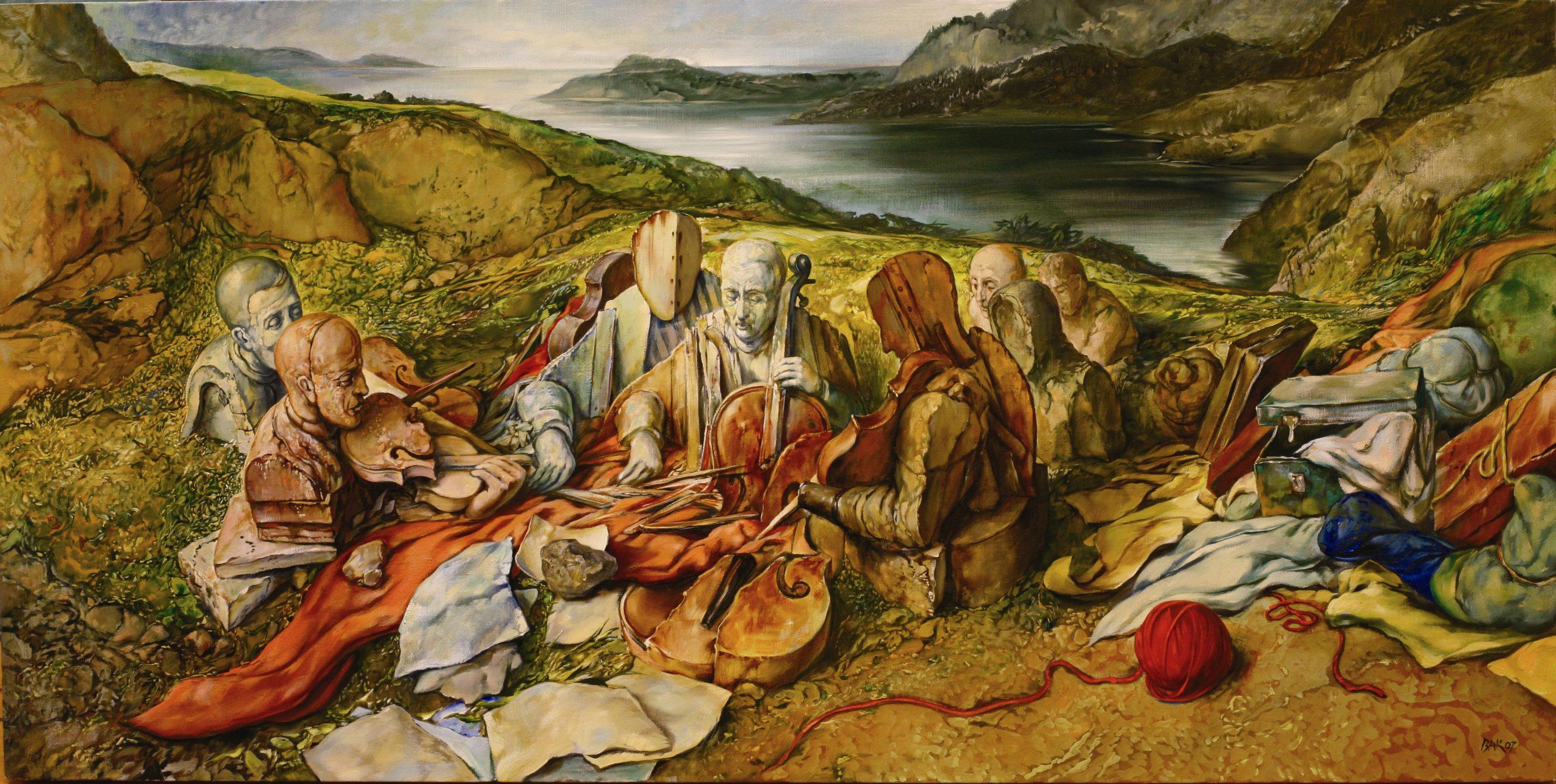
1: Holocaust Survivor Samuel Bak, ‘Accidental Music,' 2007, Oil on canvas


r/WW2HolocaustHistory • • 1d ago

November 27, 1945 Nuremberg Tribunal Day 6: Proving the Conspiracy

Post image
11 Upvotes

“We Must Establish Incredible Events by Credible Evidence”

“Alderman had assembled a remarkable array of German military and diplomatic documents, of great historical interest and utmost value for the proof of Hitler's aggressive intentions and the involvement of others in his war plans, including the substance of Hitler's meetings with the principal military commanders and other high officials. He had the benefit of excellent trial briefs prepared by bright young lawyers working under the supervision of Sidney Kaplan.

However, he did not plan to submit these briefs to the Tribunal, but rather to use them as the basis for his own running commentary on the documents which he would read to the Tribunal. That would constitute his presentation and make a written brief unnecessary. It would also eliminate any problem of making copies of the briefs for the Tribunal, defense counsel, or others, since no briefs would be submitted to the Tribunal.

But Alderman had been able to extract from the overworked clerical force only two sets of the English translations of these documents, and he knew, from what had happened with his predecessors, that this would cause trouble.

He was ready for it , and when Dr. Dix declined to accept the single set of copies offered for the defense counsel, Alderman said:

“If Your Honor please, may I make this suggestion . . . I expect to read the pertinent parts of the documents into the [interpreting] system so that they will go into the transcript of record. Counsel for the German defendants will get their transcripts in German; our French and Russian Allies will get their transcripts in their language, and it seems to me that that is the most helpful way to overcome this language barrier.”

That was essentially the way the Tribunal resolved the document problem at a closed meeting the next day. Storey's physical facilities simply could not produce enough copies to meet the needs of the trial participants, and nobody could cope with the flood of documents that Storey's lawyers had let loose.

Reading the documents into the record would ensure that after each session, when the record was typed and duplicated in the four languages of the trial, all concerned would have both the text of the documents, and what Alderman had said in connection with them, in their own languages.

It would also slow the previously mad documentary pace of the trial so that the import of the documents could be grasped as they were read. But would it slow the trial process too much?

Pending the expansion of the prosecution's translating and duplicating facilities, no better solution was suggested. When the trial sessions resumed on November 26, the Tribunal announced new rules for the prosecution's use of documents.

The first and most important of these was "That in the future only such parts of documents as are read in court by the Prosecution shall in the first instance be part of the record." Inclusion of the phrase "in the first instance" was to make clear that the parts of a document not so read could later become part of the record if read by the same or another lawyer.

The only reason for such a rule was, of course, the continuing lack of a sufficient supply of documents and briefs in the four languages. Initially, the new rule did not much hamper Alderman, who had planned in any event to read his better documents in full. But the rule did greatly slow the proceedings, and Jackson soon sought ways and means to alter it. Nonetheless, the rule remained in effect until mid-December.

Alderman's presentation continued until the afternoon of November 29, by which time he had completed the detailed evidence through the German annexation of Austria in March 1938. Other matters were taken up during the next two days, after which Alderman returned to the lectern.”

From “The Anatomy Of The Nuremberg Trials: A Personal Memoir”, by Telford Taylor

“The Victor Will Never Be Asked If He Told the Truth” -A. Hitler

October 1933: Germany withdraws from the League of Nations and the Geneva Disarmament Conference, signaling an end to international cooperation.

March 1935: Hitler publicly repudiates the Treaty of Versailles, reinstating military conscription and unveiling the Luftwaffe (air force).

March 1936: German troops remilitarize the Rhineland in direct violation of Versailles and the Locarno Treaties; Britain and France do not intervene.

November 1936: Germany signs the Anti-Comintern Pact with Japan (and later Italy), forming the diplomatic foundation of the Axis powers.

November 1937: At the secret Hossbach Conference, Hitler outlines his concrete timeline and plans for seizing Lebensraum (living space) in Austria and Czechoslovakia by force.

March 1938: Germany annexes Austria (the Anschluss) without resistance.

September 1938: Through the Munich Agreement, Britain and France cede Czechoslovakia’s Sudetenland to Germany in a final attempt at appeasement.

March 1939: Violating the Munich Agreement, German forces invade and occupy the rest of Czechoslovakia, proving Hitler's ambitions extend beyond ethnic German territory.

May 1939: Germany and Italy sign the Pact of Steel, formalizing a full military alliance.

August 1939: Germany and the Soviet Union sign the Molotov–Ribbentrop Pact (Nazi-Soviet Non-Aggression Pact), secretly dividing Eastern Europe and removing the threat of a two-front war.

September 1, 1939: Germany invades Poland, triggering declarations of war from Britain and France two days later and officially beginning WW2 in Europe.

Full Day’s Transcript: http://avalon.law.yale.edu/imt/11-27-45.asp

NOT MY LINKS

Video: https://www.youtube.com/watch?v=liYUUvYOlb8

1: Hitler Came the Closest (1943), a gouache illustration by Russian-American artist Boris Artzybasheff created for a WW2 magazine advertisement for Vultee Aircraft.


r/WW2HolocaustHistory • • 1d ago

November 27, 1942 Holocaust Diary of Ilya Gerber: "Do We Have a Choice?"

Post image
45 Upvotes

Food Smuggling & Survival in the Kovno Ghetto

Ilya Gerber, a 16 year old Jewish boy, kept a detailed record of major events that happened in the Kovno Ghetto under the German occupation.

He came from a privileged, well-connected family to the ghetto’s Jewish leadership council. For a while, he had enough food to eat, but he could see that there were many who had to go hungry.

The Nazis simply didn’t allow enough food through the checkpoints that surrounded the ghetto. The only way the starving residents could make up the difference was through smuggling.

Ilya wrote about the issue of smuggling on November 27, 1942.

“I haven’t written since the nineteenth because there was no very important Jewish news, except that brigades have lately been smuggling in [food] not in their pockets, and not in little packages, but in fact in whole bundles…

Mostly, when the ghetto commandant stands by the gate, the bundles or packages are confiscated and you sometimes feel his whip. But if he is not there it costs you whatever it takes to grease the palm of the partisan [Lithuanian auxiliary serving the Germans] or the policeman and you pass through undisturbed.”

Ilya’s description reveals one of the main problems with the smuggling strategy. The guards at the gate had to be bribed to look the other way when extra food or other necessities were brought through the gate.

Other ghetto policeman who had to be paid off as well. This could become very expensive and most people only had their savings from before the war to rely upon. Still, the payments had to be made because for many the alternative was starvation.

Even though the costs from bribery went up continuously, Ilya wrote about the only valid response.

“And we pay. Do we have a choice? What if they confiscate? And how often has it happened that they confiscated everything [anyway], the fine fellows.”

There was no guarantee much-needed food would not be seized in spite of the payment of bribes, but what choice did the people have but to try anyway?

You may read entries from Ilya Gerber’s dairy in the book, Salvaged Pages: Young Writers’ Diaries of the Holocaust by Alexandra Zapruder." (holocqustedu)

July 23, 1924. Ilya Gerber is born in Kovno (Kaunas), Lithuania, to a well-connected, Zionistic family; his father was a prominent music teacher and conductor.

June–August 1941. Germany invades Lithuania. Following brutal pogroms, Nazi authorities seal roughly 30,000 surviving Jews into the Kovno Ghetto. Ilya begins keeping a diary (only his third notebook survives).

October 29, 1941. During the "Great Action," German SS units and Lithuanian auxiliaries murder 9,200 ghetto residents at the Ninth Fort. A period of relative, tense calm ("the Quiet Period") follows as remaining residents are used for forced labor.

August 26, 1942 Holocaust Diary of Ilya Gerber: : r/WW2HolocaustHistory Begins his third surviving diary notebook, documenting daily ghetto life, rumors, starvation, and the black market. (Note: Although your excerpt notes he was 16, Ilya had just turned 18 in July 1942).

September 24, 1942 Holocaust Diary of Ilya Gerber: "Beating Their Breasts, Then a Bite to Eat" : r/WW2HolocaustHistory

November 27, 1942. Ilya records the high cost of smuggling food past the ghetto gates and bribing guards to stave off starvation.

January 23, 1943. Ilya writes his final surviving diary entry, ending with a lighthearted note asking where he can find a new notebook.

Autumn 1943. The SS takes direct control of the ghetto, converting it into the Kauen concentration camp and resuming mass deportations.

July 1944. As the Soviet Red Army advances, the Germans liquidate the Kovno Ghetto with grenades and dynamite. Surviving prisoners—including Ilya—are deported to concentration camps in Germany, including Dachau.

April 28, 1945. Just days before Germany's surrender, Ilya Gerber is killed during a forced death march from Dachau toward Wolfratshausen, Germany.

A Holocaust victim's diary depicting life in the Kovno ghetto - ‘The urge to deny the horrific reality – or alternatively to adapt to it and concentrate on the here and now and cling to a seemingly ordinary life – was characteristic of life in the ghettos’ --> https://www.jpost.com/opinion/youth-behind-barbed-wire-fences-572023

NOTE: There are no known surviving photographs of Ilya Gerber. Because he and his immediate family perished during the Holocaust and the Kovno Ghetto was systematically destroyed with explosives in July 1944, any personal family albums or portraits were lost.

1: Left: Right: A BARBED-wire fence along Panrow Street, separating the two parts of the Kovno ghetto in Lithuania.


r/WW2HolocaustHistory • • 1d ago

Whitewashing Nazi Profits?

Thumbnail
gallery
15 Upvotes

The Battle Over Hamburg’s €300M Opera House

Opponents have called it ‘a whitewashing of Nazi profits’, claiming billionaire Klaus-Michael Kühne neglected to confront his company’s role in the Third Reich

"There was the concert hall, the Elbphilharmonie, and the business college that bore the family name. There was the local football club, too, which Klaus-Michael Kühne would bail out when the team was in the doldrums.

Then, one day, the controversial billionaire philanthropist decided that the port city of Hamburg should have another significant chunk of his fortune to revive its fortunes. The city was a “little sleepy”, he complained, and “not very significant economically”. Other metropolises were “better in science”, he added, for good measure. What was required now was a vast opera house on the banks of the Elbe.

Though his offer of over €300 million towards the project was welcomed by the mayor, Peter Tschentscher, who described it as a “generous gift and a great chance for the cultural city”, others were not so sure. It might be time to look a gift horse in the mouth, said a growing number of burghers of Germany’s second city.

The reason is linked to the history of Hamburg and the history of Germany. Unlike other top companies that profited under the Nazi regime, such as BMW, which used forced labor, or Deutsche Bank, which helped to finance the construction of Auschwitz, Kühne’s family company, Kühne and Nagel, a global player in the freight business, is yet to commission research into its role during the Third Reich.

Kühne, 88, whose fortune is estimated at about €36 billion, says that there is a good reason for this: the main source of the basis of any future investigations, the company’s archives, were destroyed in Allied bombing raids. “I think about the subject more now,” he told Die Zeit earlier this month, “partly because I am constantly being asked about it.”

A son of Hamburg who has lived as a tax exile in Switzerland since the 1970s, Kühne’s family has, at best, a chequered history with the Third Reich. His father, Alfred, and his uncle, Werner, joined the Nazi Party shortly after Hitler came to power in January 1933. “It wasn’t talked about much at home,” said Kühne of his family’s past. “But that’s understandable because it was a terrible time and an embarrassing time that people don’t like to remember.”

That may be, but Hamburg is calling on the family to publicly confront its demons. The Kühne and Nagel group had a monopoly on moving furniture and other household property seized from thousands of Jews in occupied western Europe who had fled or been deported to concentration camps. It transported the goods back to the Reich, where they were sold at auction.

Its role earned it the “National Socialist Model Enterprise” award each year between 1939 and 1945. The company’s Jewish co-owner, Adolf Maass, left the company in April 1933 after more than 30 years, without receiving a payoff. He is said to have been forced out, although the exact circumstances of his departure remain murky. He was murdered in Auschwitz.

Resistance to the opera house is growing. Critics say the local authorities should have consulted the public rather than presenting it as a fait accompli reached with Kühne. “A gift worth hundreds of millions of euros is no substitute for the necessary public participation and transparency,” said Heike Sudmann, the urban development spokeswoman for the opposition Left Party.

Meanwhile, a group of historians, architects and construction experts this week called for a public inquiry into whether a new theatre was even needed, given sharp declines in opera audiences. They noted that Kühne was being accused of failing to explore his company’s Nazi past. “The city of Hamburg should only accept funds from him if these allegations are cleared up, the origin of the assets is clarified, and the role of the company in the Third Reich is appropriately presented.”

Nevertheless, the city was expected to approve the project on Wednesday. Opponents staged demonstrations ahead of the vote to protest against what they called the “whitewashing of Nazi profits”. Activists lamented what they viewed as “ignorance of historical guilt” by the authorities. Some 10,000 people have so far signed a petition against the project.

Supporters, however, said it would give Hamburg a shining new landmark during a period of economic decline. It could, assuming it gets completed on time by 2034 and within the €500 million budget, also serve as a beacon nationally given Germany’s struggles with large construction projects that have been throttled by red tape, funding problems and not-in-my-back-yard protests.

The design, chosen in mid-November, is by the prominent Danish architect Bjarke Ingels, and features concentric garden terraces reaching out towards the port. They will be open to the public without the need to purchase an opera ticket.

If it is ever completed, the opera house would represent a victory, of sorts. A sign of Hamburg’s decline came in 2023, when construction of its landmark 245-metre (804 ft) Elbtower halted at 100 metres following the bankruptcy of Austria’s Signa real estate group. Other projects are struggling across the country, too. The completion of Stuttgart’s new underground central train station — conceived over 30 years ago and now billions of euros over budget — appears set to be delayed again. Last week, reports suggested its December 2026 deadline was in jeopardy.

Then there’s another problem: the location is historically charged, too. Even if the problems around the family history of Kühne can be overcome, there’s the small matter of building work near the Baakenhafen quay. Between 1904 and 1908, the German empire dispatched colonial troops from here who went on to commit genocide against the Nama and Herero peoples in what is now Namibia. That battle, however, is unlikely to involve Kühne." lootedart.com/news.php?r=XKP6QB609681

NOT MY LINKS

UPDATE - The man who promised Hamburg an opera house has died --> The man who promised Hamburg an opera house has died - Slippedisc

1: Klaus-Michael Kühne with his father, Alfred, who joined the Nazi Party shortly after Hitler came to power Right: The winning design for the new opera house

2: The belongings of deported Jews are ransacked for valuables in 1944

3: A Jewish family’s possessions on a horse-drawn cart during their flight from Memel as German crowds watch and jeer


r/WW2HolocaustHistory • • 2d ago Regret

November 26, 1942 Holocaust Diary of Moshe Flinker: Nowhere Left to Run

Post image
74 Upvotes

"Our Sufferings Have by Far Exceeded Our Wrongdoings"

Moshe Flinker was 16 years old when he began keeping his diary.

As a Dutch citizen, he was already living under German occupation for over two years, but by the end of 1942 the danger facing Jews was increasing. Moshe and his family believed they would soon be deported eastward, so they began to look for a way to escape from Holland.

Moshe’s father found a way to get his family across the border into Belgium where he hoped they would be safer. At first, no one knew they were Jewish. Sometimes Moshe even dared to go onto the street without his Jewish star. This was not a secret they could keep for long, though. Soon they were living with all of the restrictions that applied to Jews back in Holland.

Moshe hated the fact he couldn’t go to school or work. One of the reasons he started writing was to stave off idleness. His first diary entry on November 24, 1942, told the story of his family’s escape to Brussels and the circumstances of life in this new city. By the time he made his next entry two days later, his attention began to turn to deeper thoughts.

The main theme of Moshe’s diary was his attempt to understand the reasons why Jews were experiencing so much suffering and persecution. He was a deeply religious young man and sought an explanation that would fit his experiences into a larger, purposeful plan that was in the hands of the Lord.

He struggled with this concept and was unable to find a meaningful resolution. He wrote,

“We are in a very bad situation. Our sufferings have by far exceeded our wrongdoings. What other purpose could the Lord have in allowing such things to befall us? I feel certain that further troubles will not bring any Jew back to the paths of righteousness…and indeed what can God intend by all these calamities that are happening to us in this terrible period?”

Moshe was not alone in his mental and emotional anguish. Many people, then and now, have trouble with the idea that suffering isn’t always driven by a redemptive purpose. In the case of the Holocaust, the main cause of the persecution appears to have been the unjustifiable prejudice, hatred, and false ideology of the Nazis.

Excerpts from Moshe Flinker’s diary have been published in a book entitled, Salvaged Pages: Young Writers’ Diaries of the Holocaust by Alexandra Zapruder. (holocaustedu.org)

May 19, 1943 Holocaust Diary of Moshe Flinker: : r/WW2HolocaustHistory

June 17, 1943 Holocaust Diary of Moshe Flinker: Moshe Flinker was a Deeply Religious Young Man. He was only Sixteen Years Old when he began Keeping his Diary, but saw himself as Part of an Ancient People that was coming to a Pivotal Moment in its History. : r/WW2HolocaustHistory


r/WW2HolocaustHistory • • 2d ago

November 26, 1945 Nuremberg Tribunal - Day-5: The Smoking Gun of Nazi Aggression

Thumbnail
gallery
16 Upvotes

Nazi Leaders Are Shocked—Shocked!—to Hear Hitler’s Secret 1937 Blueprint for European Conquest

“Mr. Alderman read the fateful "Hoszbach document" recording a secret speech by Hitler, outlining his aggressive plans to Göring, von Blomberg, von Fritsch, Raeder, and von Neurath, on November 5, 1937. In discussing the various possibilities in his planned aggressions, Hitler stated in part (as recorded by his adjutant Hoszbach):

 "German politics must reckon in part with its two hateful enemies, England and France, to whom a strong German colossus in the center of Europe would be intolerable . . .

 "For the improvement of our military political position it must be our first aim, in every case of entanglement by war, to conquer Czechoslovakia and Austria, simultaneously, in order to remove any threat from the flanks in case of a possible advance westward . . .

Once Czechoslovakia is conquered, and a mutual German-Hungarian frontier is obtained, then a neutral attitude by Poland in a German-French conflict could be more easily relied upon. Our agreements with Poland remain valid only as long as Germany's strength remains unshakeable . . .

The Fuhrer believes personally, that in all probability England and perhaps also France, have already silently written off Czechoslovakia . . .

Naturally, we should in any case have to secure our frontier during the operation of our attacks against Czechoslovakia and Austria . . . If Germany profits from this war by disposing of the Czechoslovakian and Austrian questions, the probability must be assumed that England, being at war with Italy, would not decide to commence operations against Germany . . .

In view of the information given by the Fuhrer, Generaloberst Goering considered it imperative to think of a reduction or abandonment of our military undertaking in Spain."

 LUNCH HOUR: Many expressed amazement at this document revealing Hitler's conception of power politics. Jodl said he had no idea of it at the time. One thing that impressed him about the document today was the overestimate of Italy's importance.

 Seyss-Inquart likewise said he could never understand Hitler's evaluation of Italy. He had always called the Italians "small fry." In reference to the Hoszbach document he said,

"If I had only known in 1937 that he had made such a statement, I certainly would have thought twice before playing along."

 Von Schirach thought the document was "concentrated political madness." Frank said,

"Just wait till the German people read that and see the kind of dilettantism with which the Fuhrer sealed their fate!"

Göring didn't like all this talk and broke it up with

"Ach, fiddlesticks! What about the grabbing of California and Texas by the Americans? That was plain aggressive warfare for territorial expansion too!"

Ribbentrop, looking quite disheveled, shook his head sadly when I asked him if he hadn't known about that statement of policy.

"No, he never told me about it. I tell you again, Herr Doktor, if the Allies had given us half a chance on the Versailles issue, you never would have heard of Hitler."

 Fritzsche admitted that the document threw a different light on the case. "Now I can see why there is a question of conspiracy, and I'll have to alter my own position to the indictment."

AFTERNOON SESSION: Mr. Alderman described the next step in Nazi planned aggression, after Austria and Czechoslovakia had been taken care of. A document by Hitler's adjutant Schmundt recorded Hitler's outright decision for aggressive war in another secret meeting on May 23, 1939, in the presence of Goering, Keitel, and Raeder. After speaking of Lebensraum, the document goes on to quote Hitler:

"The national-political unity of the Germans has been achieved, apart from minor exceptions."

(At this point Mr. Alderman interpolated, "I suppose those were in the concentration camps.")

"—Further successes cannot be obtained without the shedding of blood . . .

There is therefore no question of sparing Poland, and we are left with the decision: to attack Poland at the first suitable opportunity . . .

If there were an alliance of France, England, and Russia against Germany, Italy, and Japan, I would be constrained to attack England and France with a few annihilating blows . . . Albeit under protest, Belgium and Holland will yield to pressure . . . "

 Having made his preparations for war, Hitler called together his military leaders on August 22, 1939 at Berchtesgaden and explained that the war had to come in his lifetime and he was now ready to strike, as another document showed, "I will give a propagandists cause for starting the war, never mind whether it is plausible or not. The victor shall not be asked, later on, whether we told the truth or not. In starting and waging a war, not the right is what matters but victory."

Toward the end of the day, Frank handed me a note describing an "Apocalyptic vision" he had had in the dock while listening to the last document. It was headed "Hitler on August 22, 1939," and ran as follows:

"We sit opposite the court.—And silently the train of the dead goes endlessly by.—It is unbroken.—Pale and wan, without sound, in the dim yellow-gray light of eternity, this stream of misery flows on.—All, all surge on without pause, enshrouded in dim mist, whipped by the flames of mankind's agony—hither—thither—thither—on and on, and no end is in sight . . .

The human beings torn from life in this war are the most gruesome booty of Death, raging in hate and destruction—youth and age, growth and existence, pride and humility . . .

There they go—Poles, Jews, Germans, Russians, Americans, Italians—all nationalities, bleeding and wasting away. And one voice cries: 'This war must come, for only as long as I live can it come about!' Ah, what hast Thou suffered to come to pass, Almighty God!"

 From “Nuremberg Diary”, by G. M. Gilbert “Formerly Prison Psychologist at the Nuremberg Trial of the Nazi War Criminals”

The Smoking Gun

The Hossbach Memorandum served as the prosecution’s smoking gun, proving Nazi aggression was premeditated as early as November 1937 rather than reactive or defensive. Historically, it dismantled the postwar myth that Hitler stumbled into WW2, and legally, it directly implicated several men sitting in the dock:

Hermann Göring: The notes showed Göring didn't just listen passively—he actively participated in the strategic planning by immediately advising a scale-back of Germany's military involvement in Spain to conserve resources for Hitler's upcoming European conquests.

Konstantin von Neurath: As Foreign Minister at the time, Neurath tried to portray himself at Nuremberg as a traditional, moderate diplomat who merely tried to restrain Hitler. His presence at this secret war briefing—and his continued service afterward—proved he knew of Hitler’s aggressive intentions early on and lent diplomatic cover to them anyway.

Erich Raeder: As Commander-in-Chief of the Navy, Raeder claimed his naval buildup was purely defensive and compliant with treaties. The memorandum proved he was directly briefed on Hitler's offensive timeline years in advance and planned his fleet accordingly.

The Absent Attendees (von Blomberg & von Fritsch): Both military leaders raised practical objections at the meeting and were purged from their posts shortly afterward—a fact prosecutors used to prove that those who remained in power (like Göring and Keitel/Jodl's command structure) willingly aligned themselves with Hitler's war of aggression.

Sidney S. Alderman, Associate Trial Counsel for the United States Prosecution Team:

"One of the most striking and revealing of all the captured documents which have come to hand is a document which we have come to know as the Hossbach notes of a conference in the Reich Chancellery on 5 November 1937 from 1615 to 2030 hours, in the course of which Hitler outlined to those present the possibilities and necessities of expanding their foreign policy, and requested-I quote:

"That his statements be looked upon in the case of his death as his last will and testament."

And so with this document we shall present to the Tribunal and to the public the last will and testament of Adolf Hitler as he contemplated that last will and testament on 5 November 1937. The document comes to hand through the United States Department of State and it is authenticated by the seal of the Secretary of State of the United States. It is Document Number 386-PS in our series of numbered documents. I offer it in evidence as Exhibit USA-25.

Before reading it, I note at the start that the recorder of the minutes of this meeting, then Colonel Hossbach, was the Fuehrer's adjutant. I note also the presence at this conspiratorial meeting of the Defendant Erich Raeder. The Defendant Constantin von Neurath was present. The Defendant Hermann Wilhelm Goering was present. The minutes of this meeting reveal a crystalization towards the end of 1937 in the policy of the Nazi regime. Austria and Czechoslovakia were to be acquired by force. They would provide Lebensraum (living space) and improve Germany's military position for further operations.

While it is true that actual events unfolded themselves in a somewhat different manner than that outlined at this meeting, in essence the purposes stated at the meeting were carried out. The document destroys any possible doubt concerning the Nazis' premeditation of their Crimes against Peace. This document is of such tremendous importance that I feel obliged to read it in full into the record:"

FULL TEXT - Hossbach Memorandum --> https://avalon.law.yale.edu/imt/hossbach.asp

NOT MY LINKS

For The Full Days Transcript: http://avalon.law.yale.edu/imt/11-26-45.asp

NOT MY LINKS

The Nuremberg Defendants: https://4rs.neocities.org/index.html

NOT MY LINKS

VIDEO - https://www.youtube.com/watch?v=tengLdKIKfY

1: This is the anti-Nazi political cartoon "Pride" by Polish cartoonist Stanisław Dobrzyński, published in his 1944 collection Sein Kampf (His Struggle).


r/WW2HolocaustHistory • • 2d ago

November 26-27, 1941 Holocaust: The First Step of a Large-Scale Deportation of Jews from Würzburg Gets Underway

Thumbnail
gallery
39 Upvotes

Over 1,000 Franconian Jews are Sent Toward Riga; 52 Survive

On November 26, Jews from Würzburg and the surrounding area were ordered to gather in a square (Platz'schen Garten) where their few remaining belongings were meticulously inspected and confiscated by German officials. Each person was assigned a number on a tag they had to wear.

Early on November 27, the approximately 1,000 deportees were marched through the streets to the train station. The train, which already carried Jews from other German cities, reached Nuremberg the same day, and the deportees were eventually transferred to Riga.

The Würzburg Jews arrived in the Riga ghetto in late November/early December, shortly after most of the local Latvian Jews had been murdered in the Rumbula massacre to make room for deportees from the Reich. The Würzburg deportees were housed in the vacated dwellings and faced extreme cold, hunger, and forced labor.

Of the roughly 1,000 Jews on this specific transport, only 52 survived the war, including just 15 from Würzburg. Most who arrived were murdered about two years later during the liquidation of the "German" ghetto, with the few remaining survivors eventually sent to concentration camps like Kaiserwald and Auschwitz.

The entire operation, including the gathering and march, was documented in a photo album by the German police officer in charge for the local Gestapo officer.

Yad Vashem - DETAILS & PICS---> https://www.yadvashem.org/communities/wurzburg/during-holocaust/deportation-27-november-1941.html

January 1933 Roughly 2,145 Jews live in Würzburg (about 2% of the city's population), anchoring a rabbinate that oversees 18 surrounding Lower Franconian communities.

1933–1937 Anti-Jewish boycotts and street violence begin in March–April 1933. Over the next four years, Jewish businesses are marked or forced to close, lawyers are disbarred, passports are confiscated, and Jewish residents are barred from public pools and student housing.

November 9–10, 1938 Kristallnacht: SA units raid Jewish homes and shops, desecrate Torah scrolls, and violently attack students at the local Jewish school. Around 300 Jewish men from the area are arrested and sent to concentration camps.

1939–1941 Chief Rabbi Dr. Sigmund Hanover is forced to flee Germany in January 1939. As surrounding rural villages in Lower Franconia become increasingly unsafe, roughly 1,400 Jewish refugees move into Würzburg. By September 1941, all Jews are forced to wear the yellow star.

November 27, 1941 202 Jews from Würzburg (part of a 1,008-person Franconian transport) are deported via Nuremberg to Riga, Latvia. Only 15 from Würzburg survive.

Early 1942 Würzburg's remaining Jews are evicted from their apartments and crowded into cemetery buildings and the Jewish hospital, while older residents are conscripted into forced labor.

March 1942 – June 1943 Five more major deportations empty Würzburg and neighboring towns (such as Kitzingen, Schweinfurt, and Bad Kissingen).

March 23 & April 25, 1942: Two transports to the Lublin district / Izbica transit ghetto in occupied Poland.

September 10 & September 23, 1942: Two transports primarily of elderly residents to Theresienstadt.

June 1943 (with final stragglers sent to Auschwitz): The last major regional transport departs. In total, Gestapo records count 2,063 Jews deported from Lower Franconia across these six transports.

September 22, 1943: Nazi authorities officially dissolve the Würzburg Jewish community. Only 29 Jews remain in the city, mostly protected temporarily by "mixed" marriages.

Deportation of Jews from Wuerzburg, Germany, 27 November 1941

1: Right: 26 November 1941: an inspection of Jews and their belongings, immediately prior to deportation. Left: 26 November 1941: Jews in Würzburg, gathered prior to deportation; among them Heinrich Michel (deportation number 339).

2: 26 November 1941: Jews in Würzburg, prior to deportation. First from the right - Wilhelm Reinstein (deportation number 227).

3: 27 November 1941: Jews being marched from the concentration point to the train station in Würzburg, in preparation of deportation.

4: 27 November 1941, early morning: photographs depicting the first deportation of Jews from Würzburg.


r/WW2HolocaustHistory • • 2d ago

November 26, 1943 Holocaust: The Subterfuge of Breckinridge Long, an Antisemite in the US State Department

Post image
32 Upvotes

His Deceptive Congressional Testimony, Designed to Block Holocaust Rescue Efforts

Assistant U.S. Secretary of State Breckinridge Long appeared in a closed-door session before the House Committee on Foreign Affairs. His objective was clear: defeat a bipartisan resolution calling on President Franklin D. Roosevelt to establish a separate government agency dedicated to rescuing European refugees—a move the State Department fiercely opposed.

During his testimony, Long painted a misleading picture of American humanitarian efforts, claiming that the U.S. had already admitted approximately 580,000 refugees since Hitler took power in 1933, and implying the vast majority were Jewish. In reality, this was a gross exaggeration; the true number was less than half of what he reported.

He insisted the State Department was already doing everything possible to save Europe's Jews and argued that creating a separate rescue agency would be a direct "repudiation" of their work. Long leaned heavily on wartime security fears, implying that strict immigration bottlenecks were necessary to prevent enemy spies and saboteurs from infiltrating the country among refugees.

Initially, Long’s presentation worked. Impressed by his figures, the committee members backed away from the rescue resolution and quietly shelved it without a vote. However, Long made a critical miscalculation when he decided to release his testimony to the public.

Jewish organizations and officials within the U.S. Treasury Department quickly dismantled his claims, exposing the 580,000 figure as false and revealing that the State Department had actively suppressed intelligence regarding the Nazi mass murder of Jews.

The resulting public outcry and political pressure ultimately forced President Roosevelt’s hand: in January 1944, FDR bypassed the State Department entirely and established the War Refugee Board, while Long was stripped of his oversight of the Visa Division.

The Antisemitic Breckinridge Long - “Acquiescence... in the Murder of the Jews"

There is substantial primary-source evidence—largely from Breckinridge Long’s own private diaries and official correspondence—that he held deeply Antisemitic, nativist, and pro-fascist views. While Long publicly framed his policies around "national security" and preventing Nazi spies from entering the U.S., his private writings and actions reveal strong personal prejudice against Jews and Eastern Europeans.

When historians gained access to Long’s personal papers and diaries after his death in 1958, they found explicit remarks linking Jews to communism and praising fascist ideology. After reading Adolf Hitler’s manifesto disguised as a ‘Memoir’, Mein Kampf, in 1938, Long wrote in his diary that the book was "eloquent in opposition to Jewry and to Jews as exponents of Communism & chaos," adding,

"My estimate of Hitler as a man rises with the reading of his book".

Long frequently wrote with hostility about American Jewish leaders and refugee advocates who pressured the State Department to act. In his diary, he described feeling besieged by "communists, extreme radicals, Jewish professional agitators, [and] refugee enthusiasts".

In a 1940 entry, he complained that refugee sympathizers—whom he noted were "largely concentrated along the Atlantic seaboard, and principally around New York"—had joined forces with elements trying to push the U.S. into WW2.

He also expressed personal loathing for prominent Jewish leader Rabbi Stephen Wise, dismissing Wise's pleas for victims of Nazi torture as "sanctimonious".

Before overseeing the Visa Division, Long served as the U.S. Ambassador to Italy (1933–1936), where he openly admired Benito Mussolini’s regime. In letters to friends and dispatches to Washington, he praised Italian fascism as "the most interesting experiment in government to come above the horizon since the formulation of our Constitution".

His sympathetic reports on Mussolini were so pronounced that First Lady Eleanor Roosevelt privately referred to Long as a "fascist". Even before his diaries became public, contemporaries recognized his bias based on his relentless obstruction of Jewish rescue. Representative Emanuel Celler (D-NY), a vocal advocate for refugees, publicly characterized Long at the time as "cold and austere, stiff as a poker... [and] Antisemitic".

In June 1940, Long wrote an internal memo outlining how consular officers could effectively halt immigration without changing the law by instructing them to "put every obstacle in the way... which would postpone and postpone and postpone the granting of the visas".

Because of these policies, roughly 90% of the U.S. immigration quota places available to people from German- and Italian-controlled countries went unfilled during the war—leaving nearly 190,000 legal spots unused while European Jews were being murdered.

In early 1944, officials in Henry Morgenthau Jr.’s Treasury Department compiled a scathing report on the State Department's deliberate suppression of Holocaust intelligence and blocking of rescue funds. The report’s original draft title explicitly accused the government—and Long’s division in particular—of "Acquiescence... in the Murder of the Jews".

According to the United States Holocaust Memorial Museum, the 1930s and 1940s State Department fostered a culture that tolerated "nativist, xenophobic, and often antisemitic attitudes and actions".

Most Holocaust historians—including David Wyman, Deborah Lipstadt, and Rafael Medoff—agree that while Long cited wartime espionage fears as his official justification, his extreme nativism and personal Antisemitism were central drivers behind his efforts to keep Jewish refugees out of the United States. https://encyclopedia.ushmm.org/content/en/article/breckinridge-long

1: Left: Breckinridge Long, American Eichmann??? An Enquiry into the Character of the Man Who Denied Visas to the Jews, by Neil Rolde - “Students of mid-twentieth-century American political and diplomatic history remember Breckinridge Long as a well-connected and influential force, particularly during the Roosevelt years. Those with a particular concern for the tragically inadequate American efforts to rescue victims of the Holocaust point to Long as a central figure in resisting and obstructing those efforts.

He has been characterized as an anti-Semite, a xenophobe, and alternatively as an anti-communist who opposed immigration out of fear of communist infiltration. Interesting historical figures are, regretfully, often reduced to single dimensions, and the complexity of their lives and motivations are lost.

In this erudite, thoughtful and well-written biography, Neil Rolde has fleshed out a multidimensional portrait of this gifted, influential and flawed public figure, traced his extraordinary career, and explored a range of theories as to Long's motivations. In so doing, Rolde has provided a wealth of information not only about Long but also about this critical and troubled chapter in modern American political and diplomatic history.” -David M. Gordis, PhD, President Emeritus, Hebrew College” (Amazon)

NOTE: I've not read this book. The cover works well to illustrate the Post. -W


r/WW2HolocaustHistory • • 2d ago

Two Sisters, Two Worlds Apart

Post image
23 Upvotes

How One Survived the Holocaust the Other Knew Nothing About

"With antisemitism seeping slowly into our society, my sister Evelyn Grapek, now 97, recently talked about her childhood memories in Berlin, Germany, during the early years that Hitler rose to power.

In 1937, she explained to me, she and my parents were still able to escape the increasing disdain for the Jews in Germany, but only with plenty of planning.

They arrived in New York in 1937. I was born a year later and, for much of my life, had little knowledge of what she and my parents went through to start a new life in America. Her story is worth sharing. In italics is what Evelyn told me.

“Prior to 1935, when the Nuremberg laws, dictated by Hitler, became the law of the land, we had a wonderful life. Daddy made a good living as the proprietor of a men’s clothing store. Mommy had a maid; I had a nanny.

“Although our parents were somewhat aware of the changes in government, they were not terribly concerned that they would be affected. You could say our parents had their heads in the sand, like many of their friends and relatives. They really didn’t understand what was happening, that antisemitism was creeping up slowly.

“As Hitler became more powerful, Jewish children were forced out of their neighborhood schools, grown-ups were deprived of their civil rights, even such extreme laws as not being allowed to just sit on a park bench, enter a restaurant or simply enjoy a concert were strictly enforced.

“Daddy became alarmed. His fear reached greater heights when the laws forbade his Christian sales staff to continue being employed by a Jew. My mother’s Christian maid was forced to leave, as was my baby nurse.”

More reality set in, she told me, when one day teenage Nazi thugs, who were free to roam the streets, came into our father’s store shouting “Heil Hitler” and helped themselves to armloads of shirts and trousers. Evelyn, who was 7 years old at the time, explained how that incident remains deep in her psyche as she relives the panic when she and our mother heard the commotion from their upstairs apartment.

Over the years, I had heard bits and pieces of my family’s issues -– but never learned the full story of what they went through to leave Nazi Germany and resettle in the United States. Talking about their past lives was a taboo topic. Don’t ask, don’t tell was the unwritten rule in my home. It was too painful to talk about. While they survived, they still struggled with guilt for those family members who were burned to death in Nazi concentration camps.

However, after we witnessed the televised attacks of a Jewish synagogue and the growing number of local antisemitic attacks, Evelyn was willing to talk about the family’s horrific experiences:

“You need to know. It can happen here … I’ll tell you what I remember …

“Daddy wanted to leave, even though his siblings and friends said he was overreacting: ‘Things will change; Hitler is a passing phase.’ He struggled with his decision until I was forced to leave my neighborhood friends and attend a school for Jewish children only. As antisemitism affected more and more of our everyday life, Daddy’s fears increased. One day, walking home from school, I was stopped by a small group of boys and girls shouting, ‘Yid bitch,’ or something like that. That was Daddy’s final straw, so to speak. Our father understood what so many of his friends and family did not. Antisemitism was taking over our lives.

“That decision to leave was the easy part; how to leave was the conundrum. Visas to leave the country were becoming scarce. Monies earned by Jews were confiscated. Mom and Dad seemed nervous all the time. Talk was always in a whisper. I never understood, but I inherited their fears.”

Our discussion continued with me trying to understand how our dad not only had the courage to leave but the know-how to carry out a plan to leave a good life behind forever:

“It was about having enough money. It was our ticket to freedom …

“A year before we left Germany, I remember traveling monthly with Mommy to visit someone in Holland. What I learned decades later was that we had been transporting monies to a bank account there for safekeeping. Mommy carried money in her bra; I had money stuffed in my toy dolls. The shoemaker made a false bottom in our shoes to carry more cash. I remember we stayed in a house, which I later learned, was the home of the couple who helped Jews smuggle their monies out of Germany. The couple — who I called Tanta and Uncle — would make me toast topped with chocolate sprinkles and warm cocoa for breakfast., a special Dutch treat.

“While things were escalating in Germany in 1937, we were still able to obtain a three-month vacation visa to Marienbad, a summer resort in Czechoslovakia. (I didn’t know that Daddy’s game plan was to remain there for the summer and then go to Prague, where we could more easily obtain a visa out of Europe.)

“I remember my parents being terribly nervous when the train stopped at the border before entering Czechoslovakia. [Seeing big] men with guns attached to their hips and wearing knee-high black leather boots that clacked as they walked was so scary. I remember Daddy’s hands shaking as they asked for our passports (which had the word ‘Juden’ stamped on them) fearful that they would discover the money he had hidden in the lining of his jacket and sewn into the lining of my mother’s heavy woolen skirt. I later learned that Jews were not allowed to take money out of Germany. To find any hidden money meant an automatic arrest and return to Germany. Mommy and Daddy told me to be absolutely quiet, to look down at my feet, not at the men. Mommy squeezed my hand so tightly I thought I would scream.

“After the summer, we relocated to Prague, where we remained illegally for a year while my parents went from embassy to embassy, trying to get a visa out of Europe. My parents and other adults waiting for a visa lived in a rundown hotel. I was placed in a big house nearby with other children whose parents were also waiting for a visa. There we were given some semblance of an education. But being separated from my parents — and not being told why — was confusing and lonely. I felt abandoned, a feeling that comes painfully back to me even today.

“When Daddy finally obtained our visas to come to the United States, we took a train to Amsterdam. It was still safe to travel there from Prague. I remember my excitement when we boarded a big ship called The Statendam and traveled to New York City. It was an exciting trip for children. We were told we were going to a wonderful city where the streets were paved with gold! That ship, we learned later, was bombed by the Germans on its return to Holland.

“We were the lucky ones. But again, if we didn’t have the money for the long haul, we would just be three more of the 6 millions Jews who were murdered, and just three more names etched into the walls of the Holocaust Museum in Washington, D.C.”

“And I wouldn’t have a big sister,” I said as I wrapped my arms around Evelyn to give her a great big hug." https://www.sun-sentinel.com/2025/11/25/two-sisters-two-worlds-apart-how-one-survived-the-holocaust-the-other-knew-nothing-about-commentary/

NOT MY LINKS

Alpert Jewish Family ServicePreserving Survivor Stories for the Next Generation - Alpert Jewish Family Service


r/WW2HolocaustHistory • • 3d ago

November 25, 1901 Birth: Rudolf Höss, Architect of Mass Murder at Auschwitz

Post image
239 Upvotes

"The Killing Was Easy ... They Went In Expecting to Take Showers ... We Turned on Poison Gas"

May 1923: Beats a schoolteacher to death on Martin Bormann's wishes. Receives a 10-year sentence, serves roughly four, and walks free in a 1928 amnesty—because early murder was clearly just a warm-up.

September 1939 – January 1940: Commands the firing squad that executes the first conscientious objector of WW2, firing the finishing pistol shot himself. Months later, forces coatless Sachsenhausen inmates to stand outside in −26 °C (−15 °F) weather and locks the infirmary doors, freezing 145 people to death.

May 1940 – November 1943: Appointed Commandant of Auschwitz. Introduces Zyklon B to the gas chambers, industrializes the "Final Solution," and oversees the murder of over a million people while enjoying domestic bliss with his wife and five children in a villa right next door.

May – July 1944: Briefly recalled to Auschwitz for "Operation Höss," efficiently coordinating the murder of 430,000 Hungarian Jews in just 56 days—so many that the crematoria couldn't keep up, requiring open-air burning pits.

November 1944: Finishes his camp career at Ravensbrück, where he coordinates gas chamber operations to murder over 2,000 female prisoners.

May 1945 – March 1946: Trades his SS uniform for a fake name ("Franz Lang") and works as a humble gardener, conveniently forgetting to mention his previous management experience until British Nazi hunters track him down.

April 1946: Testifies calmly at Nuremberg, matter-of-factly detailing the mechanics of mass murder as if reviewing factory output, famously describing himself as just a "cog in the wheel."

March – April 1947: Tried by the Polish Supreme National Tribunal, sentenced to death, and—at the request of former prisoners—hanged on April 16 on a specially built gallows right outside the Auschwitz I crematorium. Turns out the "cog" was held personally accountable after all.

"He tested and implemented means to accelerate Hitler's plan to systematically exterminate the Jewish population of Nazi-occupied Europe, known as the Final Solution. On the initiative of one of his subordinates, Karl Fritzsch, Höss introduced the pesticide Zyklon B, containing hydrogen cyanide, used in the gas chambers.

Höss joined the Nazi Party in 1922 at the age of 21 and the SS in 1934. From 4 May 1940 to November 1943, and again from 8 May 1944 to 18 January 1945, he was in charge of Auschwitz, where more than a million people were killed before the defeat of Nazi Germany.

Höss was hanged in 1947 following a trial before the Polish Supreme National Tribunal. During his imprisonment, at the request of the Polish authorities, he wrote his memoirs, released in English under the title Commandant of Auschwitz: The Autobiography of Rudolf Hoess." ALL THE DETAILS: https://en.wikipedia.org/wiki/Rudolf_H%C3%B6ss

NOTE: Holocaust Criminal Rudolf Franz Ferdinand Höss (also Höß, Hoeß or Hoess)

NOT MY LINKS

The Rise And Fall Of The Commandant Of Auschwitz --> https://www.youtube.com/watch?v=ns0AxPXWk4o

1: The highpoint of his miserable life.


r/WW2HolocaustHistory • • 3d ago

November 25, 1941 Holocaust: "It’s Not Looting, It’s Administrative Forfeiture"

Post image
65 Upvotes

The "Master Race" Was a Gang of Murdering Burglars with a Filing Cabinet

Nazi Germany Finalizes the 11th Decree to the Reich Citizenship Law

Step 1: Force Jews Out of the Country.

Step 2: Declare They Abandoned Their Property.

Step 3: Profit.

Because outright robbery looks so messy on a ledger, the Nazi regime perfected the art of "legal" theft. Under the Eleventh Decree, any German Jew residing outside the Reich—including those the Nazis themselves forcibly deported—was automatically stripped of their citizenship.

Conveniently enough, losing your citizenship meant your remaining bank accounts, real estate, and personal belongings instantly became the property of the German state. This wasn't a sudden whim, of course—it was just the polite, bureaucratic finale to years of systematic exclusion.

Building on the 1935 Nuremberg Laws, which had already demoted Jews to second-class "state subjects," the regime simply updated the rules until stripping people of everything they owned was just another routine day at the tax office.

July 14, 1933 The "Enemy of the State" Starter Pack: Nazi Germany passes laws to strip political opponents and emigrants of their citizenship and seize their property. Because nothing says "legitimate government" quite like declaring your critics non-citizens so you can legally keep their houses.

1934 Weaponizing the "Reich Flight Tax": The Nazis tweak a 1931 tax originally meant to stop wealthy industrialists from moving money abroad, lowering the threshold specifically to trap fleeing Jews. Nothing says "we want you to leave" like charging people 25% of everything they own just to walk out the door.

1933–1938 "Voluntary" Aryanization: Before outright seizures became fashionable, the regime pressures Jewish business owners to sell their companies to non-Jews at rock-bottom prices—with zero compensation allowed for "goodwill." Just your average, totally uncoerced free-market transaction at gunpoint.

April 26, 1938 The Mandatory Asset Inventory: Every Jew in the Reich with over 5,000 Reichsmarks in assets is ordered to register every penny, piece of jewelry, and stock certificate with the state. How thoughtful of the government to help people organize their finances right before stealing them.

November 12, 1938 The "Atonement" Tax (Sühneleistung): Days after the Nazis wreck Jewish homes, shops, and synagogues during Kristallnacht, Hermann Göring slaps a 1-billion-Reichsmark "punitive tax" on German Jews to pay for the damage the Nazis themselves just caused. Peak customer service.

December 1938 The Great Baggage Check: New currency rules dictate that Jews fleeing Germany can only take "indispensable" personal items—and even then, they have to pay steep duties on anything bought after 1933 (including, in one real case, a baby's heating pad).

Late 1939 Blocked Accounts & Monthly "Allowances": The state freezes Jewish bank accounts and puts owners on a strict monthly allowance (around 150 to 300 Reichsmarks) to pay for basic survival. Apparently, letting people spend their own money was just too inconvenient for the war effort.

1939–1940 Looting Occupied Europe (The Haupttreuhandstelle Ost): After invading Poland, Göring sets up a dedicated agency to confiscate Polish state and private property, wiping out debts on seized real estate while leaving the former owners with nothing. Efficiency at its finest.

November 25, 1941 The Eleventh Decree - Automatic Forfeiture: The Nazis decide that any Jew outside German borders—conveniently including the people the Nazis themselves just put on deportation trains—loses their citizenship, meaning every last dish, rug, and bank balance left behind automatically belongs to the Reich.

1941–1944 "Aktion 3" - Bargain Hunting for the Volk: Right after Jewish families are deported, local tax offices swoop in to inventory their apartments and auction off their furniture, pots, pans, and clothes to ordinary German neighbors at steep discounts. Who knew genocide came with such great deals on kitchenware?

1942–1945 Aktion Reinhard & Industrial Plunder: At extermination camps like Treblinka, Sobibor, and Belzec—as well as Auschwitz—the SS systematically strips victims of eyeglasses, shoes, suitcases, gold dental fillings, and even human hair, shipping the valuables straight to the Reichsbank to fund the war.

1940–1945 Fine Art & "Safekeeping": Special Nazi task forces (like the ERR) loot hundreds of thousands of paintings, sculptures, and rare books across Europe—mostly for Hitler’s planned museum in Linz and Göring’s private estate—all under the polite excuse of "protecting" cultural treasures from war damage.

LOTS OF DETAIL--> Confiscation of Jewish Property in Europe, 1933–1945 - New Sources and Perspectives--> https://www.ushmm.org/m/pdfs/Publication_OP_2003-01.pdf

NOT MY LINKS

Victims of persecution by the Nazi regime who were forcibly deprived of their German nationality and their descendants can now be renaturalised in Germany. A decision by the Federal Constitutional Court has made it possible for more people to claim citizenship. --> https://www.germany.info/us-en/2370240-2370240

1: Left: Nazi gold stored in Merkers Salt Mine Right: Gold rings of Buchenwald victims


r/WW2HolocaustHistory • • 3d ago

November 25-26, 1942 Holocaust in Norway: The Mass Deportation of the Jewish Women & Children

Post image
60 Upvotes

How the Quisling Regime Aided Hitler’s Holocaust

"More than 500 Jewish women and children in Norway were arrested and deported to Auschwitz-Birkenau.

It was the largest of the five organized deportations of Jews from Norway by ship and represented one of the final steps in Nazi Germany's plan to systematically annihilate the country's Jewish population.

Jews had lived in Norway since the 1850s, when the Norwegian parliament annulled a part of the constitution that banned Jewish citizens. Prior to the German invasion on 9 April 1940, there were some 2,100 Jews living in the country, constituting less than 0.1% of the population.

British and French attempts to prevent Germany from conquering Norway failed. By 10 June it was completely subdued, and Norwegian Nazi party leader Vidkun Quisling was installed as the puppet prime minister.

Shortly following Germany’s invasion of Norway, the Nazis began enacting race-based discriminatory legislation against Jews. In May 1940, the Nazi SS in Oslo confiscated Jewish-owned radios in an effort to shut off information to the Jewish community. Over the course of 1941, the Norwegian Nazi party instigated several pogroms against Jewish-owned shops.

During this time of persecution, with the help of so-called “border pilots,” Norwegian Jews fled to safety in neutral Sweden, where, according to estimates, approximately 900 found refuge. However, in October 1042, a border pilot killed a frontier guard while attempting to lead a group of Jews into Sweden. The Quisling regime used the event as a pretext to deport males over the age of 15 to concentration camps; approximately 340 Jewish men were arrested and imprisoned.

This action culminated with the November roundup of the remaining Jewish women and children, in which 300 Norwegian police and militiamen took part.

In total, more than 750 Norwegian Jews were sent to Nazi death camps, of whom approximately 25 survived. Across Western Europe, only the Netherlands and Germany had a higher mortality rate by percentage than Norway.

In 1998, Norway publicly acknowledged its role in the Holocaust, and paid approximately $60 million in reparations to the descendants of the Norwegian Jewish victims and to Jewish organizations. Less than two decades later, in January 2012, Norwegian Prime Minister Jens Stoltenberg became the first Norwegian leader to publicly apologize for Norway’s role in deporting Jews to German death camps, admitting, “Norwegians carried out the arrests, Norwegians drove the trucks and it happened in Norway."

"Today I feel it is fitting for me to express our deepest apologies that this could happen on Norwegian soil,” Stoltenberg declared. " https://www.worldjewishcongress.org/en/news/this-day-in-jewish-history--norways-jews-sent-to-auschwitz-11-2-2020

1851: Norway’s parliament repeals the constitutional ban on Jews entering the country, allowing a small community to settle over the next several decades.

April 9, 1940: Nazi Germany invades Norway; roughly 2,100 Jews live in the country at the time.

June 10, 1940: Allied forces withdraw and Norway falls under German occupation, eventually led by Norwegian fascist collaborator Vidkun Quisling.

May 1940 – 1941: Authorities confiscate Jewish-owned radios, enact anti-Jewish laws, and instigate vandalism and looting against Jewish businesses.

January 1942: Norwegian police begin stamping a red "J" on the identity cards of all Jewish residents to track them.

October 22, 1942: A Norwegian border guard is killed during an escape attempt by Jews fleeing toward Sweden, giving the Quisling regime a pretext for mass arrests.

October 23, 1942 Holocaust: The Destruction of the Norwegian Jewish Community : r/WW2HolocaustHistory

October 26, 1942: Norwegian state police arrest nearly all Jewish men over the age of 15 (roughly 340 men) and detain them at Berg internment camp.

September 2, 1942 Holocaust: The Elimination of Działoszyce : r/WW2HolocaustHistory

November 25–26, 1942: Norwegian police and paramilitary forces arrest more than 500 Jewish women, children, and elderly residents, placing them aboard the cargo ship SS Donau bound for Auschwitz-Birkenau.

February 24, 1943: The final major transport leaves Oslo aboard the MS Gotenland, deporting 158 more Norwegian Jews to Auschwitz.

May 8, 1945: Germany surrenders and Norway is liberated. Out of more than 770 Norwegian Jews deported during the war, fewer than 40 survive; roughly 900 to 1,100 survived by escaping to neutral Sweden with the help of the Norwegian resistance.

1: Norwegian teachers imprisoned in the Falstad concentration camp


r/WW2HolocaustHistory • • 3d ago

November 25, 1901 The Birth of SS-Obersturmbannführer Arthur Liebehenschel

Post image
26 Upvotes

The Vile SS Officer Who Replaced Rudolf Höss at Auschwitz

"In 1932, he joined the Nazi Party, and in 1934 joined the Schutzstaffel (SS), where he served in the Totenkopfverbände.

Liebehenschel became the adjutant in the Lichtenburg concentration camp, and two years later was transferred to the inspectorate of the concentration camps in Berlin. In 1942, when the SS Main Economic and Administrative Office was founded, Liebehenschel was assigned to the new Amtsgruppe D (Concentration Camps) as head of Office D I (Central Office).

On 1 December 1943, Liebehenschel was appointed commandant of Auschwitz I concentration camp, succeeding Rudolf Höss, and adjutant Robert Mulka. While continuing mass executions, he made some minor "improvements" including removing the standing cells and halting the selections to gas chambers among regular prisoners.

According to Hermann Langbein, a prisoner at Auschwitz infirmary: "in general one could establish that even those SS members who were very bloodthirsty before became a bit more reserved because they realized that their fanaticism would not necessarily be tolerated anymore."

When Höss returned to Auschwitz, Liebehenschel was replaced as commandant on 8 May 1944, and appointed commandant of the already emptied Majdanek camp on 19 May 1944, succeeding Martin Gottfried Weiss. The camp was evacuated because of the Soviet advance into German-occupied Poland. Liebehenschel relocated to Trieste, Italy to the office of Odilo Globocnik, Höhere SS- und Polizeiführer (HSSPF) for Operational Zone Adriatic Coast (OZAK). Liebehenschel became head of the SS Manpower Office there.

At the war's end, Liebehenschel was arrested by the U.S. Army and was extradited to Poland. After being convicted of crimes against humanity at the Auschwitz Trial in Kraków, he was sentenced to death and subsequently executed by hanging on 24 January 1948." A BIT MORE: https://en.wikipedia.org/wiki/Arthur_Liebehenschel

November 25, 1901: Born in Posen, German Empire. Studied economics and public administration—skills he would later apply to the logistics of industrialized genocide.

1932–1934: Joined the Nazi Party (1932) and the SS (1934), finding his true calling in the SS-Totenkopfverbände (Death's Head Units).

1934–1942: Climbed the concentration camp corporate ladder, moving from adjutant at Lichtenburg to the Concentration Camps Inspectorate in Berlin, and eventually heading the Central Office of Amtsgruppe D (Concentration Camps).

December 1, 1943 – May 8, 1944: Served as commandant of Auschwitz I, stepping in for Rudolf Höss. He generously removed the standing cells and paused gas-chamber selections for regular prisoners—while smoothly continuing mass executions and later bragging to U.S. interrogators that he had turned Auschwitz into a "sanatorium".

May 19 – July 22, 1944: Appointed commandant of the Majdanek camp just in time to oversee its evacuation ahead of the advancing Soviet army, before relocating to Trieste to handle SS manpower for notorious war criminal Odilo Globocnik.

1945: Apprehended by the U.S. Army and promptly extradited to Poland, where his "sanatorium" defense failed to impress.

November 24 – December 22, 1947: Stood as Defendant #1 at the First Auschwitz Trial in Kraków. Convicted of crimes against humanity—including torture and mass murder—and sentenced to death.

January 24, 1948: Hanged at Montelupich Prison in Kraków at age 46. - The VENGEFUL Execution Of Arthur Liebehenschel - Commandant Of Auschwitz - https://www.youtube.com/watch?v=JYPxuEimiQk

NOTE: Sure, there are a few actual PICS of this monster. If you really want to view his ugly mug, Search.

1: Abuse, Bucharest (1940) is an expressive ink drawing by Romanian-born Israeli artist Marcel Janco (1895–1984). Created in Bucharest around 1940 amid rising antisemitism and fascist persecution in Romania, the drawing depicts a uniform-wearing assailant violently attacking a Jewish man at gunpoint.


r/WW2HolocaustHistory • • 3d ago

November 19-25, 1942 Holocaust: The First Nazi Ghetto in Occupied Europe

Thumbnail
gallery
40 Upvotes

Systematic Searches, the Great Synagogue Trap, & the Raków Forest Executions in Piotrków, Poland

"In Piotrkow, the Germans had carried out a series of systematic searches for the two thousand Jews who had escaped deportation.

Group by group, those who were found in cellars and hiding places were brought to the synagogue, held under armed guard, and sent to nearby Tomaszow Mazowiecki, where they were deported to Treblinka together with the Jews of Tomaszow.

On November 19, a further hundred Jews, most of them old people, were found in Piotrkow and brought to the synagogue. These were also led away, but not to Tomaszow. They were taken instead to the Rakow forest, just outside Piotrkow, and shot.

On November 25 the remaining 'illegals' in hiding in Piotrkow had been offered the chance of staying in the ghetto legally, provided they came out of their hiding places. Many did so. They too were taken to the synagogue. The building was then surrounded by Ukrainians , who shot into the building at random.

The Jews being held in the synagogue had no food, no water and no light. They had to relieve themselves where they could on the synagogue floor. From time to time, men with skills, such as carpenters or watchmakers, would be called for, and allowed to return 'legally' to the ghetto.

For three weeks the torment continued. In an act of selflessness remembered to this day by the surviving Jews of Piotrkow, a Jewish couple still in hiding, Yeshayahu and Tova Weinstock, gave themselves up and entered the synagogue to change places with their children, thus saving their children's lives at the expense of their own.

Inside the synagogue, the wife of Moshe Niechcicki, who had the chance of being 'ransomed', refused to abandon her three children to their fate.

One young girl, the daughter of Benjamin Liebeskind, tried to escape by jumping out of a window. She fell into the hands of the waiting Ukrainians and was shot. Among those hiding in the ghetto was Moshe Wohlreich, who had earlier succeeded in escaping from one of the trains on its way to Treblinka. He too was caught, and brought to the synagogue."

From The Holocaust: A History of the Jews of Europe During the Second World War, by Martin Gilbert

Timeline of the Holocaust in Piotrków Trybunalski

Piotrków Trybunalski was the site of the first Nazi ghetto in occupied Europe, established just weeks after the invasion of Poland and liquidated three years later through mass deportations and local executions.

September 5, 1939: German forces occupy Piotrków Trybunalski, home to a pre-war community of roughly 15,000 to 18,000 Jews. Immediate anti-Jewish violence, looting, and forced labor kidnappings begin.

October 8, 1939: Nazi authorities establish the first Jewish ghetto in occupied Poland. Initially an "open" ghetto without walls or fences, its population swells to around 25,000–28,000 as refugees are expelled into the city from surrounding towns.

April 1942: German authorities formally seal off the ghetto. Overcrowding, starvation, and typhus epidemics intensify.

October 13–21, 1942: The main liquidation of the ghetto takes place. Roughly 1,000 people are shot on the spot, and approximately 22,000 Jews are deported to the Treblinka extermination camp. Around 2,000 to 3,500 Jews with work permits are left behind in a "Small Ghetto" forced labor camp, while roughly 2,000 others go into hiding.

November 19–25, 1942: Systematic searches uncover hundreds of Jews hiding in cellars and bunkers, who are imprisoned inside the Great Synagogue without food or water. On November 19, about 100 mainly elderly Jews are taken from the synagogue and shot in the nearby Raków forest. On November 25, remaining "illegals" lured out of hiding with false promises of legal status are locked inside the synagogue, where Ukrainian auxiliaries fire randomly through the windows.

December 19–20, 1942: Hundreds of remaining prisoners held in the Great Synagogue are marched to the Raków forest, forced to dig mass graves, and executed.

July 1943: The Small Ghetto is liquidated. Most remaining workers are deported to labor camps or Auschwitz, and German authorities declare the city Judenrein ("cleansed of Jews").

November 1944: The last surviving Jewish forced laborers working in local factories (such as the Bugaj and Hortensja plants) are deported to concentration camps in Germany, including Buchenwald and Ravensbrück.

January 1945: The Soviet Red Army liberates Piotrków Trybunalski. Fewer than 1,500 Jews from the city survive the war.

Yad Vashem - The History of the Piotrków Trybunalski Jewish Community - https://www.yadvashem.org/communities/piotrkow-trybunalski.html

NOT MY LINKS

Yad Vashem - The German Occupation and the Establishment of the Ghetto in Piotrków Trybunalski - https://www.yadvashem.org/communities/piotrkow-trybunalski/german-occupation.html

NOTE: No photographs are known to exist from inside the synagogue or the Raków forest during the November 19–25, 1942 roundups and executions. However, the Great Synagogue building itself still stands in Piotrków Trybunalski, and pre-war, post-war, and modern photographs of the building—along with related ghetto and memorial records—are preserved in major archives.

1: Left: A Tale of One City: Piotrkow Trybunalski (Poland) 51°24' / 19°41' Edited by Ben Giladi--> Piotrkow Trybunalski, Poland Right: This building is the Great Synagogue in Piotrków Trybunalski, Poland.

2: A street in Piotrków Trybunalski before the Holocaust

3: Street scene in Piotrków Trybunalski before the Holocaust

4: The Kiersz family in Piotrków Trybunalski, 1921

5: A plaque from Piotrków Trybunalski with an inscription from the interwar period


r/WW2HolocaustHistory • • 3d ago

November 25, 1915 The Nazi Connection: The Ku Klux Klan Is Reborn on Stone Mountain

Post image
9 Upvotes

How a Silent Movie & a Lynching Resurrected the KKK

"The popularity of The Birth of a Nation, and specifically its appearance in Atlanta in December 1915, proved the major impetus for the reemergence of the Klan. Equally significant was the Leo Frank case, which culminated in his August 1915 lynching in Marietta by a group of armed men who had organized themselves as the Knights of Mary Phagan, named for the young murder victim in the case.

The Antisemitic sentiments aroused by that case (Frank was Jewish), along with the ongoing racism fueled by Griffith's film, led a local recruiter for men's fraternal societies named Wiliam J. Simmons to establish a new KKK.

Restricting the group's membership to white American-born Protestant men, Simmons designed the notorious hooded uniform, composed an elaborate ritual for the secret order, and secured an official charter from the state of Georgia.

On Thanksgiving evening in 1915, Simmons and sixteen other members of the new order, several of whom also belonged to the Knights of Mary Phagan, ascended Stone Mountain, ignited a flaming cross, and proclaimed the rebirth of the Knights of the Ku Klux Klan." LOTS MORE: https://www.georgiaencyclopedia.org/articles/history-archaeology/ku-klux-klan-twentieth-century

History of the KKK + The Nazi Connection

1865–1870s The First Klan: Founded in Pulaski, Tennessee, by former Confederate soldiers as a terrorist group to violently suppress Reconstruction and Black civil rights. Suppressed by federal Enforcement Acts and U.S. troops by the mid-1870s.

1915–1920s The Second Klan: Reborn on Stone Mountain, Georgia, following the Antisemitic lynching of Leo Frank and the blockbuster film The Birth of a Nation. Peaking at roughly 4 to 5 million members nationwide, it broadens its target list to include Jews, Catholics, and immigrants.

1920s–1930s Shared Eugenicists & Nazi Legal Study: While the KKK has no formal ties to the Nazi Party in Germany, both movements champion the same American eugenicists (such as Madison Grant and Lothrop Stoddard, whom Adolf Hitler praised).

Nazi lawyers closely study U.S. Jim Crow, immigration, and anti-miscegenation laws when drafting the 1935 Nuremberg Laws—though Nazi officials generally view Klan night-riding as chaotic compared to state-enforced racial law.

Note: Three Americans briefly organize a small, independent offshoot in Berlin in 1925, the "Order of the Knights of the Fiery Cross," which folds quickly with under 400 members.

August 18, 1940 Direct Contact at Camp Nordland: The most prominent direct collaboration occurs in Andover Township, New Jersey, where the New Jersey Klan holds a joint "Americanism" rally and cross burning with the pro-Nazi German-American Bund at the Bund’s Camp Nordland. The partnership sparks backlash from strictly nativist Klan factions, resulting in the ouster of the local Klan leaders who organized it.

1944 Wartime Disbandment: Strangled by a massive IRS lien for unpaid federal back taxes, the second Klan formally disbands.

1950s–1960s The Third Klan: Re-emerges as decentralized, violent cells fighting desegregation and the Civil Rights Movement through bombings, murders, and intimidation before being dismantled by FBI infiltration and federal prosecutions by the early 1970s.

1970s–1990s Fusion with Neo-Nazis: As traditional Klan membership collapses, surviving factions abandon their older anti-German nativism and merge with American neo-Nazi groups (such as the American Nazi Party and Aryan Nations)—a shift starkly illustrated when a joint KKK–neo-Nazi alliance ("United Racist Front") murders five anti-Klan demonstrators in the 1979 Greensboro Massacre.

Today, the once-mighty "Invisible Empire" of four million members has heroically downsized to a few thousand scattered individuals split across dozens of tiny, constantly feuding micro-chapters.

Between desperate attempts to rebrand around "faith and family" and losing recruits to flashier, internet-savvy extremists, the modern Klan’s grandest remaining displays of racial supremacy mostly consist of tossing plastic baggies of flyers onto suburban driveways under the cover of darkness.

It turns out it is remarkably hard to build a master race when nobody can agree on who gets to be the "Imperial Wizard" of a twelve-person club. -W

How ‘The Birth of a Nation’ Revived the Ku Klux Klan - D.W. Griffith’s controversial epic 1915 film about the Civil War and Reconstruction depicted the Ku Klux Klan as valiant saviors of a post-war South ravaged by Northern carpetbaggers and freed Black people.--> https://www.history.com/news/kkk-birth-of-a-nation-film

1: This artwork comes from a promotional poster for D.W. Griffith's despicable 1915 silent film The Birth of a Nation.


r/WW2HolocaustHistory • • 4d ago

November 24, 1942 Holocaust: What We Knew, & When We Knew It

Post image
37 Upvotes

Welles Informs Wise that the Hitler Regime Intends to Murder all European Jews

Today, the US government officially verifies for the first time that Nazi Germany is carrying out a systematic plan to exterminate the entire Jewish population of Europe. Earlier that August, Gerhart Riegner—the World Jewish Congress representative in Geneva—had sent an urgent diplomatic cable warning of the "Final Solution."

However, the U.S. State Department had initially dismissed the Riegner Telegram as a "wild rumor" and asked American Jewish leader Rabbi Stephen Wise to withhold the information from the public until it could be verified. Nearly three months later, Undersecretary of State Sumner Welles summons Wise to Washington, D.C. and presents four independent, sworn statements gathered by the U.S. legation in Bern, Switzerland, confirming that Riegner’s warning is true.

While Welles stated that he could not officially release the classified documents to the media himself, he told Wise, "There is no reason why you should not." Wise immediately held a press conference in Washington to announce the confirmed intelligence.

Although the story runs in American newspapers the following day, November 25, it was largely relegated to brief columns buried deep inside the papers—appearing on page 10 of The New York Times—and, typically, failed to spark immediate public outrage or rescue action.

"During September and October, [the World Jewish Congress representative in Geneva, Gerhart] Riegner continued to receive first-hand reports from countries all over Europe that the plan for mass extermination was being rapidly implemented. All these reports he transmitted to the State Department through Leland Harrison, American minister in Berne.

In November, four sworn statements reached the State Department through Harrison, fully substantiating Riegner's reports. Mr. Welles telegraphed that I come at once to the State Department...

In the office of Mr. Welles, we took our places and I shall never forget the quiet but deeply moving way in which he turned to us and said, every word etching itself into my heart,

“Gentlemen, I hold in my hands documents which have come to me from our legation in Berne. I regret to tell you, Dr. Wise, that these confirm and justify your deepest fears.”

He handed me the original documents from Berne which confirmed our dreadful apprehensions. The documents' red seals suggested the blood of my people pouring forth in rivers. Mr. Welles added,

“For reasons you will understand, I cannot give these to the press, but there is no reason why you should not. It might even help if you did.”

https://www.jewishvirtuallibrary.org/welles-tells-wise-he-has-information-on-nazi-extermination-plan-august-1942

What We Knew, & When We Knew It

July–August 1941 Bletchley Park Intercepts: British codebreakers at Bletchley Park decrypted German Order Police and SS radio transmissions detailing the mass shootings of tens of thousands of Soviet Jews.

Kept strictly secret to protect the "Ultra" decryption program. Winston Churchill received daily summaries and made a veiled public radio broadcast in August 1941 referring to "a crime without a name," omitting that the victims were specifically Jews.

September 11, 1941 British Intelligence Halt: A British intelligence official reviewing the Order Police decrypts wrote a memo stating that the killing of all Jews was "now sufficiently well appreciated" and ordered analysts to stop including these massacres in daily summaries unless specifically requested.

May 1942 The Bund Report: The Jewish socialist Bund in Warsaw smuggled a report to the Polish government-in-exile in London documenting the murder of 700,000 Polish Jews, including the use of mobile gas vans at Chełmno.

The BBC broadcast portions of the report in June 1942, and The New York Times buried a brief article on page 5. The public largely dismissed the figures as WW1-style atrocity propaganda.

August 8, 1942 The Riegner Telegram: Gerhart Riegner, the World Jewish Congress representative in Geneva, cabled US and British diplomats warning of a Nazi plan to exterminate 3.5 to 4 million Jews using prussic acid (Zyklon B).

The US State Department suppressed the cable, refusing to deliver it to American Jewish leader Rabbi Stephen Wise and dismissing it as a "wild rumor".

British officials delayed forwarding their copy for over a week. Once Wise received it via London in late August, Under Secretary of State Sumner Welles asked him to withhold it from the press until the State Department could verify it—delaying public release by nearly three months.

November 24–25, 1942 Public Verification: After US diplomats in Switzerland corroborated Riegner's report, the State Department allowed Rabbi Wise to hold a press conference.

Major newspapers placed the story on inside pages. It failed to shift US immigration policy or prompt immediate rescue operations.

December 17, 1942 Allied Joint Declaration: Prompted by Polish intelligence from courier Jan Karski, 11 Allied governments and the French National Committee issued a formal declaration condemning the "bestial policy of cold-blooded extermination" and promising post-war retribution.

While officially confirming the genocide, the Allies offered no rescue plans, omitted mention of gas chambers, and made no changes to restrictive visa quotas. 1943: Inaction and Bureaucratic Obstruction

January 1943 Höfle Telegram: British intelligence intercepted a message from SS Major Hermann Höfle reporting that 1,274,166 Jews had been killed in 1942 across the Operation Reinhard camps (Bełżec, Sobibór, Treblinka, and Majdanek).

Remained classified until 2000; not shared with the public or used to spur rescue efforts.

April 1943 The Bermuda Conference: US and British diplomats met in Bermuda to discuss wartime refugees while the Warsaw Ghetto Uprising was underway.

Both governments withheld details of the ongoing extermination from the press, barred Jewish organizations from attending, and rejected every proposal to ease immigration quotas or negotiate with Germany.

January 22, 1944 War Refugee Board: Following a leaked Treasury Department report (Report to the Secretary on the Acquiescence of This Government in the Murder of the Jews) exposing State Department obstruction, President Roosevelt established the War Refugee Board.

Despite minimal government funding, the board helped save roughly 200,000 Jews through covert operations and funding Raoul Wallenberg's mission in Budapest.

June–July 1944 The Vrba-Wetzler Report: Two Auschwitz escapees compiled a detailed blueprint and account of the camp's gas chambers, which reached Allied leaders in June.

The US War Refugee Board released the report to the press in November 1944, prompting rare front-page coverage in The New York Times. However, the US War Department rejected Jewish leaders' requests to bomb Auschwitz or its rail lines, arguing it would divert resources from the war effort.

April 1945 Liberation of Western Camps: US and British troops liberated Buchenwald, Bergen-Belsen, and Dachau, accompanied by journalists, photographers, and Dwight D. Eisenhower.

Graphic newsreels and photographs finally forced the Allied public to confront the physical reality of the camps, overcoming years of skepticism caused by the piecemeal, buried, or suppressed reporting of 1941–1944.

1: What We Knew: Terror, Mass Murder and Everyday Life in Nazi Germany by Eric A. Johnson, Karl-Heinz Reuband - Excellent Review---> Review: What We Knew: Terror, Mass Murder, and Everyday Life in Nazi Germany by Eric Johnson and Karl-Heinz Reuband | Diary of an Eccentric


r/WW2HolocaustHistory • • 4d ago

November, 2025 - Scotland's First Stolperstein Unveiled in Edinburgh

Thumbnail
gallery
41 Upvotes

"Rather Than Save Herself, She Tried to Protect Them”

Righteous Among the Nations

"A brass memorial plaque for a Scottish Holocaust victim is to be unveiled later in the center of Edinburgh.

The Stolperstein stone has been laid outside St Stephen's Church in Stockbridge, where a service was held for Jane Haining in June 1932 before she travelled to Budapest to work as a matron.

She was later murdered by the Nazis in Auschwitz on 17 July 1944.

The Stolperstein, or "stumbling block", is a small brass plaque set into the pavement to someone persecuted by the Nazis, serving as a personal and lasting memorial.

Gunter Demnig, who created the plaques, has placed thousands across Europe.

In 1932, Miss Haining took on the role of matron at the Scottish Mission School in Budapest, which had about 400 day and boarder pupils aged from 6-16 years old, a mixture of Jews and Christians.

She helped keep the children safe until she was betrayed and arrested by German officers in April 1944.

Charged with eight offences, she was jailed in Budapest before being transported to Auschwitz-Birkenau by rail in a cattle wagon along with scores of others on the 14 May, 1944.

Miss Haining succumbed to starvation and the terrible conditions in the camp and died aged 47.

Miss Haining is also the only Scot to have been recognized as 'Righteous Among the Nations' at Yad Vashem World Holocaust Remembrance Centre in Jerusalem.

Angus Robertson MSP, who proposed the memorial, said: "Jane Haining was Scotland's most prominent Holocaust victim.

"We must never forget the victims of Nazism or the lesson from history that persecution and extremism can tragically return," he said.

"Jane Haining left Scotland for Hungary to help Jewish children and rather than save herself she tried to protect them and died in Auschwitz.

"It is right that Scotland's first Stolperstein commemorates Jane Haining and many thanks to the City of Edinburgh Council who have made its installation possible, and to Gunter Demnig who's Stolperstein project has become the largest decentralized memorial in the world."

Haining was born in 1897, on a farm near Dunscore, Dumfriesshire.

Rt Rev Rosie Frew, Moderator of the General Assembly of the Church of Scotland, said she was delighted about the memorial for Haining, who had shown "tremendous courage by continuing to look after her young charges, many of whom were orphans or abandoned by their parents, in the face of escalating danger".

"She was simultaneously an ordinary and extraordinary woman, and her story is one of heroism and personal sacrifice and reminds us that when we feel powerless, there is always something that we can do," she said.

"It is a fine example of service over self-interest, and we hope that this honour, the first of its kind in Scotland, will help keep her memory alive for generations to come."

Members of Jane Haining's family, including her niece, are due to attend the unveiling.

Edward Green, senior member of the Edinburgh Hebrew Congregation said he was proud.

"We remember and honour her today and for future generations and are grateful to the Scottish government for its leadership in this."

https://www.bbc.com/news/articles/c8jwl08z1n8o

1: Left: Jane Haining was murdered by the Nazis in Auschwitz in July 1944 Right: A Stolperstein stone has been laid outside St Stephen's Church in Stockbridge

2: A memorial was held on Monday where members of her family and supporters held pictures of Miss Haining

3: Miss Haining's niece, Deirdre MacDowall, 77 attended the memorial

4: Miss Haining and "her" girls from the Scottish mission school in Budapest


r/WW2HolocaustHistory • • 5d ago

November 23, 1939 Holocaust: The Introduction of the Star Badge for Polish Jews

Post image
57 Upvotes

"Without It You Were Not Allowed to Go Out"

The despicable "Hans Frank, the Nazi Governor-General of occupied Poland, decreed that all Jews in Poland over the age of 10 were to wear a white badge with a blue Star of David on their right arm.

This continued until September 1941, when all Jews in occupied Europe over the age of six were required to wear a yellow Star of David.

The Nazi policy of forcing Jews to wear a star was an act of symbolization which aimed to divide the Jewish and non-Jewish population. Jews who failed to wear the star risked death, whilst Jews who did wear them were then more likely to become victims of antisemitic attacks and harassment.

As soon as the Germans entered Poland, they began to persecute the Jews. Jews were not permitted to practise their professions, they were not allowed to keep their shops open or walk on the pavement. They soon made us wear a yellow Star of David, pinned on the front and back of our clothes; without it you were not allowed to go out." https://www.hmd.org.uk/resource/23-november-1939-introduction-of-a-star-badge-for-polish-jews/

1938: Following the Kristallnacht pogroms in November 1938, Reinhard Heydrich first proposed forcing German Jews to wear an identifying badge in public. Inside concentration camps, prisoners were already forced to wear color-coded cloth triangles—with Jewish prisoners assigned a yellow Star of David.

1939: Weeks after invading Poland, local German military and civilian commanders began issuing unstandardized badge orders in specific towns (starting in Włocławek on October 29, 1939), requiring yellow patches, hats, or armbands under threat of death.

November 23, 1939: Hans Frank, Governor-General of occupied central Poland, issued the first sweeping regional decree. All Jews over the age of 10 were required to wear a white armband with a blue Star of David on their right sleeve in public. (In western Polish territories annexed directly into Germany, such as the Warthegau, authorities instead mandated yellow stars pinned to the chest and back, as described in Renee Salt's testimony.)

September 1, 1941 (taking effect September 19), Reinhard Heydrich ordered all Jews over age six in Germany, Alsace, Bohemia-Moravia, and annexed western Poland to wear a palm-sized yellow Star of David inscribed with Jude ("Jew") in faux-Hebrew lettering. Jews had to buy the badges themselves from Nazi-controlled Jewish councils and sew them onto the left breast of their outer garments. Simultaneously, German forces invading the Soviet Union imposed armbands or yellow patches across occupied eastern territories.

1942: Shortly before launching mass deportations to extermination camps, Nazi authorities extended the yellow star mandate to occupied Western Europe—introducing it in the Netherlands on April 29, 1942 (inscribed Jood), Belgium in May 1942 (Juif/Jood), and occupied northern France on June 7, 1942 (Juif).

1943–1944: As Germany occupied former allies—such as Hungary in March 1944—local authorities rapidly enforced the yellow star alongside ghettoization and deportations. Notably, the badge was never successfully enforced in Denmark (due to fierce resistance and the 1943 rescue of Danish Jews), Norway (where ID cards were stamped with a "J" instead), or Vichy (unoccupied southern) France.

By visibly marking Jewish citizens, the regime stripped away anonymity, enforced social ostracization, restricted movement (making curfews and travel bans easy to police), and streamlined roundups for deportation.

NOT MY LINKS

Holocaust survivor Renee Salt BEM describes wearing the yellow star: https://www.hmd.org.uk/resource/renee-salt/

1: Left: This photograph shows a young boy in German-occupied Poland holding white armbands marked with a Star of David, wearing one on his right sleeve. Right: An emaciated woman sells the compulsory Star of David armbands for Jews. In the background are concert posters; almost all are destroyed. Warsaw ghetto, Poland, September 19, 1941.

This photograph was taken by Heinrich Joest, a German army sergeant during WW2. On September 19, 1941, he took 140 images of every aspect of life and death in the Warsaw ghetto.