r/WorldHistory • • 1h ago

Image In 1946, World War II veterans in a small Tennessee town armed themselves, laid siege to the county jail, and forced a corrupt local government out of power. It is one of the only times in modern American history that citizens took up arms against their own officials and won.

Post image
2 Upvotes

r/WorldHistory • • 7h ago

Video Real footage of Beijing in 1949 by Soviet documentary filmmaker Vladislav Mikosha and his team. Rediscovered in Soviet archive after 70 years

4 Upvotes

This rare color footage of Beijing in 1949 was captured by Soviet cinematographer and photographer Vladislav Mikosha (1909–2004). Sent to China on Joseph Stalin's orders, Mikosha and his crew spent months documenting the final stages of the Chinese Civil War, daily street life, and the October 1st proclamation of the People's Republic of China for the documentary The Victory of the Chinese People. Stored in Russian archives for nearly seven decades, these restored reels offer an extraordinary, vibrant look at everyday life in Beijing during a pivotal moment in modern history.

Source : https://x.com/CarlZha/status/2126965023922946197


r/WorldHistory • • 46m ago

Video The Chimp Who Orbited Earth Before Any American | Enos Makes Space History 1961

Thumbnail
youtube.com
1 Upvotes

On This Day, November 29, 1961, NASA launched Enos aboard the Mercury-Atlas 5 (MA-5) spacecraft from Cape Canaveral, Florida.

The mission was an important test of the Mercury spacecraft's systems before American astronauts began orbital missions.

Enos had undergone extensive training to prepare for the flight, including learning to perform tasks and respond to signals while experiencing the conditions of spaceflight.

Aboard the Mercury capsule, Enos became the first chimpanzee to orbit our planet. He completed two orbits of Earth during a flight lasting approximately three hours and 20 minutes.

The mission had originally been planned for three orbits, but technical problems involving the spacecraft's control system and electrical equipment led mission controllers to bring him back after two.

Despite the shortened mission, the flight was considered a success.

Enos was recovered safely and was found to be in good physical condition.

His mission demonstrated that the Mercury spacecraft could support an animal during orbital flight and helped NASA prepare for the next major milestone in its space program.

Just a few months later, on February 20, 1962, astronaut John Glenn became the first American to orbit Earth aboard Friendship 7.

Enos had played an important role in the preparations for that historic achievement.

However, Enos' story did not end with his return from space. He died on November 4, 1962, at Holloman Air Force Base in New Mexico, from a disease unrelated to his spaceflight.

Today, Enos is remembered as a pioneering animal astronaut whose mission became part of the early history of human space exploration.

Before humans orbited Earth, Enos had already made two journeys around our planet!


r/WorldHistory • • 6h ago

Image Nelson’s Column in Trafalgar Square, London under construction (1844)

Post image
2 Upvotes

r/WorldHistory • • 4h ago

Video At Nalanda in the 7th century, the doorman at the gate gave the entrance exam. Xuanzang wrote that seven or eight in ten were turned away.

1 Upvotes

I made a short animated film about Xuanzang's arrival at Nalanda, told from his point of view: https://youtu.be/VX_vPV37SzI . Here's the written version, from Samuel Beal's translations of Xuanzang's own Records (Si-yu-ki, Book IX) and of his biography by Hwui Li (The Life of Hiuen-Tsiang, Books I and III).

• The Records: "the keeper of the gate proposes some hard questions; many are unable to answer, and retire." Those who failed compared with those who got in were "as seven or eight to ten." Inside, debate ran "from morning till night", and anyone who couldn't discuss the Tripitaka was "obliged to hide themselves for shame". • Xuanzang left China in 629 against a ban on travel abroad. In the desert he dropped his water vessel and went "four nights and five days" without water, vowing it was "better to die in the attempt to go to the West, than to live by returning to the East". • He wasn't quizzed at the gate. The Life says 200 monks and some thousand lay patrons walked him in, "carrying standards, umbrellas, flowers and perfumes". • When he told the abbot Silabhadra he had come from China, Silabhadra wept. His disciple Buddhabhadra explained: after more than twenty years of painful attacks, Silabhadra had wanted to starve himself, until he dreamed of three shining figures who told him a monk from China was coming to study with him. His travel time? "During three years." • The Life gives 10,000 residents, about 100 pulpits a day, the revenues of about 100 villages, and 200 households sending rice, butter and milk daily (the Records say "several thousands"). Xuanzang got fruit, nutmeg, camphor, a rare rice kept for kings, and a riding elephant. • He returned in 645 with at least 657 texts on twenty packhorses, and wrote the Records at the emperor's request.

Original cartoon animation; AI tools are part of how it's made, including the narration voice. Happy to be corrected on anything.


r/WorldHistory • • 4h ago

Image 1929, The First Aeroplane Flight Over the South Pole

Post image
1 Upvotes

On This Day, November 29, 1929, American explorer Commander Richard E. Byrd and his three companions achieved a remarkable milestone in aviation history: the first successful flight over the geographic South Pole.

The expedition had departed from its Antarctic base, known as Little America, on November 28. Their aircraft was a specially equipped Ford Tri-Motor named Floyd Bennett, after Byrd's former flying companion who had died the previous year.

Four men were aboard:

✈️ Richard E. Byrd – Navigator and expedition leader

✈️ Bernt Balchen – Pilot

✈️ Harold I. June – Radio operator

✈️ Ashley C. McKinley – Photographer and aerial surveyor

Their journey covered approximately 1,600 miles on a round trip across the frozen Antarctic wilderness.

But reaching the South Pole was far from easy.

As the aircraft approached the towering Queen Maud Mountains, the crew faced a serious problem. The heavily loaded plane struggled to climb high enough to cross the mountain range.

With the aircraft in danger of failing to clear the mountains, the crew made a difficult decision: they began throwing precious food supplies out of the aircraft to reduce its weight.

The maneuver helped them gain enough altitude to cross the dangerous mountain pass.

Finally, in the early hours of November 29, 1929, the Floyd Bennett reached the vicinity of the geographic South Pole.

Byrd and his companions circled the area, taking observations and confirming their position. They also dropped an American flag at the Pole.

The crew then began their return journey, stopping at a previously prepared fuel depot before eventually landing safely back at Little America.

The entire expedition flight lasted approximately 18 hours and 41 minutes.

This achievement marked the first time an aircraft had successfully flown over the South Pole, opening a new chapter in Antarctic exploration and aerial surveying.

A journey that demanded courage, precise navigation, and extraordinary teamwork had succeeded in one of the harshest environments on Earth.

They had conquered the skies above the bottom of the world!


r/WorldHistory • • 14h ago

Image 1967, The Discovery of the First Pulsar by Jocelyn Bell Burnell

Post image
2 Upvotes

On This Day, November 28, 1967, 24-year-old PhD student Jocelyn Bell Burnell made a crucial observation while analyzing recordings from a radio telescope at the University of Cambridge in England.

Bell had been examining enormous rolls of chart recordings when she noticed an unusual signal appearing at regular intervals. It was unlike anything she had encountered before.

Working with her supervisor, astrophysicist Antony Hewish, she captured a detailed recording of the signal. It consisted of remarkably regular pulses, arriving approximately every 1.3 seconds.

At first, the scientists wondered whether the signal could have come from an intelligent extraterrestrial civilization. They jokingly nicknamed the mysterious source LGM-1, meaning “Little Green Men 1."

But the truth was even more extraordinary.

They had discovered the first known pulsar—a rapidly rotating neutron star that sends out beams of radiation. As these beams sweep across Earth, radio telescopes detect them as regular pulses, much like the light from a rotating lighthouse.

The discovery transformed radio astronomy and provided scientists with a new way to investigate some of the universe's most extreme objects.

In February 1968, Bell Burnell and her colleagues published their findings in the scientific journal Nature. In 1974, Antony Hewish and Martin Ryle received the Nobel Prize in Physics for their pioneering work in radio astrophysics, including the discovery of pulsars. Bell Burnell was not included in the award, a decision that later became the subject of considerable debate.

What began as a tiny unexplained mark on a strip of paper had revealed an entirely new type of astronomical object.

A signal that once raised the possibility of alien life turned out to be the heartbeat of a distant dead star!


r/WorldHistory • • 18h ago

Image The Komagata Maru Incident that Challenged Canadian Immigration Laws in 1914

Post image
3 Upvotes

r/WorldHistory • • 21h ago

Educational Resource Operation "Góral" was the seizure of an Issuing Bank convoy in occupied Warsaw on August 12, 1943. The name was derived from the image of a *góral* [highlander] featured on the 500-zloty banknotes that made up the bulk of the contents of the seized sacks.

Thumbnail
gallery
5 Upvotes

The Home Army (the largest underground military force in occupied Europe during World War II and the armed wing of the Polish Underground State) seized approximately 105–106 million "occupation zlotys"—an amount equivalent to 19.2 million US dollars today.

The operation was carried out by "Motor," a specialized unit of the Home Army Headquarters’ Directorate for Subversion (Kedyw)—comprising about 43 soldiers and 2 female couriers—under the command of Lieutenant Roman Kiźny, codenamed "Poli."

The operation lasted only 2.5 minutes (150 seconds) and is considered the largest action of its kind conducted by the underground resistance in occupied Europe.

The target of the raid was a shipment of money belonging to the Bank of Issue, which was travelling along Senatorska Street in Warsaw on August 12, 1943. The operation had been in preparation for 14 months, aided by an informant inside the bank itself.

The convoy’s route was blocked by a horse-drawn flatbed wagon, and underground fighters opened fire from concealed positions. In just two and a half minutes, they neutralized the escort and seized the cash, though they suffered the loss of two of their own men during the withdrawal.

The occupiers published notices in the daily press, encouraging the public to provide any information that might lead to the capture of those involved in the raid. A reward of 5 million zlotys was offered for identifying them.

In response, the Polish resistance movement organized a campaign to send hundreds of anonymous letters containing false information.

One of the more amusing tips received by the Gestapo came from an "eyewitness" who promised to provide a detailed account of the event. When Gestapo agents arrived at the address provided—"Warsaw, Castle Square 1"—they found themselves standing before the statue of King Zygmunt III.

Shortly thereafter, strips of paper appeared, pasted onto the German notices, effectively outbidding the occupiers' offer: "We offer 10 million zlotys for information leading to the next, similar transport."


r/WorldHistory • • 2d ago

Educational Resource On August 5 or 6, 1942, Janusz Korczak and approximately 200 children from the Orphans' Home were taken from the Warsaw Ghetto to the German extermination camp at Treblinka, where they were all murdered.

Thumbnail
gallery
40 Upvotes

On the morning of August 5 or 6, 1942, German units surrounded the orphanage located in Warsaw, ordering an immediate evacuation. Korczak, together with his closest associate Stefania Wilczyńska and ten other caregivers, led approximately 192–200 children—marching four abreast—to the "Umschlagplatz" (deportation point).

According to eyewitness, the march was calm and dignified. Children carried the green banner of King Matt the First (a character from a children’s book), while Korczak held the youngest children by the hand.

Despite numerous offers to escape from the so-called "Aryan" side, as well as opportunities to leave the transshipment area at the very last moment, Korczak firmly refused, unwilling to leave the children alone.

They were all murdered in Treblinka.


r/WorldHistory • • 1d ago

Educational Resource What we now call the first Thanksgiving lasted three days, and about 90 Wampanoag men showed up to meet roughly 53 surviving English settlers

Thumbnail gallery
2 Upvotes

r/WorldHistory • • 1d ago

Educational Resource Alexander · The Moving Frontier

Thumbnail 1423thememelorder.github.io
3 Upvotes

I've created an open-source interactive map tracing the campaigns of Alexander III of Macedon, better known as Alexander the Great. It follows his route from Chaeronea in 338 BCE to Babylon in 323 BCE. The map includes 83 campaign episodes, such as battles, sieges, camps, crossings, and political decisions. You can follow the route chronologically, play an animation, filter events, and explore key people and places. It also includes notes on sources and marks where dates or locations are uncertain.


r/WorldHistory • • 2d ago

Image Germany and Jews

Thumbnail
gallery
3 Upvotes

axis powers
japan the rising red sun
italy il tricolore
germany swastika flag / nazi flag / Hakenkreuzflagge


r/WorldHistory • • 2d ago

Educational Resource The Rise and Fall of Ancient Babylon: Hammurabi, Nebuchadnezzar, and an Empire's Legacy

Thumbnail
historychronicler.com
1 Upvotes

From Hammurabi's famous legal code to Nebuchadnezzar II's magnificent capital, Ancient Babylon rose from a modest Mesopotamian kingdom to become one of history's most influential civilizations. Despite centuries of warfare, foreign domination, and its eventual conquest by Cyrus the Great in 539 BC, Babylon's achievements in mathematics, astronomy, law, and architecture left an enduring legacy.

What do you consider Ancient Babylon's greatest contribution to civilization?


r/WorldHistory • • 2d ago

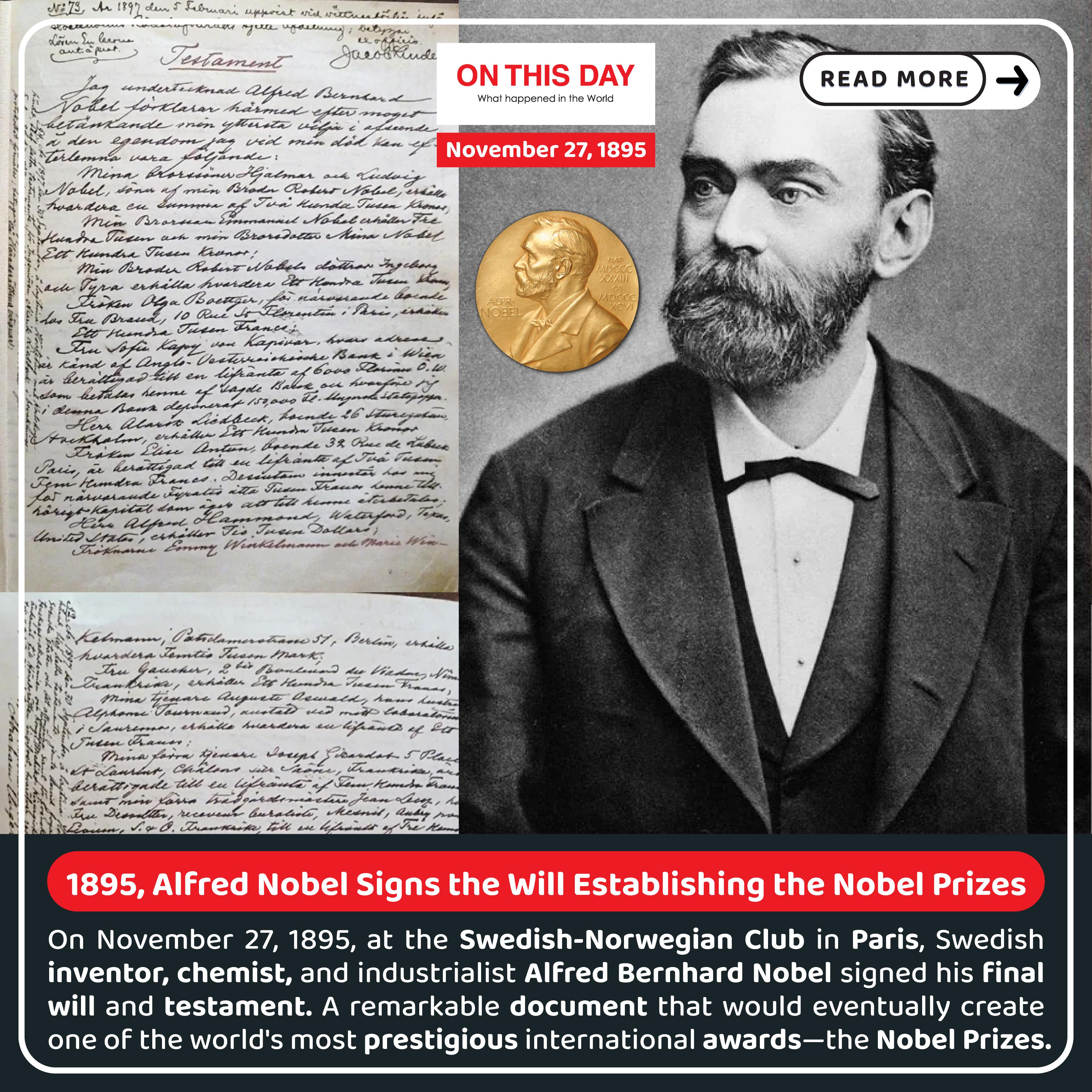
Image 1895, Alfred Nobel Signs the Will Establishing the Nobel Prizes

Post image
1 Upvotes

On November 27, 1895, at the Swedish-Norwegian Club in Paris, Swedish inventor, chemist, and industrialist Alfred Bernhard Nobel signed his final will and testament. A remarkable document that would eventually create one of the world's most prestigious international awards—the Nobel Prizes.

But what made this document extraordinary?

Nobel directed that the majority of his remaining fortune should be invested in a fund, with its annual returns used to reward people whose work had brought the greatest benefit to humanity.

He specified five prize categories:

Physics – For outstanding discoveries and inventions in physics.

Chemistry – For important chemical discoveries and improvements.

Physiology or Medicine – For significant medical and scientific discoveries.

Literature – For outstanding literary contributions.

Peace—For efforts to promote international friendship, reduce standing armies, and advance peace.

He also made an important point: the prizes should be awarded without considering the nationality of the candidates. The most deserving individuals should receive them, regardless of where they came from.

However, his decision was not immediately accepted.

When Nobel died on December 10, 1896, in San Remo, Italy, his will surprised many of his relatives. Some opposed his decision to leave most of his fortune for the prizes, and questions surrounding the will led to lengthy legal and administrative negotiations.

Eventually, the Nobel Foundation was established in 1900 to manage his estate and organize the awards.

On December 10, 1901, the first Nobel Prizes were presented, marking the beginning of a global tradition that continues to recognize extraordinary contributions to science, literature, and peace.

Interestingly, Alfred Nobel was also the inventor of dynamite, patented in 1867. His invention brought him enormous wealth, but his final will ensured that his name would become associated with some of humanity's greatest achievements.

A sixth award, the Sveriges Riksbank Prize in Economic Sciences in Memory of Alfred Nobel, was established in 1968 and first awarded in 1969. It was not one of the five original prizes specified in his will.

More than a century later, Nobel's decision continues to influence science, culture, and international peace.

One signature. Five original prizes. A legacy that continues to inspire the world.


r/WorldHistory • • 2d ago

Educational Resource Pawiak was a former investigative and political prison in Warsaw. It became the primary Gestapo prison and a site of mass terror.

Thumbnail
gallery
18 Upvotes

Approximately 100,000 people—including members of the underground, intellectuals, and hostages seized in street roundups—passed through Pawiak. From there, detainees were taken to the Gestapo headquarters on Aleja Szucha for brutal interrogations.

Designed for a much smaller capacity, the facility was constantly overcrowded. Prisoners struggled with hunger, disease, a lack of hygiene, and persistent violence at the hands of the guards.

It is estimated that approximately 37,000 people died as a result of executions, during interrogations, or in the prison hospital, while about 60,000 were deported to concentration camps (including Auschwitz-Birkenau).


r/WorldHistory • • 2d ago

Video Tipu Sultan owned a wooden tiger that "eats" a man in a European coat. Turn the handle and the man wails, the tiger growls, and a flap in its side hides an organ. It's still in London.

1 Upvotes

I made a short animated film about Tipu's Tiger, told from Tipu Sultan's point of view: https://youtu.be/G-qJl-l7OeA . Here's the written version, mostly from the V&A's own article and collection record, cross-checked with Wikipedia and Britannica.

• It's a wooden semi-automaton, about 172 cm long: a tiger over a man lying on his back in 18th-century European dress (coat, waistcoat, breeches, white stockings). The V&A dates it to about 1790; it certainly existed by 1792, when James Hunter drew it. • Turn the crank and bellows push air through a pipe in the man's throat so he wails, his left arm swings between his mouth and the tiger's ear, and a pipe in the tiger's head growls. A flap in the flank opens on a small organ with ivory keys. • Nobody knows exactly when or why Tipu ordered it. It was probably made locally, maybe with help from French craftsmen at his court. Tipu used the tiger everywhere: gold tiger heads on his throne, stripes on his coins, tiger-striped jackets for his soldiers. • The popular story that it shows General Sir Hector Munro's son, killed by a tiger on Saugor Island in December 1792, is probably wrong, since the tiger already existed that year. • Tipu died when the East India Company stormed Seringapatam on 4 May 1799. The tiger was found in the palace music room. His gold tiger throne was broken up for prize money, but painted wood was worth little, so it survived. • By 1803 it was on show at East India House on Leadenhall Street, and visitors could turn the handle. The Athenaeum called its shrieks and growls "the constant plague" of anyone working in the library, and the handle eventually vanished "to the great relief" of the readers. Keats worked it into a poem. • It went to the South Kensington Museum (now the V&A) in 1880, was badly damaged during WWII and repaired, and it's still there behind glass.

Original cartoon animation; AI tools are part of how it's made, including the narration voice. Happy to be corrected on anything.


r/WorldHistory • • 2d ago

Video The Day the UN Decided Palestine’s Fate in 1947

Thumbnail
youtube.com
0 Upvotes

r/WorldHistory • • 2d ago

Video Fridtjof Nansen!!

Post image
1 Upvotes

the day I found out about the story of Fridtjof Nansen!!, very interesting historical story, here is a mini documentary I made about it, you can find it in the last 3 mins of the video:

https://youtu.be/xGVaOqI7yPE?is=Q_6C2y5B-8i6nH5i


r/WorldHistory • • 2d ago

Question A Brief History of Our Civilization. As I See It.

Thumbnail reddit.com
0 Upvotes

r/WorldHistory • • 4d ago

Image "Happiest Man in China", taken in 1901 by British anthropologists after deciding to document the Chinese. The Chinese didn't know photos were a "serious matter" and decided to be goofy, hence the pose and smile.

Post image
400 Upvotes

r/WorldHistory • • 3d ago

Question Why is taking/has it taken longer to clean up the WW1 chemical weapons contamination than the Hiroshima/Nagasaki atomic ?fallout

5 Upvotes

I kinda always figured nuclear contamination took longer to clean than chemical


r/WorldHistory • • 3d ago

Image 1914, WWI: HMS Bulwark Disaster

Post image
1 Upvotes

On This Day, November 26, 1914, one of the Royal Navy's most devastating peacetime disasters unfolded in the waters off Sheerness, England. A massive explosion tore apart the British battleship HMS Bulwark, killing almost everyone aboard.

HMS Bulwark was anchored in the River Medway near Sheerness, Kent. The battleship was part of the Royal Navy's 5th Battle Squadron and was replenishing its ammunition supplies.

At approximately 7:53 a.m., a tremendous explosion ripped through the vessel.

The blast was so powerful that the battleship was practically blown apart. Witnesses aboard nearby ships watched in horror as a towering cloud of smoke and flames rose into the sky. When the smoke cleared, HMS Bulwark had virtually disappeared, leaving only wreckage scattered across the water.

The human cost was devastating.

Of a crew of approximately 750 men, only a small number survived. Historical records commonly report 738 lives lost, including every officer aboard. The survivors were left with the unimaginable experience of witnessing the destruction of their ship and the loss of their fellow sailors.

What caused such a catastrophic explosion?

An official naval inquiry investigated the disaster. The evidence pointed towards an accidental ignition of ammunition, possibly involving cordite charges stored in conditions that allowed them to overheat. However, the precise sequence that triggered the explosion could not be established with certainty.

There was no evidence that an enemy attack had destroyed the ship.

The loss of HMS Bulwark became one of the deadliest accidental explosions in British naval history. Its wreck site is now protected as a military war grave under British law.

More than a century later, the tragedy remains a reminder of the dangers faced by sailors even when they were not fighting in battle.