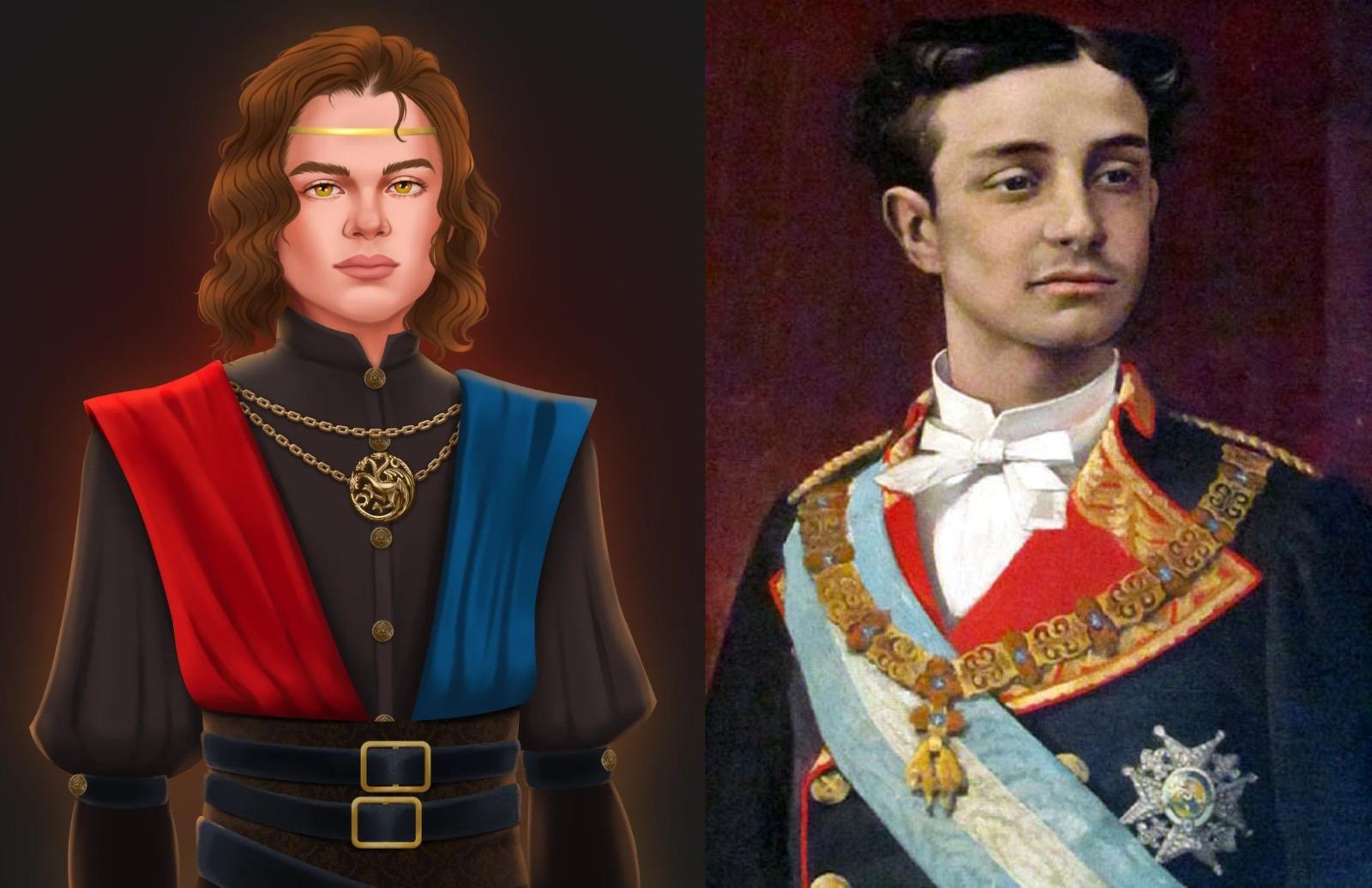
On the left: Artwork of Jacaerys Velaryon by Jaenarra. On the right: Portrait of Alfonso XII by José María Fenollera Ibáñez, circa 1876.
Disclaimer: The purpose of this post is to make a comparison of historical characters to those from asoiaf; I don't intend to guess if GRRM was actually inspired by any of this for his work, maybe he was or maybe not, I just like to compare asoiaf with real-life history, official inspiration or not.
Before we begin comparing, allow me to introduce you to King Alfonso XII of Spain:
Alfonso XII of Spain, popularly known as "the Peacemaker" (“el Pacificador”), reigned as King of Spain from late 1874 until the end of 1885. He was a young monarch who lived through a turbulent era for his nation, yet he distinguished himself through his institutional governance and labor. Sadly, he died at a young age but still left behind a legacy worth recalling. And today, on the anniversary of his birth, we will compare him to Prince Jacaerys Velaryon from A Song of Ice and Fire.
Origins: Born a prince, dubbed a bastard. “Young Jacaerys, Rhaenyra's boy, is Strong's, or so the rumors tell…”
Cradle of gold…upon pillars of salt and pillars of sand
Prince Jacaerys Velaryon was born at the very heart of power in Westeros in the waning days of 114 AC, as the firstborn son of the Princess of Dragonstone, Rhaenyra Targaryen—making him second in line to the Iron Throne held by his grandfather, King Viserys I.
Meanwhile, the future Alfonso XII was born on November 28, 1857, into the heart of power in Spain as the first surviving son (though the second child, as he had an older sister) of Queen Isabella II of Spain—making him the heir to his mother’s throne.
It is difficult to imagine more privileged origins for two children within their respective nations; yet, they did not enter a court in a golden age—far from it. Instead, they found themselves in a realm divided and consumed by factionalism, rivalries, intrigue, and opportunism. In their short lives, they would face exiles, wars, uprisings, and all manner of hardships—but will they prove equal to the task? That, we shall see...
Whose goddamn baby is that?
As previously mentioned, our two protagonists share the common trait of being born to a woman who was a reigning queen or an heiress in her own right. Furthermore, the parallels regarding their paternal origins do not end there; both princes—born as heirs to these women—found themselves dogged by rumors of alleged "bastardy" or "illegitimacy." These claims suggested that they were not the biological sons of the man who, legally speaking, ought to have been their father, but were instead the offspring of "other men"—favorites of their respective mothers.
In both instances, there is a further parallel: these rumors did not affect only these two princes; several of their siblings found themselves in the same position (Princes Lucerys and Joffrey in the case of Jacaerys; and the infantas Isabel, Pilar, Paz, and Eulalia in the case of Alfonso).
Additionally, in both cases, a significant portion of the speculation—that they were the "sons of another man"—was rooted in the fact that they bore little physical resemblance to their legal fathers.
Well, that explains it…
While trying to find an answer as to how everything happened so that a Crown Princess like Rhaenyra Targaryen, or a Queen in her own right like Isabella II of Spain, ended up with rumored lovers and children of questionable paternity despite being married to consorts of noble and relevant standing, we will find that these explanations (and therefore, the "founding myths" of our two protagonists) are very, very similar:
Both of their mothers were married—against their own wishes and purely for political reasons—to a homosexual cousin of theirs (the legal fathers of the protagonists).
In the case of Rhaenyra, the mother of Jacaerys, she married her second cousin, Ser Laenor Velaryon—heir to Driftmark and House Velaryon—at the age of 17. Meanwhile, Isabella II, the mother of Alfonso, married her double first cousin, Francisco de Asís de Borbón, on her 16th birthday. In both instances, the groom was a young man in his twenties with a reputation for preferring the company of other men.
In Laenor’s case, his apparent homosexuality was such common knowledge that it was even a point of discussion regarding his suitability as a potential consort to the heir to the throne. Similarly, in the case of Francisco de Asís de Borbón, his homosexuality was so well-recognized by both the royal court and the general public that he was nicknamed "Paquita Natillas" ("Paquita Custard"), a pejorative allusion to his sexuality, even before their marriage.
Naturally, neither of the protagonists' mothers was pleased with the match (and both were quite vocal about it, but that’s another story). All this, however, sets the stage for remarkably similar backgrounds for the two young men—even before Jace or Alfonso were born—creating the exact conditions that fueled the doubts and mockery over their legitimacy that would haunt them for years to come.
Interestingly, we can also find parallels in how the figure of the "alleged father" is handled.
Fire & Blood leads us to infer that Jace, Luke, and Joff resemble Harwin Strong, yet it never specifies Harwin’s exact physical features. Similarly—as historian Nieves Michavila points out in her article "The Secret Father of Alfonso XII"—
“It is not even possible to discern the physical resemblance to Alfonso that is often claimed, given that, to this day, no image of this much-discussed officer, Puigmoltó, has ever come to light.”
And there is another figure worth mentioning: Federico Puig Romero (not to be confused with Puigmoltó)—a man to whom the alleged paternity of Alfonso XII has also been attributed (albeit to a lesser extent). Why is he worth mentioning? Because, in his role as a "supposed secret father to the heir," Puig Romero shares a very significant characteristic with Harwin Strong: his ultimate fate.
Let’s recall: what was the fate of Harwin Strong? That’s right—he died in a fire alongside his father, under circumstances that were never clarified.
And what about the fate of Federico Puig Romero? He was murdered in a barracks in Madrid under circumstances that were never clarified, with multiple conflicting accounts of what actually happened... sounds familiar?
“Federico Puig Romero, who—like his parents—paid with his life for his closeness to the Bourbons.”
says historian Nieves Michavila once again… So, if we change “Federico Puig Romero” for “Harwin Strong” and “the Bourbons” for “the Targaryens” it kinda fits, right?
Thus, Harwin Strong—the alleged biological father of Jacaerys—seems to embody many of the dynamics associated with the two men most frequently cited as the potential biological fathers of Alfonso XII: Puigmoltó and Puig Romero. In this post, however, we will focus primarily on the Puigmoltó theory, as it was, by far, the most widely believed account at the time—as we shall see.
And you call that a joke?
Both princes were victims of the same kind of bad jokes regarding their supposed true paternity.
In the case of Prince Jacaerys, he and his younger brothers, Princes Lucerys and Joffrey, were called "Strong Boys" by some (mainly political detractors of their mother and her faction), along with other provocative comments containing the word "Strong." This stemmed from the rumor that the prince's true father was not Ser Laenor Velaryon, heir to Driftmark and House Velaryon, but rather Ser Harwin Strong, heir to Harrenhal and House Strong, and Princess Rhaenyra's sworn shield for years (and a clear favorite of hers).
Meanwhile, in the case of Prince Alfonso, almost from birth, several people began to refer to him, in a comical and derogatory way, as "the Puigmoltejo," a word that, as in the case of Rhaenyra's eldest children, stemmed from rumors that his biological father was not actually his mother’s husband, the King Consort Francisco de Asís de Borbón, but rather a favorite of hers, the nobleman and military officer Enrique Puigmoltó.
And, as you can see, in both cases, the derogatory nickname or nicknames consist of using the surname of the supposed true father (the “Strong” of Harwin Strong or “Puigmoltó” of Enrique Puigmoltó) for the children, as if to say "son of" and making fun of it.
An eventful childhood
Our two protagonists also share the experience of having lived through turbulent times, times of palace intrigue, rival factions, and civil wars.
As the book 1885: The Last Year of Alfonso XII points out:
“His childhood unfolded amidst his parents' well-known bad relationship, his mother Isabel II's love scandals, and political and court intrigues.”
I can't even begin to express in words how much it resembles the foundations of Jace's life, as it is quite obvious but still worth emphasizing: "his mother's love scandals" like those of Rhaenyra and his own disputed paternity... "political and court intrigues" like all the squabbles between "Blacks" and "Greens" in the court of his grandfather Viserys I and his and his siblings' rivalry with the children of Queen Alicent Hightower, his uncles.
That same book also clarifies that:
“Alfonso XII only experienced one of the usual pronouncements of our liberalism, precisely the one that expelled Isabella II from Spain. This led the Prince of Asturias to live abroad from the age of eleven until he turned seventeen, when he was restored to the throne.”
Thus, in his short life, Alfonso would also experience the battlefield (much like Jace) but he only lived through one liberal uprising: the one that expelled his mother from the throne... just as Jace who, in his short life, only experienced one war: the one that deprived his mother of the throne that, as heir, corresponded to her.
That perilous path, however, would also represent an opportunity, one of maturation and personal growth for both young royals.
Because, as the aforementioned book about Alfonso’s life correctly states:
“In the dangers and privations of war, the child's heart became the heart of a hero.”
Which is equally true for Jace.
For it was exile after that liberal uprising and living through the Carlist Wars that forged Alfonso into the celebrated "Constitutional King" historians speak of today, just as putting up with the rivalry between factions and living in the context of the Dance of the Dragons made Jace the future "worthy heir to the Iron Throne" that Gyldayn describes in his work.
Circumstances forced them, and their highnesses complied.
Pleasing to look at and of brave heart (Physical appearance and personality)
The first physical description of Jace that we are given is at the time of his birth, and in it we can already discern similarities to Alfonso XII.
“The boy was a large, strapping lad, with brown hair, brown eyes, and a pug nose.”
Claims Fire and Blood.
"The boy was a large, strapping lad…”
“The Queen, our Sovereign, has given birth to a robust PRINCE—a delivery that went perfectly well—at a quarter past ten tonight.”
So announced the Gaceta de Madrid—joyfully, in a statement made by the Council of Ministers—the day after the birth of Prince Alfonso.
“...with brown hair, brown eyes…”
Everyone knows. Just look at one of his official portraits.
But, if you still find yourself in need of confirmation:
“plenty of dark hair, splendid eyes.”
Claim Major Desmond Chapman-Huston and Princess Pilar of Bavaria (Alfonso XII's own niece through one of his sisters) in their joint work "Don Alfonso XIII: A Study of Monarchy.”
“of serene brown eyes"
The historian Carlos Dardé says in his book "Alfonso XII" of the year 2001.
“... and a pug nose.”
This is, notably, the only trait of Jacaerys’s that Alfonso does not share. Nevertheless, an interesting comparison can still be made: just as Jace’s (along with Luke’s and Joffrey’s) "pug nose" was regarded as an "anomaly" within his family—standing out, for instance, when contrasted with Laenor’s aquiline nose—Alfonso did possess a nose that was characteristic of his own family (the House of Bourbon; and it was, in fact, referred to as a "Bourbon nose"). However, in his case, it was clearly less prominent and a bit "out of place" than it was among other members of his family, including his own future son.
“His Bourbon nose, not so pronounced as that of his son Alfonso XIII, gave character and strength to his face.”
Chapman-Huston and Alfonso’s niece, Princess Pilar, speak of him—once again—in their work.
Fire & Blood also later describes Prince Jacaerys at age 14 (along with his younger brother, Prince Lucerys) as:
“Bold and handsome lads, skilled in arms, who had long served as squires.”
These are all characteristics that can be equally identified in His Majesty, King Alfonso XII—even in his early age.
This is attested to by the Spanish diplomat and writer Augusto Conte in the third volume of his work “Recuerdos de un diplomático” ("Memories of a diplomat"), in which he recounts his interactions with a young Alfonso XII—then 17 years old and newly ascended to the throne following the restoration of the monarchy—as well as by the historian Pablo González-Pola de la Granja in his work “La configuración de la mentalidad militar contemporánea (1868–1909)” ("The formation of the contemporary military mentality, 1868–1909").
“Bold…”
“Don Alfonso also possessed the courage characteristic of his race, and was, moreover, daring—almost reckless.”
Writes Conte.
“...and handsome lads…”
“A seventeen-year-old youth, he possessed all the charm and freshness of that early age. Had he been somewhat taller, he would have been considered a handsome fellow; yet, despite his small stature, he was very well-liked by the ladies, thanks to the gentleness of his eyes and the intelligent expression of his features.”
Conte adds.
“...skilled in arms…”
“Alfonso XII, [...] was not only a good soldier-king, but was, fundamentally, a military man of his time.”
Tells us González-Pola de la Granja.
“...who had long served as squires.”
“A soldier who also had an excellent opportunity to receive training outside of Spain”
The historian affirms.
“He had received a very thorough education, first at the Theresianum in Vienna, and later at the Royal Military Academy Sandhurst, in England.”
The diplomat recalls.
Rise: The Peacemaker and the Prince
A bastard? What bastard? We only see a prince. ~x.o.x.o., your loyal subjects.
Despite everything said thus far regarding the rumors of illegitimacy that dogged our two protagonists, it is curious to note that, in both cases, a great many prominent political figures and individuals paid little to no heed to such whispers, choosing instead to regard them unequivocally as princes and heirs. This serves as a reminder that truth is relative, and that often, what matters is not merely "being," but also "appearing to be."
While Queen Dowager Alicent Hightower and Ser Criston Cole—even in the immediate aftermath of King Viserys’s death—remained fixated on the issue of bastardy, trapped in an echo chamber that resonated only for them, speaking of “dire consequences for seating a bastard on the Iron Throne” for they are “monstrous by nature,” Prince Jacaerys was preparing for a journey to forge pacts and alliances with the great lords of the realm.
It was a journey during which Lady Arryn and her knights knelt before him, pledging their swords; where Lords Borrell and Sunderland paid him obeisance; where Lord Manderly treated him as nothing less than a prince of the blood and his mother’s plenipotentiary; and where Lord Stark—even with winter looming—offered him a warm welcome, eventually coming to regard him with affection and forging a blood-brotherhood sealed by a solemn pact, thus paving the way for the very culmination of the Dance of the Dragons and so that his younger half-brother, Aegon, might one day sit the Iron Throne.
For pray tell, what weight do mere whispers carry against the sight of the realm’s great lords kneeling in fealty? How could petty, crude jests ever compare to the endorsement and support of some of the finest swords in the entire kingdom?
And that—that is exactly what happened to His Highness, Don Alfonso.
For while his mother’s Carlist enemies never ceased shouting "Puigmoltejo"—all the while styling themselves as the "true Catholic and good Christian" monarchist claimants—and pro-Republican pamphlets flooded the nation, satirizing young Alfonso and his family, questioning the legitimacy of any monarchical act performed from exile, and simultaneously mocking him for being "spurious,” it was a teenage Alfonso, living in exile and dismissed by them as a "mere bastard," who, first as his mother’s heir and then as the holder of the dynastic rights in exile, was engaging with prominent figures of Spanish politics, securing their support and receiving their expressions of fealty and homage, thus paving the way for the future restoration of the Bourbon monarchy and his family.
His was a six-year journey of legitimacy in exile—a journey in which thirty-nine of the forty-five prelates of Spain attending the First Vatican Council in Rome, including a Cardinal, visited his private residence to kiss his hand and lend their support to his political cause with their homage, where Grandees of Spain and prominent political figures present at the abdication of his mother in exile recognized him as King and natural lord, where Don Antonio Cánovas del Castillo, the greatest statesman of his country and architect of the Restoration, took him under his wing to forge him into the constitutionalist King he would become, and where the military led by General Martínez Campos rose up in arms in Sagunto and proclaimed him their King without even having to shed a drop of blood to achieve it.
For what weight do proclamations about being "better Christians" carry in the face of thirty-nine princes of the Church kneeling before a 12-year-old boy in exile branded a bastard? And what good are satirical pamphlets when that same bastard boy, now a teenager, only needed to send a communiqué from his military academy in England to rally the military to his cause?
A fine young man mindful of his duty
Of course, that support they had gained as figureheads was all well and good, but it came with something very significant: EXPECTATIONS.
For those who had decided to throw their full weight behind our protagonists—or their causes—there was an expectation that everything would lead to a specific outcome. Naturally, for both young royals, this meant living up to those expectations and, above all, becoming the kind of statesman capable of leading and thus delivering on such prerogatives.
And this section serves to note precisely that—based on everything we know about both of them, and supported by various sources—they certainly lived up to the expectations placed upon them; and even exceeded them.
As stated in the work 1885: The Last Year of Alfonso XII published by the Agencia Estatal Boletín Oficial del Estado (BOE, 2025), Alfonso XII had to assume the role of the kind of monarch Spain needed from a very tender age, and did so remarkably:
“Very soon, the now King had to assume, from the summer of 1870 onward, the responsibility of being both a constitutional sovereign and a soldier-king. For the former, he drew upon the teachings of Cánovas; for the latter, the Prussian model. [...] Thus, the young king diligently fulfilled his role as a constitutional monarch, avoiding cliques and spurious influences.”
In a similar manner to how Archmaester Gyldayn speaks of Jacaerys’s assumption of the role of heir in Fire and Blood:
“When the Prince of Dragonstone took his dragon back into the cold autumn sky, he did so with the knowledge that he had won three powerful lords and all their bannermen for his mother. Though his fifteenth nameday was still half a year away, Prince Jacaerys had proved himself a man, and a worthy heir to the Iron Throne.”
And, as you might notice, both quotes share a similar rhetoric and dichotomy; both emphasize the youth of the individuals when they assumed their roles, how they performed exceptionally well—surpassing expectations for their young age—and how their success was tied to both political and military frameworks.
A silver tongue and a willing spirit
Both royal youths would prove to be, above all else, men of consummate diplomatic skill and negotiating ability.
We have already touched upon Jace’s diplomatic efforts in the North and the Vale of Arryn—and even hinted at their future ramifications—which were no small thing, but there is no doubt that they even had an immediate impact on how the conflict which was bleeding Westeros out, was handled:
“Meanwhile, the seeds Jacaerys Velaryon had planted on his flight north had begun to bear fruit, and men were gathering at White Harbor, Winterfell, Barrowton, Sisterton, Gulltown, and the Gates of the Moon. Should they join their strength to that of the riverlords assembling at Harrenhal with Prince Daemon, even the strong walls of King’s Landing might not be able to withstand them, Ser Criston warned the new Prince Regent.”
It is also impossible to overlook how this teenage heir brought "the Sea Snake" back into the fold following the disaster of Princess Rhaenys's death.
“Prince Jacaerys soon brought the Lord of the Tides back into the fold by naming him the Hand of the Queen.”
He also knew how to be conciliatory and pragmatic in his treatment of him.
“For it was Laenor's own father, Lord Corlys himself, who brought the boys to Prince Jacaerys for the Sowing.”
In addition to supporting his request that Rhaenyra legitimize Addam and Alyn. In doing so, he managed to retain the one who was, without a doubt, the most powerful and important ally of his mother’s cause—assigning him an institutional role and bestowing upon him other honors and concessions—thereby, in conjunction with his external dealings, securing vital alliances both within and beyond his own house.
On the other side, we find Alfonso XII, who, throughout his administration and reign of just over ten years, managed—among other things, in the diplomatic and social spheres—to:
Establish a functional system for the alternation of power, which put an end to the resistance fronts arrayed against his crown and family, while integrating other sectors of society—such as leftist parties—into the fold.
“In 1881, through a personal initiative by the King—one not free from controversy—the core of a project aimed at establishing an alternation of power became a reality. […] This paved the way for the definitive collapse of the revolutionary coalition that had, in 1868, driven the Bourbons out of Spain. In the years that followed—again with the King playing a prominent role—the other leftist forces were gradually integrated into the system.”
Maintain a balance of power—avoiding both favoritism and personal animosities—and ensuring that everything functioned...
“Seeking the best support in each instance, he maintained an impartial balance among the Constitution, the Church, the Army, and the various political camps. He saw only Spain—and he viewed it solely as a single, unified whole.”
Bring an end to the wars that were devastating the nation (such as the Third Carlist War) as well as the insurrections in the "overseas territories" (Cuba), thus earning the nickname by which he has gone down in history: "the Peacemaker."
“But the defining characteristic of his reign […] was the glory of having brought an end to the civil war on the peninsula and the insurrections in the overseas territories […] History has already bestowed upon this illustrious king the title of "the Peacemaker."”
Among other things; all this, as Rafael Fernández Sirvent shows us in his work “From “Soldier-King” to “Peacemaker” Symbolic Representations of Alfonso XII of Bourbon.”
Venturing into the Art of War
His Highness and His Majesty, from their respective trenches, also had prominent roles in predominantly martial measures, as their own education as squire and cadet in military academies, well attended for years, allowed.
Alfonso, by promoting a new constitution that, besides bringing social peace, allowed a “balance” between the monarchy and the army and prevented any new attempts by the military at coups or interventions, and put the figure of the King at the center of martial authority.
“The primary mechanism for underscoring the indissoluble tandem of Monarchy and Army within the legal sphere was the Constitution of 1876. In it, the Monarchy was presented as the cornerstone of the new regime. [...] The constitutional text granted the holder of the Crown extensive powers over two elements fundamental to the proper political functioning of the state: first, the monarch became the moderator of the executive branch [...] and second, the king was established as the supreme symbolic and effective authority over the Army.”
He also promoted modernization reforms for the Spanish army.
“González-Pola unravels and analyzes the monarch’s manifold activities in the military sphere throughout his reign, as well as his persistent and resolute initiatives to undertake a genuine professionalization—"regeneration" being the term most commonly used in the vocabulary of the era to convey the same idea—of the Army.”
And, above all, he acted as a true leader—a commander—to his followers whenever the situation demanded it, as was the case during the Third Carlist War, and this is precisely what he conveyed to his soldiers in the Somorrostro Manifesto—His Majesty’s final speech, delivered following the end of the war and the surrender of the Carlist forces at Somorrostro:
“Soldiers: it is with sadness that I part with you. I will never forget your deeds; do not forget, however, that you will always find me ready to leave the palace of my forbears to occupy a tent in your camps; to put myself in front of you and that in the service of the country the blood of your King may flow, if necessary, mixed with yours.”
For his part, it is well known that the idea for the Dragonseeds originated with Prince Jacaerys Velaryon:
“It was to them that Prince Jacaerys turned, at the urging of his fool, vowing that any man who could master a dragon would be granted lands and riches and dubbed a knight. His sons would be ennobled, his daughters wed to lords, and he himself would have the honor of fighting beside the Prince of Dragonstone against the pretender Aegon II Targaryen and his treasonous supporters.”
[...]
“The Sowing of the Seeds,” Munkun names the triumphs and tragedies that ensued (crediting the notion to Jacaerys himself, not Mushroom). Others prefer “the Red Sowing.”
Also interesting when you notice the similarities in the way the King and the Prince address the men they are meant to lead: “in the service of the country the blood of your King may flow, if necessary, mixed with yours” and “fighting beside the Prince of Dragonstone against the pretender Aegon II Targaryen and his treasonous supporters,” and all that...
But going back to Jace's military measures, he also had the good idea of securing “spare heirs” for his mother's cause in case of any eventuality:
“The Prince of Dragonstone also had a care for the safety of his half-brothers, Aegon the Younger and Viserys, aged nine and seven. [...] so Jacaerys reached across the narrow sea to the prince of that city (Pentos), who agreed to foster the two boys until Rhaenyra had secured the Iron Throne.”
And regardless of how that part may have concluded... the idea was, in essence, that of a strategist.
Also—and though perhaps less frequently recalled, yet worth remembering—the planning for the fall of King’s Landing was also his doing—the very cornerstone of the greatest military achievement of the Blacks during the entire war.
“Together he and Lord Corlys began to plan an assault upon King's Landing.”
All of that, on the eve of the inevitable...
An abrupt ending: “Where are you going, Alfonso XII, Jacaerys Velaryon? Where are you going so sad and so forlorn?”
Only the good die young…and the realm is left to mourn
“King Alfonso XII, in the year of his death, had the greatest public exposure of his entire reign, so neither the press nor the political circles could foresee the sovereign's imminent end.”
This sad truth about Alfonso XII is also accurate when speaking of Prince Jacaerys, because, just as who could have foreseen the end of such a beloved King who, in the last year of his life, had only reaffirmed his role, who could have believed that the rising star of the Blacks would not even live to see the end of the year in which he would finally have turned sixteen, when he had proved himself a man at just fourteen and fifteen?
They both had already done so much, proven to be more than they might seem at first glance; it was only the beginning, and yet, the heavens fell silent.
Jacaerys Velaryon, Prince of Dragonstone and heir to the Iron Throne, died fighting in the Battle of the Gullet, which—according to Fire & Blood—began "in the early morning hours of the fifth day of the 130th year since Aegon’s Conquest." He had just turned fifteen in the later part of last year…
Alfonso XII, King of Spain, died of tuberculosis on November 25, 1885, in the Palace of El Pardo, in Madrid, he was barely twenty-seven years old and exactly three days shy from his 28th birthday…
One died from crossbow bolts or harpoons, another from a disease; however, in both cases, it was largely their dedication to their families and their work that consumed them, in one way or another, whether entering the battlefield to defend their people, like Jace, or exhausting themselves from work for them, like Alfonso, in both cases without regard for their own physical integrity.
“I thought I was physically very strong […]. I’ve been burning the candle at both ends. I discovered too late that it’s not possible to work all day and have fun all night. I won’t do it again in the future.”
Alfonso XII confessed—without reservation and even with a certain humor—to the German ambassador, Solms, on the eve of his death.
Their deaths would be mourned by many:
“Religion told me that this King was the well-beloved Prince, the favored son of the Pontiffs of Rome; the nation proclaimed that this Prince was its peacemaker and its father; throughout Europe, the maturity of his judgment was well known.”
Dr. Francisco Sánchez Juárez stated on November 24, 1888, in the Royal Chapel of the Royal Palace of Madrid, in his funeral prayer given on the occasion of the third anniversary of the death of the beloved Alfonso XII.
“Thousands died. Yet none of these losses were felt so deeply as that of Jacaerys Velaryon, Prince of Dragonstone and heir to the Iron Throne.”
Archmaester Gyldayn tells us in his work.
And with good reason—not only because of the loss of two fine young men, but because of the loss of what they represented: the hope and promise of a better future... now shattered.
Mama’s Boy
How can one measure the love received by a son from one who has been both a mother and a Queen?
Perhaps in beautiful words of love and affection towards them as their cherished children...
“Four living sons remained to her. “My strength and my consolation,” the queen called them.”
[...]
“Alfonso, my life, my dear son of my heart. Thank you, son of my life, for your loving letter.”
...perhaps in how those mothers placed the future—which they perceived as uncertain, yet viewed with longing—into them…
“Aegon the Younger and Viserys, Prince Daemon's sons, were nine and seven, respectively. Prince Joffrey was but eleven...but Jacaerys, Prince of Dragonstone, was on the cusp of his fifteenth nameday.”
&
“Rhaenyra named her eldest son, Jacaerys, the Prince of Dragonstone and heir to the Iron Throne.”
[...]
I HAVE ABDICATED my Royal authority and all my political rights, [...], along with all those pertaining to the Crown of Spain, to my beloved son, DON ALFONSO, PRINCE OF ASTURIAS.
&
I will keep Don Alfonso under my guardianship and custody while he resides outside his homeland and until, [...] I deliver him to you as my desire and as my hope inspires, for I feel the strength to do so, even though my mother's soul is torn apart by promising it.
…or in how their words were heard by their mothers first amidst the clamor of the world, considering them faithful and sacred, given who they came from...
“Lord Corlys went so far as to petition Queen Rhaenyra to remove the taint of bastardy from him and his brother. When Prince Jacaerys added his voice to the request, the queen complied.”
[...]
“On October 1, a royal decree appointed, as private secretary to Queen Isabella «in accordance with my most beloved Son» the much more respectable Marquis of Monsalud”
...or, in how when their voices were lost forever in the silence of eternity, their mothers' souls were never quite the same.
“Jace’s death hardened her, burning away her fears, leaving only her anger and her hatred.”
[...]
“Her son, Alfonso XII, was gone—a treacherous blow dealt to her by life. Since then, other events have occurred that only graze her further, stirring her ever so faintly with memories of the past.”
Much loved were they as princes and leaders, Alfonso XII of Spain and Jacaerys Velaryon, but even more when they were simply "Jace" and "Alfonso, son of my life," to their unfortunate mothers.
Playthings to the gods, hostages to lesser men
"Man proposes, God disposes." What could be truer than that? Perhaps only how painful it is to accept it.
Many and grand were the plans already set in motion or projected, both by His Highness the Prince and His Majesty the King—plans which, in truth, did not die with them, but perhaps they should have, for a plan is only as good as the hands that shape it, like clay and the potter.
And their designs, alas, would descend into an abysmal state of degradation, falling far short of what, by all rights, they ought to have been.
While they were still alive—and despite their titanic efforts—it is not as though everything was a "fairy tale" for their people (the Spanish nation, or "The Blacks"); yet, God knows there was still hope that things would turn out well—precisely because they remained a factor, and the ones holding the reins.
“As 129 AC drew to a close, the prince prepared to fly against King's Landing. The date he chose for the attack was the first full moon of the new year.”
Gyldayn reminds us in Fire & Blood.
“Even in 1884, one could still envision a healthy evolution of the regime; however, the monarch's premature death halted all attempts at reform and elevated what had been achieved and criticized up to that point to the status of the highest good to be defended. [...] The consequence under the regency was the ossification of the Restoration.”
The BOE reminds us with its work on Alfonso.
After them? Madness and stupidity.
Alfonso XII’s intentions to forge a stronger military foundation for the nation were clear—much like Jace’s desire to effectively employ new dragon riders, who would prove pivotal to bringing the war to a close. Yet, in both instances, the leaders died, leaving their projects in other hands. The result? A Spain as militarily weak as it had been in years past, plagued by the same old follies of the entrenched military establishment; meanwhile, the new dragonriders became such a complication for the "Blacks" that they proved more of a hindrance than an asset—simply because those left in charge of them... well, they didn't know how to handle them.
Look at all the effort it cost Jacaerys to keep the Velaryons content—only for others to lose them so easily; look at what it cost Alfonso to maintain social balance—only for rigged elections to take hold before his body was even cold.
Did King’s Landing fall just as Jace had planned? Oh, yes—it certainly fell, and in its wake would fall a Dragonpit, a Queen, and heaven knows what else... Poor Alfonso—Cuba fell, too, even before the boy king left upon the throne could shake off his mother’s regency... which brings us to the very last point of this political charade that succeeded them: those child kings who ended up with their thrones.
The Hour of the Wolf Childcare!
The post-mortem fate of the legacy left by our beloved—though tragically unfortunate—protagonists is as symmetrical as much of their lives and deeds have been up to this point... resulting in what Roose Bolton calls "the bane of every House": a child in power—and one who required years of regency, at that.
About a year after Jace’s death, it all came to an end—"it all" being the bloodiest "Dance" that no one has ever heard of. The result? The line of the usurpers was brought to an end, and the throne was secured for his mother’s line through his beloved half-brother, Aegon—now Aegon III—as the very armies he had helped to recruit hastened the enemy’s downfall.
As for Alfonso? Much the same story... his second wife, who was pregnant at the time of his death, gave birth months later—the following year—to a long-awaited son. The boy was named Alfonso, in honor of his father; and, just as in Jace’s case, the throne was successfully secured for their well-loved family branch.
And yet... at what cost?
“A regency wisely steered by Maria Christina of Austria, who had to contend with the loss of the remnants of the Spanish colonial empire.”
The Spanish Empire? Gone. The Dragons? Gone. The glory of the Hispanic Monarchy? Gone, down the same drain as the glory of the High Targaryen era.
And yet, hope must remain, in the fragments of that good work given by them and shattered by so many others.
Even today, after all, a King sits on the Spanish throne... from the seed and blood of His Majesty, Don Alfonso XII, his great-great-grandson, Felipe VI, and on Jace's side, the descendants of his beloved mother and half-siblings sat on the throne for centuries. Right now, there has been an interruption... but I imagine you've heard rumors of a girl to the east, of that same lineage, with dragons, haven't you? Besides, if the Bourbons have returned so many times, couldn't the Targaryens do it too?—Whatever the case, perhaps, and just perhaps, all is not lost, after all.
Conclusions
His Majesty, King Alfonso XII, and His Highness, the Prince of Dragonstone and heir to the Iron Throne, Jacaerys Velaryon, were two young men who, through their lives, show us that a youth can overcome adversity—if not the cruel hand of fate itself—by making much out of very little, and that a complicated origin or a complex background need not define a person; for one’s life does not need to be shaped in a mentality of "because of all that," when it can be "in spite of all that."
They were called bastards, yet they proved to be the ideal of a prince—navigating the intricate waters of high politics, warfare, and personal dealings with key figures, with an extraordinary level of excellence.
However, beyond being two young men who excelled in their roles as heirs, statesmen, and leaders, bearing an immense burden at such a young age and yet always remaining so charmingly proper in it by believing in their purpose and being of merry heart, they achieved something even greater, which only makes their loss all the sadder: something every good son dreams of, yet for many remains just a dream—the right to be truly called "the pride and hope of his mother."