r/aussie • • 8h ago

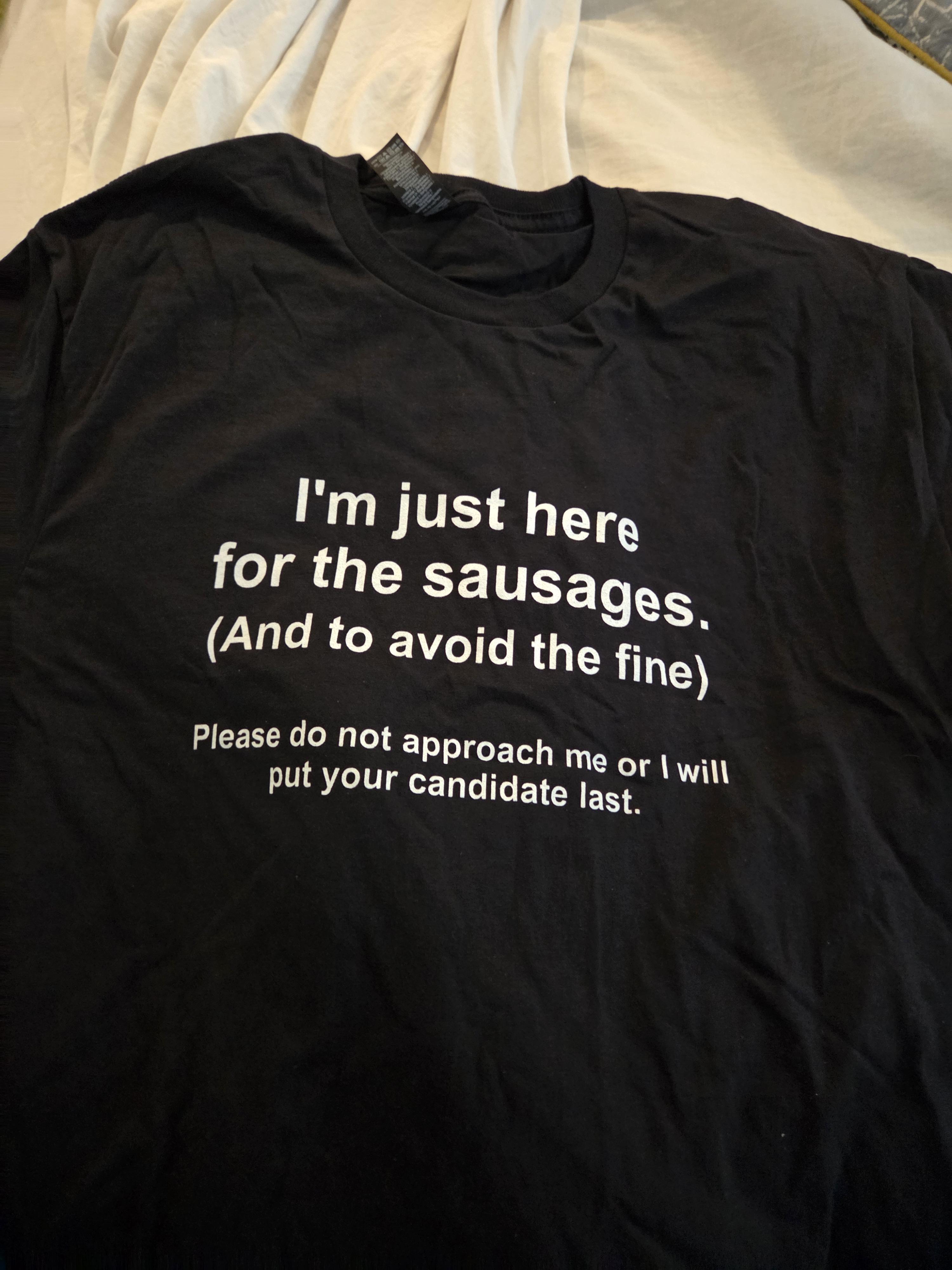
Politics Wearing this to the polls today to see if it works

Post image
979 Upvotes

Note: I am actually decided and have already decided my voting order. The people at the booths just don't know that.

I'm on the spectrum and can't stand being approached at the booth entry, so I'm trying to come up with a deterrent. I personally don't think that it will work, but as a scientist, I would rather test the theory than just dismiss it.

I'll update this post with my findings after I've voted.

RESULTS The findings of this experiment were consistent with the original hypothesis. Whilst there was some expectation of hesitance, this finding was not present, as every single volunteer approached the experimenter. The sausages, however, were highly palatable, and there was even a cake stall present at the election venue. This study was limited as it had a sample size of only one entry, in a marginal seat. As some pointed out, the second line may have been more effective had it been more visible. However, there was another finding. As I was exiting the booth, there was another entrance that led straight to polling, which was ignored by the political volunteers. In the future, it is recommended to seek these entries if you do not wish to be approached.

In conclusion, wearing a 'do not approach me' shirt provides little deterrence if you do not wish to be approached. Instead of spending $30 to get a custom shirt printed, the sum could be used for other things, such as going to your local Cafe to buy half a coffee, or getting a big mac from McDonald's.

Hope this was fun for you guys. I will return at the next election in my area with another pointless experiment. Till then, happy democracy day everybody!!


r/aussie • • 13h ago

News Gold Coast Schoolies invaded by adult creators filming with school leavers

Thumbnail kidspot.news.com.au
193 Upvotes

r/aussie • • 11h ago

News Northern Territory government confirms they are looking at introducing 'castle law'

Thumbnail abc.net.au
187 Upvotes

The Northern Territory government has confirmed it is looking at introducing "castle law" in the NT.

The principle, also known as castle doctrine, removes the duty of residents to retreat from an intruder within their own home.


r/aussie • • 7h ago

Politics Socialist party with only extremely attractive candidates

76 Upvotes

I feel like the public easily agrees with socialist ideas but then they see the faces of socialist candidates and then lose all trust in their competence.

No one wants to vote for the nerd look 20 something new grad or the fat rainbow haired woman.

If someone started a socialist party where candidates had to be super physically attractive then they could actually win votes.


r/aussie • • 6h ago

Politics Victorian Liberal costings reveal unannounced plan to scrap first home owner grant

Thumbnail abc.net.au
74 Upvotes

The Liberal Party has faced some criticism for releasing its costings two days before the election — after half of the state's voters had already cast their ballot.

The document revealed a number of policies which hadn't been announced yet, including plans to privatise the sewerage system, further privatisation of VicRoads, selling the air rights above Richmond railway station and cancelling the Yarraville and Spotswood level crossing removal.

But it also reveals the party plans to scrap the state's first home owner grant.

The Coalition had long announced it would exempt first home buyers from stamp duty for properties valued up to $1 million.

 This would cost the budget $5.5 billion, partly offset by $913.1 million in savings by removing the first home buyers grant.


r/aussie • • 5h ago

News Aussie WWE wrestler dies aged 38

Thumbnail news.com.au
47 Upvotes

r/aussie • • 5h ago

News Former media exec Matt Handbury admits saying Grace Tame was 'looking to be raped again'

Thumbnail abc.net.au
34 Upvotes

r/aussie • • 7h ago

Opinion From Beau Lamarre-Condon to Erin Patterson: the domestic and family violence we don’t name

Thumbnail theconversation.com
30 Upvotes

r/aussie • • 9h ago

News Telstra employee fired for calling own phone to avoid work

28 Upvotes

https://stocks.apple.com/AItUzP6a2Sq2vSrfR9wwgqw

Call Centre customer service member working from home fired for avoiding customer calls by calling themselves over a seven month period totalling 45 hours of work time. Member claimed it fault finding equipment and managing stress from dealing with customers.

Telstra representatives claim that there was insufficient evidence and dismissed the employee after the investigation in March this year. Telstra states that technical and staff well-being programs are available but appears the member didn’t not engage with services either self initiated or staff prompted.


r/aussie • • 2h ago

Opinion Event Cinemas prices are offensive

12 Upvotes

I'm a movie buff. Love going out for dinner and a movie with my wife, and go semi regularly, well at least we used to. But the pricing at Event Cinemas these days is a complete joke nowadays...

So you want to go see a movie as a couple. The standard screens are too small now, so you go to the VMAX session because you're there for a BIG screen. And you want to be comfortable, so you get the recliner seat (even though they should all be recliners at this point). And it's a popular movie so you book online to reserve your spot. Now say you're snackish and don't want to be parched, so you get the large combo. Ok checkout....annnd it's $98. Sorry what? A crisp, green hundo parts your hands and they give you some pocket change.

Now ok ok I hear you, that's worst case scenario. Say you get discounted tickets through CommBank or RACQ or something, and you do a cheeky run to Coles first for coke and Maltesers. You're still up for $60+. And that's the best case scenario.

Bruh


r/aussie • • 9h ago

Opinion Can someone explain why our laws are based on outcome rather than intention?

10 Upvotes

Why, for example, do "attempted" offences usually carry a lesser sentence. The intention was there, whether the outcome occurred shouldn't matter, should it?


r/aussie • • 9h ago

Politics ‘Flat-out lie’: Richard Marles given powers to override laws to aid US

Thumbnail thesaturdaypaper.com.au
7 Upvotes

New legislation gives the minister for defence unprecedented powers to exempt foreign nationals from Australian laws and override restrictions on data centres and nuclear waste dumps.

By Jason Koutsoukis

‘Flat-out lie’: Richard Marles given powers to override laws to aid US

Defence Minister Richard Marles during Question Time this week.Mick Tsikas / AAP Image

Copy linkView saved

See more of our journalism in your search results

Make us a preferred news source on Google?Learn more

Defence Minister Richard Marles has been granted new powers to override state planning laws to build data centres and nuclear waste sites for AUKUS, under legislation passed this week. He can also exempt foreign military personnel and arms dealers from specified Australian law, and in some cases keep those decisions secret.

The 231-page Defence Legislation Amendment (Accelerating Capability and Protecting Bases) Bill 2026 has outraged a broad coalition of legal experts, defence analysts, digital rights advocates and crossbench MPs and senators, who argue that the Albanese government has compromised Australian sovereignty in the service of the United States alliance.

Michael Shoebridge, a former first assistant secretary at Defence, who led the team that wrote the 2013 Defence White Paper, says the department’s claim that security zones can be established only for the purposes set out in the legislation is blatantly untrue.

“It’s not often you get a flat-out lie in rolled-gold government talking points, but here’s one on this proposed new law which allows the government to create ‘Defence Security Zones’ anywhere in Australia by ministerial decision,” Shoebridge tells The Saturday Paper. “These ‘security zones’ can be permanent, temporary or mobile and be on any property, on the land, in the sea or in the air, not just on defence bases administered by defence bureaucrats. Penalties include two years in jail and other penalties for Australians breaching them, and penalties for disobeying an official’s instructions.

“We have police forces for ensuring compliance with Australian law and administering security inside Australia – that is not a role for the military. It’s also not a role for defence bureaucrats at the whim of whoever the current minister is. A bureaucracy that can’t be honest with the public about the powers it’s proposing cannot be trusted to exercise these extraordinarily intrusive powers.”

Richard Tanter, senior research associate with the Nautilus Institute for Security and Sustainability, says the legislation has been drafted to please the Trump administration.

“I think this is purely a matter of alliance management, keeping the Americans happy, and addressing a situation where US forces and defence firms now have access to around 70 per cent of Australian military facilities,” he says. “This is outrageous, just awful stuff.”

Pointing to a surge in drone incursions across Australian military facilities, including at RAAF Base Williamtown, which houses most of Australia’s fleet of F-35 fighter jets, the Defence Department says the new legislation will allow it to better protect its military assets and build and test new equipment in partnership with industry and other allied nations.

One part of the legislation creates a “capability declaration regime”, whereby the minister can specify an activity and the people involved, and then declare that it does not contravene specified state, territory or Commonwealth laws.

The legislation also creates defence security zones, including around sensitive areas such as the Pine Gap joint Australian–US satellite surveillance and signals intelligence base 18 kilometres south-west of Alice Springs.

Critics warn that the new law gives a single minister the power to decide which Australian laws apply to defence work, including work for foreign governments, and that nothing in the legislation limits which laws or people can be named.

“There’s been no public debate – or even awareness – about the extraordinary expansion of defence bureaucrats’ authority over Australians on Australian territory.”

Sydney human rights lawyer Rita Jabri Markwell told the Parliamentary Joint Committee on Defence that the term “defence official” could be extended to include private arms contractors, and that foreign forces can be specified without naming a country.

Temporary declarations made under the legislation can last up to 12 months and can stay off the public register at the say-so of the relevant minister.

In parliament, crossbench MPs and senators who voted against the bill have also expressed fury at the haste with which it was rushed through parliament.

After beginning work on the legislation in 2022 and holding a six-week public consultation in 2023, the bill itself was bundled with nine other bills and rammed through the House of Representatives in two days, before being referred to the Parliamentary Joint Committee on Defence for a seven-day review and consultation period, including two weekend days and Melbourne Cup Day.

“The committee held a three-hour public hearing the next day with evidence from five witnesses: Defence and Home Affairs for more than two hours, and three defence companies or industry bodies, who shared 45 minutes,” Western Australian independent Kate Chaney told parliament this week. “Nobody from the legal profession, civil liberties groups, First Nations organisations or the broader community appeared.”

“The powers in this bill are significant,” Chaney added. “The minister can make capability declarations that set aside state and territory laws and create defence security zones that extend to privately owned land, including mobile and emergency zones, with little public notice. The people exercising these powers can include industry partners and members of foreign militaries, and failing to follow their directions becomes a criminal offence.

“Powers like this need careful scrutiny, and they haven’t had it. The Law Council of Australia has said that urgency shouldn’t override due diligence and that a rushed process increases the risk of unintended consequences. I agree. Amnesty International has warned that the bill could erode the right to peaceful protest. People can disagree about whether those concerns are justified, but they do deserve a proper hearing.”

When Chaney asked Anthony Albanese about the new bill in Question Time, the prime minister gave a defiant answer, categorically rejecting criticism of its apparent overreach.

“I have seen some nonsense on social media – not from the member for Curtin, but from others – that simply feeds conspiracy theories that don’t just come from the far right but can come from the far left as well. And what this legislation is about is simply making sure that our defence institutions and infrastructure are kept safe,” Albanese told parliament.

“And quite frankly, to suggest that a minister would abuse powers in order to designate something that was not associated with defence of this country as somehow needing protection is quite frankly irresponsible, and those spreading that misinformation online should know better.”

Independent senator David Pocock also strongly opposes the legislation. “The rule of law and protecting our civil liberties are at the heart of our democracy,” he tells The Saturday Paper. “The government has rammed through a bill, refusing proper scrutiny, that undermines both. It’s no surprise that Australians have reacted with anger and concern. The Albanese government promised so much on transparency and good government. This bill is the opposite.”

Richard Tanter says that, alongside the bill, the culture of the US alliance is already reaching Australian defence personnel.

After US Secretary of War Pete Hegseth said in September the Trump administration had achieved a cultural shift in the military by allowing “no fatties, no trannies, no beardos, no weirdos, no wimps, no radicals, just warriors”, Tanter believes transgender Australian service people “are now in trouble when they’re involved in anything to do with the United States, certainly US bases or on US aircraft and warships”.

While the new law does not mention transgender personnel, he believes it’s important for the public to also consider what they cannot see. Documents released to Guardian Australia under freedom of information laws show transgender and non-binary personnel in the Australian Navy are not involved in submarine training because they would be excluded from US activities under AUKUS.

“Who knows, and we’ll never know because the oversight provisions are so extraordinarily weak,” says Tanter. “I guess anyone who covers federal politics knows what a joke parliamentary scrutiny is.”

He says the minister’s power to decide to register a declaration as a legislative instrument is the government’s “get out of jail card”.

Shoebridge, who is also a former deputy of both the Australian Signals Directorate and the Defence Intelligence Organisation, and the founder and director of Strategic Analysis Australia, says that while he strongly believes in the need for bases to be better protected, the zone powers contained in the legislation are an example of “extraordinary overreach”.

“Defence bases have very loose security measures in place and Defence absolutely needs to lift its game in how it protects those bases,” Shoebridge tells The Saturday Paper. “The power to protect ADF bases would make sense to most Australians.”

However, he adds, the zone powers are “so extreme, it’s amazing even the narrow-minded, self-focused defence bureaucracy got away with it”. He calls it an “extraordinary law the government just rammed through parliament without proper scrutiny”. He says, “There’s been no public debate – or even awareness – about the extraordinary expansion of defence bureaucrats’ authority over Australians on Australian territory.”

Tom Sulston, co-founder and head of policy at Digital Rights Watch, an Australian pressure group established in 2016 to promote and protect human rights in the digital age, finds no fault with many of the provisions contained in the legislation, such as the legal framework for allied troops on joint exercises here in Australia. The problems, he tells The Saturday Paper, “largely arise from the bill being very expansive in terms of its definitions”.

Referring to the June hack of Medicare by an AI agent built by OpenAI, the company behind ChatGPT, in which the agent gained access to internal, unreleased data files, Sulston says the government’s legislation almost encourages “companies to do more of it by saying we will give you legal protections by making you defence officials and making your installations defence installations, so you can keep running things that do hacking on the civilian internet – and that’s a really worrying place to be”.

His answer is physical separation: “If you are going to make defence systems, they need to be physically separated from the civilian systems, and you can run it on a data centre, but that data centre is going to be in Pine Gap or on some other military base, not in a civilian suburb.”

As the legislation gives either the secretary of defence or the chief of the defence force power to declare individuals defence officials, with the minister of the day to decide which laws their conduct escapes, Sulston believes that it’s also important to consider how a future defence minister would interpret the law.

“The minister kind of has a lot of power in this bill to just say, ‘That’s Defence and that’s not, and you’re a defence official but you’re not.’ And there’s no transparency over that. There’s no accountability,” Sulston says. “Would the current minister misuse it? Probably not. Could a future defence minister? Seems likely.”

The legislation allows a minister to grant a company an exemption from a problematic law if the company argues that it hinders their ability to effectively carry out their work, which Sulston says would give less accountability to companies than there is for the government.

“When you smash something through really fast, you don’t get that kind of wide analysis from society. You just get, you know, the generals have asked for this, the defence companies have asked for this. We’re going to give them everything they want.”

After Marles was forced into a humiliating backdown earlier this month over the planned sale of four historic Australian military sites, including Victoria Barracks in Sydney and Melbourne, a proposal Marles had championed personally and assured his cabinet colleagues would face such little pushback that a public consultation plan was not needed, questions are also being asked about his political judgement. Some of his caucus critics wondered whether the backlash over the Defence Legislation Amendment (Accelerating Capability and Protecting Bases) Bill 2026 will also cost the government public support.

“Richard Marles is more focused on his role as deputy prime minister than he is on doing the hard work required to be a capable minister for defence, which is almost amusing because the deputy PM role is an empty one and the defence minister role right now should be one of the most important in government,” Shoebridge says.

“In addition, Mr Marles seems to think that he is doing a terrific job and that he is both a visionary strategist and a change agent. The fact that the defence organisation he presides over is producing a military force that is failing to adapt to the world of war, and which depends on US resupply to fight for more than three weeks, at a time when the US cannot make enough to supply its own military, seems to have passed him by.

“His work to get very close to US defense secretary Hegseth has gone down well with the Trump administration, but as we see with the tech bros starting to say they were never MAGA, the tide is turning on the value of being tight with key Trump figures like Hegseth. And Mr Marles and PM Albanese’s happy snaps with Hegseth and Trump come over as our key leaders having limited self-respect. Maybe Mr Marles should think about giving up his honorary Kentucky Colonelship, just to show a bit of Australian independence. But he’s apparently a hard Labor numbers guy, who is powerful in the party, so that gives him security.”

Jason Koutsoukis is The Saturday Paper’s special correspondent.


r/aussie • • 7h ago

News Centrelink loophole for retirees opens as another one closes

Thumbnail au.finance.yahoo.com
6 Upvotes

r/aussie • • 9h ago

Opinion COP may have reached its use-by date, but it's hard to imagine a replacement

Thumbnail abc.net.au
7 Upvotes

If people remember anything about this year's UN climate summit in Türkiye it will surely be that image of Bowen, slouched despondent in his seat as President of Negotiations.


r/aussie • • 9h ago

News Community divided over proposed youth offender boot camp at historic prison site

Thumbnail abc.net.au
6 Upvotes

In short:

Residents of a regional community have mixed feelings about a controversial Coalition proposal to turn the former Dhurringile prison into a boot camp for young offenders.

The Labor government decommissioned the prison in 2024 after 59 years of operation.

The Coalition presented the boot camp plan at its campaign launch two weeks ahead of the state election.


r/aussie • • 9h ago

Politics How RBA interest rate cuts could save Anthony Albanese, Labor from being ousted from government

Thumbnail thenightly.com.au
6 Upvotes

Reserve Bank interest rate cuts in 2027 and 2028 could see Anthony Albanese delay calling the next election to maximise his chance of victory as the cost-of-living crisis becomes less of a concern for voters, a former Labor MP says.

Opposition Leader Angus Taylor is now expecting an early election to be called next year, even though Parliament doesn’t have to be dissolved until July 2028.


r/aussie • • 13h ago

Show us your stuff Show us your stuff Saturday 📐📈🛠️🎨📓

4 Upvotes

Show us your stuff!

Anyone can post your stuff:

  • Want to showcase your Business or side hustle?
  • Show us your Art
  • Let’s listen to your Podcast
  • What Music have you created?
  • Written a PhD or research paper?
  • Written a Novel, poem or short story

Any projects, business or side hustle so long as the content relates to Australia or is produced by Australians.

Post it here in the comments or as a standalone post with the flair “Show us your stuff”.


r/aussie • • 9h ago

Politics Anger, uncertainty and ‘deals with the devil’: Countdown on to an election like no other

Thumbnail smh.com.au
2 Upvotes

Political operatives are discarding everything they thought they knew about NSW elections as the March poll looms.

One Nation’s leader in NSW Mike Newman (centre) threatens to redraw the state’s electoral map.Matthew Absalom-Wong

On a stage inside the auditorium at Trades Hall on Goulburn Street, Unions NSW secretary Thomas Costa grips a lectern and talks about anger.

“Workers are worn out and, for many, they have run out of options,” Costa tells a crowd of union delegates and members in mid-November.

“All that’s left is anger at a system they feel is failing them. That anger is real, and we shouldn’t dismiss it.”

Thomas Costa, the secretary of Unions NSW.Janie Barrett

In front of him as he speaks is a poster of One Nation’s leader in NSW, Mike Newman. In a building where union bosses have cooked up campaigns for more than a century, Costa is launching the Unions NSW pitch for next year’s state election. “The risk you can’t afford,” the poster reads.

It is a sign of the times that the old enemy – the NSW Liberal Party – barely rates a mention. In his speech, the Coalition is a foil. “The only way that One Nation can win is in coalition with the NSW Liberals, and they will bring out the absolute worst in each other,” he tells the crowd.

This is not the campaign Costa, only recently appointed to the job as the state’s top union official, thought he would be running.

A day earlier, seated at a long table inside Trades Hall, he recalls a meeting at the end of 2025, when 40-odd union leaders gathered for a roundtable for their first talks about the upcoming election.

An official stood up and mentioned One Nation. “He said he was really worried,” Costa remembers. “He said, ‘These people are pitching to our people. They’re going after blue-collar workers’.”

He admits he was dismissive. “My initial statement was: ‘These people were never our people.’ I said our people would never be attracted to this type of ideology. We’ve got nothing to worry about. Clearly, I was wrong.”

Labor warns MPs party could lose a dozen seats at March election

He was not alone. Only a year ago, it seemed a fait accompli that Premier Chris Minns and Labor would romp in for a second term. As a rule, NSW doesn’t like switching parties. You have to go back to the 1920s and 30s to find the last time a first-term government lost power in the state.

But the past 12 months have prompted a radical reevaluation of Australian politics, as the rise in One Nation’s polling translated first to big swings in the South Australian election, then to victories in byelections in the federal seat of Farrer and the Western Australian state electorate of Secret Harbour.

The once-fringe party has consistently polled in the mid-20s in NSW since this masthead began tracking its vote earlier this year. After Victoria votes this weekend, attention will turn to NSW, where an election is due on March 13.

It promises to be a poll like no other in the state’s modern history. The combined effect of One Nation’s rise and NSW’s optional preferential voting system has political operatives discarding everything they thought they knew. Optional preferencing means voters are not required to number every box, and ballots can be put aside, or “exhaust”, if there is no preference for a remaining candidate as counting progresses.

When Sonia Hornery, the long-time member for Wallsend, announced her retirement earlier this month, her seat immediately came into play, despite Labor holding it on a margin of almost 32 per cent. “Margins don’t mean anything any more,” one Hunter Labor official said.

Political operatives in Sydney’s south-west are gearing up for genuine three-cornered contests in seats such as Penrith, Camden and Holsworthy. In the Hunter, Central Coast and down south, long-time Labor seats risk flipping orange. Polling conducted for Unions NSW in 10 target seats in September showed a combined One Nation and Liberal vote of almost 50 per cent in some battleground Labor electorates.

At the same time, optional preferencing and Minns’ courting of conservative voters mean Liberal suburban Sydney strongholds are under severe threat, including seats such as Miranda and Lane Cove. The Nationals are prepping for the apocalypse.

“It’s not just total random chaos, but it’s going to be a mess,” election analyst Ben Raue, from the Tally Room website, says of the dynamics.

In the Hunter, One Nation has its sights on seats including Cessnock – where state party leader Mike Newman is running – Maitland, Swansea, Port Stephens and Wallsend. After barely visiting the region for most of his term as premier, Minns has made near-weekly visits for months.

Yasmin Catley, minister for police and Swansea MP, is blunt about the prospects of a One Nation surge in her seat. “Will I take a hit? Most likely,” she says. “I mean, you’d be a fool not to take them seriously.”

Police Minister Yasmin Catley expects to feel some voter frustration in her seat of Swansea.Sam Mooy

Catley, like most Labor MPs, has seen a surge in voter frustration amid five consecutive interest rate hikes and the bite of cost-of-living pressures. Even if the state government is not directly to blame, she is certain it will face the consequences. “They want to blame someone, and I think it will be incumbent governments,” she says.

“People are super frustrated. They’re struggling. They want to make change. I really feel that.”

But it’s not just Labor MPs in the region staring down One Nation. Along with Labor’s Clayton Barr in Cessnock, Nationals MP Dave Layzell in neighbouring Upper Hunter, held on a 3.8 per cent margin, is also in the firing line.

Upper Hunter Nationals MP Dave LayzellWolter Peeters

“Honestly, they will go well,” Layzell tells this masthead. “In our seats, there will be a tough contest. Minns says that the real opposition is One Nation. It is for me too.

“If you take the polling, they’re double me. I have the same support, but Labor has fallen off the Earth.”

The shift in the electorate’s mood outside inner Sydney has been so dramatic that even the newest MP, Katelin McInerney, who won the seat of Kiama for Labor at a byelection after the resignation of Gareth Ward a little more than 12 months ago, has felt it.

“I think one of the differences I’ve felt between even 2023, but also the byelection, is, you know, you’d rock up in the afternoon, there’d be a ute in the driveway, pair of boots on the front doorstep. You’d knock, the dog would go off, someone would get up, take the [printed] materials, and you’d get a chance to introduce yourself and have a chat,” she says.

Kiama MP Katelin McInerney with Minister for Small Business Janelle Saffin visiting a local florist in Albion Park, in the Kiama electorate. Jes O’Hare/zoomcollective.com.au

“Now, you knock on the front door, dog goes off, but you’re just not getting the engagement. People don’t want to talk to me as much.”

Costa takes heart from focus group research which shows One Nation support is often quite shallow, and dissipates once people differentiate between Pauline Hanson and the NSW party, led by the relatively unknown Newman. “It’s fascinating how gendered the language around One Nation is,” he says. “People refer to them as ‘her’, or ‘she’. It’s just getting that message across that Hanson’s not on the ballot.”

Liberal Party research shows the same. While the primary vote has taken a hit, insiders familiar with the party’s internal research say One Nation support, particularly among women in their most marginal seats, tends to flow back to the Liberals the more voters hear about Opposition Leader Kellie Sloane.

While One Nation’s surge has already resulted in electoral victories, NSW’s optional preferencing system has made it a key focus for the populist-right party. Perhaps the closest analogue is the 1998 Queensland election, which also had optional preferences. Hanson’s relatively new party won 11 seats with almost 23 per cent of the vote.

While six of those came from Labor, the ALP won six back from the Liberals and formed a minority government.

The Pauline factor: Why NSW women love One Nation

In other words, even the ALP’s worst-case scenario could see it emerge in NSW with the same or more seats, as long as the Liberals are in worse shape at the end of it. That dynamic helps explain the peculiar contours of this election.

While Labor believes it is at risk from One Nation in as many as a dozen seats, it could also benefit from the flow of preferences – or lack thereof – in Liberal-held electorates. The Liberals hold seven seats on a margin of less than 2 per cent, and a clutch of others – Miranda, Epping, Willoughby, Lane Cove, Hornsby and Hawkesbury – on less than 10 per cent.

While some of the most marginal Liberal seats could fall to Labor – including seats such as Ryde and Oatley following the retirement of sitting MPs Jordan Lane and Mark Coure – the party insists it is still in the running in most of them. But the form of the problem facing the Liberals is best encapsulated by two seats in Sydney’s aspiration belt in the north-west.

Monica Tudehope, the member for Epping and shadow finance minister, with her seven-month-old son Jude.Sam Mooy

Monica Tudehope, in Epping, and James Wallace, in Hornsby, entered parliament after byelections this term prompted by the resignations of two of the party’s most dominant figures from the previous 12 years – Dominic Perrottet and Matt Kean.

Both are factional allies of their predecessors – Tudehope, whose father Damien is also a senior NSW Liberal, worked for Perrottet and is from the right, while Wallace, a longtime ally of Kean’s, is a moderate – and are highly regarded within the party as potential future leaders.

On a humid Friday morning in mid-November, Tudehope is knocking on doors with her very own “heat vest” – seven-month-old son Jude – strapped to her front.

Epping is a seat the Liberals have always held, one in a clutch of blue in the north-west along with Ryde, Castle Hill, Kellyville and Winston Hills. But increased density and changing demographics have ebbed away its margin. Tudehope now holds it on a slim 4.8 per cent. It’s precisely the type of seat which, on a bad day for the Liberals, could end up red.

Epping MP Monica Tudehope speaking with a voter while doorknocking ahead of the NSW election.Wolter Peeters

As she knocks on doors in Epping, there are certainly no brickbats, nor any mention of One Nation. Instead, the issues are hyper-local. One resident wants a zebra crossing outside his house. A few doors down, a neighbour thinks that’s a terrible idea. There are concerns about traffic, construction noise from the new apartment developments surrounding the metro a few blocks away, and how crowded the public transport is.

But it won’t take much. A small swing to One Nation that does not flow back to the Liberals via preferences could flip it. Tudehope knows this. Her biggest fear is voters could assume a Liberal victory in the seat, and park their vote elsewhere.

“I guess it’s always been a Liberal seat, right? I don’t think any seat is safe any more, but for voters that have voted kind of recently in Epping ... there’s a risk, I guess, or I worry that those people might consider putting their vote elsewhere [because] there’s an assumption I’ll win,” she says.

“[But] I’m optimistic that people will understand that a vote for the Liberals is a vote for a plan. You can park your vote with a protest, but I think people can grapple with the idea that if you genuinely want change, we have a plan, not just grievance.”

Tax gas exports, electrify the bush: Labor think tank’s plan to beat One Nation

Minns, a centrist premier who has alienated some within his own party because of his conservative stances on issues such as protest rights, has not been shy about courting Liberals. His popularity with more conservative-leaning voters is an opportunity the government is keen to seize on.

Last week he announced the latest in a string of captain’s picks by unveiling Tanya Raffoul, a former chief of staff to Liberal minister David Elliott, as his candidate in the seat of Epping. Raffoul had been lobbying to run for the Liberals in the seat of Winston Hills as recently as June, before quitting the party in September.

The potential for a wholesale realignment of the political map after March is forcing both major parties to face uncomfortable questions about what they stand for.

For Costa, a scenario in which Labor picks up traditional Liberal seats while shedding its base in places such as Cessnock and Wallsend presents an uncomfortable vision of the future.

“It worries me in terms of a kind of existential view of where politics is going, definitely,” he says. “I’m very concerned about the long-term horizon. If that were to happen, how would we deal with a Labor government where its MPs are based in seats that don’t represent our members and the people we seek to represent?

“How would we influence that Labor Party to do right by working people when they don’t have MPs in parliament from those communities?”

Key too for the Minns government is distancing itself from Prime Minister Anthony Albanese, whose growing unpopularity weighs heavily on the party. “He’s toxic,” a Labor MP in an at-risk seat speaking on the condition of anonymity to speak openly said. “As soon as people on the doors find out I’m Labor, they launch into a rant about Albo.”

The NSW party is doing everything possible to distance itself. Campaign corflutes and material contain very little Labor branding, instead promoting candidates as part of “Chris Minns’ NSW team”.

“There is a lot of disgruntlement with the federal space,” McInerney says. “It’s just, you know, it’s a sense that things are not going as well for people.”

On the other side, the Liberals know their only prospect of forming government is likely to involve some form of supply agreement with One Nation. “It would be a deal with the devil,” one Liberal MP says, “but it’s a deal we’d probably have to take.”

The nervousness among Liberals is exacerbated by the uncertainty surrounding their junior Coalition partner. The Nationals face the full spectrum of possibilities, from total wipeout to potentially holding most of their seats.

While a Nationals MP puts the likely losses at two or three of Upper Hunter, Tamworth and Myall Lakes, others believe the only seats that will survive will be Cootamundra and Northern Tablelands.

While Clarence MP Richie Williamson acknowledges the idea of a safe seat no longer exists, he believes the party is in good shape ahead of the election. “If anyone writes the Nats off, they’re a fool,” he says.

Hornsby MP James Wallace outside Asquith train station, in his electorate of Hornsby.Sitthixay Ditthavong

A similar dynamic to Epping is at play in Hornsby, though with a slightly different tilt. After the announcement that Nathan Tilbury, a former Liberal councillor who quit the party in 2024, would run as an independent, a Coalition frontbencher texted this masthead: “This has now become a seat in play, unfortunately.”

For the Liberals, losing blue-blooded Hornsby would be gut-wrenching. Both because it is an electorate they’ve held since its reincarnation in 1999, but also because it would end the nascent career of Wallace, a former lawyer widely tipped as a future minister.

Like Tudehope, Wallace hopes he can convince voters to stick with the mainstream in the face of a global shift towards short-termism and easy solutions. “The approach is to be extraordinarily honest with people about what the problem is, the complications of that problem, and then to demonstrate what the pathway forward is,” he says in his parliamentary office.

Here’s a different scenario, though, one that keeps Minns up at night. The ALP is decimated in the Hunter, South Coast and south-west Sydney, but fails to pick up enough seats to offset its losses. In that case, Labor is left governing deep in minority and reliant on the support of the growing crossbench and Greens.

Or, the party is foisted out of office and whoever finishes with more seats out of the Coalition and One Nation forms government with a supply deal from the other.

To blunt the One Nation protest vote, Labor officials have rammed home the importance of pointing to tangible achievements, holding a series of workshops with rank-and-file members and MPs to brief them on the party’s strategy.

As the MP for Swansea since 2015, Catley believes she has the track record to convince voters to stick with her, and despite holding a senior ministry, is homing in on local achievements as the election draws close. “That’s building and developing trust with the people that have voted you in,” she says.

For newer MPs, such as Sally Quinnell in Camden, Karen McKeown in Penrith, or McInerney in Kiama, that is a tougher challenge. McInerney draws optimism from the “green shoots” coming from the government’s investment in local infrastructure such as new roads and housing. But, she concedes, the hurdle is communicating that.

“Things take time to build,” she says. “It takes time to build a school. It takes time to build a road.”

r/aussie • • 9h ago

Lifestyle Tasmania's cave explorers are still making discoveries after 80 years

Thumbnail abc.net.au
1 Upvotes

Underneath Tasmania lies kilometres of sprawling networks of underground caves, including the deepest in the country.

The Southern Tasmanian Caverneers, the oldest caving club in Australia, has spent 80 years exploring this hidden world.


r/aussie • • 7h ago

Opinion ATO system maintenance is infuriating

0 Upvotes

Busy working my ass off during the week. Have to use the weekend to sort out and pay my taxes. How incompetent are they to need 3 days of downtime?

Friday27 November 202611:30 pm AEDT Monday30 November 20267:00 am AEDT System maintenance

r/aussie • • 8h ago

Opinion How do local AI data centres increase productivity & sovereignty?

0 Upvotes

There seems to be media/political spin that local data centres increase productivity and sovereignty. After the build phase there's minimal local workforce required, its foreign owned hence profits and control go overseas, and it's the same case as the IP. Assuming they put money into increased power generation then there's no issue with being a net user of electricity. Water usage is a relative non issue since it's a closed system.

So what net benefit do local data centres offer to Australia?


r/aussie • • 9h ago

Politics Gina Rinehart: Inside the world of Australia’s richest person

Thumbnail theage.com.au
0 Upvotes

r/aussie • • 20h ago

Politics I was a first-time voter and I feel betrayed already! So mad

0 Upvotes

I am first time voter for Victoria state election. I was considering liberal but then I saw the news of Jess back peddling to privatise sewer system that will surely rack up my water bills as if it’s not high already! I already feel so betrayed and so mad ! On top of that her lawyer script reading demeanour is starting to irk me! Seriously F*** all of them they are all lying sons of bitches! I’m just gonna draw a giant c*ck on the ballot paper and do a donkey vote! So disappointed!


r/aussie • • 8h ago

Opinion Labor should build Ben Carroll a statue, not make him a scapegoat

Thumbnail theaustralian.com.au
0 Upvotes

https://archive.li/TT5PF

Labor should build Ben Carroll a statue, not make him a scapegoat

Victorian Labor faces a historic reckoning at the weekend election, yet the Premier who triggered long-overdue reform risks being punished by the very party he tried to save.

By Nick Dyrenfurth

If Labor goes down on Saturday night, its first instinct ought to be to thank Ben Carroll, writes Nick Dyrenfurth. Artwork: Emilia Tortorella

194 Comments

7 min read

13 hours ago.

Updated 10 hours ago

When the history of this period of Victorian politics comes to be written, there will be a compelling case for erecting a statue of a Labor premier outside Melbourne’s Old Treasury Building. But not of Daniel Andrews. Ben Carroll is the bloke who deserves one.

Victorian voters seemingly are waiting for Labor with something considerably more brutal than the proverbial baseball bats. Whatever the electoral verdict delivered by Victorians this weekend, Carroll has performed an immense service to the Labor Party and the state. He took on a near-impossible assignment, brought forward a reckoning that was long overdue and willingly absorbed a political cost that others were unwilling or too cowardly to wear.

Should the widely anticipated drubbing materialise and Carroll retain his seat, he deserves a proper go as opposition leader should he want the job. More important, Victorian Labor must resist the lazy temptation to make him the scapegoat for years of accumulated failures. To do so would be an act of monumental stupidity, not to mention ingratitude.

Victorian Premier Ben Carroll and Deputy Premier Gabrielle Williams hop on the Labor bus with the state election days away. Picture: Ian Currie

Victorian Labor is the Titanic and Carroll may well go down as the bloke who just happened to be its captain when it sank. The problem was, across time, Victorian Labor drifted ever further away from the gold-standard model of governance established by Steve Bracks and John Brumby: fiscal discipline, a Victoria-first mentality and plain common sense.

Carroll is hardly without blemish. He served in cabinet under Andrews and as Jacinta Allan’s deputy for almost three years. He could and arguably should have forced a leadership contest in September 2023 rather than accepting his lot as deputy. In his revealing interview with this newspaper’s Anthony Galloway, Carroll conceded he frequently reflected on that decision. Having witnessed the Rudd-Gillard wars up close in Canberra, he was reluctant to be a wrecker. His faction, the Right, had been weakened by defections to the Socialist Left.

One of the great tragedies of Victorian Labor is that a leadership contest in 2023 might have occasioned precisely the debate about the party’s direction that it so desperately needed. Carroll wanted to pivot “from the Big Build to the social build”, reorienting the government towards healthcare, education, the care economy and the basics of state administration.

Imagine what three years of such a government, rather than four months, might have achieved. Instead, Allan’s insipid premiership largely represented a continuation of the Andrews government, minus the considerable political skills of Andrews himself.

Daniel Andrews and Jacinta Allan in 2022. Picture Ian Currie

In one important respect, things deteriorated after Andrews departed. It is difficult to imagine him tolerating two years of aggressive weekly anti-Israel demonstrations that routinely crippled Melbourne’s CBD, rendering the heart of our capital effectively off-limits on Sundays to thousands of Victorian families, Jewish and non-Jewish alike.

Consider Carroll’s decision to establish a royal commission into the construction industry. There was nothing politically expedient about it. Indeed, there are apparently people within Labor who think he should have delayed the inquiry until after the election. That attitude rather neatly encapsulates how Victorian Labor got itself into this mess. “I love the Labor Party, I love the Labor movement, but I love Victoria even more,” Carroll told Galloway.

Every remaining Labor MP ought to have those words pinned above their parliamentary desk.

Carroll’s preparedness to take on vested interests was evident as education minister when he championed the teaching of phonics despite institutional resistance. His commitment to a commission of audit into the state’s finances similarly bespeaks a leader willing to confront uncomfortable realities. None of this should be especially radical. It appears so only against the backdrop of recent Labor history. As electoral analyst Antony Green’s fascinating dissection of Victoria’s political geography this week reminds us, Labor’s electoral dominance of the noughties was neither historically inevitable nor principally the creation of Andrews. In 1999, it was the Bracks-led ALP that redrew Victoria’s political map. Eight of Labor’s gains came in regional Victoria, twice as many as in Melbourne, and its hold on Ballarat, Bendigo and Geelong underpinned the electoral success that followed.

Carroll alongside former premier Steve Bracks at a dental clinic in Wyndham in southwest Melbourne. Picture: Luis Enrique Ascui

Bracks and Brumby reconciled economic competence with social progress, cultivated constructive relationships with business and built an electoral constituency that transcended the traditional boundaries of Labor politics. Both understood that fiscal discipline was an indispensable precondition of durable social democratic reform. Neither mistook the extraordinary privilege of governing Victoria for a side hustle in giving jobs to mates.

Victoria’s ubiquitous potholes were both a practical problem and a potent symbol of governmental failure. If you cannot be trusted to fill the state’s potholes, why should Victorian voters trust you with its coffers? Resorting to a land tax grab in 2023 while neglecting such elementary obligations was terrible politics. Nor was the problem unforeseen. In 2021, a John Curtin Research Centre report I wrote, Private Gain, Public Pain, warned that outsourcing nearly all urban and half of rural road maintenance had deskilled VicRoads and left it chasing the lowest tender. The warning went unheeded.

Of all the constituent parts of the Victorian labour movement, the dominant Socialist Left faction has the most soul-searching to do. What, exactly, is its contemporary political purpose? Having secured the reins of governmental power, it presided over the effective privatisation of the Port of Melbourne and the commercialisation of the land titles registry and VicRoads’ registration and licensing functions. Had a Liberal government embarked on such a program, the Socialist Left presumably would have mobilised the labour movement against it. What is the point of spending decades accumulating factional power if, on acquiring it, you implement policies your faction was established to oppose?

Perhaps the most extraordinary feature of this election campaign has been the spectacle of sections of the trade union movement publicly turning on Carroll and his government. Victorian Trades Hall lambasted the government over workers compensation. Where was that fighting spirit when one of its own affiliates, the Australian Workers Union, was terrorised off civil construction sites across the state?

Speaking of potholes, the AWU historically represents the workers who maintain our roads, and it was neutered in the grubby factional power play involving the CFMEU. The roads went unfixed while the union that fixes them was pushed aside.

Jess Wilson poses with a pothole on the Liberal Party election campaign in Croydon. Picture: David Crosling

Meanwhile, some union leaders have declared ostentatiously that they cannot recommend their members vote Labor. Unions are independent organisations whose first obligation is to their members. But a movement that collectively failed across many years to correct the course of a Labor government might exercise a little humility before unloading on a premier of just four months’ standing.

Nor has Carroll been particularly well served by Labor’s election campaign. The attempt to manufacture an electoral wedge over abortion was cynical politics. It risked needlessly aggravating socially conservative working-class voters and religious communities.

By contrast, Carroll’s signature dental care policy was crying out for a campaign of scale and ambition akin to Medicare. Anyone who has put off visiting a dentist because of the cost understands the practical radicalism of such a policy. Here was an opportunity to talk about the cost of living, economic insecurity and the enduring social democratic conviction that access to essential healthcare should not depend on the size of your bank balance. Then there was the folly of playing on the Liberals’ (and One Nation’s) home turf of law and order.

But perhaps the greatest failure of Victorian Labor in recent years has been its loss of any meaningful sense of collective responsibility. When manifestly bad things happened, too many people in the parliamentary caucus and the wider labour movement said nothing.

Where were the internal debates? Where were the interventions by senior union leaders? Where were the backbenchers prepared to risk their prospects of promotion by telling the leadership something it did not want to hear? The extraordinary electoral success of Andrews bred an unhealthy deference to his leadership, accentuated by Covid. Winning elections became the all-purpose justification for decisions and conduct that otherwise would have been fiercely contested within the labour movement. There is nothing particularly courageous about discovering your critical faculties four months before an election you expect to lose.

Liberal leader Jess Wilson deserves considerable credit for presenting Victorians with a credible governing alternative, but should she become premier she and her party would be wise to understand the nature of their mandate. A brutal repudiation of Victorian Labor should not be mistaken for a mass conversion to the teachings of Friedrich Hayek, much less a licence to dig out Jeff Kennett’s greatest hits of the 1990s and play them at full volume.

Nor should any Labor faction imagine that dispensing with Carroll in the aftermath of a defeat would absolve it of responsibility for the parlous condition in which the party may find itself come Sunday morning. Even a catastrophic electoral defeat need not condemn Labor to a generation in opposition. First Brumby and then Bracks set about rebuilding a party comprehensively repudiated by Victorians in the 1990s, restoring it to government in 1999. Andrews completed an equally remarkable electoral turnaround between 2010 and 2014.

But renewal will require intellectual honesty, collective responsibility, ideological clarity, a willingness to revisit the record of the past 12 years – not simply the previous four years or the past four months – and the courage to upset powerful people within Labor’s own ranks. Above all, it will require rediscovering the notion that the Labor Party exists for a moral and practical purpose infinitely greater than the acquisition and retention of state power.

Carroll has demonstrated a greater appreciation of that fact in four months than some of his colleagues managed in three parliamentary terms. If Labor goes down on Saturday night, its first instinct ought to be to thank him, not offer him up as a sacrificial lamb for the sins of others.

Nick Dyrenfurth is executive director of the John Curtin Research Centre.


r/aussie • • 22h ago

Politics I want to be president by 2030, yes I'm drunk

0 Upvotes

By 2030 i will be a minority GenX who have enough money to live past monthly costs.

I want to do my civil duty, i want no money, no praise, no chinese spy sex workers (😭) and i want to establish a new centre left political party.

I have been a "labor shill" and "greens supporter" but once voted liberal in 1990s

I want a group of left and right supporters to help me

  1. Stop all political donations

  2. Tax all multinational companies on actual earnings...

I fully expect cia to make me do a "harold hault" but i a, GenX and i welcome a 9mm 3 times self inflicted wound

So lets see who on reddit really want to change australia!