If this is the first time you’re seeing this, Connect Connects are City Connects specifically themed around the transportation that gets us to the ballpark
Pitchers: Fastball: Walter Johnson/Nolan Ryan/Lefty Grove Curveball: Sandy Koufax Slider: Bob Gibson/Steve Carlton Change: Pedro Splitter: Bruce Sutter Screwball: Christy Matthewson/Carl Hubbell Command: Greg Maddux Best Delivery: Luis Tiant Coolest Guy: Bill Lee
Offseason thread. I was never good enough to play baseball since I started at a fairly late age. But I did join co-ed softball and also passed a tryout to play for a men's comp team. But I still miss actually using a wood bat and those 90 feet basepaths. What if MLB players played baseball with mostly slowpitch rules? Here's the list (with modifications):
9 innings, no Manfred runner in extras.
No max run limit per inning.
No home run limits. EDIT: 2 home runs per inning per team, regardless of number of runs generated off each HR. Subsequent home runs = auto-outs. Only out of park home runs count. If fielder touches a ball about to be hit over fence, won't count towards limit. Inside the parkers don't count.
Wood Bats only.
Base paths are 90 feet long + standard MLB park sizes.
Baseballs will be pitched instead of softballs.
No DH. 11 fielders must all bat (using 11 instead of 10 due to field size).
No shift limits besides C must stay behind the plate until ball is struck.
Pitcher's distance: 50 feet (on flat ground)
Min pitch arc: 6 feet (no max arc to allow for more creativity)
Strike zone uses a board mat
Each team that uses ABS challenge automatically will display pitch arc and pitch landing spot
Fouls with two strikes counts as a foul-strikeout
No leadoffs but anticipation is allowed
Bunting or showing bunt is not allowed but swinging bunts are allowed (if ump sees you attempt bunt, it's an auto-out)
Double-first base is used (orange for runner, white for fielder)
Live home plate (despite most leagues using dead home plate with commit line)
Which team do you think would excel best off a slowpitch lob?
tl;dr – To thread the needle between demands for a hard cap vs. a free market for players, force the biggest spenders subsidize the smaller-budget teams’ stars. MLB and the players should agree to centralize media revenue, beef up penalties for spending above and below defined thresholds, and use luxury tax proceeds to cover part of the player costs of lower-spending teams that re-sign their homegrown stars.
I’ve been talking to anyone willing to be a sounding board, and I think there’s a way to get the owners the cost certainty they want (or something close to it) without the players having to sacrifice guaranteed contracts or agree to fight over what constitutes “baseball revenue” for the rest of eternity. Some friends have encouraged me to stop bothering them put it into the world, so mods willing, this is me doing that.
Before I get into it, I want to say up front that this is meant to be an honest attempt to find a solution to the current labor morass. The owners say they will only accept a cap, and the players say they never will. So I’ trying to find another path so we can see baseball next year.
I gladly acknowledge my biases (which my username and comment history will make clear to anyone) but this post is not about villainizing either side. I’m trying to accept and distill the owners’ and players’ (and fans’) interests and find a way to honor all of them. The goal here is to find something both sides can take something out of and that will hopefully throw a bone to fans, too.
To state my assumptions up front, hopefully in non-judgmental terms:
The owners want cost certainty that will boost franchise valuations. They also want to narrow payroll disparities, viewing financial competition to be as important as differences in on-field results. They see a cap and floor system as the cleanest and most effective way to achieve this.
The players want to keep their ability to sign massive free agent contracts. They want to get young players paid more earlier in their careers and maximize the ability to have teams freely bid against each other for their services. They are against a defined split in revenue that would require players to put some of their pay in escrow to potentially be clawed back by the league.
The fans just want to watch baseball, man. Those outside of the biggest markets want their teams to be able to compete and to re-sign their best players entering their primes. Megateam fans want their teams to be able to flex the financial muscle that being a well-run (or at least well-backed) organization provides.
Those are a lot of conflicting thoughts, but they aren’t necessarily mutually exclusive. To achieve the interests at the core of each group, I propose these three key features of a new CBA:
Share (almost) ALL the revenue! Centralize all media rights with the league, proceeds to be distributed evenly to every team. Continue pooling a portion of local/stafium revenue (definition and percentage of that revenue TBD).
Enforce and strengthen the current roster-spending rules. Leverage that new league-wide revenue baseline to create enforcement mechanisms ensuring that no owner can profit by spending below the minimum, and increase luxury tax penalties (even adding harsher non-monetary penalties at higher levels) to add more downside to just outspending everyone else. Banning deferred wages can and should be a part of this.
Make the biggest spenders subsidize smaller markets who extend or re-sign their stars. Use all or part of the luxury tax proceeds that currently go into the commissioner's slush discretionary fund (and other sources as necessary) to create a homegrown player retention fund, which would pay for a portion of recipient teams’ costs when they extend or re-sign players they’ve developed.
Both sides are already on board with the first one, the players having agreed* to the owners’ proposal to share all media revenue. (Because every one of the owners’ proposals to date are contingent on a hard cap-and-floor, this wasn’t really “agreeing,” but media-shring is something they’ve both said they’re into.) This seems likely to happen.
The second is basically how the last lockout ended (introducing the Cohen tax tier), and the owners want something that will constrain the Steves Cohen and Marks Walter of the world more effectively than that CBA (i.e. at all). Boosting the tax rates at every threshold (especially at the top end) and adding measures like forfeiting a large portion of the team’s international signing pool and/or harsher draft penalties at the highest tier(s) would create a deterrent closer to the NBA’s dreaded second apron (which the owners are said to admire), without establishing a true hard cap the players will never agree to. Figuring out these thresholds and penalties will be the toughest part of this negotiation and will require both sides to accept something they view as less than perfect.
If the owners get a harder limit on outlier spending, the players get something better than the existing, unenforced “spend your revenue share, pretty please” rules. By attacking spending on both ends, constraining the highest spenders while also removing incentives for teams to spend less than whatever minimum the negotiators hash out, we’d be requiring both sides to accept some legitimate give-and-take.
Number three is the new piece, and I see it as the key to both sides agreeing to the harder-but-still-soft cap/floor. Without some mechanism to make Cincinnati more competitive when they try to get Elly de la Cruz to stick around, we’re basically back where we started this negotiation. And unlike other approaches (such as Bird Rights in a cap-limited setup), creating a subsidy fund doesn’t constrain players’ rights – it doesn’t cap their AAV or or contract length, or force them to re-sign for less money than they could make elsewhere.
But it does act as another level of penalty to prevent runaway high spenders. Every dollar paid to players over the Cohen tax line not only costs that team multiples extra, it sends more than a dollar into a fund that will be used to bid against that team when its next target hits the market.
The precise amount of the subsidy available for each player/team and definition of who qualifies as a homegrown can be worked out in negotiations, informed by economic modeling. To prevent abuse, teams that aren’t already at the floor in a given year can be disqualified from the retention fund, and the subsidy can be cut off when a retained player is later traded, making their new team responsible for the full remaining topline figure. Safeguards like that are very workable.
I’m not able to do serious modeling myself, but just from some back-of-the-envelope fiddling, the numbers ought to work. Even if the meatier luxury taxes don’t fully stop the really high-end spending, those tax bills would now have to be spent on players specifically outside of the spendiest teams. If there’s too much money in the retention fund, the excess can funnel into a bigger pre-arbitration bonus fund, or boosting the spending floor the following year, or something else the sides agree on. The important thing is that the combination of the increased revenue share, those higher taxes, and the subsidy fund would make the cost for lower-budget teams to re-sign their own players a fraction of what it would cost the biggest spenders – all while the player makes the same money, wherever they end up.
Say James Wood on my Nationals enters free agency without being extended or traded by the Nats. The Mets and Dodgers offer him a Skubal-esque ~$50M a year. Depending on exactly where the luxury taxes are set, that could effectively cost them more than $120M a year and keep them out of the first round and/or drain their ability to sign international amateurs. With something like a 1/3 subsidy, though, the Nats could match that annual figure but only pay $33M out of pocket, a number the Lerners are far more likely to be comfortable hitting (helped along by the media revenue-sharing). The contract becomes several times more affordable for the original team, without constraining what the player can earn.
But now extending players before free agency becomes more attractive, too. On top of owners needing to spend to the floor, teams can offer more to their young stars without increasing their own costs by the same amount, creating offers that players are more likely to agree to. By limiting the subsidy to teams that don’t pay the luxury tax, the retention fund really is a transfer from higher- to lower-spending clubs – the Yankees would be directly helping pay for the Brewers’ to re-sign their young core.
Again, I think this can work. If the two sides negotiating want, it can even be set up (e.g. by indexing the various spending thresholds to each team’s share of media rights revenue) in a way that organically trends toward whatever revenue split the parties work out between them — without having to constantly go to war over what counts as revenue to be split, conduct adversarial audits, or hold paychecks in escrow.
To be sure, this all would probably have to come with changes to the minimum salary and arbitration/free agency to get the players to agree to luxury tax levels/penalties that would actually rein in the biggest spenders. What happens to the qualifying offer and the international amateur system is for the negotiators to decide (though I think the QO is not long for this world, and there was a recent post on here that proposed a centralized Latin American academy, which is worth exploring). This isn’t to minimize those issues – they’re very important! – but they’re specifics to be worked out rather than the framework questions I’m focusing on here.
This structure gets to the heart of everyone’s interests, not just their negotiating positions:
Owners outside the biggest markets get an equitable revenue baseline similar to those in other US leagues. That also naturally reduces several big teams’ high-end spending power. By bringing up the lowest spenders, penalizing the most exorbitant, and forcing the latter to subsidize the former’s big homegrown signings, the gap between them drops precipitously. All owners get greater cost certainty through stronger luxury tax mechanisms. Franchise valuations soar just in time for an expansion windfall.
Players fight off the hard cap and get an enforceable mechanism to ensure owners aren’t just pocketing media revenue and luxury tax payments. Prospects who come up outside of the biggest-spending teams can get better extension offers and gain a new credible bidder in free agency thanks to the retention subsidy – but they aren’t chained to the club where they happened to debut if they want a change of scenery. (Plus whatever boost to the league minimum and acceleration to arbitration and free agency they work out.)
Fans get baseball! Small market fanbases see their teams spending more and having a real opportunity to keep their stars from decamping for New York or LA. But thanks to local sponsorship and stadium money, those coastal teams will still have some structural ability to spend a lot of money, even if doing so funds their competition in bidding wars for players.
There are obviously other potential hang-ups, and implementation details will make or break the whole thing. And I recognize that this isn’t a situation fans can logick our way out of.
But that’s what’s been rattling around in my head. I’ve been annoying everyone in my life trying to speak this into existence all month, so thanks for reading indulging me for 1,800 words.
Someone in my Sunday league went to the Rawlings store in Orlando and found an MLB-issue Rawlings Mach Pro helmet for $20. Only issue is it was a Baltimore Orioles helmet and I didn’t care for the orange bill, so I painted it all matte black!
• Sanded with 400-Grit sandpaper • Three coats of Rust-Oleum Acrylic Enamel 2X Spray Paint, Ultra Matte Black • Two coats of Rust-Oleum Painter's Touch 2X Ultra Cover Spray Paint, Matte Clear
Most Hall of Fame analysis focuses on the regular season, and rightfully so, since the vast majority of baseball occurs then. Furthermore, not every player gets a chance to play in October or win a World Series. Some famous Hall of Famers never made it to October, most notably Ernie Banks but also Fergie Jenkins and Nap Lajoie. It’s rare now for a player to never play in October with expanded playoffs, but for generations there was little guarantee you would make it to the dance at all.
But the most memorable moments in baseball history come in October. The biggest home runs in Babe Ruth’s career came in the seven championships he won. Randy Johnson’s most memorable performance came when he locked down the Yankees in 2001, and then relieved Curt Schilling in Game 7. Few remember Madison Bumgarner’s regular season career but his October performances are legendary. We should seriously consider postseason performance when evaluating Hall of Fame cases and in fact most already do.
Take Jack Morris. Would Jack Morris have received nearly 70% of the vote on the BBWAA ballot, and gotten inducted into the Hall of Fame via an Era Committee, if he did not pitch arguably the best World Series game of all time? 10 shutout innings against John Smoltz? I do not think so, I think he would have fallen off the ballot. That does not mean postseason performance alone can get you to Cooperstown. David Freese’s 2011 heroics were not enough to even make the Hall of Fame ballot.
But if a player dominated October, or performed well extensively: that warrants serious consideration. I changed my mind on Andy Pettitte on the strength of his postseason performance, calling him a modern Whitey Ford, the famous Chairman of the Board who led Yankee pitching staffs on six championship winning teams. Andy Pettitte ‘only’ won five. That matters. This year’s ballot features four postseason heroes: Mark Buehrle, Cole Hamels, Jon Lester and Andy Pettitte. All four won at least one World Series, and all four posted some outstanding performances in October. Today I want to place their October heroics in context, to help grade their overall Hall of Fame candidacy.
The Guy You Give the Ball To
X personality NotGaetti (from now on: NG) wrote a lengthy article on Pettitte arguing he belonged in the Hall of Fame on the strength of his October performance. His entire article is worth reading, but one line in the article stuck out to me calling Pettitte “the guy you hand the ball to” in October. NG has a good point; over the course of baseball history no pitcher received the ball more in big moments than Andy Pettitte. Longevity is not everything but Andy Pettitte ranks first in postseason history in:
-Innings Pitched -Games Started -Wins -Quality Starts
That is a crazy statistic, but it gets wackier. Andy Pettitte ranks first in quality starts in elimination games: no pitcher provided more consistent value to close out a series than Andy Pettitte. Pettitte did this three times during the Yankees’ 2009 World Series run closing out the ALDS, ALCS and World Series; the last start coming on short rest. Impressive stuff from Pettitte.
Now, to be fair to all the other great starters: volume is not everything, and while nobody pitched more games and innings than Pettitte, many of those innings were solid, not spectacular. Among pitchers with at least 180 innings in October: Pettitte ranks 6th in ERA ahead of only Clayton Kershaw. You will not find Andy Pettitte’s name on the best starts in postseason history. He never threw a complete game or shutout. He only once struck out 10 batters in a game. What you saw with Pettitte in the regular season is what you got in the postseason.
As I said above, Pettitte ranks 6th among the seven pitchers with 180 October innings. If we lower that threshold to 150 (a nice round number) we get 9 pitchers: Roger Clemens, Tom Glavine, Clayton Kershaw, Jon Lester, Greg Maddux, Andy Pettitte, Max Scherzer, John Smoltz and Justin Verlander. Andy ranks 8th in this group, only ahead of Clayton Kershaw:
We will come back to Jon Lester later, but if you want to argue that Pettitte’s innings in October are merely volume this would be your best argument. However, it would be a mistake to argue that Pettitte’s volume was merely average. As stated above: Pettitte ranks first in quality starts. But he also ranks first in starts of 7 innings or more, giving up 3 or fewer earned runs. If I increase the requirement to ‘super’ quality starts, or starts of 7 innings or more and only 2 earned runs or less surrendered, Pettitte ‘only’ ranks 4th. In short: there was a lot of quality in Pettitte’s volume of work.
We should also keep in mind that many of those pitchers ahead of Pettitte have relatively small ERA advantages. Clemens, Scherzer and Verlander rank less than ½ a run of ERA better than Pettitte… and all three pitched many fewer innings. Max Scherzer pitched over 100 fewer innings than Pettitte in October. It’s also fair to remember that John Smoltz, who pitched over 200 innings, also spent significant time as a reliever.
It is fair to argue that a lot of Andy Pettitte’s chances are due to him spending time on the Yankees, and that his postseason performance is not much better than his regular season performance. But I would argue this does not damage Pettitte’s success at all. Roger Clemens, Clayton Kershaw, Greg Maddux and Max Scherzer all underperformed their regular season ERAs (in Kershaw’s case significantly). Andy Pettitte was able to maintain his regular season performance on the biggest stage, while pitching more innings than anyone. To me that’s an impressive accomplishment, not a knock.
I will close with this: Andy Pettitte did not match the dominance of Whitey Ford, who pitched over 100 World Series innings with a 2.71 ERA. Ford is one of the best World Series pitchers of all time. But Andy Pettitte still ties for 5th all time in quality starts in the World Series. Of the pitchers who threw 150 innings or more in October: only John Smoltz has as many as Andy. Andy was a great postseason starter, the most prolific postseason starter of all time, and the guy you give the ball to. Even in context: that’s still amazing.
This adds to Pettitte’s Hall of Fame case in my mind. Andy pitched into his 40s, racking up over 3,300 innings with an ERA+ of 117. Almost all of those pitchers are in the Hall of Fame. Of the eligible modern pitchers who are not tainted by scandal or used PEDs, only two pitchers with that combination are outside the Hall of Fame: Andy Pettitte and Billy Pierce. With all due respect to Billy Pierce, who was a great pitcher and criminally underrated by the BBWAA and many versions of the Veterans Committee: Pettitte is more worthy.
Now, to be clear: Andy Pettitte himself used HGH, and was named in the Mitchell Report. I do not personally consider PED use disqualifying, but many do. For purposes of ranking players not in the Hall of Fame I regularly break out the PED users, and other tainted candidates, since it muddies the statistical waters. It’s difficult to discuss benchmarks when non-baseball issues intrude on the data. If Andy Pettitte falls off the ballot he would get the same treatment, but since I am comparing Andy Pettitte to the group of non-Hall of Fame players I am keeping the PED users out of the data.
Pettitte does not quite have the peak I expect from Hall of Fame pitchers. His peak falls short of Felix Hernandez’s, among several others. If I ranked this ballot by peak performance I would place Pettitte tied with Lester, behind Hamels and Hernandez, and slightly less behind Buehrle. But peak is not everything in Hall of Fame analysis. Pettitte’s significant October achievements narrowly bring him over the line. It’s a very close thing, but you cannot tell the story of ‘90s and 2000s baseball without discussing Andy Pettitte.
One Good Run
It all came together for the White Sox in 2005, their first World Series win in 88 years. They won the AL Central (one of only four division titles this century), stormed through the playoffs and won it all. Mark Buehrle was a key cog in that run, starting Game 2 in all three series, winning two of those games, and saving Game 3. He won two games during that run and saved a game, only nine other starters achieved that in MLB history: Herb Pennock (1923), Bill Foster (1926), Grover Cleveland Alexander (1926), Bill Hallahan (1931), Catfish Hunter (1974), Orel Hershiser (1988), Kevin Millwood (1999), Madison Bumgarner (2014) and Ranger Suarez (2022). It was, without a doubt, an impressive run.
But that list makes the run sound more impressive than reality; a lot rides on the ‘save’ bit. Mark Buehrle’s overall numbers in 2005 were impressive, but hardly historic. He pitched 23 ⅓ posting a 3.47 ERA. Strong, but Jose Contreras outdid him on his own team in 2005 (32 IP with a 3.09 ERA). Spit that out and you get 59 such seasons, including four by Andy Pettitte on his own.
I do not want to knock what Mark Buehrle did: pitching 23 good innings, in one postseason, is good stuff. That is more innings, for instance, than Gavin Williams threw this year in October. That’s more innings than Bob Feller threw in his entire postseason career. But, in context, Mark Buehrle’s postseason work does not add that much in my mind towards his Hall of Fame career. It matters, I think it would break a tie if I were ranking him against other pitchers. But it’s not enough to get him over the edge.
If we consider Buehrle’s overall body of work: it bears a lot of similarities to Andy Pettitte’s. Buehrle only just falls short of the 3,300 inning threshold I described above with Andy, and he too posted an ERA+ of 117 for his career. I think if you squint you can also see a small peak difference, in the regular season, between Mark and Andy. Mark’s WAR7 is 35.8 and Pettitte’s is 34.1.
But neither would get into the Hall of Fame on the strength of their regular season resume. Both Pettitte and Buehrle had staying power, but neither had a peak where I could seriously consider them the best in baseball. The closest either of them comes is Andy Pettitte’s 1996 and 1997. Andy finished 2nd in the Cy Young voting in 1996 (although I would not have ranked him second that year), and in 1997 I feel Pettitte could have won a Cy Young in other years but got swamped by Roger Clemens in Toronto. While Mark is unquestionably a hero in Chicago, where his number is retired and a statue will rest forever: a plaque in Cooperstown is not in his future.
Consistently Understated
Last year I called Cole Hamels the Prince in the Shadows since his career, and Hall of Fame case, are criminally underrated, especially compared to Felix Hernandez. Hamels debuted to over 20% of the vote, and I suspect in the fullness of time he will join Felix in the Hall of Fame. However, his fate remains to be criminally underrated in all aspects. Last year Hamels got overshadowed by Felix, and this year Jon Lester overshadows what I view as Hamels’ biggest edge over Felix: his postseason record.
Since expanded playoffs started in 1969 with the addition of the Championship Series 27 pitchers have thrown at least 100 innings in October. Cole Hamels ranks 15th in ERA sandwiched between Tom Glavine and Mike Mussina. Hamels quietly won the 2008 NLCS MVP and 2008 World Series MVP; one of only seven pitchers to win both awards, and only four to win them in the same season.
Overall, Hamels’ record in October is substantial, but understated. He did win the two MVP Awards, but the rest of his work largely fell out of the limelight. But Hamels pitched some big games too. He threw a shutout and out dueled Johnny Cueto in 2010, pitching Philadelphia past the Cincinnati Reds. He pitched well against the Blue Jays in Game 2 of the ALDS for Texas in 2015. He even pitched some relief innings for the Cubs at the end of his career. Overall, Hamels tossed 100 innings of postseason baseball, posting a 3.41 ERA. That’s a worthy record.
I do not think Hamels ranks as one of the best postseason performers ever, but he was a consistently average who (at his best) pitched his team over the top to win a World Series. It’s the kind of performance which can easily get overlooked, just like the rest of Hamels’ case. I do think Hamels’ postseason heroics add to his case, and it’s one of the reasons I rank Hamels ahead of Felix in terms of Hall of Fame support. I do not quite rank Hamels as a Hall of Famer, but if Felix Hernandez is in: then Hamels belongs too.
Best of the Best
Who is the best postseason starting pitcher of the Wild Card Era? It seems to me there are three strong candidates:
Candidate 1: Curt Schilling pitched in four World Series…and pitched well in all of them. In 1993 he pitched 15 innings including a complete game shutout in Game 5 to keep the series going. In 2001 he won World Series MVP alongside Randy Johnson. His 2004 and 2007 appearances were muted in comparison, but he still managed another quality start in 2004, and pitched 5 ⅓ innings of 1 run ball in 2007 (at age 40).
Candidate 2: Madison Bumgarner, who famously turned superhuman for the Giants. Madison was a solid regular season starter…but he transformed into a legend in October. His magnum opus came in 2014 where he threw 7 strong innings in Game 1 (winning the game), tossed a shutout in Game 5 (winning the game) and came on in relief in Game 7 throwing another 5 shutout innings, saving that game. Madison won World Series MVP for his performance. His 2.11 ERA is the lowest for any postseason starter with at least 100 innings under his belt.
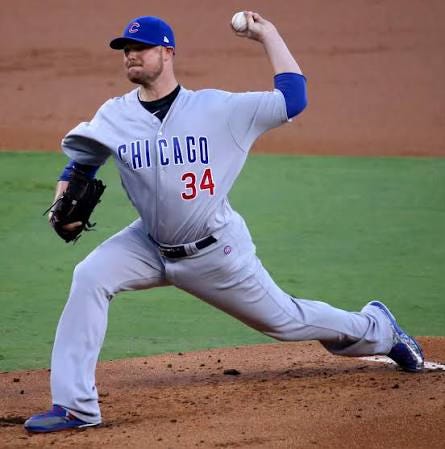
Candidate 3: Jon Lester won three World Series and played a large role in each postseason run. In 2007 won the clinching Game 4, throwing 5 ⅔ scoreless innings. It was an emotional season for Lester since his 2007 campaign came after successful treatment for lymphoma. I attended his first game back, which came against the Indians in Cleveland (he pitched well). But Lester was not done. Lester also played a vital role in the 2013 Red Sox championship. Everyone recalls David Ortiz going nuclear in the lineup, but Lester pitched two superb games, picking up the win both times, and surrendering only one earned run the entire World Series. Finally, his 2016 postseason campaign was superb, and Lester was the ace who led the Cubs rotation that beat Cleveland. Lester lost a heartbreaker to Corey Kluber in Game 1, but Lester’s Game 5 start was exactly what the Cubs needed, outpitching Trevor Bauer and picking up the win. He came on in relief in Game 7 tossing three vital innings Chicago desperately needed to close out the clinching Game 7.
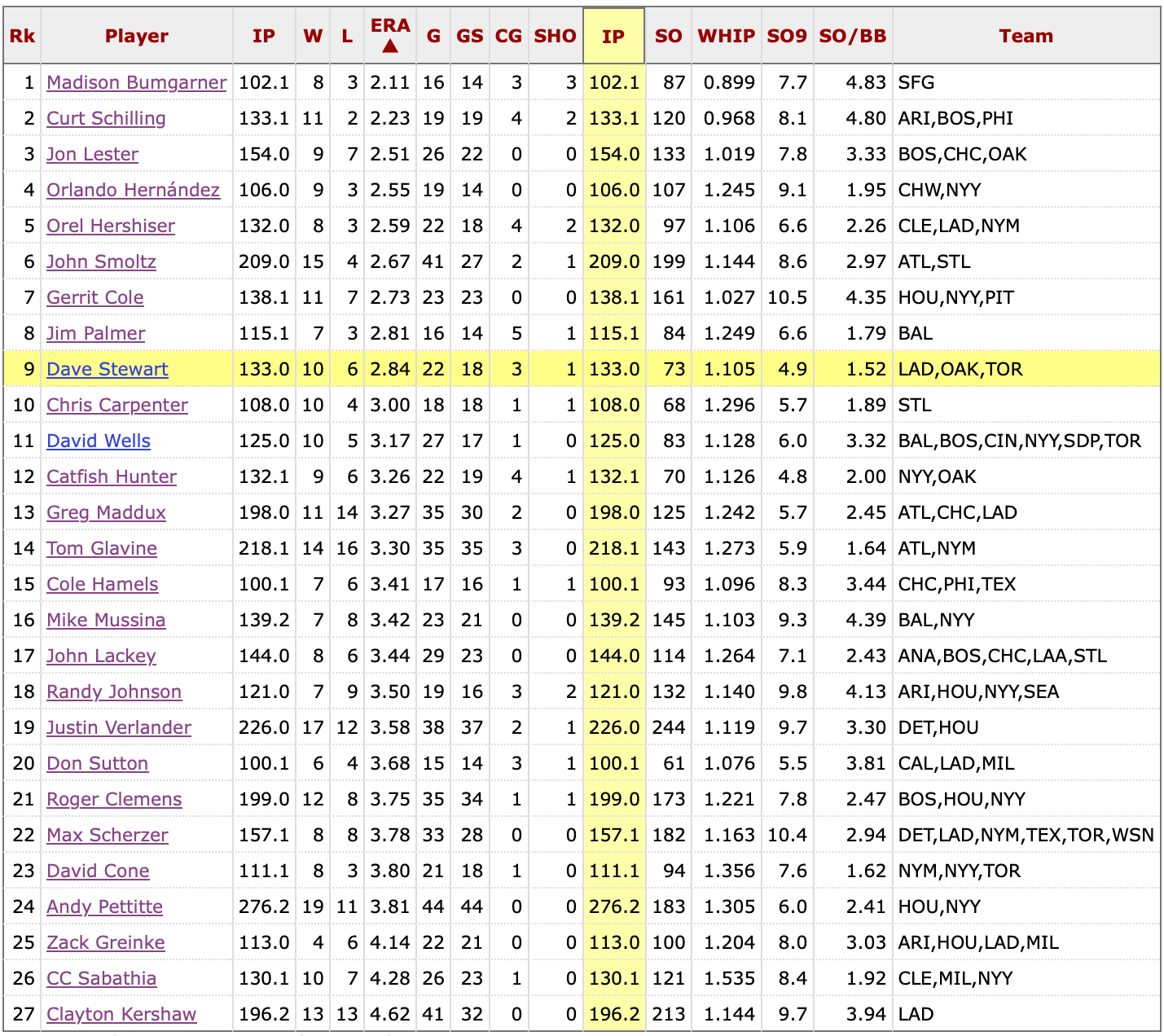
I don’t have an answer for which one is the best. You could also argue for Orel Hershiser, who pitched superbly for the Dodgers and the Indians across several seasons. You could also argue for John Smoltz, although he also spent significant time as a closer. However, Jon Lester is at least in the conversation and his numbers are quite strong. Here is every pitcher since 1969 with at least 100 postseason innings:
It’s a compelling list, and Jon Lester ranks near the top. Notably he pitched more innings than both Bumgarner and Schilling. On a quality per inning basis: Bumgarner finishes a touch ahead of Lester. But Lester pitched more overall. It’s a tough judgment call.
But for me whether Lester ranks 1st or 3rd matters little in terms of how it impacts his Hall of Fame candidacy. In short, Lester’s postseason dominance is vital to his candidacy. If Jon Lester had Felix Hernandez’s postseason legacy (i.e. he never pitched in October) then I would not even consider Lester for the Hall of Fame. With his postseason performance I think Lester is at least on the map. I think Lester’s regular season is underrated. His bWAR is only 6 wins behind Hernandez, but if we look at his career as a whole: both pitchers tossed around the same number of innings, with the same ERA+ (117).
I do think there’s a substantial difference between Lester and Pettitte. Lester pitched far fewer innings than Pettitte, and that matters. Pettitte was still pitching important October innings into his 40s, while Lester retired at 37. Had Lester been able to replicate Pettitte’s final seasons I would likely rank them at least evenly. I have not ruled out Lester making my hypothetical ballot, as I think Lester makes up for what he lacks in postseason volume with quality, but I need to review it in depth.
Each pitcher provided at least some postseason value, although it impacts their cases in different ways. I already wrote about Andy Pettitte and Mark Buehrle here, and discussed Cole Hamels here; I will break down Jon Lester in detail in a future post.
I remember that Mariano Rivera mechanics was widely taught in the minor leagues. Very smooth mechanics. He pitched for 20 years and never had TJ surgery.
Among those nine players, four have signed contracts:
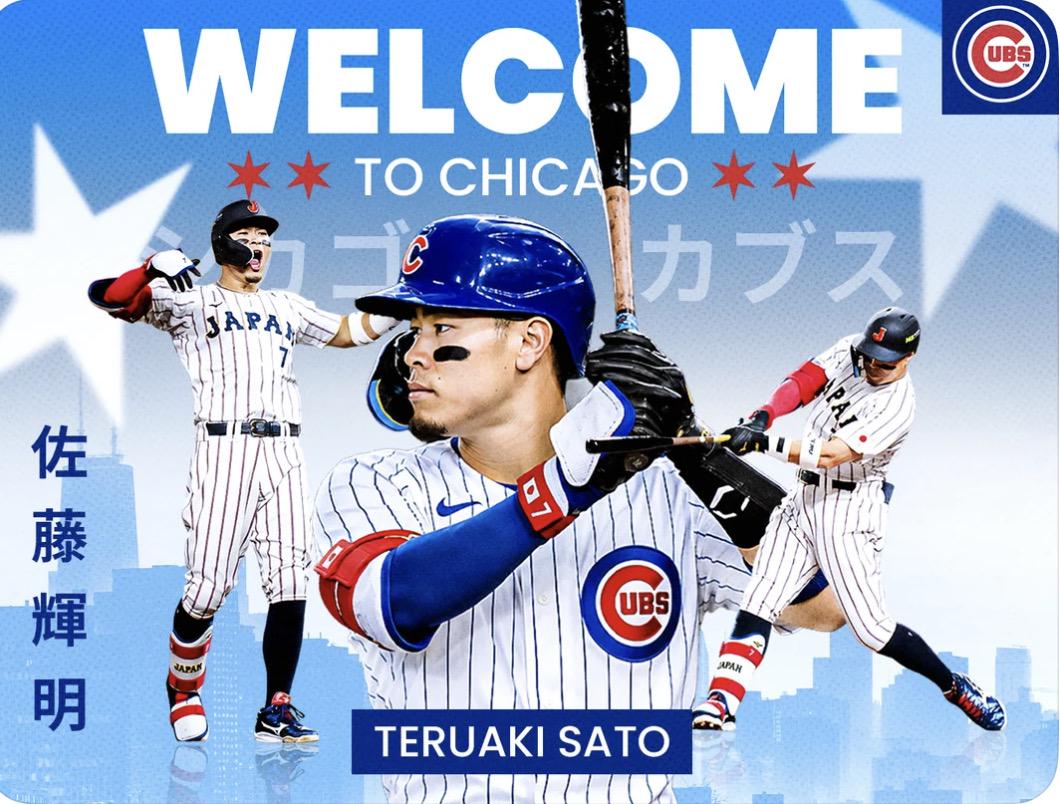
Teruaki Sato → Cubs
Hiromi Itoh → Cubs
Kaima Taira → Blue Jays
Kona Takahashi → Dbacks
Also, Maki’s request to be posted got rejected by his club, and Tatsumi has re-signed with Rakuten.
Now three players are left: Kozono, Roh, and Won.
Kozono and Won are unrestricted free agents, so they don’t need to go through the posting system.
Roh is the only one left who needs to go through the posting system, and he doesn't have much time. He needs to get it done before Dec 1st.
There has been no news or progress regarding his signing.
He must be quite frustrated with this situation because he would never have thought that no MLB teams would be interested in him. FG and BA ranked him higher than Sato in their international prospect rankings a couple of years ago.
That kind of irresponsibility from baseball media is cruel to some foreign players. Is there any possibility that Roh could sue them for fraud?
Triston Casas has not played since May 2025. He had missed all of the 2025-2026 MLB seasons while recovering from a ruptured left patellar tendon and dealing with subsequent abdominal/intercostal and left wrist injuries.