r/bonecollecting • u/BoneAndSkullFanatix • 13h ago
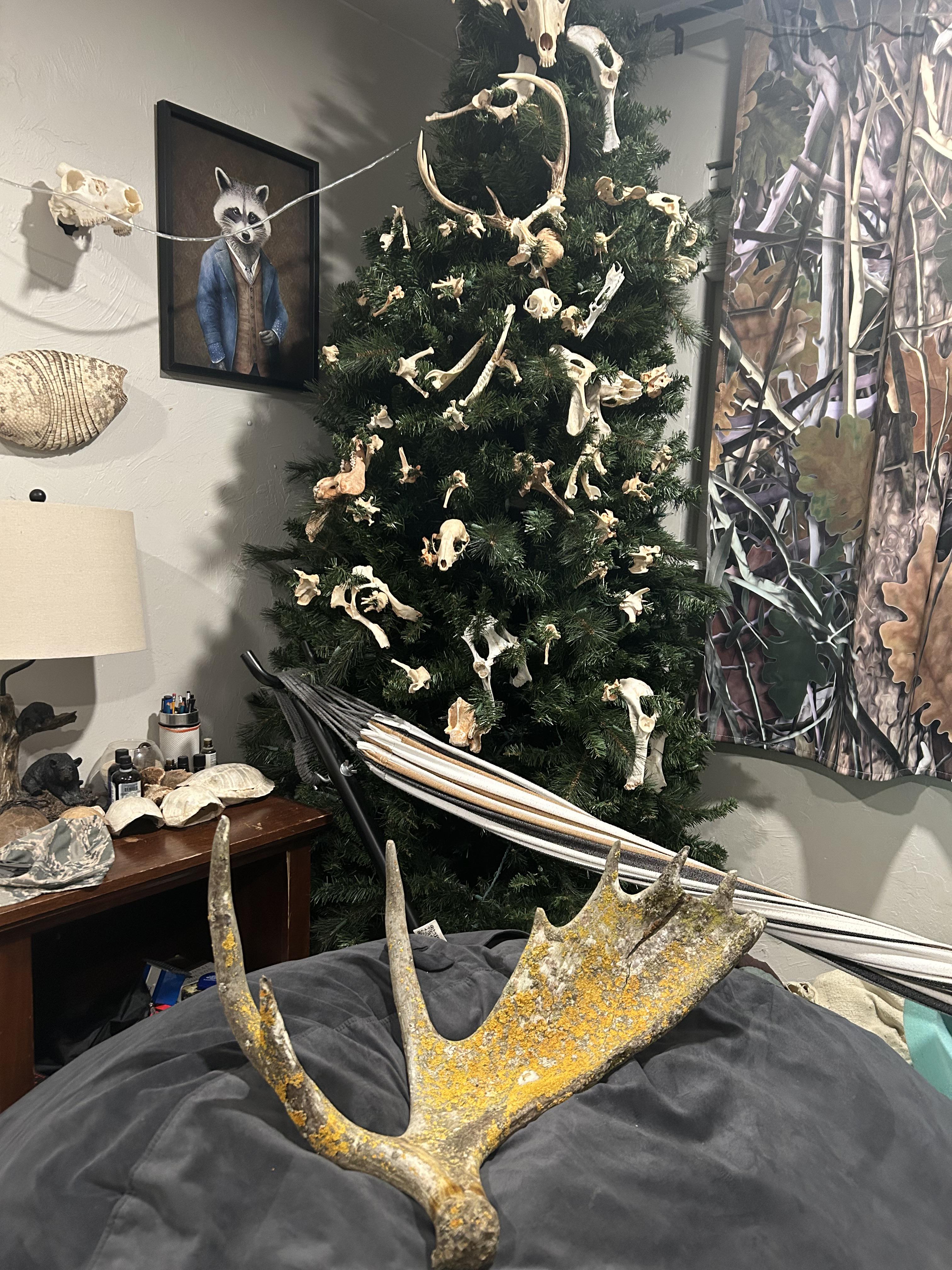
Art Getting ready for Christmas
285
Upvotes
r/bonecollecting • u/firdahoe • Sep 12 '20
Ok, so given how many comments we get requesting info on how to process a carcass, I figured it was time to update the stickie for this topic. Enjoy and, as always, feel free to comment and I will append this as needed. Just a reminder to A) always check your local and federal laws to make sure it is legal for you to possess parts of the animal, and B) if you are in an area prone to rabies or other diseases (rabbits and tularemia, armadillos and leprosy, etc), please take adequate precautions when handling dead animals, especially fresh carcasses. Always use gloves when handling a fresh carcass.
HOW TO PROCESS A CARCASS
There are generally three steps in the process of rendering a carcass down to a skeleton: 1) defleshing, 2) degreasing, 3) whitening. In general, these three steps are most effective when done sequentially. Two main things to remember during the process – Chlorine bleach should NEVER be used in any step of this process, and cooking bare bones will fix the grease and potentially cause long-term damage to the bones. Below are a few good guides for processing a carcass for you to take a look at.
http://www.jakes-bones.com/p/how-to-clean-animal-bones.html
http://baccyflap.com/txt/natmat/bones/
http://www.nara.accu.or.jp/img/elearning/2011/animal.pdf
http://bone-lust.blogspot.com/2015/05/bonelust-q-ive-been-macerating-bones.html
DEFLESHING
In general, the more flesh and skin that is removed, the faster the defleshing step is and the less smell you will have. Once you finish defleshing, you will want to pick clean any remaining soft tissue with tweezers, a scalpel, brush, etc before moving on to the degreasing step.
Open Air - This is easily the fastest method for defleshing. Using this method, you let the carcass rot naturally on the ground and let the flies and other insects work their magic. To do this technique, it is highly recommended that you use a locking cage to keep out scavengers that will be drawn to it. You simply put the carcass in the cage or fenced in area. You do not need to deflesh, skin, or gut the animal first for this to work, in fact the skin can help keep the moisture in. Sometimes it helps to poke a few extra holes for the maggots to get in. There are a few major drawbacks to this technique 1) the smell is awful and your neighbors will hate you, 2) you have to keep the carcass moist for the maggots to keep working, or you will end up with a mummified carcass, and 3) you will develop a fly problem. So, this is better done in a more warmer and more humid climate (doesn't work so well in a desert), and you only want to do this if you have adequate land and distance from your residence (and neighbors, think about your neighbors). Once the skeleton is reasonably clean, remove the bones and rinse them off.
Dermestids – great method if you have the ability to sustain a colony, and works well in the winter if you have a heated set-up. Rather than go through this process, here is a great link that goes over it. Be forewarned, dermestids will smell and do require you to keep feeding it as they are living creatures. If you do not properly ventilate, clean, or feed them, they will find a way to swarm out of their enclosure and I speak from personal experience when I say that you don’t want that to happen. Note that this is the only one of the defleshing techniques that will keep fish, birds, lizards, and small mammal skeletons somewhat intact. The other techniques mentioned below will result in disarticulation.
https://www.natsca.org/sites/default/files/publications/JoNSC-Vol7-Munoz-Saba_et_al_2020_0.pdf
Burying – this technique works best when you have a piece of property to do it on, have time, and can reasonably protect the carcass from scavengers. It also is the easiest for cleanup and has the least smell, and is a great method for when you are dealing with a whole carcass from a larger animal. This method also works with smaller animals, like rodents, if done in a flowerpot. You will still want to skin and deflesh as much as possible beforehand, and you’ll want to keep the soil slightly moist. With burying, there are two primary concerns: scavengers and loosing parts. To prevent scavenging, try to bury at least 2 ft (60 cm) deep (or deeper if sandy soils) and place larger rocks above the carcass to act as a barrier to digging. To prevent the loss of smaller elements, consider placing a wire mesh below the skeleton. The time it takes to decompose depends a lot on the local soil conditions (soil type, soil temperature, soil moisture, soil acidity), but will generally be several months for a larger carcass. I have heard of people adding bacteria (yeast) or compost to the carcass to help speed the process along. Oh, and one last helpful tip…place a clear marker over the pit so you can find it again when it is time.
Maceration – the smelliest method, but highly effective and you can use the same container the entire way through the process. You will want a large container with water, and a way to keep the water on the warmer side (over 70 F/21 C). If you can stomach it, stirring the pot every day will help with the maceration process. You will want to do pour-off’s (replacing the water) regularly initially as the water becomes too fouled (and to remove chunks of soft tissue that will invariable float around), and this is where the most offensive, gag-inducing, eye-watering, curse-laden part of the process will occur. But as the decomp gets farther along, do fewer pour offs. With each pour off, you are reducing the amount of bacteria for digesting the soft tissue. As long as there is plenty of food available, they will repopulate (try to leave some of the scum with each pour off to allow faster recovery of the bacterial population). If the water is allowed to get too cold, the decomposition process will stop and, even worse, you will convert the fats to adipocere (bone wax) which is very difficult to remove. Under ideal conditions, you can easily render a fleshed animal to bones in a few weeks using this method. You don’t necessarily need to deflesh for this technique to work (and I have found that having the bacteria from the stomach contents helped things along), but you do want to skin the animal. Stirring the mix also will aid in speeding up the process. If at all possible, try to keep the buckets out of direct sunlight to keep the algae from growing (I throw a tarp over my bins).
I am going to add in a caveat here since we see it so often - DO NOT ADD ANTIBACTERIAL DISH SOAP OR HYDROGEN PEROXIDE AT THIS STEP. You need bacteria to digest and break down the soft tissue. These two things make the environment hostile to bacteria causing it to take substantially longer to process. The only thing that you can add to help the process along is enzymatic detergent, which brings us to the next method.
Enzymatic Detergent Maceration - You also can add an enzymatic detergent (BIZ is one example) to the water to aid in the process. u/octane80808 has a great summary of the use of enzymatic detergents in the comments section that I have copied sections of here: "For anyone in Europe, we have enzyme-based washing powders [mod note - Biotex in Europe, powdered Biz w/out bleach in US]. I've been using it for years and I can't imagine it doing any other way. It's essentially an all-in-one method, as it dissolves the tissue, but also the fat, so it degreases at the same time. There's no need to whiten the bones afterwards, they come out perfectly clean (there is no bleach, or whitening agent present AFAIK, so it's all natural). The only downside is that any cartilage also dissolves. So for fish, birds, young animals, or small animals, you'll be spending an afternoon gluing the bones.
I also clean my skull manually during this process. Depending on how impatient I am, and how much free time I have, I take them out of the solution every day to every other day. I remove the tissue I can remove without disturbing the skull too much. And I refresh the solution. So a new spoonful of washing powder, and warm water. The latter also helps to speed up the process, as higher temperatures seem to be favourable. By refreshing the solution every day, I can usually clean a skull within one or two weeks...renewing the solution isn't necessary, it will just take a lot longer.
The washing powder is relatively cheap, and it comes in large boxes. You only have to use a teaspoon or tablespoon, depending on the size of the container/skull. So it lasts quite a long time as well..Note that the bone may feel soft after this step, especially if processing a bird or fish. It is better to allow the bone to dry before handling as this will re-harden the bone. Also, bones may turn black during this process if the water isn't changed regularly enough. Do not worry, you can treat this discoloration during the "Whitening" step."
Simmering/Cooking – this method ONLY should be used with larger animals, and can be effective when you have a carcass that is dehydrated jerky. The reason is that high heat will warp bones, and will fix the grease in the bones making step 2 (degreasing) incredibly difficult. Never use this step with birds, fish, and small mammals. To use the boiling method, you actually want your carcass to have flesh, but gutted, in order to protect the bones. Place the carcass into the boiling water and allow the water to return to a low simmer, then remove from heat. Leave the carcass in the water for only as long as it takes for the flesh to “cook” (if you are boiling for an hour, you have ruined the bones). Remove from water and the flesh should come off easily, although internal tissues (like the brain or inside the nose) will still be adhered. You can use a pressure washer or hose with a good nozzle to try and clean off the hard-to-reach areas. Be extremely cautious using a pressure washer as it will blast more fragile bone to pieces and can easily destroy a skull.
DEGREASING
You will need a degreasing agent for this step, most of the liquid dish soaps will work great here, just avoid the opaque ones or ones with strong colors (colorless and clear work great and won't dye the bones). Laundry soap often doesn’t work as well, and some will dye the bones. The exception to this is enzymatic detergent (in the US this is sold as BIZ), which works well as a degreaser. This step requires a container big enough for you to submerge the remains in. Add water and soap – how much soap is up to you and depends on the amount of grease in the bones. You will need to change the soapy water as it becomes cloudy, generally at least once a week. Continue this process until fully degreased – i.e., the water doesn’t cloud after a week. This is the longest step, and will take much longer than you think. If you see any yellowing or oily spot on the bone, then it still needs degreasing.
You can substitute acetone or ammonia for dish soap as the degreasing agent, but both have their safety issues. Ammonia is an irritant, so only use ammonia if you have a respirator. Also, be careful when emptying the liquid as household ammonia will kill vegetation.
Acetone also can be used, but you cannot dilute it with water. As a result, acetone is often more expensive that using the other two agents, and as a bonus it can melt plastic, so you will want to use a different type of container than a plastic bucket. It also dissolves nitrile and latex gloves, is flammable (no heating the liquid), and the fumes are toxic, so there is that. Also, acetone will evaporate, so the container needs to have a tight lid. If used correctly, you can treat multiple batches of bones with acetone, and acetone works faster than other methods. Lastly, acetone can’t be disposed of down the drain because of it’s toxicity and remember that bit about dissolving plastics…like your drain pipes?
WHITENING
After the bones have been degreased, you may wish to whiten the bones. This is not a necessary step, and is mainly cosmetic though it does help to sterilize the bones. You can use 3% hydrogen peroxide from the store, and it can be found in higher concentrations as hair developer, which is up to 12% hydrogen peroxide. Other options for obtaining hydrogen peroxide are from a pool supply store, though you have to be careful that it isn’t mixed with other chemicals. The important things to remember during this step is that A) hydrogen peroxide will degrade quickly when exposed to sunlight, and B) hydrogen peroxide degrades rapidly when exposed to heat, C) hydrogen peroxide will degrade faster when exposed to air. So, it works better when covered and not in direct sunlight.
Simply submerge the bone in the hydrogen peroxide until you reach the desired whiteness. If using 3% hydrogen peroxide, it isn’t necessary to dilute the liquid. Higher concentrations may require dilution as it is a powerful oxidizer.
An alternative method to submerging in hydrogen peroxide is sun bleaching. Note that this exposes the bones to the elements, and you lose a lot of control over the whitening process. It also takes considerably longer than the hydrogen peroxide approach.
NOTE: Chlorine Bleach should NEVER be used to whiten bones. Chlorine bleach degrades the bone collagen, which is the protein component of bone that holds the mineral component (hydroxyapatite) in place. This will leave the bone brittle and powdery, and the bone will continue to degrade over time. The effects are irreversible.
DRYING
I add this as a last step as this is a critical step where mistakes are often made. Bone is a porous material that contains organic components. If dried too rapidly, those organic components can shrink, or parts of the bone may dry faster than other parts. This can result in cracking, warping, and delamination of the bone. In general, let the bones dry slowly and out of the sun. Do not bake or expose it to high heat, or attempt to speed up the process. You may notice teeth cracking during the drying process. This is not uncommon, and you can glue the teeth back together after they drying process is complete.
r/bonecollecting • u/Sol3794 • 11h ago

r/bonecollecting • u/catemoji1891 • 1h ago

I'm thinking of purchasing this skull. It's listed for €300. Is this a good price? Is this truly a wolf?
r/bonecollecting • u/Independent_Wafer_74 • 3h ago

My friend got this cat skull in Iraq, he found a dead cat and cleaned it himself. I posted it for sale and someone commented and saying it’s not a cat. I just want to confirm before I sell.
r/bonecollecting • u/Lucy_machine • 20h ago

A believe a squirrel skull and some snake vertebrae
r/bonecollecting • u/Sbotmtwigrm • 19h ago

r/bonecollecting • u/choso_brainrot • 2h ago

I’ve been macerating a stone marten for a couple months in a bucket with the lid closed after I realised I’ve been accidentally farming mosquitoes. Now the water and bones have turned green and there are a lot of dead mosquitoes (obviously). Normal? I am pretty sure most of the leftover flesh has come off, move to degreasing?
r/bonecollecting • u/manymanymanymoonsago • 15h ago

I think he's a whitetail deer?
I'm going to try burying him in a bucket of dirt over the winter. I've wrapped his antlers in tinfoil and added a lid with air holes and large rock on top to prevent animals.
Anything else I should look out for?
r/bonecollecting • u/markedhand • 1d ago

Photography remains not my gift, but I do still love the art I make. As ever I now need to add them all to my shopify/marketplace so they can be Not In My House Anymore.
r/bonecollecting • u/zogmuffin • 14h ago

A relative bought this at an antique mall, so I don’t know where it’s from originally. It’s not terribly well cleaned and the mandible is glued to the cranium. Seems too small for a coyote and too big for a red fox, plus the space between the orbits look wrong to me for a fox. Any ideas? I never buy mystery skulls myself in case it’s something endangered or illegal, so please tell me it’s not endangered nor illegal 😂
r/bonecollecting • u/BeanSatanist • 19h ago

Found this spine while out hunting. I'm typically good at identifying bones and wildlife, but this one has me stumped. The area is very, very rural. Apologies for not including a scale; I was hunting and didn't have much with me. My hands are rather small.
The typical medium/large animals that are in this area are: deer, elk, pronghorn, cows, cougars, donkey, and horses. There are also (but rarely/extremely rarely) wolves, black bears, domesticated pigs, bighorn sheep. That's all I can think of right now, but I'm certain there are a couple more.
In the area, there are ranches and wildlife. Noting the short spinous processes (which appear to be naturally small rather than ground down) I'm guessing it's not a cervid. My best guess is a yearling calf.
I did not find any other parts of this skeleton while out hunting.
r/bonecollecting • u/IndependentDriver46 • 1d ago

Thats the jaw of a badger. I shot him a few weeks ago because of his unusually way of walking. He had a big abscess in his right hind leg. Could this be because of an accident with a car? Or is there no connection between the abscess and this kind of jaw?
r/bonecollecting • u/Cayjay- • 10h ago

Thinking coyote or fox? Found in the Shuswaps, central British Columbia.
r/bonecollecting • u/beautifulntrealistic • 2d ago

r/bonecollecting • u/James2118 • 15h ago

r/bonecollecting • u/PuzzleheadedRoom8067 • 15h ago

Found in SW US. Seems like a deer to me based on the teeth, but it is so small (about 11cm or 4.5 inches). Even for a fawn it seems small.
r/bonecollecting • u/BunnyGetsTea • 16h ago

My friend doesn't remember where she finds this,but we want to know what they are
We live in south American
Thanks!!
r/bonecollecting • u/ChihabZebida • 1d ago

C'est un crâne de chevreuil mâle européen trouvé en brocante. Je le trouve magnifique et tellement stylé, il me fait penser à un petit crâne de Wendigo😁
r/bonecollecting • u/LeaM0NSTER • 15h ago

I'd love to identify it first of all. Also, how would I clean it so I can keep it?
Thank you in advance, this is my first cool find!
r/bonecollecting • u/Ill-Possible-8717 • 16h ago
Hello everyone!! i have just recently received some deer bones that need to be cleaned and was curious on the best ways to go about it! any tips would be appreciated, thank you!!!
r/bonecollecting • u/Vic_Vaporub • 19h ago

I found a poor squirrel victim of road kill and took the opportunity to preserve their skull. I macerated them and it's going well, but It's the first time I process a mammal and I was very surprised to see teeth becoming loose and then falling.
I put the smaller teeth on a separate jar to clean, but the larger teeth in the top and bottom jaw are still very dirty inside. I tried cleaning them using a toothbrush but because of the curvature on the teeth, is not long enough to reach the dirtiest parts. I'm wondering if I should keep macerating and hope the gunk come out, or if maybe degreasing will help with this. If anyone has tool ideas to use something to clean and reach inside that would be great too. Thanks!