r/carpetbeetles • u/Brainfuzzdisco • 1h ago
Please help, crying and still itchy. What are these and why still itchy?
gallery
2
Upvotes
r/carpetbeetles
•
u/Bugladyy
•
Dec 28 '24
I’ve been seeing a lot of misinformation about carpet beetles floating about in here, so I would like to offer my expertise and help get people on the right track and feeling a little better about a seemingly bad situation.
Ask away!
(Sorry if this isn’t allowed. Delete if so. Just looking to offer a professional’s perspective in this sub)
r/carpetbeetles
•
u/waronbedbugs
•
Nov 04 '24
The purpose of this post is to provide information about carpet beetles and dermestid beetles in general, their identification, their life cycle, and to understand how infestations occur, how to manage them, and how to prevent them.
While the sub name is r/carpetbeetles, this post is actually dedicated to all beetles of the family dermestidae, with the species discussed here mostly belonging to the genus: dermestes, attagenus, anthrenus, and trogoderma. Some of these beetles are sometimes referred to as: carpet beetles, furniture beetles, warehouse beetles, cabinet beetles, black beetles, common carpet beetles, black beetles, larder beetles, khapra beetles...
There is quite a bit of variation in which beetles can be found in different geographic areas, but many of the dermestid beetles seen in this sub are well travelled (thanks to global trade) and can be found almost anywhere.
While much time and effort has been put into this guide, it is not perfect and may not always be accurate. I am a random person on the internet and take no responsibility for anything you may believe or do after reading this. Please consult your doctor, local licensed entomologist or licensed pest control professional before doing anything stupid or dangerous.
Search engines lead people to websites of pest control companies trying to scare them into hiring their services, or poorly written websites full of dubious claims made to attract traffic. The high quality information from entomology departments, agricultural extensions programs, and peer reviewed publication is well hidden and sometimes costly to access.
AI is making things worst, as the model have apparently been trained on poor quality sources, so they give answers matching this qualities but in a credible way.
That's how people end up here on reddit and that's why this guide was created: an attempt to vulgarize and give clear answers to the question people keep asking here.
The information provided here is fairly basic and should not be controversial, but you are strongly encouraged to verify any aspect that you find questionable with a reliable source (and report any discrepancies by commenting).
If you live in the countryside and find a few adult carpet beetles in the spring, or a few larvae from time to time, it's ok and you shouldn't worry too much.
Typically, an adult carpet beetle will enter your home by flying in through an open window (or any other opening in your home, often due to poor sealing) because they are attracted to the light from our doors and windows. It may then find a food source (dead insect, wool, lint...) to lay its eggs. After a few weeks, these eggs will hatch and the larvae (the longest and most destructive stage) will begin to feed on whatever they find. Once they turn into adult carpet beetles (after going through the pupal stage), they will usually try to leave the house (attracted by light) and you may find them on (or near) a window... but if they can't get out and have access to a good source, they may mate and lay eggs inside your house again. Swift entry and exit at night is wise.
Carpet beetles undergo complete metamorphosis, which means that their life cycle consists of four stages: egg, larva, pupa, and adult. The amount of time spent in each stage varies greatly from one beetle species to another, as well as with environmental conditions (humidity and temperature) and the availability and quality of food sources.
The number of eggs left, the time spent in each stage (the number of times the larva will molt) varies greatly depending on the species and conditions (temperature, humidity and food availability)
When it comes to pest identification, don't rely on Google, Apple or even dedicated AI insect identification apps: they are not reliable at all, don't trust random websites (especially those of pest control companies) and googled images either, they are often mislabeled (and sometimes AI generated).
Adult carpet beetles are fairly easy to identify with a good picture, geographic location, information about the part of the house where they were found, and (ideally) what they were eating.Unfortunately, in their larval stage they are more difficult to identify to species level without a microscope, but we can usually get a rough idea and tell if it's likely to be a carpet beetle larva or not. While it's really important to identify the pest family, exact species level identification is generally not necessary to start dealing with the problem. Most species are treated similarly when found in a home, so as long as you don't mistake it for something other than a dermestid beetle, you should be fine.
As you are reading this guide, the easiest way for you to identify what you found is to take a good picture (focused and close up) and create a new post with the picture in this sub. Alternatively, you can look at the pictures below and perhaps identify them yourself (it's easier to take a good look and compare it to a picture than to take a good picture of a moving insect).
There are many species of dermestid beetles, but here are the most commonly found and posted in this sub.
Varied Carpet Beetle (Anthrenus verbasci) and its larva - Worldwide
Black Carpet Beetle (Attagenus unicolor) and its larva - Worldwide
Larder Beetle (Dermestes lardarius) and its larva - Worldwide
Brown Carpet Beetle (Attagenus smirnovi) and its larva - Mostly in Europe
Australian carpet beetle (Anthrenocerus australis) - Mostly in Europe/Oceania
Common Carpet Neetle/ Buffalo Carpet Beetle (Anthrenus scrophulariae) and its larva - Worldwide
Warehouse Beetle (Trogoderma variabile) - Worldwide
Furniture Carpet Beetle (Anthrenus flavipes) - Worldwide
The larvae may infest items made of animal-based materials or containing food.
Let's start by saying that in most cases, it's ok and not an issue to find a carpet beetle once in a while. Control of the population is only needed if they are in significant number or causing issues, and often don't mean total elimination. Said otherwise if you live in a location where carpet beetles are thriving in nature, you are bound to find a few of them in your house every year, that's normal and OK.
We assume that you have already done a thorough inspection, identified the source(s) of the infestation, and correctly identified the insect; if you haven't already done so, start by doing that.
It's important to understand that there is usually no simple, one-step method or product that will solve the problem immediately. Successful, long-term control of carpet beetles depends on what's called an Integrated Pest Management (IPM) approach, which is a combination of methods that together have a high success rate (sanitation, exclusion, non-chemical control methods, and in very rare cases chemical control methods handled by a profesional).
This is the most important step in controlling carpet beetles, you need to find and remove what they are feeding on, this will allow you to eliminate most of the already existing larval population and prevent re-infestation (for another adult beetle to return to the food source and lay new eggs).
Pesticide treatment is not usually necessary to control carpet beetles. Prevention, sanitation, and targeted non-chemical methods are often sufficient. However, in cases of widespread or hard-to-reach infestations, pesticides may be used as a last resort (ideally done by a professional).
It's important to understand that insecticide spray can only be applied on areas that are accessible and often have difficulty penetrating deep into fabrics and hidden areas, making complete carpet beetle elimination difficult. Chemical treatments alone is temporary and may fail if root causes persist (available food sources). In addition, pesticides pose health risks to humans, pets and the environment, so limiting exposure is a good idea. Homeowners often lack the knowledge and proper tools to apply pesticides effectively and safely, making DIY pest control difficult and sometimes ineffective (it's often not a great idea)
If you really want to use pesticides, hiring reputable pest control professionals is a good idea, as they should have the knowledge, tools, and experience that you lack. Typically the treatment would cost a few hundred dollars and you would be asked to leave the house for a few hours (the time for the sprayed pesticide to dry). My recommendation would be to look for a reputable local company to handle it. You want to look for a mom & pop shop: people who are passionate about their job, have a good reputation, and actually care about solving your problem (rather than their commission on the sale).
Being successful require persistence and patience, regular monitoring for signs of activity, and continued cleaning/vacuuming and preventative measures to avoid re-infestation. It often means A LOT of regular vacuuming.
As for carpet beetle "removal", there is no single, simple measure you can take that will guarantee you won't have any issue with carpet beetles. There is a long list of measures that, when combined, will make it much less unlikely that you will have an infestation, and will allow you to detect and deal with it earlier. It's up to you to decide how much effort you want to put in.
There is a rare condition caused by a reaction to the "hairs" (hastisetae) of some of larvae, sometimes medically referred to as "carpet beetle dermatitis," which are sometimes confused with bed bug bites. It's seemingly affecting a very limited number of people.
A lot of people have skin issues, find a carpet beetle, and then ascribe their skin issues to the beetles and drive themselves bonkers without consulting a doctor... If you are one of the many people coming to the subreddit and this guide to self-diagnose the origin of a skin symptom I suggest that you read this great page MYSTERY BITES: Insect and Non-Insect Causes and try to get help from a medical profesional.
If the situation is causing you a lot of distress (such as fear, anxiety, sleep issue), which is common and understandable, that's also something that you should bring up with a medical profesional to get support.
To help dispell some myths, u/Bugladyy (an entomologist with expertise about carpet beetles) made a serie of post and videos demonstrating that she could expose her skin to carpet beetles without any adverse reactions.
u/Bugladyy (an entomologist with expertise on carpet beetles) published some great posts that you may want to read:
A post about carpet beetle eggs
I’m an entomologist with expertise about carpet beetles AMA
Please feel free to correct any errors or misleading statements in this guide by commenting below, but try to cite a reliable source (i.e., something academic/institutional and not a random pest control company website).
Just comment below, I will read it (I normally don't see and don't reply to DMs and chat requests).
r/carpetbeetles • u/Brainfuzzdisco • 1h ago
r/carpetbeetles • u/btl117 • 1h ago

I found these little chubby, long white guys all over my couch. I first suspected bedbugs, but couldnt find any anywhere in their usual spots. I posted elsewhere and got directed here. I just wanted to verify they are carpet beetles. I do have a couple dogs that shed here and there, but we felt we did enough to keep up after them. Residing in north Houston,TX
r/carpetbeetles • u/charl1e112 • 5h ago

Hi guys as explained in title we got this hanging shade off of Vinted and had noticed that some of the wool has been eaten through. Can anyone confirm and if so are we smart to get rid of it?
r/carpetbeetles • u/joobs_fully • 8h ago

I vacuumed them all up but a few are surely in between the baseboard cracks. I haven't seen any evidence they've gotten into my mattress/pillows - that is my main concern. Aside from pulling the bed away from the wall, are there any other recommendations? Thanks for the help!
r/carpetbeetles • u/luckycocogolfo • 1d ago

r/carpetbeetles • u/Djolltax • 1d ago
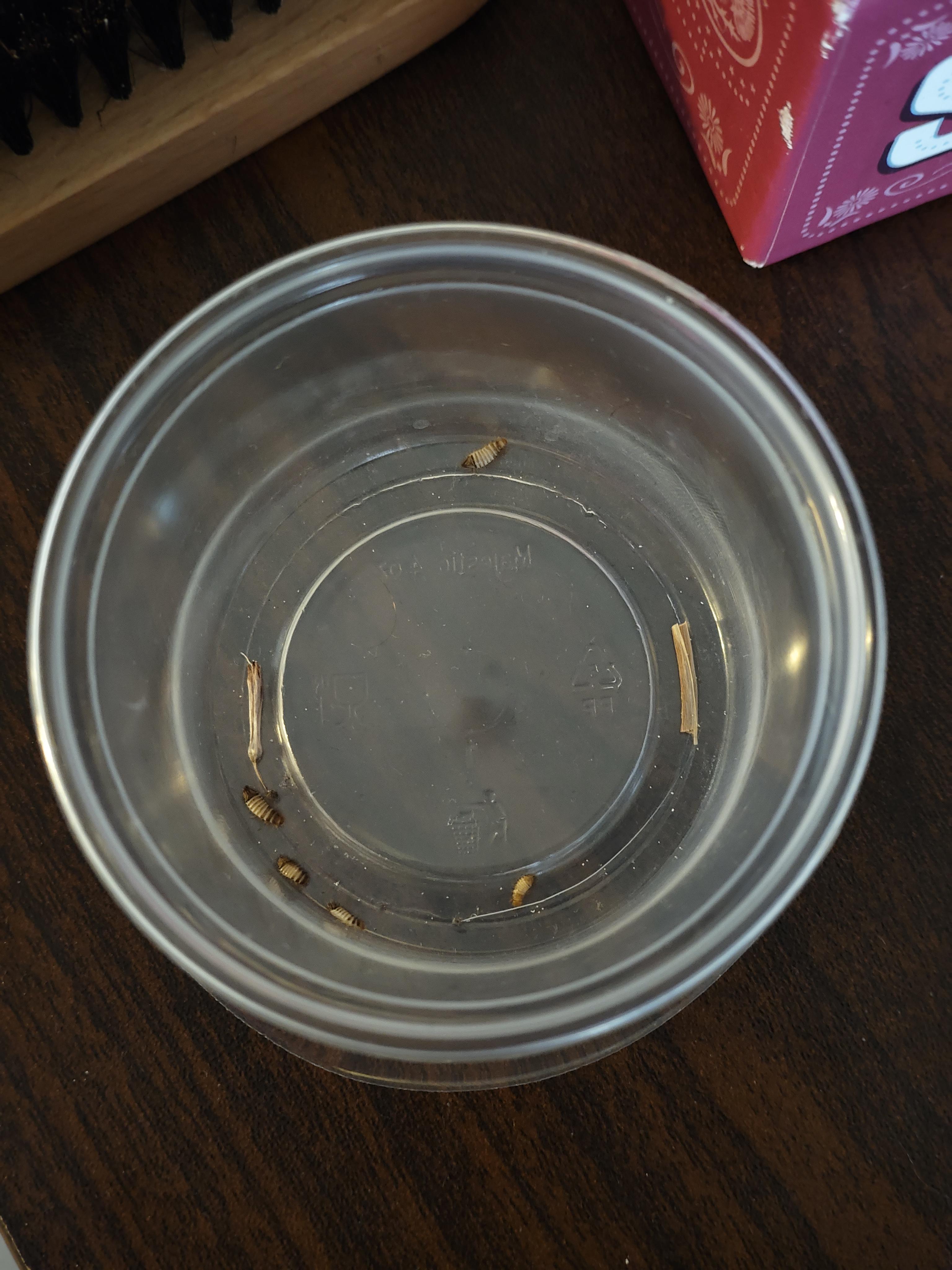
(Bedroom/livingroom, larvae found, UK)
Found these suckers over the past couple days, has anyone got good tips to catch em?
It started with one crawling on my bedroom wall, found another on the same wall a day later and I found the rest by digging around in the carpet - 2 in the bedroom, one in the living room.
I've seen the tips around this sub and I'm not too worried, finding 5 in 2 days could be a lot worse - but just so I'm getting them all, has anyone got good tips to catch em?
I'll be getting some killer spray for the skirting boards if I find some more, but for now I'm just waiting and seeing what happens next.
Also yes, I'm capturing instead of killing, idk why, but they can't get out of the cup so don't worry!
r/carpetbeetles • u/sweetchillichickenn • 1d ago
Every time I vacuum (around once every 4 days) the following day I see 1 carpet beetle larvae on the wall. I never see adults and it’s always 1 singular larvae I find just randomly on the wall. Is there anything else I should be doing!?
r/carpetbeetles • u/manco-8q3 • 1d ago
Ok so I've lived in my house for over 10 years and have never seen these things but suddenly about 3 weeks ago I found a tiny little larvae crawling up my bed headboard (upholstered unfortunately but entirely synthetic). Literally kind of tore apart my room searching for these things and found about 7. 1 on my headboard, 4 under my bed, 2 under my nightstand. I couldn't find anymore and vacuumed like crazy around my entire room (carpeted 😭), like I'm talking the corners, under the bed, and baseboards. Found another tiny one (smaller than any other I found) under my nightstand about 2 weeks ago but other than that nothing. I've been vacuuming around 1-2x a week at this point. Thought I was mostly good but recently found two tiny (black/ dark brown pepper sized) larvae on the floor of my closet. I will admit my closet is the one place I didn't tear apart cause I did a deep clean on it 1 month ago before these things ever showed up. Now I'm terrified they're in my clothes 🥲.
I live with my parents and they think I'm overreacting over a few bugs but an infestation would genuinely be my personal hell. I have 2 senior dogs with CHF who like to hang in my room so I really don't want to put down any diatomaceous earth or use pesticides. I don't really know where they came from as I vacuum my room biweekly, dust, and clean so I like to think I'm fairly neat. All my clothes are on hangers or on the top most shelf of my closet and the only thing I have on my floor is a wood shelf for my pants and a plastic drawer. I know they're pretty much ubiquitous in every household, my brother says he's seen a few before, but I've never seen them in my room. Please tell me it's not the end of the world, this is actually my worst nightmare.
r/carpetbeetles • u/rubber_ducc • 1d ago

And should I panic?? I have only found one and havent seen any beetles, not in summer either, so Im hoping I don't have to but we had a moth infestation last year and I rlly don't wanna go through that again... Located in the Netherlands
r/carpetbeetles • u/Old-Connection-2949 • 1d ago
I am really searching for these. But I live in Germany and they are banned. Can someone pls help me
r/carpetbeetles • u/Aelis_ • 2d ago
in the PNW , USA , found in bedroom closet and dresser drawers. found two pieces of clothing with this bizarre hole pattern on them . they are 80 % cotton and 20% polyester. also have two cashmere sweaters , one came with a hole but i found more and don't know if they were already there or not . the other sweater is untouched , even though they are stored in the same place. they appeared suddenly , and i haven't been able to find any larvae casings or beetles themselves , both of which i have seen before and would be able to identify . any ideas ?
thank you ! edit ; have added a video of the cashmere sweater
r/carpetbeetles • u/MainMagician2837 • 3d ago

Moving this weekend. Apartment does not have carpet but during a walk through we found what we believe to be two carpet beetle pupa. One in the pantry and one in the linen closet. Any advice or thoughts on the odds of there being more and how bad it could be in an apartment that is currently empty with no linens, no carpet. Also found what used to be a moth nest of some kind.
r/carpetbeetles • u/Haunting_Judge5294 • 3d ago
If you have carpet beetles and are reading posts saying you can’t get rid of them please don’t listen!! I was so anxious when I started to see them, I have a fabric headboard and saw them crawling on it at-least a few a day.
I lifted my bed up and found them all on the hard wood floor, I have such bad anxiety about stuff like this especially as it’s bugs in the bed!! I’ve hoovered them all up and took my bed apart. (My whole bed is a brushed cotton material and has two base boards underneath) I’ve been following what Google said to hoover every day and I’ve also been steaming my bed and in the crevices and then leaving it to air out throughout day and have been doing this daily. After doing this I’ve only been seeing one each day at the bottom of my bed. I’ve invested in a carpet beetle spray (Nope carpet beetle spray) and have been spraying this over my whole bed the back and the mattress.
I’ve also been Cleaning my bedding daily and making sure to hoover the whole room just in case and it’s made a huge difference. Carpet beetles don’t cause any harm to you but the thought of having them in your room isn’t nice, I just wanted to say you definitely can get rid of them just by making sure to clean thoroughly every day as this has made a huge difference in seeing them, I am still continuing this process until I don’t see any at all and will be using a white vinegar spray as a deterrent I hope this helps anyone who’s worried!!!
r/carpetbeetles • u/sheswims • 3d ago

What part of these carpet beetle larvae cause the welts. Will these be destroyed in the washing machine and dryer?
r/carpetbeetles • u/phonebizz • 3d ago
If I don't vacuum this one room, I always find these larvae (no carpet in the room). This has been going on for years. However I have barely ever found an adult beetle. The window is never opened in this room. If I pick up some fabric that has been laying on the floor for a long time it's like 50% chance I find a larvae, but almost always just one larvae, very rarely two.
I would love to find many as that would mean I'm close to finding the spot they hatch from or at least better the situation.
So why do I never find the adults and why do I always only find one at the time?
r/carpetbeetles • u/666nbnici • 3d ago
I’ve had them on the sides and on the under side of my mattress, in the crevices of my sofa, in my coats and clothing, in my laundry basket in boxes on top of my closet where I had clothing stored even in the organizers where I only had hair products stored.
I’ve finally not found another larvae on my mattress or around my bed for 3? months maybe
None in my bathroom or clothes.
I do still find a larvae from time to time but it’s been like one or two in the last 1-2 months and luckily only on a wall and the other one was on a box, but none inside.
I definitely think I’ve been making progress and hopefully I’ll be able to get completely rid of them or at least if they aren’t in my clothes or mattress I’m fine with them.
So don’t get discouraged. I’m also no where near as clean as other people just because I don’t have the energy.
Central Europe
r/carpetbeetles • u/Desperate_Sample_157 • 2d ago
r/carpetbeetles • u/Pineapple5811 • 3d ago
Newly washed bedding, just did my bed and sat down for 20 mins or so with my laptop on my bed. This little thing comes wiggling out right in front of me.
I can't tell what it is and don't understand how it's on newly washed and put down bedding. I've put away the rest of the clothes from that load into my cupboard and am now freaking out a little. Do I need to rewash my bedding? What about all the clothes I folded up and put away with the rest of my clothes?
I have another post with pictures.
r/carpetbeetles • u/Delicious-Mud-616 • 3d ago

I have been finding tiny beetles in my home in Germany since i moved in a year ago. Super rare, I see maybe one a month. I thought they were cigarette beetles, but today i saw 1 larvae on my bedroom wall. That appears to be carpet beetle larvae. I have found the beetles super randomly around the house. In the bathroom, one on the couch, one on the hallway wall, now one in the bedroom. It’s very sporadic though that I find them, i have seen maybe 10 in total over a year. I never see droppings or carcasses any signs of damage. What should I do? I have no idea where to even begin with where they could be coming from.
r/carpetbeetles • u/Artistic-Badger6632 • 4d ago
Hi all, as the title says I have found signs of carpet beetles. I had a larvae on the wall weeks ago but did a good clean and thought it was okay. Now I found another larvae on the wall again and when I checked my stash (under my bed in bags) I found a husk. Just one, but still a husk.
What is the best route? I put everything in plastic bags now, but I do not have freezer space to freeze it. Terrified of my whole stash being a goner :( Any help is appreciated