r/dostoevsky • • Aug 26 '26

A sketch from Dostoevsky’s notebook for The Idiot

Post image
153 Upvotes

I recently read Dostoevsky’s notebooks for The Idiot, and they were super interesting. As we all know, Dostoevsky tended to write under deadline pressure, and The Idiot was no different. It was published in serial form in the Russian Messenger, and 23 days before the first five chapters were due, he threw out what he had written and started over.

What would eventually become The Idiot was Dostoevsky’s seventh version of the story and specifically the character of Prince Myshkin. Interestingly, earlier versions of Myshkin were closer to to Raskolnikov from Crime and Punishment, marked by “immeasurable pride” and a “burning need for love,” and capable of extreme manifestations of both good and evil.

It’s also interesting that the first five chapters were written before the idea of what Myshkin would be was fully developed. After submitting the first installment, he wrote to his niece, explaining that he was trying to portray “a perfectly beautiful human”.

“There is nothing more difficult than this in the world, especially now”, he wrote. “All writers, not only ours, but even all European writers, whoever has attempted to portray the positively beautiful,—has always given up. Because the task is immeasurable. The beautiful is an ideal, but the ideal—neither ours nor that of civilized Europe—is as yet very far from having been worked out.”

Anyway, I wrote an article that I’ll post here if anyone is curious. I also recommend reading the notebooks for fans of The Idiot. Very interesting. https://dostoevskyrr.substack.com/p/a-perfectly-beautiful-human-how-dostoevsky?r=1cx4ka&utm_medium=ios


r/dostoevsky • • Jul 06 '26

Notes From Underground Stage Production in GTA in Two Weeks

15 Upvotes

Hello, members of r/Dostoevsky... I have made this reddit account specifically to reach out to you (and any other subreddits that may be interested)

I am staging a production of Notes From Underground at the Hamilton Fringe Festival, opening on July 16 and running until July 25. I adapted it, am directing, and will also be playing the Underground Man. It is a 7-actor production, and the majority of the play consists of The Story Apropos of the Wet Snow.

If any of you happen to be in the GTA and would like to come out, that would be incredible. Please let me know if you do -- I would love to say hello after the show.

Not sure if I am allowed to post links -- feel free to just Google 'Notes From Underground Hamilton' if it gets removed-- but show details are here: https://hftco.ca/events/notes-from-underground/

Hope to see some of you there, because that would be awesome!!

- an Insect


r/dostoevsky • • 1d ago

My view on White Nights, Poor Folk and Christmas Tree Wedding.

10 Upvotes
  1. I see WN as a breakdown of loving the idea of romance. The dreamer is a lonely man filled his imagination about talking buildings getting upset over paint. He meets a girl waiting for her lover who might never come, she doesn’t desire romantic feelings from him and he promises not to. But he can’t help himself, he still greatly desires romance with her and one night when he finally does… her lover arrives and takes him away. Years later his place is in ruin and he gets a letter from her saying she’s getting married, a lot of would be mad and blame and curse her, spit on that letter and how dare she do this to him. But instead he doesn’t, he writes how he wishes nothing but only the best and that her wonderful smile never ends. And I see it as the act of genuine love, not idealised perfectly scripted love but one from his soul.
  2. I see it as two deeply connected cousins holding onto each other for support in terrible poverty. Told In a very unique forms of letters. It’s the day to day struggles and shame of Makar Devushkin and Varvara Dobroselova. Distant cousins who struggle because they lack money to buy fresh clothes. One of the characters keeps giving his money to her and at the end for her own survivor agreed to marry this cruel man for wealth. But must leave him and left him heart broken and running at her carriage taking her away. The only person he loved.
  3. The Christmas Tree one. It’s about the evil, greedy and corrupting nature of noble society. During the Christmas holidays a boy is celebrating his birthday but doesn’t treat his gifts well. The adults use this occasion to discuss business rather than celebrating cheer. There’s a meek boy who befriends an older girl who is nice to him, then this creepy adult comes to scare him away and torment this girl. The narrator watches all of this go down was present when sees her as a sad teen marrying this man, the narrator in disgust leaves over how horrible marriage.

r/dostoevsky • • 1d ago

Tell me the most unhinged thing from your favourite Dostoevsky novel!

7 Upvotes

My personal obsession is Crime and Punishment. I've been reading it for about 14 years, with roughly 25 rereads so far. Needless to say, I've developed a rather unhealthy attachment to its characters.

My contribution: “The real crime was what Dostoevsky did to my nervous system.”

Your turn! Give me a quote, sentence, scene or inside joke from your favourite Dostoevsky novel that fellow readers will immediately recognize. No explanations necessary. Let's see how unhinged this literary corner of Reddit can get 😂


r/dostoevsky • • 1d ago

Pavel Fyodorvitch appreciation! Spoiler

28 Upvotes

SPOILERS FOR THE BROTHERS KARAZMOV!!

Pavel (Smerdyakov, though I refuse to call him that) is the lynchpin of all the themes of TBK. He is the unloved, suffering child who is rejected by even his brothers. Even Alyosha rejects him and struggles with active love until the end of the novel. Ivan comes the closest to genuinely loving Pavel, but in the end he can't do it and Pavel's suicide drives him insane.

The theme of how easy it is to love in dreams versus how hard it is to love actively centers entirely around Pavel. Also "the more I love humanity the more I hate the individual man" can be seen in Ivan and Pavel's relationship -- in the novel, literally right after the grand inquisitor Ivan goes home and almost BEATS Pavel for being an unloved child. Ivan "I love suffering children more than God" Karamazov can't even stand his suffering half brother because of how much their similarities unnerve him.

So many times I see people talk about the three Karamazov brothers which entirely misses the point of TBK! So here is an appreciation post for Pavel!


r/dostoevsky • • 2d ago

Inspired By Dostoevsky's White Nights

Post image
153 Upvotes

r/dostoevsky • • 3d ago

What is the best movie adaptation of the Dostoevsky’s novels?

47 Upvotes

Hello all I just watched the 1960 version of White Nights and wondered if there were any other good film adaptations of Dostoevsky novels or any favorite of yours.


r/dostoevsky • • 3d ago

An 1848 cartoon of Dostoevsky and Andrei Kraevsky

Post image
26 Upvotes

Kraevsky was the editor of Otechestvennye Zapiski (Notes of the Fatherland), and the cartoon was drawn by Nikolai Stepanov. It appeared in Illustrated Almanac, a book Ivan Panayev and Nikolai Nekrasov had promised to annual subscribers of their journal Sovremennik (The Contemporary). Though the almanac had been printed, the censors ultimately banned its distribution.

Dostoevsky: Did you have occasion to read my novella?

Kraevsky: I did, it’s all right, not bad, there are some missteps here and there, a superficial view of things…

(With an air of profound importance.)

You know, your novella is, strictly speaking, not a novella, but a psychological development.

Dostoevsky: Precisely, sir… Perhaps you’ve forgotten that this is Mr. T.’s opinion, which I set out in my letter to you when I sent you the novella?

The novella to which the cartoon referred was almost certainly The Double, and Mr. T was likely Ivan Turgenev, who had heard Dostoevsky read from The Double at Vissarion Belinsky’s apartment

The Illustrated Almanac also included a short story by Dostoevsky entitled “Polzunkov”. Since distribution of the almanac was banned, the story wasn’t published until after Dostoevsky’s death.


r/dostoevsky • • 5d ago

We all want a Razumikhin in our lives, he's simply just the goat

Post image
256 Upvotes

- not my artwork


r/dostoevsky • • 4d ago

"Don't Believe Me More Than You Should": Porfiry's Victory over Raskolnikov

15 Upvotes

A few days ago I was going to write about these two characters, and I asked what people made of their exchanges. Having reread these apparent dialogues between them (since it's Porfiry who runs the show in almost all of them), I've found it hard to give an opinion that takes in everything Porfiry represents in relation to Raskolnikov. Still, here is what I think was the key to the investigating magistrate's victory over the former student, Rodion Romanovich.

Anyone reading Crime and Punishment is bound to conclude, as they go, how fruitless and pointless Raskolnikov's murder was. He himself embodies how ridiculous and aberrant his own theory is. Guilt, the engine of the novel, drives him out of the blue to the home of his adversary, Porfiry Petrovich, where he makes the worst possible choice: he laughs. A giveaway by nature, and one Porfiry, of course, doesn't miss. Then, startled to learn where his article has ended up, and egged on by the curiosity only two cynics share (as Porfiry and Raskolnikov are), he lays out, without hesitating, that pathological philosophy of crime. Porfiry can do nothing but mock him, in his own way, naturally, just as that sick, faint man suddenly, unexpectedly takes on the air of an insolent, vain one.

Second interview. This one in particular shows us a bit more of the other side: the investigating magistrate. Porfiry has a rather sharp, slippery opinion of himself, one that leaves the reader, and Raskolnikov for sure, utterly bewildered. He says he's prone to laughter; other times he says he's a finished, ossified man (note how grotesquely he describes himself); and what he seems to enjoy most is psychological upheaval. Though, to tell the truth, I don't know how much weight to give those self-descriptions (I'll come back to this for the last interview). As I was saying, Porfiry, in his office, pushes Raskolnikov to exasperation until the suspect has no choice but to defend himself, loudly and openly, pounding his fists on the table, denouncing the unbearable personality of this monstrous judge. To which, as a last resort, Porfiry responds by baiting his friend even more, warning him of a supposed surprise...

Third and final interview. In my view the best of them all, and the one in which Porfiry beats Raskolnikov once and for all. The investigating magistrate has a "little detail" and already knows Raskolnikov is the guilty one. Let me pick up what I said above: even though Porfiry Petrovich holds those opinions of himself, which make even the reader doubt him, there is one thing this investigating magistrate undoubtedly has: intelligence. And this broad, much-debated trait is, in the novel, apparently the raw material of an effective antidote. Porfiry tells Raskolnikov that he may know a thing or two, but that he himself is a finished man; that perhaps, deep down, he knows Rodion could laugh at him or take offense at so much nonsense, but that, I repeat, deep down what he's telling him is the truth: "You need a change of air," says Porfiry. "That's the first thing." What he's trying to make Rodya understand is that he understands him: that feeling of pent-up enthusiasm, of loneliness, of a heat that has intoxicated him so much that he, Raskolnikov, wanted to sort people into two categories and still say, with all those miseries: I am a Napoleon. And what Porfiry tells him is that that's not what matters! Rather, "it's you who matters!" A piece of life advice in what he himself calls "poetic language," but which is precisely what Porfiry, despite all his games of appearances and flustered mannerisms, wants to teach Rodion. There's intelligence in that.

It isn't a theory that wins, it's life. And you were mistaken about that. "Let yourself be carried along," Porfiry tells him, "accept the suffering, but don't believe me more than you should."

In short, Porfiry wins because he has, of course, something Raskolnikov has deprived himself of: life. And while the latter sinks into theories incompatible with his surroundings, we know the investigating magistrate has hit on one of the principles that untangle the guilty man's wretched situation.

That's why Porfiry Petrovich makes my list of Dostoevsky's best characters.


r/dostoevsky • • 6d ago

On to another journey...

Post image
187 Upvotes

Continuing to delve deeper into Dostoevsky's world after finishing Notes from Underground and The Idiot.


r/dostoevsky • • 6d ago

Who's everyones favourite dostoevsky character?- mine is stavrogin

Post image
245 Upvotes

then ivan and rodion as my top three


r/dostoevsky • • 5d ago

My Review of Crime and Punishment Spoiler

7 Upvotes

Alright, let me get into this, because I love this book, and after reading it I’ve given myself over a week to think it over and think about the themes.

Redemption is definitely a major theme in the book, BUT I hear a lot of people saying Raskolnikov was “redeeming” himself by the end, but really I don’t think it’s that simple.

I don’t think Raskolnikov really even became a better person by the end of the book, even though he did confess to his crime, and is now paying the price for it.

If you disagree with me, feel free to debate or enlighten me in the comments, because I do love discussing books.

Now I’m going to get into the meat of my argument.

In the second section of the epilogue, Raskolnikov says “‘Why does my action strike them as so horrible?” he said to himself, ‘Is it because it was a crime? What is meant by crime? My conscience is at rest. Of course, it was a legal crime, of course, the letter of the law was broken and blood was shed. Well, punish me for the letter of the law… and that’s enough’”.

I think this shows the he doesn’t even think what he did was wrong, and he only views his punishment as being of the law, not as him being punished for something truly wrong.

By extension, that means his redemption is only in law, and only in legality.

When it comes to his confession itself, one of the big reasons he did that was so he could have the life with Sonia that he wanted. Sonia told him to confess, and because he wanted that life with her he did. He did not confess because he came to the conclusion that what he did was truly evil, he still denies that even while in prison.

Another piece of evidence to me that Raskolnikov is still not redeeming himself, yet only wishes to appear redeemed is the New Testament he asked for.

Redemption is a major part of the Bible, and Raskolnikov is someone who wants to be redeemed, but not have to go through the introspection to even begin.

Him asking for, yet never opening the Bible appears to me as him trying to appear like he is growing, when he isn’t, it’s performative really.

Don’t get me wrong, I love Raskolnikov as a character, but I would not define him as “morally grey”. He’s really just a piece of shit looking for people and society to tell him he’s a good man, or he’s reformed, so that he can clear his own conscience.

He’s human, he feels human emotions, he feels human guilt, but that doesn’t make him morally grey. He isn’t the embodiment of evil itself, and almost any person really would feel guilt, but Raskolnikov is, in my opinion, not at all morally grey because he does shitty things, and is just looking for people to tell him he’s a good man without him actually admitting or coming to terms with how horrible everything he did was.

Thank you for reading all this lol, if there’s any other points you have for or against me we can discuss them for sure.

Overall C&P was a 9.5/10 for me, the cast was amazing, and Raskolnikov, Sonia, and Porfiry were my favorites in terms of writing.


r/dostoevsky • • 5d ago

Quixote book club remote

Thumbnail reddit.com
4 Upvotes

r/dostoevsky • • 7d ago

An edition of Dostoevsky’s Works published for the centenary of his birth in 1921

Post image
93 Upvotes

I’ve always been fascinated by how the Soviet Union handled 19th century writers, and Dostoevsky is particularly interesting because so much of what he wrote was completely against what the Soviet Union stood for. I stumbled across a speech given by Lunacharskii, the Commissar of Enlightenment, during the 100-year anniversary of Dostoevsky’s birth (1921).  In that speech, if you can believe it, he claimed “Yes, Dostoevsky is a socialist. Dostoevsky is a revolutionary!”

As it turns out, there were tons of events held in 1921 for the centenary, and a lot of mental gymnastics to try to fit Dostoevsky into the Bolsheviks’ worldview. Of course, not everyone agreed (Lenin himself had famously said Demons was “reactionary filth”), but this was before there was a real hard and unforgiving cultural policy. That would change when Stalin consolidated power, and then again with the turn toward the Russian canon in the late 1930s and during the War.

Anyway, I wrote something about the 1921 centenary here if you’d like to know more. Surprisingly little about it is available in English. Dostoevsky and the Bolsheviks: The Centenary of 1921


r/dostoevsky • • 8d ago

"Love life more than the meaning of it." — Commemorating the master at his final resting place (Tikhvin Cemetery, St. Petersburg).

Post image
405 Upvotes

From Part II, Book V, Chapter 3 of The Brothers Karamazov, during the profound, soul-baring dialogue between Ivan and Alyosha.

Dostoevsky reminds us that we must love existence regardless of logic, for only then can we truly grasp its meaning. If we begin to love the 'meaning' of life—the cold logic, the rigid ideologies, or our own hidden agendas—more than life itself, wouldn't that be where the ultimate human tragedy begins?

Captured and shared with deep reverence for the great master who rests in Tikhvin Cemetery, St. Petersburg.


r/dostoevsky • • 8d ago

I hated reading The Idiot, but couldn't stop reading until I finished it.

71 Upvotes

I assume this is a common experience when reading The Idiot (I have seen previous posts about it). It took me several months to finish it. Sometimes I couldn't go beyond 5 pages without being sick of the characters' absurdity. I kept reading without really understanding the hidden meaning of such idiocy until I finished it and read the introduction, and this stuck in my mind:

When Max Brod complained to Kafka that there were too many mad protagonists in Dostoevsky's novels, Kafka disagreed vehemently. Their illness, Kafka argued, was a way to make visible their inner terror. Many of Dostoevsky's characters may well be either insane or diseased, but their 'dis-ease' must be understood as a consequence of their sensitivity to the absurdity and hopelessness of human existence.

​The trivialities, superficiality and hysterical behavior in each character must be hiding their weakness and vulnerability - noise as armor - but it's so hard not to be engulfed by the overwhelming absurdity throughout the entire novel.


r/dostoevsky • • 9d ago

Where is Sonya?voice over

30 Upvotes

Mods , delete if this doesn’t suit the sub.

Hello folks ,

I know it’s frowned upon but I stumbled upon a voiceover of the letter Dostoevsky wrote to this friend after the untimely demise of sonya.i thought you might appreciate it .
Thanks.


r/dostoevsky • • 10d ago

I am so excited to read this

Post image
1.2k Upvotes

Crime & Punishment was my first Dostoevsky novel, followed by Notes from the Underground and White Nights. Is there anything I should know going into it? No spoilers obviously 😅

Side note: I am beyond disappointed in myself for not reading Dostoevsky’s work sooner. To think that I have spent the past 33 years of my life not reading these masterpieces pains me to my core. I read them slowly, take notes as I go, and write down words I am unfamiliar with along with their definitions. I intend to read every single one of his books.

Thank you fellow readers 🤍


r/dostoevsky • • 10d ago

Do we know if this is releasing in hardback yet?

Post image
152 Upvotes

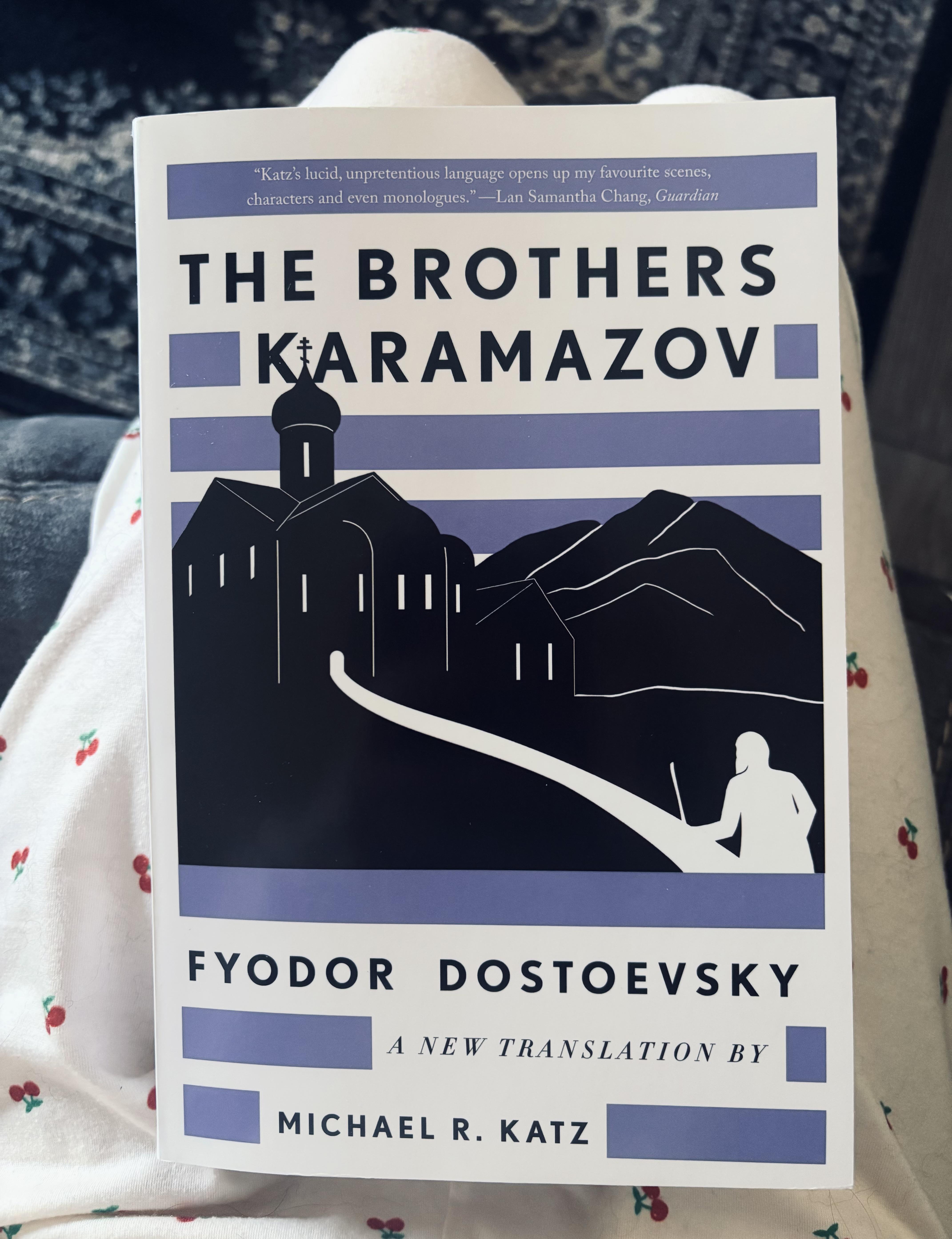
Only seeing paperback and Kindle edition on Amazon. I thought we might get a hardback edition to go with Katz’s Brothers Karamazov and The Idiot, but looks as though it’ll be a paperback to go with Crime & Punishment instead….

https://www.amazon.co.uk/Notes-Underground-Translation-Fyodor-Dostoevsky/dp/1324146915


r/dostoevsky • • 13d ago

Rodions dream analysis

Post image
187 Upvotes

The dream state refers to Rodion's inner mind, glimpses of his morality buried under his consciousness. The unconscious can be understood using Lacanian psychoanalysis to refer to symbolism displayed during Rodion’s dreams. But the poor boy, beside himself, made his way, screaming, through the crowd to the sorrel nag, put his arms round her bleeding dead head and kissed it, kissed the eyes and kissed the lips. . . . Then he jumped up and flew in a frenzy with his little fists out at Mikolka. At that instant his father, who had been running after him, snatched him up and carried him out of the crowd."Come along, come! Let us go home," he said to him."Father! Why did they . . . kill . . . the poor horse!" he sobbed, but his voice broke and the words came in shrieks from his panting” . Using Lacanian psychoanalysis, we observe that the dream symbolizes Rodion’s internalized emotions regarding his planned murder. The horse symbolises Lizaveta Ivanovna and their innocence within their inexcusable deaths resulted from deluded individuals. Marmeladov symbolises the real within Rodion, a raw existence driven by physical desires. As both kill the innocent in a fever, symbolising their rebirth, free from morality. However the child’s conflict with Marmeladov's actions, symbolises Rodion's inner guilt and morality. His conscience has purposely displayed the duality of his nature, and the conflict to come due to opposition between the Child(Morality) and Marmeladov(desire).

- not my artwork


r/dostoevsky • • 13d ago

Ivan Karamazov - Poem by R.S. Thomas

Post image
41 Upvotes

r/dostoevsky • • 13d ago

Are there any good film or mini series adaptations of TBK?

8 Upvotes

I know it’s such a sacred and deep work so it might be blasphemous… but some of the scenes, particularly the dialogue gave me head movies while reading and I’d really love to see what visual artists do with the story.

I also think my gf would really enjoy the story and all the philosophy, but a 900+ page novel that’s light on plot for 400+ pages isn’t her vibe.

The Japanese adaptation from 2010 looks the most promising. Did it do the book justice?


r/dostoevsky • • 14d ago

Sonya version of my analysis

Post image
150 Upvotes

The Super Ego within Rodion is symbolised by Sonya. Sonya is the child of a drunken man, who’s married into a new family. Her father, stepmother and her children all live in extreme poverty and depend on Sonya for cash, forcing her to sell her body. This lifestyle forced upon Sonya clashes with her morality as she is a devout Christian. Now despite having the ability to step above her morality through her actions, she clings to her faith and morals. Acting as the lead figure within leading Rodion towards redemption.The symbolism between Sonya and Rodion's superego comes from her actions, rather then confronting Rodion with the truth or pressuring him through psychological torture, she forces Rodion to confront his morality(superego) through her words. “What have you done—what have you done to yourself”. The quote itself, displays Sonya’s symbolising Rodion's superego’s and its function as an internal moral compass suppressed under the ego. Rather than mechanical condemnation, the question challenges Rodion’s justification and reasoning for committing murder and the practicality of the extraordinary man theory. The result is that Rodion superego confronts his ego and ID, rather than hiding within his philosophical rants in an attempt to suppress self loathing. Therefore the duplication of Sonya’s question, suggests that morality and moral judgement can’t be suppressed by ego/rational thinking but only through spiritual redemption/judgment can an individual truly escape guilt.  

-not my art in the post


r/dostoevsky • • 15d ago

IT’S PEAK 🏔️ (Father Sergius - Tolystoy)

Post image
84 Upvotes

Although this does say more about the ethics and virtuous of Christianity, rather than pure faith which we often see in doestotevetsky — there faith leads to human communion.

Here, Tolstoy said the opposite: that human communion leads to faith.

He says in another page; Communion with Humans doesn’t come from Communion with God, rather Communion with God comes from Communion with Humans.

Do you guys agree? Or do think that faith in God (here Christ) does lead to communion with humans? We’ve seen it with prince myshkin (the idiot) and also I’m Alyshoa (near the end; TBK).

Or…