r/gallifrey • • Dec 14 '25

SPOILERS The War Between the Land and the Sea 1x05 "The End of the War" Trailer and Speculation Thread Spoiler

21 Upvotes

This is the thread for all the thoughts, speculation, and comments on the trailers. if there are any, and speculation about the next episode.

YouTube Link will be added if/when available


Megathreads:

  • Live and Immediate Reactions Discussion Thread - Posted around 20 minutes prior to initial release - for all the reactions, crack-pot theories, quoting, crazy exclamations, pictures, throwaway and other one-liners.
  • Trailer and Speculation Discussion Thread - Posted when the trailer is released - For all the thoughts, speculation, and comments on the trailers and speculation about the next episode. Future content beyond the next episode should still be marked.
  • Post-Episode Discussion Thread - Posted around 30 minutes after to allow it to sink in - This is for all your indepth opinions, comments, etc about the episode.

These will be linked as they go up. If we feel your post belongs in a (different) megathread, it'll be removed and redirected there.


Want to chat about it live with other people? Join our Discord here!


What did YOU think of The Witch of the Waterfall?

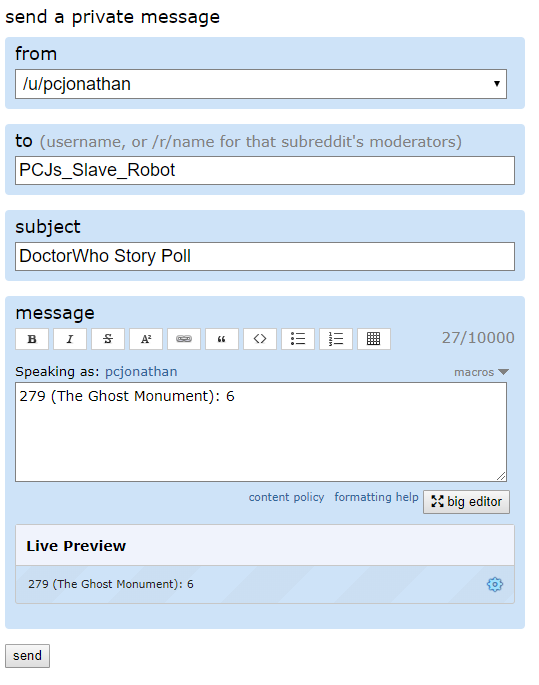
Click here and add your score (e.g. TWBTLATS_04 (The Witch of the Waterfall): 8, it should look like this) and hit send. Scores are designed to match the Doctor Who Magazine system; whole numbers between 1 to 10, inclusive. (0 is used to mark an episode unwatched.)

Voting opens once the episode is over to prevent vote abuse. You should get a response within a few minutes. If you do not get a confirmation response, your scores are not counted. It may take up to several hours for the bot (i.e. it crashed or is being debugged) so give it a little while. If still down, please let us know!

See the full results of the polls so far, covering the entire main show, here.

The Witch of the Waterfall's score will be revealed next Sunday. Click here to vote for all of RTD2 era so far. Click here to vote for all of The War Between the Land and the Sea so far.


r/gallifrey • • 12h ago

MISC Bookish Christmas story based on unmade Doctor Who story

4 Upvotes

Mark Gatiss revealed that the upcoming Bookish Christmas story The Crown of Destiny had originated as a Doctor Who story:

https://www.radiotimes.com/tv/sci-fi/sci-fi-bookish-the-crown-of-destiny-mark-gatiss-preview-interview/

Gatiss submitted the Doctor Who story for David Tennant's final season as the Tenth Doctor but got replaced by The Fires of Pompeii.


r/gallifrey • • 15h ago

DISCUSSION Is it just me or did DW's kill count dropped recently?

0 Upvotes

In RTD1 used to have a lot of people die/get killed. Like in Voyage of the Damned like 2/3s of the guest cast die. Or Rise of the Cybermen has the party massacer Dalek has like 200 killed.

So The Dr Dance's having the 'just this once everybody lives'. Like killing Adric it had impact because it was genuilenly unique and had never happned before.

But it seems like around the mid Moffatt era the body count shrunk. It feels like half the episodes have had a nobody dies ending. Or if anyone dose die its a) the baddie or b) some red shirt. Like remmber when members of the crew die in Satan Pit or Robots of Death and they are proper characters. Worse is when everyone magics back to life like in Empire of Death, Intersteller Song Contest dose the same.

Or there is Moffatt trope of the body dies but the soul lives on in a computer. Which he has done like 5 times. Both of these things mean there are 0 stakes. If death isn't permenent why should the Dr not just wait till everyone dies then bring them back to life or upload them onto a computer?

Even the villians don't die a lot of the time in RTD2. The Meep, Conard, Bird people, Hellians.

Just makes you go. Where is Eric Saward when you need him?

Yes, yes, I know Eric Saward can be to gnarly. But can we have some kind of balance?

Is this a censorship thing? Surely not. Disney films still kill characters for reals so do Dreamworks movies.

The show is meant to scare the kids right? Hiding behind the sofa. Like RTD1 had tension. Nice characters dying showed how dangerous the universe is and makes the threat real so the Dr stopping it, stops more people dying. Its basic drama.

Do they think today's kids can't handle people dying? Is that the angle we are going for? Now that I think about it, Moffatt did have orphans die in Thin Ice. Like could imagine a scene like that with the mature conversation the Dr has with Bille afterwards about it in recent DW? I don't get it. I must stress I don't want DW to turn into Die Hard, but I want there to be stakes again.

Off the top of my head

  • The Star Beast the Meep kills some space police people
  • Wild Blue Yonder the not things die
  • The Giggle the Toumaker kills like three people and gets sort of killed himself
  • Church on Ruby Road the Goblin King dies and I think someone almost gets killed by a Christmas Tree
  • Space Babies no death
  • The Devils Cord some old lady gets strangeled by musical notes
  • Boom no death
  • Dot and Bubble lots die including Ricky September
  • 73 Yards no one dies
  • Rogue a few extras and three line people die
  • Legend of Ruby Sunday/Empire of Death only Sutekh dies
  • Joy to the World no one dies
  • Robot Revolution quite a few and so dose Alan
  • Lux, I the projector man dies and so dose Lux
  • The Well a whole platoon is wiped out
  • Lucky Day no one dies
  • Story and the Engine no one dies
  • Intersteller Song Contest no one dies
  • Wiah World/The Reality War the Rani dies and its unclear if Omega dose

So basically Dot and Bubble is the only epsiode in RTD2 were someone the audiance cares about or likes dies. Its either the villian or on a red shirt. Like in contrast in Serise 1 in Clive from Rose dies, Jade in the End of the World dies, Gwendalyn dies in Unquiet dead etc. I don't get it. Because its not like the show is going smaller scale or anything. Its' still 'this world will be mine'! Notice also that The Well is written as a sequel to RTD1 is the one with the most deaths. Even if the effect of people blasting off into the sky like team rocket is pretty silly looking.


r/gallifrey • • 23h ago

DISCUSSION Torchwood: Expectant

3 Upvotes

Expectant is the antepenultimate episode of the fifth Torchwood Big Finish season.

Starring John Barrowman as Captain Jack Harkness and Gareth David-Lloyd as Ianto Jones.

Released in December 2019, written by Xanna Eve Chown and directed by Scott Handcock.

Due certain allegations that later surfaced against Barrowman this unintentionally became his swansong in the Torchwood Monthlies with the 50th Monthly release Absent Friends which had Jack reuniting with the Tenth Doctor got pulled from its planned release for May 2021.

Overall Expectant is not Barrrowman's released Big Finish swansong as he would be in The Sins of Captain John released in January 2020 the month after Expectant's release and then The Lives of Captain Jack Volume 3 in March 2020 and prior to his subsequent TV return as Jack in Fugitive of the Judoon & Revolution of the Daleks.

Expectant has Jack being pregnant as a surrogate in carrying the next ruler of the Yalnix Empire. It is not the first time Jack has been pregnant with his previous pregnancy being mentioned by Jack in Everything Changes.

This is set between Exit Wounds, with the loss of Owen and Tosh, and Children of Earth.

Jack's decision to be pregnant again is to make up for what happened to Owen and Tosh as well as John and Gray in Exit Wounds.

Very campy and very silly story that this episode presents with its premise and I am not sure I am surprised with it being Barrowman's released swansong in the Monthlies albeit unintentionally.


r/gallifrey • • 1d ago

NEWS RIP Dicken Ashworth (1946–2026)

Thumbnail bsky.app
36 Upvotes

He was Sezon in Timelash.


r/gallifrey • • 21h ago

MISC [Fan Script] Doctor Who Virtual Season 3, Episode 3: "The Quiet Before the Storm"

0 Upvotes

New to my Doctor Who Virtual Season 3? Please read Episode 1 and Episode 2 first so you're caught up on how 2005 Rose Tyler ended up with the Fifteenth Doctor! Otherwise, enjoy Episode 3: "The Quiet Before the Storm"—the final standalone adventure before our 5-part finale arc begins!

Links for Episode 1 and 2 down below https://www.reddit.com/r/doctorwho/s/24eieupAcz https://www.reddit.com/r/gallifrey/s/jxG3Q3CeFC

DOCTOR WHO

Season 3, Episode 3: "The Quiet Before the Storm"

───

COLD OPEN

EXT. WHISPER-4 - MIST VALLEY - TWILIGHT

A hauntingly silent, fog-drenched valley filled with towering, hollow crystal spires that chime softly whenever a breeze passes through them.

Beside a moss-covered stone wall, the TARDIS materializes—except instead of its usual loud wheezing groan, the ship lands in complete, eerie silence, its blue roof light pulsing quietly through the mist.

INT. TARDIS CONSOLE ROOM - CONTINUOUS

THE FIFTEENTH DOCTOR (Ncuti Gatwa) stands at the console—wearing a sharp cobalt-blue wool jacket over a dark turtleneck—tuning the triple-core decryption prism he salvaged from the Clockwork Bazaar.

Beside him, ROSE TYLER (Billie Piper) rests one hand on the console railing. The hairline veins of golden Artron light beneath her skin are noticeably brighter now, pulsing steadily in rhythm with the central rotor.

THE DOCTOR

(Speaking softly, adjusting a dial on the console)

Took the brakes off for once. Whisper-4 is a quiet-zone colony—harmonic resonance is so sensitive out here that the usual TARDIS wheezing could trigger an acoustic landslide.

ROSE

(Looking at the glowing decryption prism)

And you think those giant crystal spires outside can read the rest of the Gallifreyan code inside me without cracking the firewall?

THE DOCTOR

(Placing a reassuring hand over hers so their telepathic link hums warmly)

Natural quartz harmonics. Gentle, organic frequencies—no brute-force hacking. Just stay close to me, keep your voice low, and let the spires do the listening.

EXT. WHISPER-4 - MIST VALLEY - CONTINUOUS

The Doctor and Rose step quietly out of the TARDIS into the silver fog. Ahead of them sits a small, dimly lit timber-and-stone outpost surrounded by perimeter acoustic sensors.

Suddenly, the heavy wooden door of the outpost creaks open. Two colonists in thick, sound-dampening felt cloaks—ELDER CORIN (60s) and a young scout named TALIA (20s)—step out, raising urgent fingers to their lips.

TALIA

(Whispering urgently)

Get inside! Right now! Don't make a sound!

THE DOCTOR

(Lowering his voice to a crisp whisper)

Easy, friends—we just arrived. What’s the trouble?

Out in the thick mist, a faint, chilling sound drifts toward them—the unmistakable, tearful voice of a lost child calling out from the fog.

CHILD'S VOICE (O.S. IN MIST)

...Mum? Is anyone there? Please, it’s so cold...

Rose instinctively takes a step toward the fog, frowning in concern—until Elder Corin grabs her sleeve, shaking his head violently.

ELDER CORIN

(Whispering in pure terror)

Don't answer it! There are no children out in the mist! Those are the Echo-Weavers—and if they hear your voice, they’ll wear it to hunt you!

SMASH CUT TO OPENING TITLES.

───

ACT ONE

INT. WHISPER-4 OUTPOST - MAIN HALL - TWILIGHT

A cozy, lantern-lit wooden hall lined with thick wool tapestries to absorb every stray sound. Inside, a dozen nervous colonists sit in silence while Talia bars the heavy oak doors.

The Doctor stands near a shuttered viewport, scanning the mist outside with his sonic screwdriver set to silent visual-readout mode, while Rose sits beside him on a wooden bench—keeping her hand resting lightly against his jacket sleeve so their telepathic link stays steady.

ROSE

(Whispering quietly)

What are they, Doctor? Ghosts?

THE DOCTOR

(Whispering back, squinting at the waveform on his sonic)

Subterranean acoustic predators. Blind as bats, completely deaf to normal frequencies—except vocal cords. They absorb sound waves, mimic the voices of their prey to lure people out into the fog, and drain the bio-electric energy straight out of their nervous systems.

ELDER CORIN

(Whispering grimly)

Four of our scouts vanished into the valley last night. When we found Marcus at dawn, his skin was frozen solid—every ounce of warmth and electrical spark sucked right out of his nerves. Ever since the crystal spires started humming louder at dusk, the Weavers have been pressing right up against our walls.

TALIA

(Glancing at Rose’s collar, where a faint golden shimmer peeks beneath her jacket)

Who are you two, anyway? Your ship appeared out of thin air without making a single sound.

THE DOCTOR

(Offering a warm, quiet smile)

Travelers. Scientists, sort of. And those crystal spires outside are actually the exact reason we’re here—they’re natural harmonic resonators. If I can link my scanner to the central spire on the ridge, I can run a silent diagnostic for my friend here and broadcast a sub-audible pitch that’ll drive those Echo-Weavers straight back underground.

ROSE

(Whispering, looking at the frosted window)

Wait—how far up is the central spire?

THE DOCTOR

(Checking his readout)

About two hundred yards through the mist. Easy walk—as long as nobody coughs, sneezes, or drops a boot.

Outside the shuttered window, massive, shadowy silhouettes—tall, spindly, translucent creatures woven from swirling grey mist and vibrating membrane-wings—glide silently past the glass.

Suddenly, one of the Echo-Weavers presses its featureless, undulating head against the outer wall right beside Rose. Even though Rose hasn't spoken a word, the creature’s sensory membranes vibrate wildly—picking up the inaudible, high-frequency hum of billions of Gallifreyan voices locked inside her cellular matrix!

───

ACT TWO

EXT. WHISPER-4 - CRYSTAL RIDGE PATH - NIGHT

Night falls over the valley, turning the silver mist a deep, eerie indigo.

The Doctor, Rose, and Talia move single-file along the narrow stone path leading up toward the towering Central Spire—a massive, hundred-foot column of pure translucent quartz glowing faintly in the dark.

The Doctor keeps one hand linked firmly with Rose’s to maintain their telepathic link. Suddenly, Rose winces, halting on the path and pressing her free hand against her temple.

ROSE

(Whispering tightly, breathing faster)

Doctor... the spires. They’re humming inside my head. It’s loud—like a thousand people talking all at once.

THE DOCTOR

(Stopping immediately, turning to face her and closing his eyes briefly to reinforce their telepathic link)

Focus on me, Rose. Breathe slow. The quartz is just picking up the static from that encrypted code inside you. Stay anchored to my rhythm.

Suddenly, the mist swirls violently around them, cutting off their view of the path behind them. Out of the darkness, two achingly familiar voices call out—uncannily accurate, dripping with desperate panic.

JACKIE'S VOICE (O.S. IN MIST)

Rose?! Rose, sweetheart, where are you?! Help me!

NINTH DOCTOR'S VOICE (O.S. IN MIST)

Rose! Get back to the TARDIS right now—run!

Rose freezes, her heart leaping into her throat.

She looks at the Fifteenth Doctor's unfamiliar face, then back toward the fog where her mother and the Ninth Doctor—the face and voice she actually remembers from Satellite Five—seem to be calling for help.

Scared, overwhelmed, and desperate for home, Rose pulls her hand completely free from the Fifteenth Doctor's grip, breaking their telepathic link herself as she stumbles forward into the mist!

ROSE

(Calling out in breathless panic, forgetting every warning)

Mum?! Doctor—I'm here! Where are you?!

THE DOCTOR

(Lunging after her in alarm as her golden veins flare brightly without his anchor)

Rose, no! Don't let go of my hand—it’s a trap! They’re reading your memories through the spires!

Too late. The moment Rose lets go and calls out, four Echo-Weavers drop silently out of the fog—towering, eight-foot-tall predators of shifting grey vapor, razor-sharp acoustic ribs, and vibrating membrane-maws, surrounding her instantly!

Talia rushes forward to pull Rose back—only for one Weaver to lunge from the blind spot, clamping its translucent claws onto Talia’s shoulder! Talia cries out silently in agony as frostbite veins race rapidly down her arm, draining the bio-electric heat from her body!

THE DOCTOR (CONT'D)

(Drawing his sonic screwdriver and firing a sharp, high-frequency pulse into the creature's flank)

Let her go!!

The Weaver shrieks in a deafening, glass-shattering chord, releasing Talia and lunging straight at the Doctor!

Simultaneously, the lead Weaver opens its membrane-maw in front of Rose—unleashing a piercing, concentrated chorus of overlapping Gallifreyan whispers that matches Rose's exact internal frequency!

With their telepathic link already broken, the golden Artron veins beneath Rose’s skin erupt out of control—blasting a shockwave that knocks the Doctor backward as the lead Weaver tackles him down the steep, slick stone embankment into the dark ravine below!

ROSE

(Screaming aloud as agonizing golden fire erupts across her arms)

Doctor!!

───

ACT THREE

EXT. WHISPER-4 - CRYSTAL RIDGE & RAVINE - CONTINUOUS

The moment Rose screams, the entire valley erupts with terrifying, overlapping shrieks. Dozens of Echo-Weavers surge out of the mist like a tidal wave, swarming up the ridge toward Rose and Talia!

Down in the dark, rocky ravine, the Doctor scrambles upright through the mud, bleeding from a scrape across his forehead as two massive Echo-Weavers circle him—cutting off any climb back up to the ridge.

THE DOCTOR

(Shouting upward over the deafening shrieks, using sonic screwdriver to keep the two Weavers at bay)

Rose! The Central Spire! Use it to broadcast a sub-bass pulse—collapse their resonance! Talia, help her reach the crystal!

Up on the ridge, Talia—clutching her frostbitten, numb left arm—grabs Rose’s coat sleeve and drags her backward toward the base of the towering Central Spire as three Echo-Weavers close in, claws outstretched.

Rose drops to her knees against the quartz column, gasping through searing pain as jagged bolts of golden Time Vortex energy arc wildly from her skin.

ROSE

(Gritting her teeth, slamming both palms flat against the towering crystal spire)

Come on! Take it!

A bright torrent of golden Artron energy surges from Rose’s palms into the quartz column. The spire lights up with blinding golden fire and unleashes a massive harmonic shockwave—blasting the three attacking Weavers backward into the mist!

TALIA

(Looking out into the fog in terror)

It didn't kill them! They’re reforming—they’re coming back faster!

Out in the fog, the surviving swarm merges together into a towering, thirty-foot wall of screeching vapor and vibrating acoustic ribs, charging straight up the ridge to overwhelm the spire—while down in the ravine, the two Weavers corner the Doctor against a sheer rock wall, raising their claws to drain him!

THE DOCTOR

(Shouting from the ravine as frost begins creeping across his jacket sleeves)

Hold the frequency, Rose! Don't let go—push it straight down into the bedrock! Shatter their tunnels!

ROSE

(Tears of pain streaming down her face as golden veins flare across her neck and cheeks)

It’s burning me up!

TALIA

(Kneeling beside her, placing her good hand firmly over Rose's shoulder to anchor her)

I’ve got you! Just hold on!

With a desperate, guttural cry, Rose opens the floodgates—pouring a sustained, blinding pillar of raw golden Time Vortex energy straight into the Central Spire!

CRACK-BOOM!

The quartz spire vibrates at an earth-shaking frequency, driving a massive ultrasonic shockwave straight down through the stone ridge into the subterranean caverns below.

The ground heaves violently. With a deafening, agonizing shriek that echoes across the entire valley, the giant wall of Echo-Weavers and the two creatures cornering the Doctor shatter into harmless grey mist—sucked downward as their underground tunnels collapse into silence!

Rose gasps, collapsing backward into Talia’s arms—her jacket scorched, bright golden cracks still flickering violently across her skin, completely out of control.

The Doctor scrambles furiously up the ravine wall, dropping to his knees beside her and immediately pressing his forehead to hers to restore their telepathic link.

THE DOCTOR

(Breathless, straining desperately as he tries to pull her erratic energy back under control)

I’ve got you! I’ve got you—match my hearts, Rose, slow it down!

For five agonizing seconds, the golden cracks under Rose’s skin refuse to fade—pulsing violently against the Doctor’s own biology before finally dimming to a shaky, unstable flicker.

Talia stares at the smoking quartz spire and Rose’s glowing hands in awe, cradling her frostbitten arm.

TALIA

(Whispering)

They’re gone... the valley is silent again. Who are you people?

THE DOCTOR

(Helping Rose slowly to her feet, his face grim, bruised, and exhausted)

People who’ve officially run out of time. Thank you for the shelter, Talia—keep your people safe.

───

ACT FOUR / ENDING

INT. TARDIS CONSOLE ROOM - NIGHT

The TARDIS doors slam shut, sealing out the mist of Whisper-4.

Rose leans heavily against the console railing, breathing hard, wincing as bright golden arcs of Artron energy snap violently across her knuckles—scorch-marking the brass.

The Doctor rushes over, placing his fingers to her temples to re-establish their telepathic link—but this time, the unstable energy inside her shocks his hands backward with a sharp CRACK!

THE DOCTOR

(Shaking out his scorched fingers, his playful demeanor vanishing instantly)

The telepathic buffer is failing. Your matrix is expanding faster than my two hearts can ground it. If we keep running like this, Rose, you’re going to burn right through your cellular structure.

ROSE

(Breathless, fighting the pain, looking at him with fierce trust)

Then what do we do, Doctor? Where do we go?

The Doctor stares at the navigation screen—where the cryptic Gallifreyan circular script and the Seal of Rassilon pulse rapidly in crimson light. His jaw tightens with grim, heavy resolve as he punches in a set of forbidden coordinates.

THE DOCTOR

(Voice dropping low, cold and serious)

There’s only one computer in creation built to handle that much temporal data. Hold on, Rose... we’re going to Gallifrey.

The Doctor slams the dematerialization lever down.

Instantly, the ambient TARDIS music and rotor hum cut out completely—replaced by the deep, resonant, echoing thump-thump... thump-thump of two Time Lord hearts beating faster and faster as the time rotor plunges into the Time Vortex.

SMASH TO BLACK. END OF EPISODE 3.

NEXT TIME — THE FIVE-PART SEASON FINALE ARC BEGINS:

DESOLATION OF THE DOCTOR

Episode 4: "The Living Archive"(Part 1 of 5)


r/gallifrey • • 1d ago

AUDIO NEWS Big Finish Podcast Notes / Misc. Doctor Who News Roundup - 27/11/2026

Thumbnail reddit.com
2 Upvotes

r/gallifrey • • 2d ago

REVIEW We're All Stories in the End – Robot of Sherwood Review

22 Upvotes

This post is part of a series of reviews. To see them all, click here.

Historical information found on Shannon Sullivan's Doctor Who website (relevant page here) and the TARDIS Wiki (relevant page here). Primary/secondary source material can be found in the source sections of Sullivan's website, and rarely as inline citations on the TARDIS Wiki.

Story Information

  • Episode: Series 8, Episode 3
  • Airdate: 6th September 2014
  • Doctor: 12th
  • Companion: Clara
  • Writer: Mark Gatiss
  • Director: Paul Murphy
  • Showrunner: Steven Moffat

Review

And remember Doctor. I'm just as real as you are. – Robin Hood

Ever since the return of Doctor Who in the 21st Century it's been typical to open up a series with a trilogy of stories set in the present, future and past. And while Series 8 actually starts with an episode set in Victorian London, since it's the new Doctor story, "Deep Breath" effectively fulfills the role that the present day story typically fills. So that means to close off the opening trilogy of stories for Series 8, after "Into the Dalek's" futuristic setting, that we're due for a story set in the past. And given the Revival's tendencies, it shouldn't be too surprising that this is a celebrity historical written by Mark Gatiss.

Admittedly the fact that it's a "celebrity historical" featuring the decidedly fictional character of Robin Hood is a bit odd.

This is part of a larger project in this series to focus in on what it means to be "the Doctor". For this episode, showrunner Steven Moffat asked Mark Gatiss to use the Doctor meeting Robin Hood as a way to talk about the concept of heroism and the Doctor's relationship to the idea of being a hero. And we do get that. We actually get a lot of that. But Gatiss also leans heavily into the whimsy of the Robin Hood character. This version of Robin Hood, played by Tom Riley, leans heavily into the archetypal version of the character. Obviously he looks the part with the pointy blond beard, long hair and green cap. And he talks like it too, with most sentences ending on an upward emphasis and a lot of laughing. Which raises an obvious question. How does this seemingly unserious character relate in any way to the very serious 12th Doctor?

Indeed, the Doctor is mostly just annoyed by Robin Hood. He doesn't like the laughing, and really doesn't like the bantering (he's "totally against bantering" apparently). But he sticks around Robin because there's the question of what a supposedly fictional character is doing in 1190 Nottingham. It's got to be a trick right? There's no way that Robin Hood is real. That would be silly. So the Doctor sticks around taking blood and hair samples from the Merry Men (he tries to go for a urine sample but Clara shuts him down at that point). At one point, noticing that Sherwood Forest is far too sunny and green he takes a bite out of an apple…and then starts sonicing the rest.

I'm going to skip to the end here: Robin Hood is real. Flesh and blood. Not a robot as the Doctor had suspected. And that's sort of the point. Deep down, the Doctor doesn't believe in Robin, not because he's supposed to be fictional, but rather because he doesn't really believe in the kind of heroism that Robin Hood represents. The irony that he himself is that same kind of hero never quite sets in with him, though Robin does actually make the parallel clear at the end. Robin, like the Doctor, doesn't see himself as a hero deep down. But he pretends to be. And maybe by pretending to be a hero, he can live up to it one day. The parallels with the Doctor, who for the purposes of this era calls himself "the Doctor" as something to live up to, should be obvious.

But Robin Hood being real should feel like a contradiction, given how much this portrayal leans into the camp version of the character. And honestly, even by the end of the episode, it still kind of does. I know the fact that Robin laughs too much is actually discussed in the episode, as a sign of the underlying hurt. But even for someone who is supposed to laugh too much, Robin laughs too much. And we should remember that the Merry Men are here as well, and there's not even a token explanation for why they lean so far into camp.

But still, I do think the episode manages to make sense of Robin Hood's overly mirthful disposition. There's two angles to take here. First, the stuff that's in the episode. As I hinted at, Clara takes note of how Robin laughs too much as a hint at the fact that he's not okay. It's a costume he puts on, a mask if you will. Then there's the moment that really sold me on the idea of this Robin Hood as a real person. Just after learning that he's thought of in the future as a fictional character, maybe even questioning if he's a real person a bit in the moment, the Sheriff of Nottingham comes in with Clara. As the players move around a bit, Robin ends up behind Clara and in front of an opening in the castle/spaceship. He grabs Clara and Clara asks him what he's doing to which gives one word "surviving". And in that moment the camp is gone, and you can see the man behind the mask. The next scene we see of Clara and Robin he's deadly serious as he asks Clara just what is going on. That's what sold it for me, but the ending does make this all a bit more explicit. Robin is actually glad he's remembered as a legend and not a real historical figure. "History," he says, "is a burden. Stories can make us fly."

It's in that scene that Robin draws an explicit parallel between himself and the Doctor, Clara having explained who the Doctor is to Robin. Which is odd if you think about it. The 12th Doctor is the most serious incarnation of the Doctor since the original, especially in Series 8. As was covered in "Deep Breath", this is a Doctor who has dropped the pretense, who no longer covers his pain with a mask of mirth. So why are we drawing this parallel to a man whose defining character trait seems to be exactly that? Well, I've been talking a lot about artifice and masks with Robin Hood. And I did call my 11th Doctor retrospective "Masks". While way more campy, this Robin Hood is in a lot of ways like the 11th Doctor. And considering the 12th Doctor seems to be trying to do things differently from his predecessor, not lie as much, especially to his friends and allies, not mask pain with a smile, and so on, his extreme dislike of Robin Hood kind of makes sense. When the Doctor says to Robin, "you're not serious", Robin replies with "I'm many things, sir, but I'm never that," a line that is reasonably close to something the 11th Doctor said in "Let's Kill Hitler". And the fact that, by the end of the episode the Doctor and Robin have reconciled their differences could be seen as the Doctor accepting who he was in his prior incarnation.

You'll notice I haven't talked much about the plot yet. That's because there's not much to talk about honestly. It's standard issue Robin Hood hijinx with the added wrinkle that the Sheriff of Nottingham's men are robots that have seduced the sheriff with promises of power. The whole thing exists in this kind of low level campiness. The robots are trying to leave the planet but they need gold to make it work and so are taking gold from the surrounding countryside. Even given that, the spaceship barely makes it into space before exploding, and that required the help of a very goofy scene where the Doctor, Robin and Clara all shoot the ship with a golden arrow which, in defiance of all sense of coherent science, somehow provides the ship with that last boost to reach exit velocity. It's a pretty thin scene, that is thankfully bolstered by the strong character work I've already referenced.

This actually led me to a revelation about Mark Gatiss as a writer. Back when I reviewed "Cold War", I started off by talking about Gatiss' unique ability to take a great concept and turn in a mediocre episode. I think a lot of that might be because Gatiss' weakness is in his plot development. But his strength might just be in character work. This is the second time I've praised a Gatiss-written work for it's strong character work, and while this is nowhere near as good as Nightshade (that's a 7th Doctor novel), I think you can see how this episode shares some of the same strengths, if not to the same extent. I don't know, maybe I'm just spouting nonsense, but it feels right to me.

So if Gatiss does well with the Doctor, and Robin, in this one, how about our companion? Our heroes only arrive in 1190 Sherwood Forest because Clara loves the Robin Hood stories. There's a fair amount you can draw from this, most of which is made clear in the episode. Clara's love of Robin Hood is pretty explicitly tied to the same reason she admires the Doctor. Actually it's implied that the reason Clara thinks that Robin Hood might actually be real is that, if one "impossible hero" can be real, why not another? She ends up telling Robin all about the Doctor when he asks. As Robin puts it, "once the story started, she could hardly stop herself". If you think about it, she's essentially telling one of her heroes all about another. She trusts Robin implicitly, so she feels no fear in telling him the truth. And she admires the Doctor so much that she just wants to keep singing his praises.

Of course all this admiration turns quickly to annoyance at the bickering between the two "impossible heroes". A very funny scene has the three all in the Sheriff's dungeon and Clara desperately trying to get the two idiots she's been locked up with to stop arguing and focus on the task at hand. It doesn't go well, though the Sheriff does decide she's the leader of the gang. That leads to an interrogation scene, where Clara pulls off a very Doctorish reverse interrogation. Even the Sheriff can only admire the skill with which she pulled the whole thing off. And decide she's destined to become his Queen. For when he becomes King of the world. Because he wants to become King of the world. Because this episode never truly abandons the camp. But overall I think this episode does quite well with Clara. It does a really good job at showing her character through the lens of the people she admires.

Oh and I should probably mention Marian. Through most of the episode we don't even know who this random peasant girl is, and are just left to assume that she's here as someone to show the Sheriff's cruelty through, and to be helpful to the Doctor as he frees her and a bunch of other peasants from working on the spaceship. At the end of the episode we find out that this was Marian all along, in a fun scene where it turns out she'd just been hiding behind the TARDIS while the Doctor and Clara said their goodbyes (although…how long was she there?). But we do learn a bit about Marian before that, thanks to Robin being separated from her. Specifically, Robin tells Clara that Marian was the one who told him to fight back against the Sheriff. Robin tells Clara that he wants to "to be the man Marian wanted, to be a hero". The parallels with the Doctor and his companions are obvious, especially if you think back to Barbara and Ian and how they influenced the Doctor to become his more heroic self.

And that's kind of what this story is about. At times the episode veers a bit too far into the camp, the bickering between the Doctor and Robin can be a bit excessive, and the plot is thin, but the character work more than makes up for all of that. Using the lens of a storybook plot, this episode manages to say a lot about the Doctor generally, and the 12th Doctor in specific. In some ways, it feels like the last remnants of the 11th Doctor era seeping through. But I think this is an episode that works best with Twelve, as his grumpy attitude makes for a fun contrast with Robin's lighthearted persona. And I don't think I emphasized enough that this episode is, at its core, just kind of a fun time, even as it has some real character stuff to explore. And that's just worthwhile in and of itself.

Score: 7/10

Stray Observations

  • The working title "Robots of Sherwood" honestly makes a lot more sense. I mean, there's definitely more than one. Then again, I suppose the singular was chosen because it sounds more like Robin of Sherwood, a 1985 ITV series.
  • The idea of the story came because Steven Moffat wanted to explore the idea of the Doctor as a hero through the 12th Doctor. In "Into the Dalek", the Doctor asked if he was a good man, in this episode the Doctor would, as writer Mark Gatiss put it "[wrestle] with the idea that he's a hero by really meeting the greatest hero in English folklore"
  • The depiction of Robin and his Merry Men was heavily inspired by the 1938 movie starring Errol Flynn, The Adventures of Robin Hood.
  • When writing the story, Mark Gatiss imagined it as a sort of lost story from the Key to Time season. In particular he drew inspiration from The Androids of Tara and, like Phil Ford with "Into the Dalek", he initially wrote the episode with Tom Baker's Doctor in mind.
  • At one point Marian would have been a man.
  • During filming, Peter Capaldi turned 56 years old. The crew helped him celebrate his birthday with a Dalek-themed cake.
  • For establishing shots of Nottingham Castle, Bodiam Castle in East Sussex was used. The same castle was also used in the 5th Doctor serial, The King's Demons.
  • The episode opens with the Doctor writing in chalk on a blackboard. While we saw him use the chalk on the floor in "Deep Breath", the blackboard and chalk thing is going to become something of a signature of the 12th Doctor's from here on out. It, along with the bookshelves in the TARDIS kind of emphasizes his professorial vibe.
  • The Doctor references having had sword-fighting lessons from Richard the Lionheart (I guess that could have happened at some point during The Crusade), Errol Flynn (not actually a real sword-fighter but an actor famous for doing showy movie swordfights…including as Robin Hood), and Cyrano de Bergerac.
  • In trying to explain how Robin Hood can exist, the Doctor suggests they might be in a miniscope. That's the device from Carnival of Monsters.
  • Clara took Tae Kwon Do lessons as a child.… Or maybe she just takes her students there.
  • No Missy scene in this episode, but we do get a slight tie into the series arc. When they've arrived on the robot's spaceship, the Doctor and Robin discover that the ship is trying to reach "the promised land", the same phrase the Half-Faced Man used in "Deep Breath". This is, admittedly, a bit odd. We don't know where exactly these robots, or for that matter the half-faced man, got the idea of the Promised Land from, and given what we'll eventually learn about what Missy is doing, I'm not entirely sure it makes sense for her to be targeting robots.
  • Among the pictures of Robin Hood in the ship's databanks is a picture of Patrick Troughton playing the part. Before he became the 2nd Doctor, Troughton was the first person to play Robin Hood for television.
  • Originally, during the fight between the Sheriff and Robin, Robin would have beheaded the sheriff only for the sheriff to reveal that he was part android and eventually get his head back. However, in the time between filming and airing of the episode, two American journalists were beheaded by ISIS, and so the scene was cut from the final version, and indeed the original edit does not exist to this day. The only remnant of this bit is the Sheriff saying he is "half man, half engine".
  • This led to the episode being about a minute shorter than originally planned.
  • Honestly, given the nature of the next episode, it's kind of shocking how from the "Next Time" trailer you could easily believe that it's an ordinary, if spooky, episode of Doctor Who.
  • This point nearly went in the review, but I couldn't get it in there smoothly: I think it's interesting to compare this version of Robin Hood to another supposedly fictional character that the Doctor has met in real life, Odysseus. The thing is, the Odysseus we met in The Myth Makers did not live up to his legend. Intelligent yes, but not nearly as intelligent as the Homeric version. But also cruel and uncaring. Maybe one of the reasons that the Doctor has trouble accepting a supposedly fictional figure could not only be real but also live up to his legend, is that he's met one already, and must have found him disappointing.

Next Time: The Doctor goes chasing after a childhood nightmare. You're telling me that the bit where none of it is real is supposed to be the twist?


r/gallifrey • • 1d ago

MISC New Peter Capaldi Radio Times interview! Doctor Who Mentioned!

Thumbnail radiotimes.com
0 Upvotes

r/gallifrey • • 1d ago

DISCUSSION Why do some story titles begin with "The" when others don't?

0 Upvotes

It’s strangely arbitrary which Doctor Who story titles begin with “The” and which don’t, and I find myself getting some of them wrong. Sixties stories usually begin with the definite article, but even in the 60s there are exceptions: Planet of Giants, Mission to the Unknown, and Fury from the Deep.

The 70s stories are more unpredictable, while still usually beginning with “The,” although there does seem to be a rule that “Planet of” is never preceded by a definite article. Titles ending in “Space” (Spearhead from Space, Colony in Space, Frontier in Space) generally don’t get a “The” either, although The Ark in Space is an exception. I’m guessing Invasion of the Dinosaurs deliberately lacks the “The” to distinguish it from The Invasion, because the first episode of Invasion of the Dinosaurs omitted the “of the Dinosaurs” to avoid spoiling the cliffhanger. Then again, the second episode of The Web Planet is also titled simply Invasion. Titles ending “of the Daleks” also begin with a bare noun in the 70s (contrary to 60s practice). Perhaps this is true for monster names in general, actually: Terror of the Autons, Revenge of the Cybermen, Terror of the Zygons, Image of the Fendahl. The logic behind Carnival of Monsters, Pyramids of Mars, City of Death, and Nightmare of Eden is less clear.

Definite articles at the beginning of story titles become much rarer in the 80s (State of Decay, Black Orchid, Arc of Infinity), but there are still counterexamples (The Leisure Hive, The Keeper of Traken, The Caves of Androzani, The Mark of the Rani).

The new series is even more unpredictable, although somehow it trips me up less often than the classic series. There are still a few I’ve found myself having to check, though: Rise of the Cybermen (not The Rise of the Cybermen – Amazon gets this wrong!), Last of the Time Lords (not The Last of the Time Lords), The Beast Below (not Beast Below), and The Day of the Doctor (not Day of the Doctor). The 70s rules about “of the Daleks” and “Planet of” still seems to apply, at least.

Has anyone written something discussing this in detail, or has anyone asked, e.g., Terrance Dicks in an interview about the logic of this?


r/gallifrey • • 2d ago

DISCUSSION Galaxy 4 & The Savages - General consensus?

10 Upvotes

I’ve been watching each of the animated reconstructions in order and was wondering what people thought about both the stories & the animation style?

I surprised myself by really enjoyed Galaxy 4 as a story, there is something so comforting about it. Like hungover Sunday night telly. It goes on a bit, and I agree with the Review of Death that it really should have been a 2 parter.

The animation’s a bit clunky too, they don’t look anything like the cast and some of it really is unintentionally hilarious.

“We’ve got to move, fast!”
proceeds to glide out the door with not an ounce of urgency

The same rings through with The Savages. God what a bore. Every time the story felt like it was going to do something interesting it shyed away from it and looped back to the usual tropes. It’s a shame because the premise for this story promises to abstain from them but oh well.

Thought the character design was better here but still everything looks very flat. Much prefer the atmosphere of PotD and The Invasion.

Looking forward to watching The Tenth Planet next!


r/gallifrey • • 2d ago

NEWS RIP Renu Setna (1929–2026)

Thumbnail bsky.app
28 Upvotes

r/gallifrey • • 2d ago

MISC I'm very hopeful and optimistic that a Doctor Who feature film will finally happen to celebrate the show's 70th Anniversary which is 7 years away.

0 Upvotes

r/gallifrey • • 3d ago

MISC Satan Pit: help identifying musical motif

Thumbnail sndup.net
6 Upvotes

Title says it. There's a small musical phrase in the second episode, which isn't part of the Impossible Planet track on the Season 1/2 soundtrack. Is it just a little bit of standalone music, or is it something we hear in other episodes? It's at 30m45s, after the Doctor falls into the pit and the crew is preparing to leave in the rocket, just after Rose says "No, I'm going to wait for the Doctor". Link above. Thanks!


r/gallifrey • • 3d ago

MISC Class: The Metaphysical Engine, or What Quill Did tenth anniversary

2 Upvotes

November 26 2026 marks ten years since the original broadcast of The Metaphysical Engine, or What Quill Did, the penultimate episode of Class.

Written by series creator Patrick Ness.

Directed by Wayne Yip, the second of two episodes of the series he directed. The other is the previous episode Detained.

The previous episode Detained ends with Quill turning up at the end of detention looking different to how she appeared at the beginning of the episode. The differences is she now has long hair, a scar below on her left eye and the arn is no longer in her head, enabling her to use weapons.

The Metaphysical Engine, or What Quill Did is set concurrent to Detained and starts the same way with Detained with Quill taking Charlie to detention.

Afterwards Quill meets with Dorothea Ames, the latter telling her that the Governors have decided to help the removal of the arn from Quill's brain.

They are joined by a shapeshifting alien called Ballon. Due to his shapeshifting nature Quill mistakenly thought he was a Zygon.

Ballon's purpose in this is that of a surgeon tasked to remove the arn from Quill's brain.

As indicated in the episode title, the trio then goes to a metaphysical reality.

Ultimately Ballon does remove the arn from Quill's brain after finding in the metaphysical reality an arn specimen to study.

Quill's scarred eye and long hair is the consequence of the arn's removal from her head.

Ames then reveals that there are in the Cabinet of Souls and that she will only allow either Quill or Ballon to leave there and return to Earth.

To settle this Quill and Ballon fight to the death with Quill winning and Ballon dying.

On her return to Coal Hill she and the viewer hears the commotion heard before in Detained and Quill then fires at the meteor.

The ending of this episode provides a little more from Detained as this time Quill collapsing and that she is now apparently pregnant!


r/gallifrey • • 3d ago

DISCUSSION What tracks on the 60th anniversary soundtrack releases, apart from UNIT Tower, incorporate Murray Gold’s UNIT theme?

8 Upvotes

r/gallifrey • • 3d ago

MISC UNIT: Silenced: In Memory Alone tenth anniversary

3 Upvotes

November 23 2026 marked ten years, in fact on Doctor Who’s 53rd anniversary, since the release of Silenced, the third UNIT season from Big Finish.

As indicated in the umbrella title, the third season is about the Silence.

Consisting of four episodes the final of which is In Memory Alone.

Written by Matt Fitton.

Directed by Ken Bentley.

I had found it surprising how this felt separate from the previous episodes of Silenced with the General Election that briefly brought Kenneth LeBlanc to power has since become a distant memory (no pun intended).

However the Silence is not done with humanity yet.

For this finale the main setting is on a space station that is part of the Silence's schemes.

Apart from references to what went on before with UNIT's encounter with the Silence this plays more or less like a standalone adventure.

I had found it brilliant the use that Jacqui McGee made of the Silence's ability as well as becoming an unlikely aid to UNIT.

As Kate says here there is a precedent for recruiting journalists and I of course knows what she meant by that.

I had found it a neat resolution that was made here to foil the Silence's scheme.


r/gallifrey • • 4d ago

MISC The face of Sharaz Jek

Post image
54 Upvotes

What Sharaz Jek looked like before being burned and betrayed.


r/gallifrey • • 4d ago

MISC "Faction Paradox" 29th Anniversary Teaser - "Reconstructions", Starring Ellis C. Pike As Godfather Morlock

Thumbnail youtu.be
11 Upvotes

r/gallifrey • • 4d ago

DISCUSSION Terrance Dicks as Script Editor

11 Upvotes

What’s the opinions on Terrance Dicks when he was Script Editor?

Started as script editor for the rest of season six after ‘The Krotons’ I’m assuming and was ofc script editor with Barry Letts as producer for all of Pertwee’s era which I’m loving the 3rd Doctor era because of Letts and Dicks.Plus War Games is his most memorable work in the Troughton era!

He wasn’t no Robert Holmes when he was script editor with Hinchcliffe and Williams but Dicks was an fine script editor for Letts with some great stories he edited which were very well done especially from season 7 and 8 like Inferno and Terror of the Autons.

There’s so many stories to choose from but if I had to pick some then I’m choosing “The Space Pirates” and “The War Games” from S6. Spearhead from Space” and “Inferno” from S7.”Terror of the Autons”,”The Claws of Axos”,and “The Daemons” from S8.”The Curse of Peladon” and “The Time Monster” from S9.”Carnival of Monsters”,”Frontier in Space”,and “The Green Death” from S10.”The Time Warrior” and “Invasion of the Dinosaurs” from S11.


r/gallifrey • • 4d ago

DISCUSSION What did everyone think of the theatrical release of ‘The Satan Pit’? Spoiler

105 Upvotes

Today for Doctor Who’s anniversary they released a newly edited version of the series 2 two parter The Impossible Planet & The Satan Pit, now combined and including deleted scenes.

Personally, I thought it was great. They chose a great a story and the two episodes were combined seamlessly. In terms of exclusive content, there was an interesting interview between Crystal Dee and the director of the episodes. There was also a hilarious skit before the movie started where an Ood sits down at a theater and fails to turn off his little lighty speech translator to the chagrin of the other theater goers.

I was heartened to see how many young kids were in the audience. I took a glance around, expecting to see mostly older people but I’d say a 3rd of the audience was kids under 13. This was in an American theater by the way a little under half full which is pretty impressive for an episode of British television from 2006.

So, how was the experience for you? Was it a satisfying anniversary?


r/gallifrey • • 4d ago

MISC Torchwood One: Machines: Blind Summit

4 Upvotes

Blind Summit is the middle episode of Machines, the second season of Torchwood One.

Written by Ianto Jones actor Gareth David-Lloyd and in this capacity he gets to tell in this episode how Ianto in a flashback got to join Torchwood One.

Directed by Barnaby Edwards.

Guest stars Paterson Joseph.

Curiously Joseph had been in Jekyll in 2007 by future Doctor Who showrunner Steven Moffat and it presented Joseph as a villain in a Torchwood-like situation and I am sure it is a fact that Big Finish had not forgotten and no doubt influenced Joseph's casting in Blind Summit.

In Blind Summit, Joseph played Matthew, Yvonne's secretary in the flashback and there is a reason why he is no longer that in the present day.

Unlike Fragments on TV which showed how Ianto joined Torchwood Three after the fall of Torchwood One but the TV series never showed how Ianto got to be in Torchwood One in the first place.

David-Lloyd as this episode's writer and in playing Ianto performed the very task of his Torchwood One's origins.

Blind Summit starts at the present day when Yvonne, Ianto and Tommy talked about how Ianto got to join Torchwood and this leads into the flashback.

The episode titular Blind Summit is the name of a firm which test a nanodrug called Excellium and that forms the circumstances that led to Ianto to become part of Torchwood.

As well as David-Lloyd telling the origin of Ianto becoming part of Torchwood One, David-Lloyd undoubtedly mirrored the circumstances of how Gwen got to join Torchwood Three in the first TV series episode Everything Changes in particular how it flushes out a traitor at Torchwood.

David-Lloyd writes a fascinating origin story for Ianto, having known his character so well, at Torchwood One, an origin story that is solid in its presentation and very well done

Enjoyable interview with David-Lloyd afterwards including learning that Ianto's landlord and boss at the coffee house were based on people he knew.


r/gallifrey • • 5d ago

REVIEW The Reinforcement of Evil – Into the Dalek Review

30 Upvotes

This post is part of a series of reviews. To see them all, click here.

Historical information found on Shannon Sullivan's Doctor Who website (relevant page here) and the TARDIS Wiki (relevant page here). Primary/secondary source material can be found in the source sections of Sullivan's website, and rarely as inline citations on the TARDIS Wiki.

Story Information

  • Episode: Series 8, Episode 2
  • Airdate: 30th August 2014
  • Doctor: 12th
  • Companion: Clara
  • Other Notable Characters: Danny (Samuel Anderson), Courtney Woods, Missy
  • Writers: Phil Ford and Steven Moffat
  • Director: Ben Wheatley
  • Showrunner: Steven Moffat

Review

[The Doctor will] get us out of here. The difficulty is not killing him before he can. – Clara

There are, in my opinion, four stories that define or redefine the Daleks to a substantial degree. Of course, the original Daleks serial falls under this umbrella. From the beginning it establishes the thematic underpinning of the Daleks, their racism (as Ian put it, "dislike of the unlike") as their core trait. Genesis of the Daleks, naturally, follows suit. Terry Nation's reworking of the foundations of the Daleks, giving them a creator not only added to their mythos but made them more complicated. From that point forwards the Daleks were, in some way, victims of Davros and the expression of the trauma felt by war. As the episode that brought the Daleks into the 21st Century, "Dalek" has to get some attention. That episode transformed the Daleks in two ways: first by heightening everything to do with them, turning them into nigh-unkillable death machines, and second by establishing the Time War mythos which fundamentally altered their relationship to the Doctor. And the fourth is today's offering, "Into the Dalek".

I will admit that that last one kind of sticks out a bit amidst a list of very famous and celebrated stories.

The big shift that "Into the Dalek" gives us isn't the possibility of a good Dalek. That's been in play since The Evil of the Daleks, and the Revival has gone to that well a few times by this point. But there's always been a sense of some extraordinary event as catalyst, either someone tinkering with the Daleks themselves, like in Evil, or some bizarre event bordering on a supernatural experience, as seen in "Dalek" or with Dalek Caan in "Journey's End". And indeed, you could argue that the latter is the case with "Into the Dalek" as well, though I do think there's a slight but substantial difference here. But the real big shift seen in this episode isn't that a Dalek becomes good. It's what we learn about how the Daleks are kept evil.

Let's go back to the beginning. The Daleks were always meant as an allegory for the Nazis and are, by extension, an allegory for fascism. The Daleks have also always been portrayed as geniuses in the general sense of the term. And there's a contradiction there. Because fascism is many things, including frustratingly persuasive, but a robust philosophy that can stand up to serious scrutiny is not one of them. Surely, if the Daleks are as intelligent as we're repeatedly told they are, they could work out the blindingly obvious fact that there's nothing meaningfully "superior" about them. But that's not a criticism. The Daleks don't have to completely make sense to function as great villains. The Daleks have endured as villains largely because hatred of the Other has never gone away, and so the Daleks make sense in any era. But still, there's that contradiction. Just because we don't need an answer to how the Daleks can possibly believe in their own superiority, doesn't mean it's useless to provide an answer.

So how do real life fascists do it? Besides not being particularly smart, obviously. Well, quite simply, they destroy the evidence they don't like. Nazis burnt books. Today's fascists are more likely to ban books from libraries, but if they can go for destruction, they will. And there's the self-censorship, as fascists consistently refuse to engage with evidence contrary to their worldview. What if the Daleks did something similar? What if every time a Dalek encountered a piece of evidence that made it realize the contradictions of its core philosophy, it suppressed that memory? What if any time a Dalek had a thought contra to Dalek ideology, it suppressed that thought? We know that Daleks are genetically engineered to hate. But they're also cyborgs, trapped inside mini-tanks for their whole lives. What if those mini-tanks were more than weapons, but were that extra layer of thought suppression? That, I would argue, would be a significant evolution of the presentation of the Daleks, one that enforces the Daleks partial status as victims of Davros and, most crucially, further aligns them with their fascist inspirations.

Which is a lot to get out of an episode that mostly exists because Steven Moffat wanted to do Fantastic Voyage with a Dalek.

That's just so very Doctor Who though isn't it? You've got an episode of television that's grappling with some pretty big ideas, and not just the Dalek stuff, you've got the Doctor questioning his own morality, and a whole soldier thing that's going to take this whole series to sort through. And also you've got the Doctor, Clara and a bunch of soldiers shrunk down to miniature size so that they can be shoved into a damaged Dalek. And they almost immediately end up in the waste disposal unit. Also, since I mentioned Steven Moffat, it's probably worth clarifying that while Moffat's listed as co-writer it would seem that Phil Ford did most of the work on this script, and likely deserves credit for the strong thematic backing this thing has, although my usual sources are pretty light on information about the writing process this time around.

So yes, the Doctor, Clara and some soldiers are shrunk into a Dalek because the Dalek seems to be developing morality, or at the very least has turned its murderous tendencies on other Daleks but also has a bad radiation leak that needs fixing. A good Dalek could help humanity win its war against the Daleks, it could even be used as a template to turn the rest of the Daleks good. A good Dalek that dies of radiation poisoning is just a lump of flesh inside a weirdly shaped bumper car. So, despite the Doctor's skepticism that a good Dalek could even exist, he has to try and fix the Dalek anyway.

Though I do have a criticism with how this is presented. It's in some ways a small point, but the episode does rather tip its hand here. I was very careful in how I worded the prior paragraph not to link the radiation leak in the Dalek to its morality. Because if you watch the episode carefully, it does try to avoid making that connection. Even the Doctor saying "morality as malfunction", avoids really raising the possibility that fixing the radiation leak will erase the Dalek's newfound morality. And yet, it's such an obvious result that all of the characters feel kind of stupid for not suggesting the possibility. It feels like a gross oversight. The thing is, I think you can argue that that the characters had no reason to assume that the radiation leak was the thing that caused the Dalek to turn good (and it's actually not that simple as it turns out), or that fixing the Dalek would entirely undo that event. But in the context of a narrative it feels so obvious a result that everyone involved missing it kind of feels out of place.

So yes, the Dalek, which the Doctor has nicknamed Rusty, turns evil again. But, in a weird way, it's not Rusty's fault. When the Doctor fixed the radiation leak, that fixed that system I talked about which suppresses non-Dalek thoughts, referred to in the episode as "evil engineering". But the memories that caused Rusty's transformation are still present. So Clara and one of the soldiers head off to give Rusty's memories back to him, while the Doctor does a Time Lord mind meld with Rusty to, as he puts it, save Rusty's soul. This, naturally, works, and Rusty kills off a group of invading Daleks he'd called over during his relapse into evil. Of course that's a very clinical way of looking at things. So let's actually dig into the character stuff going on here.

The Doctor is naturally at the center of this thing. There's two things that really stand out here. The first is his dislike which borders on prejudice for soldiers. This is a longer term arc, but it's introduced here. He rescues Journey Blue from a Dalek attack, but spends the rest of the episode belittling her for being a soldier. Oh and the other soldiers too. Frankly, it's a wonder he doesn't get shot. But there's a larger point here. Despite his antipathy towards soldiers, when one of the team, Gretchen, performs a self-sacrifice, his reaction is much more sincere, as he solemnly agrees to her request to "do something good and name it after me". That shift suggests a deep down respect for ideas of sacrifice and duty…but the antipathy for the soldier remains. For now, this is the introduction of a recurring element that will run through the entirety of Series 8.

The other thing that sticks out here is the Doctor's hatred of the Daleks. Now, obviously, this isn't anything new. But as "Into the Dalek" is rethinking why the Daleks are the way they are, the Doctor's attitude towards them takes on a slightly different tone. When he declares that there's no such thing as a good Dalek, Clara says it sounds "prejudiced". And maybe that's the point. Maybe the Doctor has been fighting the Daleks so long that, even though he knows about the evil engineering, he can't see them as anything but monsters. Or maybe it's just that he's defined himself in opposition to them. Late in the episode the Doctor describes the moment he decided what the Doctor would stand for. It came when he first came to Skaro in the original Daleks serial. As the Doctor puts it, "I understood who I was. The Doctor was not the Daleks." This idea actually works pretty well. In The Daleks the 1st Doctor was kind of taken aback by how cruel the Daleks were, as he'd assumed that any civilization as technologically advanced as the Daleks were would naturally be made of reasonable people. And it's not long after that serial that the 1st Doctor's attitude starts to soften (although the events of The Edge of Destruction are pretty crucial in that regard). So the Doctor spends much of the episode insisting that a "good Dalek" is a contradiction in terms, until Clara literally slaps some sense into him. After all, there was a good Dalek, and even if at that moment in time it had gone back to being all muderery, if a Dalek can be turned good, that can be replicated.

To do so, as mentioned above, the Doctor mind melds with Rusty to some interesting results. Rusty does regain his morality. But in looking into the Doctor's soul, a big part of what he sees is the Doctor's hatred for the Daleks. There's a great bit in here where Rusty starts killing the other Daleks and a disbelieving Dalek says "under attack…from a DALEK?". The Daleks have gone to war with each other before of course, but that's always been between two Dalek factions who have some fundamental difference (owing to stuff to do with things Davros did towards the end of the Classic era). The Daleks can't conceive that another "pure" Dalek would turn on one of its own. But through all of this the Doctor is disappointed that Rusty looked into his soul and the main thing the Dalek took from the experience is that it's good to kill Daleks. "Victory would have been a good Dalek", says the Doctor, to which the Dalek replies, "I am not a good Dalek. You are a good Dalek".

This of course recalls a similar line from another lone Dalek (that was nicknamed "Rusty" by fandom) in the episode "Dalek": "you would make a good Dalek". But while the reference is neat, the larger question is, what is Rusty getting at here? Well, what is the defining characteristic of the Daleks? What is the thing that made the original Rusty say that to the 9th Doctor? Hatred. A "good Dalek" as this Rusty means it, would be someone who could channel an overpowering hatred towards good. And that is what makes the Doctor a "good Dalek". He hates the Daleks, but manages to turn that hatred into good. Which also explains why the Doctor was so disappointed at this ending. After all, "the Doctor was not the Daleks".

All we've talked about to do with the Doctor ties into a continuing thread from the last episode: the 12th Doctor's a bit of a jerk. He makes Journey say "please" before returning her to her mothership at the beginning of the episode, after her brother had just died. He then promptly forgets who Journey and her commanding officer/uncle were the moment he's left the room they were in (in fairness, uncle Morgan did nearly have him shot). When Clara calls herself the Doctor's "carer" he replies "she cares so I don't have to". When another one of the soldiers, Ross, dies, after the Doctor essentially tricked him into eating a pill that would lead the team to the waste disposal unit, he's is pretty insensitive about the fact that Journey and Gretchen are standing in a pit that includes their friend's remains. That's enough to make the audience question, for the second episode in a row, is this really still the Doctor?

Seemingly anticipating this, early in the episode we get a conversation between Clara and the Doctor in which he asks her a pretty loaded question: "am I a good man?" Her answer is "I don't know", and I imagine from her perspective she's still a little unsure of this new Doctor and worried that he isn't a good man anymore. But I'll just draw your attention to one point: the 11th Doctor did not think of himself as a good man. The Doctor asking if he's a good man here is an optimistic question not a pessimistic one. And the episode ends on a point that was in my mind a lot when I wrote my 11th Doctor retrospective. As Clara says, "You asked if you were a good man and the answer is: I don't know. But I think you try to be, and I think that's probably the point."

Which is as good an excuse to talk about Clara as any. Throughout the episode it's made clear that Clara has consistently strong insights. Again, there's that "prejudiced" remark that comes back in a big way. She later works out how to return Rusty's memories to him, with a bit of luck. Easily glossed over though is when the Doctor says they have to "get into [Rusty's] head", and she takes this to be a figurative statement, only for him to clarify that they're going to get shrunk down to literally get into Rusty's head. Except understanding Rusty's state of mind, getting into his head figuratively speaking, does turn out to be very important. The thing is, all of this comes off well. Clara throughout the episode comes across as someone who's been traveling with the Doctor for long enough that she's developed the instincts required to deal with the dangers, and is able to deal with the Doctor at his worst. Maybe, as becomes a running gag between the two for the episode, he should be paying her.

There is another element to Clara's story in this episode: Danny Pink. He's a math teacher at Coal Hill. He's a veteran, introduced running a mock cadet program for some of the students. We get a little hint at his backstory with it being made clear that he killed a civilian during a combat mission, though for now we know no more than that. Of course the big thing about Danny is that he's going to serve as Clara's love interest for this series, which is established with a genuinely fun meet cute between the two. There's going to be a lot to say about Danny going forwards, but for now there's actually precious little. Samuel Anderson plays him well and has good chemistry with Jenna Coleman. And the episode ends by making it clear that while the Doctor might have a rule against soldiers, Clara doesn't.

That soldier that the Doctor has a rule against probably deserves some discussion. Obviously, this episode is hard on Journey Blue. She loses her brother in the opening sequence, and then has to deal with a rude Scotsman who wants her to ask nicely to take her back – though she did pull her gun on him. That detail does remind us that she is a soldier. Put in an unfamiliar location with someone who, while standoffish, isn't being threatening, she pulls her weapon and tries to threaten him. That being said, she quickly realizes that the Doctor is something special. And honestly she gives the Doctor a lot of grace all things considered. Over the course of the episode her grudging respect for the Doctor seems to transform into admiration. I think if this episode were a bit longer (we're back in the 42 minute format after a bit of a hiatus), Journey probably could have been developed out a little better, because we don't really see this transformation happen. Still, at the end of the episode she does ask to go traveling with the Doctor. He turns her down due to the aforementioned rule against soldiers, in spite of granting that she's better than he initially gave her credit for. As for the Doctor's feelings on soldiers? I'll have more time to dig into those later.

Because, honestly "Into the Dalek" gives me plenty to dig into for now. The relationship between Rusty and the Doctor is an early highlight of this Doctor's, and of course we get the Doctor first asking "am I a good man?". That would be enough to work with, but then we get a reimagination of how the Daleks work which is a lot more profound than I think it's given credit for. As for the episode's faults? Well there's not much big picture that's going wrong here, hence why I didn't spend a lot of time complaining in this review. But this is a story and a set of characters that could probably use more time than it gets, especially since the episode is juggling so many ideas. Still, I have trouble complaining too much, as what we get is still very impressive.

Score: 8/10

Stray Observations

  • Steven Moffat originally developed this concept as a pitch for The Adventure Games, a series of interactive games based on Doctor Who, but he decided to save it for a full episode.
  • The inspiration for the concept was Fantastic Voyage, which also inspired the shrunken down cast in The Invisible Enemy (and no, I'm still not over the disposable clones). The movie even gets a little shoutout when the Doctor sees the molecular nanoscaler and says of it "fantastic idea for a movie, terrible idea for a proctologist."
  • Phil Ford had actually pitched a handful of story ideas for Series 8 to Moffat. He was more than happy to take on this idea however.
  • Since Peter Capaldi had not been cast when Ford started writing, Ford had to rely on Steven Moffat's description of his plans for the 12th Doctor. Thinking that that description reminded him of the 4th Doctor, Ford wrote his earliest drafts of the script as though it would be starring Tom Baker.
  • When Ford was asked to introduce "Danny Lawrence", as he was then known, Ford assumed that the idea would be that he and Clara had been dating for some time. The production team asked him to instead write their initial interactions.
  • At one point, Journey and Gretchen would have been childhood friends. This was dropped.
  • Originally, Rusty would have self-destructed to save the humans from the Daleks. This was changed to leave open the possibility that he might return.
  • The original script notes this episode as taking place in the 31st Century. This did not make it on screen.
  • Peter Capaldi attended the filming of the scene of the Daleks boarding the Aristotle, despite not being needed. This was because, as a massive Doctor Who fan, Capaldi wanted to experience the filming of such a classic Doctor Who scenario – the Daleks invade a spaceship – live.
  • Samuel Anderson banged his head on the desk so many times in the scene where Danny reacts to not taking the opportunity to go out with Clara, that his head was hurting by the end and he needed an ice pack.
  • Like in "Deep Breath", this episode has a scene with Missy, this time with Gretchen. The reason I bring this up is because for this episode, and this episode only, the scene takes place mid-episode, immediately after her death. I do not understand this choice. It unnecessarily breaks up the momentum of the episode, and doesn't really add anything to the episode in recompense.

Next Time: Robin Hood was actually real. I don't know why you're even surprised at this point.


r/gallifrey • • 5d ago

DISCUSSION Satan Pit Extended Edition-What did they change?

19 Upvotes

I just got back from the Satan Pit cinema screening, which was great! For anyone else who was there, can someone do a breakdown of which scenes were new/what else was changed? I haven’t watched that particular episode in maybe close to a decade so I‘m not familiar enough with it to point out the changes.

I know the snow scene was new, and I think there’s a scene where Scooty is working outside that’s new (it seems to have been given the music from Bolero, my wife says). Did they change any of the score (I don’t remember the somber cello music but again I’m not familiar enough with the episode)? Any other scenes?