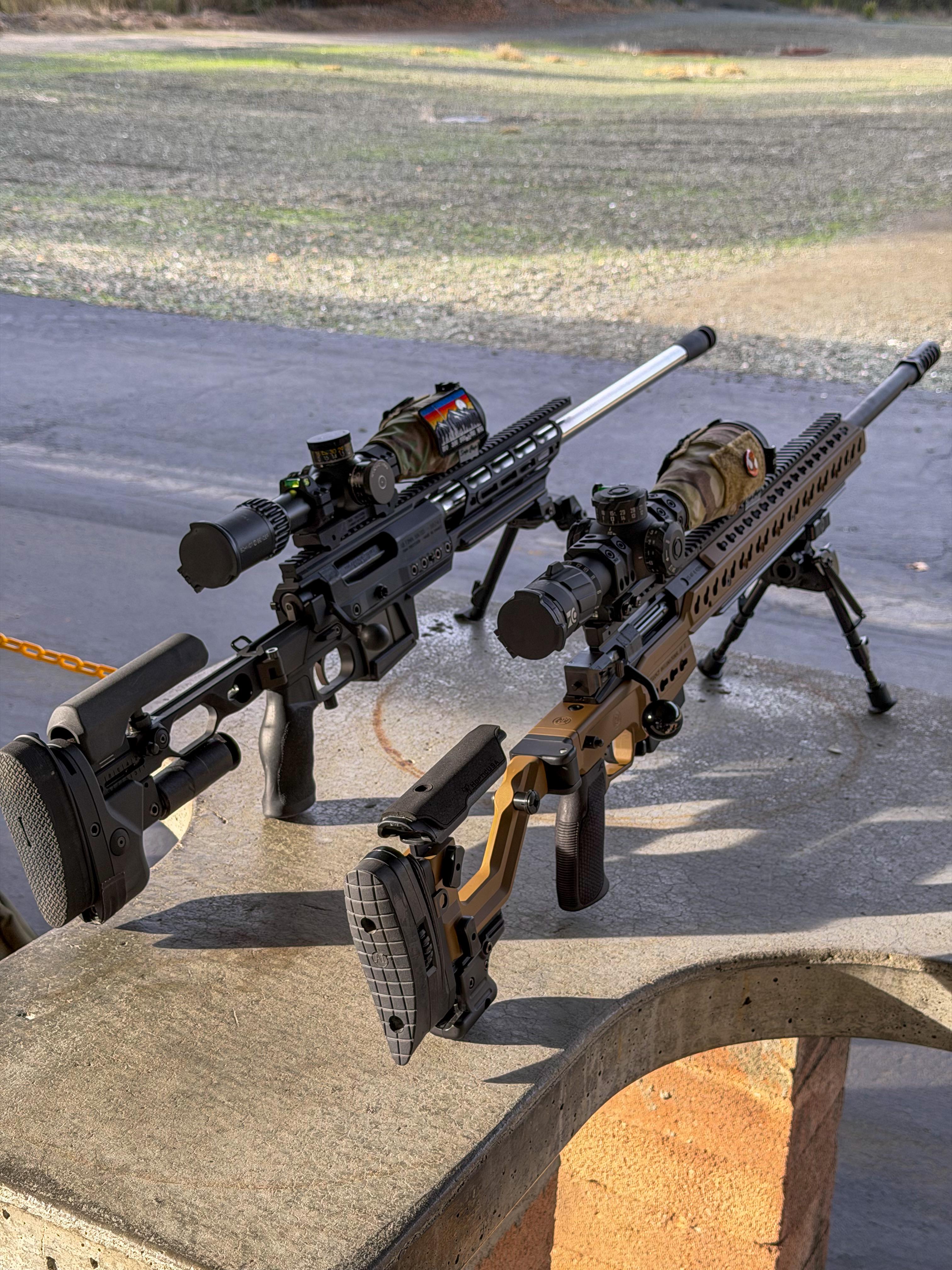
This is the resolution follow-up to the tall target post on the same three scopes. The full write-up, with every reading and a downloadable data set, is on Sniper's Hide, linked at the bottom. This is the condensed version.
Short version: across the chart as a whole, every observer, on both days, read the TORIC finest, the Ares second and the EP5 GENII third. The steps are about two thirds of an element each. That's real and it reproduced, but it's small: the largest gap works out to about 0.06 inch at 1,000 yards. In the field, mirage and light will usually matter more than gaps this size.
Prediction against result
The method took two development runs to get right (November 13, and November 14 and 15). The result here is from a third pair of days, November 19 and 20, run under rules written down before the first reading. I emailed myself the analysis plan and a prediction at 09:56 on November 19. The first reading started at 10:00.
| Pair | Predicted | Result (elements) | 95% interval | Outcome |
|---|
| TORIC minus Ares | about +0.5 | +0.67 | 0.18 to 1.17 | Reproduced |
| Ares minus EP5 GENII | about +0.5 | +0.65 | 0.15 to 1.15 | Reproduced |
| TORIC minus EP5 GENII | about +1.0 | +1.32 | 0.83 to 1.82 | Reproduced |
| Any single pattern | no measurable difference | 0 of 60 cases | n/a | As predicted |
All three observers and both days point the same way on every pair. The test is corrected for comparing three pairs at once (Holm). The Ares vs EP5 GENII pair cleared its bar narrowly (t 3.52 against 3.50), and I'm reporting it as computed, which is what the rules say to do.
One prediction that didn't hold: my protocol expects a tie at the center darkest pattern, at about G0E6 to G1E3. All three read at or below that range, and the EP5 GENII didn't tie, so I'm reporting it as not borne out.
How it was run
- Target: Edmund Optics #53-715, USAF 1951 at four contrast levels, five positions (center and four corners). One physical target for every reading.
- Distance: 25.00 yards, laser meter to each scope's front lens, within 10 mm.
- Magnification: 24x, measured, not read off the ring. A phone at the exit pupil photographed a rule on the target, and each ring was set within 1 percent of 24x before anyone read it. The measured means were 23.81x to 24.23x, and a guard band for those differences is built into the comparison.
- Observers: three people unrelated to me, who had never seen the test, target or scopes. They got a scripted briefing and practice print, and weren't told which scopes or how many were in the test. Each wrote down beforehand whether they recognized a scope.
- Design: two days, two passes a day (coarse to fine, then fine to coarse). Order changed every pass, and the target was rotated 180 degrees between passes. In each pass one scope was secretly shown twice under different codes, to measure how far a reading moves when nothing has changed (0.88 element). Day 1 sheets stayed sealed until day 2 was done.
- Scoring: a pattern counts as resolved only if both horizontal and vertical bars are, and the coarser pass is kept.
What it means behind the rifle
Very little you'd see. One element is a 12 percent step in resolving power, and two thirds of an element is about 8 percent. At 24x the eye resolves about 2.5 arcseconds, and the darkest center readings sit right at that limit. So this separates the scopes by how much contrast they deliver near the limit of the eye, not by their ultimate resolution.
What I'm not claiming
- That glass is the cause. The order matches what each maker says about its glass (SCHOTT HT, Japanese, J-XED), but nothing I measured connects the two. Coatings, design, assembly and the individual unit are all in the same number.
- That resolution is the whole story. Contrast, color, CA, edge sharpness and low light aren't captured by a USAF chart.
- That this is a value ranking. The EP5 GENII is by far the cheapest of the three, and it tracked as true as the others.
- That every unit reads this way. It's one unit of each. A two-unit comparison is planned.
Disclosures
- All three scopes were manufacturer supplied. Arken and Athlon have since given me theirs outright, and the TRACT may end up mine at no charge. TRACT also sent a non-locking turret for a follow-up test.
- Each maker heard its own result first and was offered a read of its own portion, for factual accuracy only. Arken had no corrections. TRACT and Athlon hadn't replied when this went up.
- No maker has review or approval rights.
- The TORIC was already on record as my favorite before any of this was read.
Check my math
The download has every reading from all three sessions, the magnification measurements, the pre-registration, and a Python script that rebuilds every figure. If you think I got something wrong, run it and tell me what you get.
Full write-up, data download and every reading: https://www.snipershide.com/shooting/threads/7310106/
Tall target post on the same three scopes: https://www.snipershide.com/shooting/threads/7307603/