r/lowlevel • u/CLI0019 • 5h ago
My Nvidia driver can draw now.

1
Upvotes
r/lowlevel • u/Cool-Conflict8299 • 13h ago
r/lowlevel • u/kroggens • 15h ago
r/lowlevel • u/HopefulCarry8357 • 12h ago
We just hit a major stability milestone on HELLCORE Holographic Computing Platform—an independent, bare-metal x86-64 operating system and spatial computing platform built from scratch (no Windows or Linux cloning). Following issues flagged in our recent VMM debug reports, we went through all 3,435 lines of VMM-REPAIR-SOURCE.txt line by line. Every bulk source chunk has now been transferred, reviewed, and patched. What this covers: • Full 3,435-Line Transfer & Audit: Zero remaining source chunks left to process; the entire VMM repair baseline is consolidated and accounted for. • Debug Report Fixes: Resolved issues uncovered in memory management diagnostics, reinforcing our private VMM ownership model and V5 bottom-up page-table reclamation (PT -> PD -> PDPT). • Pure Native Architecture: Built and compiled 100% on a Samsung Galaxy A26 via Termux, Clang/LLVM 21.1.8, LLD 21.1.8, and QEMU 10.2.1. With the VMM repair baseline locked in, focus shifts to regression verification before moving toward live CR3 activation. Built for Gamers, by a Gamer — Unleash Hell.
r/lowlevel • u/RampageKernel • 18h ago
r/lowlevel • u/Adventurous_Hippo692 • 1d ago
r/lowlevel • u/detetivefontes • 1d ago
Meu sistema operacional que estou desenvolvendo do zero. No momento testando no QEMU, logo em cima em hardware de verdade! Cada passo é aprendizado, cada linha é minha. Obrigado por acompanhar!
r/lowlevel • u/nurdek1 • 1d ago
Hit a
go/sigill-fail-fastcrash trying to run Google Antigravity on an older Bay Trail laptop (lacks AES-NI and AVX). StandardGODEBUGflags didn't work because thecpuid+raise(SIGILL)check runs inside.init_arrayduring_dl_init.
After NOPing the constructor abort and replacing the centralaesdec-based hash function (0x810a910) with a branchless, memory-safe 64-bit ALU stub, the IDE and AI agents work cleanly without anySIGILLorSIGSEGV.
Full technical write-up (GDB backtraces, ASLR offset math, and a reproducible Python patcher) is here:https://github.com/nuraddin557/antigravity-legacy-cpu-fix
r/lowlevel • u/IEEENaN0S • 1d ago

I've been building NaN/0S, a bare-metal OS in a custom 16-bit-word ISA (NaN16), custom NaNIX shell, nearly have ISO C parity, and I'm working on formally verifying the stack from the bottom up. There's no C or PY or Assembly that's not NaN Native. This is a milestone, with the limits stated up front.
What's proved (Coq 8.20.1, coqchk-checked, closed under the global context, no Admitted/Axiom/Parameter):
A fixed 23-state × 8-symbol Turing machine, with its 184-row transition table, is simulated on a Coq model of the NaN16 VM. For every state width, every nonempty well-formed program, and every left-infinite configuration, the source machine halts iff the VM run halts. The proof is about 156 files and 59k lines, and the raw certificate and coqchk transcript are checked in with a reproduce.sh.
What it does not claim:
• It's a theorem about the Coq model of the fixture, not the assembled .nas image or the host C oracle. That bridge is a separate obligation. Right now only a Python mnemonic comparison covers it.
• It does not show "NaN0S is a UTM" in general.
• Finite guest memory isn't an unbounded tape. The statement uses an existential left-window depth K to handle that.
I also included negative results, such as certified obstruction theorems showing exactly where earlier tape layouts break.
The bigger system: NaN/0S has an x86_64 kernel with a 1024-slot process table, timer preemption, a NANIX shell and GUI, and PAE tests up to 16 GiB. The Coq side there covers the mirrored-lattice memory model (32,896 canonical cells, signed addressing, write commutativity). The open work is proving that the real kernel implementation refines these models.
Repos:
• https://github.com/shemshallah/NaNLMind (see formal/utm)
r/lowlevel • u/Gloomy-Animator-2778 • 1d ago
r/lowlevel • u/detetivefontes • 1d ago

Hello everyone!
I'd like to share FydelisTechOS, an independent operating system I'm building from scratch in Salvador, Brazil. It's a bare-metal kernel written in Assembly and C — no libc, no dependencies on any existing OS.
Current features:
Tech stack:
Repository & documentation:
This is a learning and research project focused on transparency, security, and understanding how an OS works at the lowest level. Feedback, questions, and suggestions are very welcome!
Thanks for reading! 😊
r/lowlevel • u/Budget_Ad_2544 • 2d ago
Built an asynchronous distributed MapReduce in C++23
A non-blocking, data sharing distributed engine using boost asio C++20 coroutines and asio-grpc
How Map & Reduce works:
How Data Sharing happens:
Fault Tolerance (SHUFFLEFIX):
r/lowlevel • u/amgcr7adm10 • 3d ago
r/lowlevel • u/HopefulCarry8357 • 3d ago
r/lowlevel • u/alberthemagician • 4d ago
(I am the author of ciforth, a ISO compatible Forth model that has implementations for linux, windows, 32 and 64 bit, I86, arm and riscv).
I have given up on the x86 optimiser for ciforth, as the 86 will be history before long. The instruction set is too barocque.
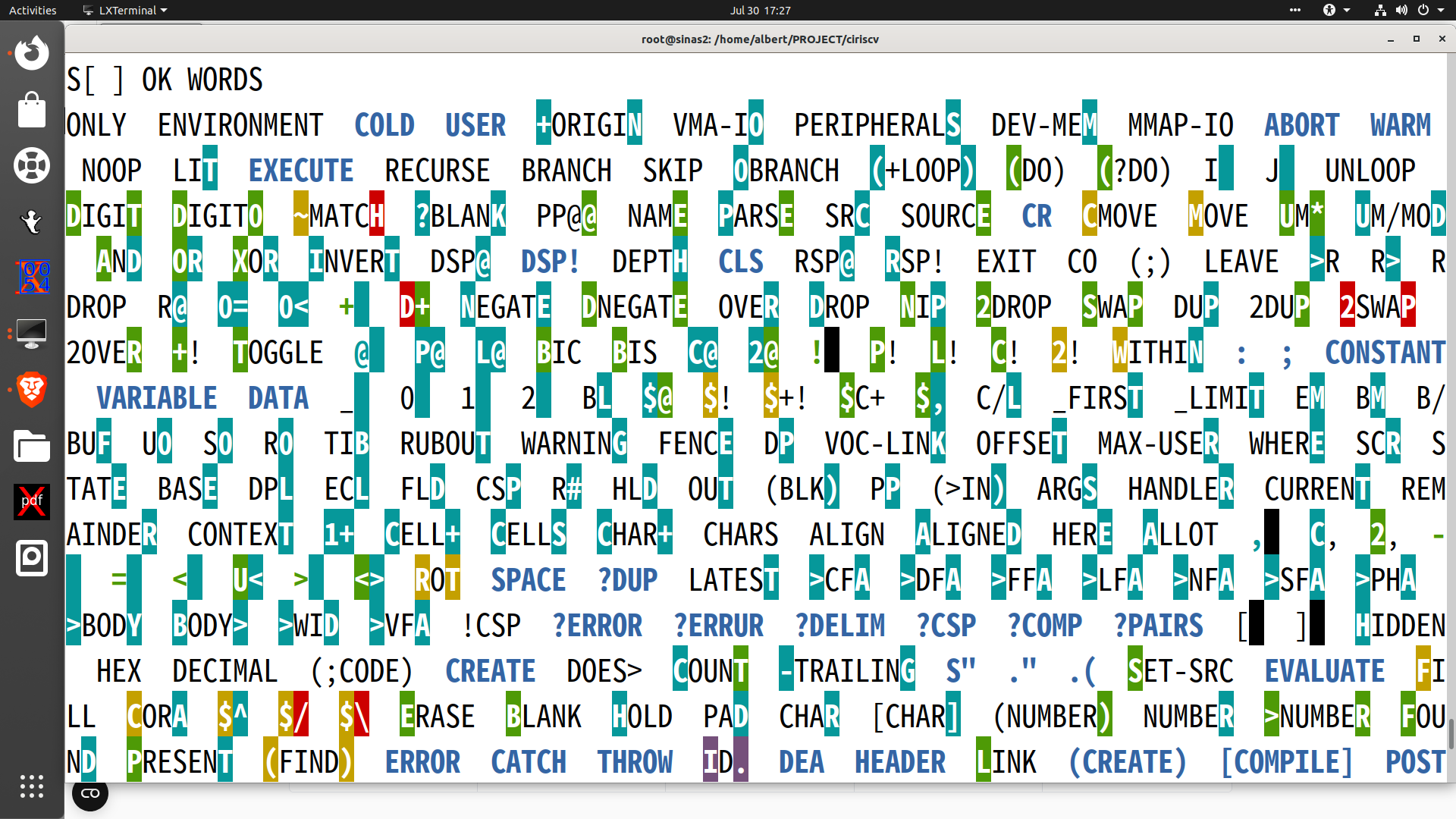
As the first part of the riscv optimiser I made the forth aware of the stack effects words have, counting POP's and PUSH's. This hinges on the ciasdis object oriented disassembler. FILL-ALL fills all words as best it can, but skips what you have filled in beforehand. Also a host of other optimisation relevant properties of Forth words are analysed. E.g. it is important if a word has no so called "side effect" that means storing and fetching. An example is the word SQUARE that squares a number. If the input is known at compile time, SQUARE can be executed at compile time. See also lecture 5 en lecture 14 in
https://home.hccnet.nl/a.w.m.van.der.horst/forthlectures.html
Lecture 14 contains an old example of coloring on the now vintage 32 bit x86 processor. If you have a linux that can run 32 bit programms you can try it out. The experience is more or less the same what I want to show here. A useful visualisation is coloring the stack effect of each word. aqua is one, green is two, orange is three, above three is red. For an unknown stack effect the whole words is printed in blue.
https://home.hccnet.nl/a.w.m.van.der.horst/words.png
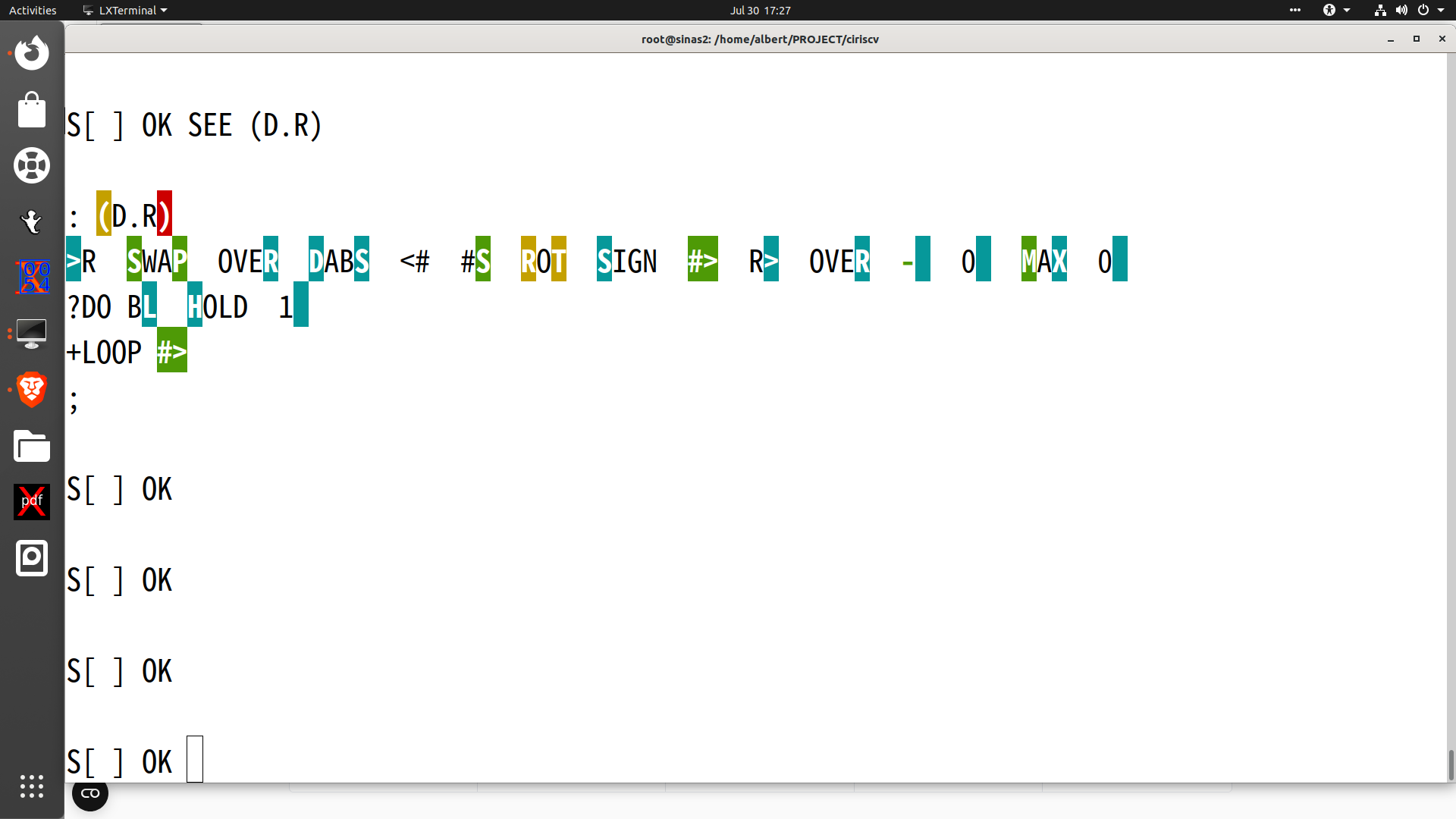
The stack effect is useful to understand words better. E.g. (D.R) takes a double word and a box length (orange) and generates a string (green). You can ask the analysis of a word like so
https://home.hccnet.nl/a.w.m.van.der.horst/decompile_ddot.png
And you can spot the mistake Apparently +LOOP takes one argument not zero. These things must be added manually. ~
I have prepared the pictures, but I don't know how to publishit in this forum. So I put a link to my personal website.
~
r/lowlevel • u/Early-Toe646 • 6d ago
I reversed a TCL Smart TV board (Realtek RTD2841 / RTK284x SoC, AArch32) with no public datasheets and wrote a custom QEMU machine model to boot its commercial Android 9 Pie firmware.
I just reached the milestone where the full 1080p launcher boots and can be navigated with a host mouse and IR remote.
The big hurdles I had to solve:
Demo video is in the repo:
r/lowlevel • u/tinymoat • 6d ago
r/lowlevel • u/razecrsx • 6d ago
r/lowlevel • u/DataBaeBee • 6d ago
r/lowlevel • u/lynxbossx • 7d ago
Hi friends,
I'd like to show you my operating system, AriCodeOS. It's written in Rust: a `no_std` microkernel with UEFI boot on x86-64. The current version is 0.11.0 and it runs in QEMU and on one real laptop (keyboard, USB stick as the system disk and wired networking already work).
I'm looking for people who want to try it, tell me what breaks, and suggest ideas and improvements. Any feedback is welcome, including harsh feedback.
- Repository (Apache 2.0): https://github.com/AriCodeLabs/AriCodeOS
- Website: https://www.aricodeos.org/
Thank you to the Rust community for the language that made this possible.
r/lowlevel • u/EBIOSSANTO • 8d ago
https://github.com/ebiossanto/prova.git
I’ve been working on Prova, an experimental verified programming language designed around a specific premise: humans shouldn't write low-level boilerplate, and LLMs shouldn't be trusted with system invariants.
Instead of adapting human-centric languages for AI, Prova combines three layers into a single pipeline:
spec/prova.gbnf) for constrained decoding (e.g., llama.cpp), eliminating syntax errors at generation time.pre/post contracts, strict types with no implicit conversions, linear ownership (own/drop, no mutable aliasing), and explicit effects (syscall, atomic, mmio).deny-flow), static stack budgeting, and direct MLIR emission targeting x86-64, AArch64, and RISC-V bare-metal ELFs.The Core Workflow (audit + fix)
The human audits only the specification (prova.py audit), while the AI iterates on the function body (prova.py fix --model-cmd ...). The compiler feeds structured JSON counterexamples back to the LLM on failure, while strictly locking signatures, contracts, effects, and memory flow rules—if the AI tries to weaken a pre/post condition to make it compile, the candidate is rejected.
Here is a quick look at a verified packet inspector example (examples/packet_inspector.prova) enforcing a deny-flow policy so raw network bytes cannot leak to u/write:
lisp
(region net-rx)
(deny-flow net-rx u/write)

(fn checksum ((buf (slice u8 n)) (n u64)) u64
  (pre (<= n 65535))
  (post (<= result (* 255 n)))
  ...)