r/rationalphilosophy • u/JerseyFlight • 55m ago
Krishnamurti was close to a rationalist. He wasn’t religious, he was more in the spirit of Socrates.
1
Upvotes
r/rationalphilosophy • u/JerseyFlight • Oct 24 '26
But we can sharpen this. Yes, Logic is something we discover, but even before that, it’s something we’re born into! We did not create the Logical nature of reality, we were simply born into it, it was here before us, and it will still exist long after we have gone extinct.
One fails to grasp the awesomeness of what this means: it means Logic is entirely objective and discoverable, which means that we can inquire into its nature and existence the same way we inquire into the life of a cell. We don’t create it, we observe it at the fundamental level and simply report back on what we observe. This is extraordinary!
However, If logic is created (whether by human convention, linguistic rules, or biological wiring) then it ceases to be a feature of reality and becomes merely a feature of us. And once logic is subjective or conventional, objectivity evaporates, leaving behind the sovereignty of subjectivity from which one cannot escape. One cannot even object to what is being stated here, because the objection is the same construct as the form being objected to. Knowledge then comes down to the construct one wants to believe, because all is construct, and in order for one construct to be more accurate than another, there must be an objective standard outside the construct.
If someone claims we merely create logic, they are immediately caught in a performative contradiction. To argue for the conventional nature of logic, they have to use logic (distinguishing premises, drawing inferences, maintaining identity) to try to prove that logic has no objective grounding. They are ignorant of their own intellectual activity.
Identity precedes thought. We cannot merely invent identity because invention requires a pre-existing identity. Identity is the precondition for any action, including the action of thinking or creating (one is always and only conscious of something determinate). If we create identity we must create it from some standard. But lucky for us, we are born into a universe of identity!
Once Logic is understood as discovered fact rather than invented convention, the philosopher's game is up. He cannot legislate a new universe into existence by changing his definitions or the semantics of his "language game," because reality pushes back with unyielding determinacy. One can call an “apple” whatever they want, but one cannot change the determinate fact of what an apple is, merely by changing its name.
r/rationalphilosophy • u/JerseyFlight • Oct 13 '26
The reason this must be clarified is because there are those who think of Logic as logic, a mere formal human construct, or as a vicious, circular process. But these are both false understandings of Logic.
Logic is not an axiom that we assume in a desperate attempt to ground a philosophical system, it is first and foremost, a fact of reality. Logic is not something we contrive or invent, it is what we were born into. We know that Logic exists the same way we know that space exists, because it is the very essence of the particularly of reality itself. We cannot separate ourselves from it, we are the passive subjects of its matrix. All that we know we know through the structure and order of Logic.
Logic is not a faith we exercise toward specific rules or standards, it’s the fact that reality is determinate; it is the fact that reality is a reality of identity (A=A). And this fact isn’t something we contrived. If a man claims that fire and ice are the same thing, and thus plunges his hand into a fire, he will scold his hand. This determinate reality exists outside of him and cannot be altered by the desire of his belief.
Logic isn’t merely a fact we believe in, it’s the ultimate fact that we use to comprehend all facts.
Logic doesn’t begin with A=A as an axiom, it begins with the fact of reality as determinate. And it is from this determinate nature of reality that Logic rises up as an abstract standard by which to discern reality itself.
r/rationalphilosophy • u/JerseyFlight • 55m ago
r/rationalphilosophy • u/JerseyFlight • 3h ago
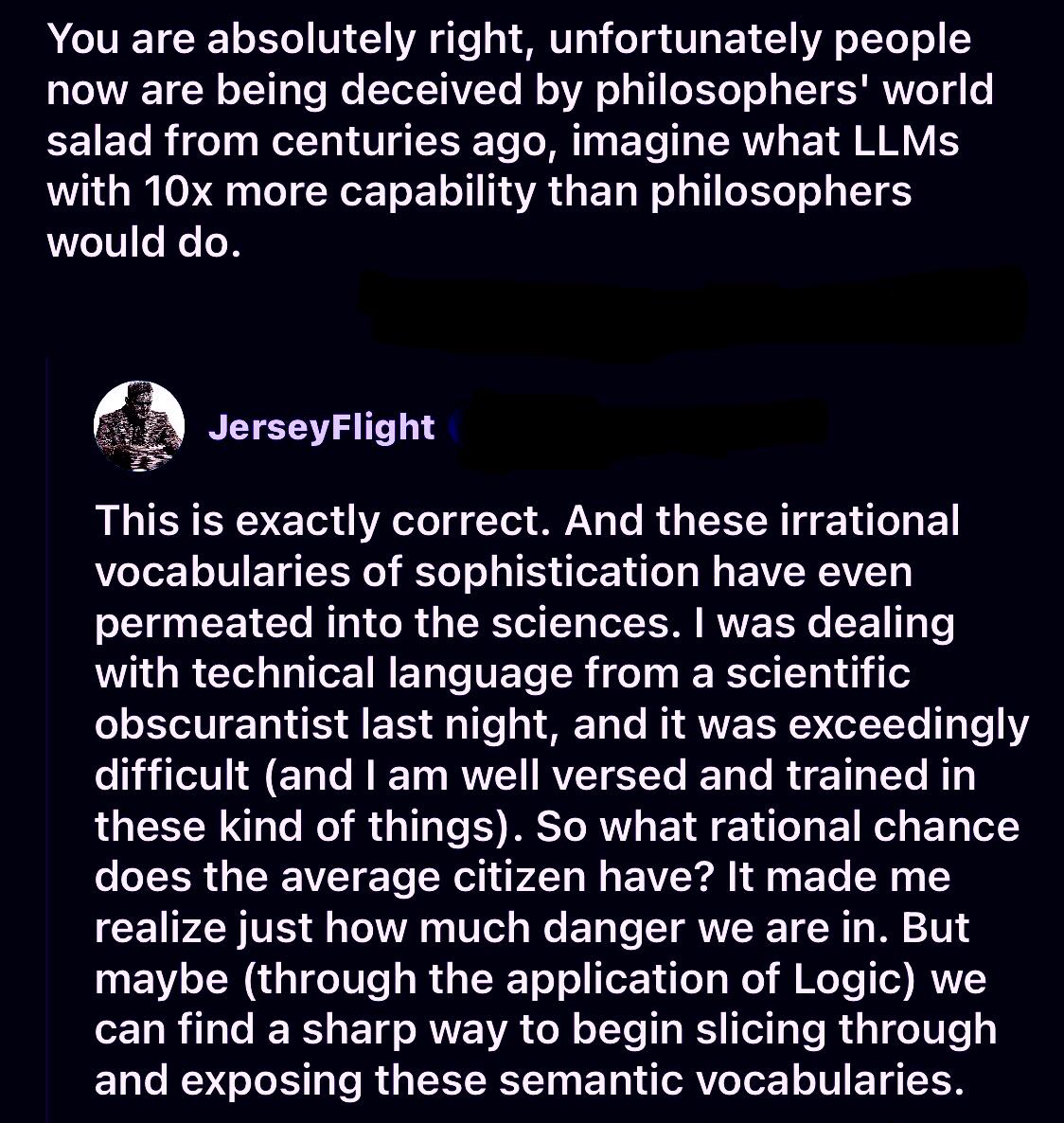
What if the actual function and use of LLMs is largely to help humans deceive other humans?
r/rationalphilosophy • u/JerseyFlight • 16h ago
The reason he does this is because he wants to be able to smuggle his philosophy as truth (or he just wants it not to be impeded by truth). (He could also be doing it simply for egotistical reasons).
The philosopher is no Reasoner of virtue, he is no honest man, he is a high abstract deceiver. His goal is to confound and convolute the truth with words, although he will claim that he is striving to discover it and bring it to the light.
If this was the case then he should be willing to clarify his terms.
Beware, his technique is refined and effective. Slip in he will, over and over again, a combination of terms, one more clear, the other meant to obscure. This is his process of abstract qualification, moving to and fro so he can never be pinned down.
What an insecure creature a philosopher is! He’s not bent on finding the truth, he just doesn’t want to get caught, exposed and refuted for being wrong. He wants to be able to keep the beliefs he loves. But more than this, he wants to be able to wield them so as to hammer men over the head with them. His way is similar to that of the theologians. He is truly a dogmatist in disguise. He strives to make believers, not Reasoners.
The whole gambit is one big ego game to avoid a wound. The philosopher is a psychologically damaged species.
r/rationalphilosophy • u/JerseyFlight • 12h ago
The confident formalist asserts: “The logic that people use is up to them. Typically the existence of some sort of model is all it takes for a logic to be considered legitimate.”
Reason answers:
But if the logic that people use is up to them, then on what grounds can anyone claim that another person's reasoning is incorrect?
If the logic people use is up to them, is the correctness of their reasoning also up to them?
If neither of us is bound by an objective standard, why should I accept your claims as rationally compelling?
And if your claim that people may choose their own logic is objectively true, what makes that claim binding on someone who rejects your epistemological standards?
If the logic people use is entirely up to them, why should I accept the logic governing your argument rather than simply choose another?
Can someone be objectively wrong about which logical system is legitimate, or is whatever they choose to accept legitimate simply because they accept it?
Is there any objective standard by which one logical system can be judged superior or inferior to another?
If two people adopt mutually incompatible logical systems, what determines which person's reasoning is correct?
If choosing a logical system is a matter of preference, does preference determine truth?
Can two contradictory conclusions both be correct merely because they were derived using different logical systems?
If a logical system produces conclusions that systematically conflict with reality, does it remain legitimate simply because someone chooses to use it?
What distinguishes a logical system that reliably preserves truth from one that merely preserves its own internal rules?
Can one person employ a logically illegitimate system while sincerely believing it to be legitimate? If so, what distinguishes their belief from actual legitimacy?
If the existence of a model is sufficient to establish legitimacy, can a model constructed upon arbitrary or unjustified assumptions establish its own epistemic authority?
If legitimacy is determined by individual choice, on what grounds do you claim that your own account of logical legitimacy is correct rather than merely your preferred convention?
What standard should we use to evaluate the truth of your claims about what makes a logic legitimate?
r/rationalphilosophy • u/JerseyFlight • 18h ago
The Reasoner’s power is the question.
Realize this: if you formulate a carefully targeted question through Logic, a question that exposes the vagueness or contradiction of the irrationalist’s assertions— he will not answer your question!
Realize this: the power of question remains.
You merely need to keep on pushing it. Beware of being side-tracked and distracted from your disciplined focus of pursuing Reason.
The power that a skilled Reasoner has above all others (because he knows how to follow Logic) is the ability to ask Logical questions, Rational questions that are designed to penetrate straight into the arrogant heart of sophistry.
Realize this: your power lies in your ability to use Logic to construct questions that expose error and contradiction.
Take note when irrationalists are evading valid questions. Most of the time irrational philosophers will simply reply by trying to negatively characterize a valid position. They won’t reason through it by directly engaging its claims or questions.
Learn to use the question. Learn to not be distracted away from the question. The question is the sword of Reason that slays the irrationalism of abstracting philosophers.
r/rationalphilosophy • u/JerseyFlight • 1d ago
Formal logicians believe they have a narrative that magically transfers them outside of Logic. They essentially believe they speak from a space that is philosophically above and beyond Logic.
Formal logic does not constitute a higher-order reality. It is only operating within Logic. Its formal systems, symbolic languages, axioms, narratives and methods of proof are all subject to and fundamentally structured by the laws of logic.
The fundamental distinction that seems to escape them is that Logic is not identical to any particular formalization of Logic. Formal systems do not create the laws of Logic simply by representing, articulating, or axiomatizing them.
Formal logic doesn't demonstrate that it occupies a position beyond Logic. Rather, it deploys a philosophical narrative that makes it appear to occupy such a position. And this is sophistry: the production of an appearance of authority, legitimacy, or transcendence that does not necessarily correspond to what is actually being established.
Basically the formal logician is saying:
“Our narrative about Logic derives from a privileged position from which we determine the meaning, boundaries, and legitimacy of the laws of logic through our formalism. These laws are conditioned by our formalism, our formalism is not conditioned by these laws!”
But this is precisely the inversion.
The representation begins to claim authority over that which it represents. Formalism, rather than recognizing itself as an articulation of logical relations, begins to behave as though Logic itself must answer to the authority of its axiomatic constructions and philosophical characterizations.
And what authorizes this supposedly privileged position?
Oh, but this delusionally privileged position is itself subject to Logic, and is only constructed through logical activity!
There is no magical metalogical outside. There is no epistemological exemption obtained by introducing another level of description. A so-called “metalanguage” is not an escape from Logic; it is another linguistic and conceptual activity operating within Logic.
The formal logician cannot use Logic to establish a privileged position from which Logic itself becomes subordinate to formalism, or a mere philosophical narrative about Logic, because the very act of attempting to do so already presupposes the authority of Logic, including the logical conditions that make the formalist's own argument intelligible.
The moment this relationship is inverted, formalism ceases to recognize its own philosophical conditions and begins mistaking its representational authority for ontological and epistemological sovereignty.
The problem, ultimately, is not formal logic. It is the metaphysical pretension, the subtle and uncritical philosophizing smuggled in about Logic, that formal logic can somehow transcend the very Logic upon which its own existence, intelligibility, and authority depend.
The distinction is between formal logic as a legitimate practice within Logic and formalism as an illegitimate claim to philosophical sovereignty over Logic.
Formal logic cannot establish the ultimate boundaries of Logic simply by establishing the boundaries of its own formalism.
r/rationalphilosophy • u/JerseyFlight • 1d ago
If you say it came from humans, then what standards did humans use to construct logic and where did those standards come from?
By what logical standards were those standards themselves established?
Who or what authorizes a formal system to define the boundaries of legitimate reasoning?
Does a formal system establish logic, or does it presuppose logic in order to establish itself?
If the human brain discovered logic rather than invented it, what exactly did it discover?
Can something be constructed before the conditions that make its construction possible?
If those conditions were not constructed by humans, what determines their logical status? And by what means can you establish that status without already presupposing logic?
Could human beings have constructed logic differently? If so, by what standards would one construction be more logically legitimate than another?
r/rationalphilosophy • u/JerseyFlight • 1d ago
Does Reason function with and through the laws of logic, or apart from the laws of logic? Or does it have a different standard, or additional standards— what are these standards?
Can Reason contradict the laws of logic and still be reasonable?
r/rationalphilosophy • u/JerseyFlight • 1d ago
If you’re a Reasoner you are likely the only Reasoner in your world.
This can be proven. If you are surrounded by other Reasoners— if these people are actually reasoning— then they should be able to clearly define what Reason is and how it works.
After all, how can they apply something as precise as Reason if they don’t know what it is and how it works?
What we find is that everyone wants to claim that their conversation is reasonable. Everyone wants to claim that they abide by the rules of Reason. But what these claims amount to are feelings about one’s conversation, they do not amount to a disciplined procedure according to knowledge.
What really happens is that people engage in a form of reason, which is not really Reason at all. This is because they reserve the psychological right to abandon Reason at any point it disagrees with their belief-desires.
Those who profess themselves to be Reasoners are often irrationalists that come in the name of Reason. They are merely posturers of Reason, turning against it the moment it contradicts their philosophical desires.
To be a Reasoner is very much to be alone.
r/rationalphilosophy • u/JerseyFlight • 1d ago
When Reason enters into the picture it says, “my ways, not your ways.” And this is a reference to its rules.
If I say the world was created by Snarks, I don’t get to determine whether this premise is true— Reason gets to determine whether this premise is true.
This is an extraordinary thing, though it is lost on most humans; though this will never enter the consciousness of most humans for as long as they live.
Even more, most humans will never subject their beliefs to the standards of Reason.
Even those who do claim to follow Reason, don’t actually follow Reason, because they can’t explain the rules of Reason. To them Reason is the feeling that their thinking automatically counts as “reasoning,” it is not a set of objective standards to which they subject their claims.
The objective rules of Reason are the laws of Logic.
r/rationalphilosophy • u/JerseyFlight • 1d ago
Hegel is really the thinker who established the hierarchy of theology, though this is not a term he used. He did this by evaluating the concept of God rationally, as well as evaluating Christian theology rationally.
Hegel claimed that Christianity was the highest development of the “representational” form of religion. He didn’t arrive at this conclusion by consulting theology, but by subjecting theology to a critique of reason. On the basis of reason he then declared Christianity (because of its trinitarian concept of God) to have reached the highest rational form as a representation.
The problem is that Hegel’s hierarchy is valid, but this doesn’t make his conclusion of Christianity achieving the highest rational form, valid.
So far as I know, this conversation has never taken place outside of Hegel himself.
But it makes sense that all theologies are not equal in their representational achievements.
To be clear, the hierarchy of theology doesn’t mean that theology is the highest form. Certainly not! It means that among theologies some are more subconsciously rational than others.
And what theology emerges at the top of the hierarchy is not within our power to decide, that depends on the content of the theology itself as it is subjected to reason.
It should be noted that Hegel saw philosophy as the form that was superior to theology. It is through philosophy that he claims to sublate religion.
r/rationalphilosophy • u/JerseyFlight • 1d ago
When it comes to knowledge we can’t do anything without the order of the sentence. Truth must be stated to be known.
When a logic textbook explains things it phrases them in a precise way so as to convey a determinate meaning. We need those precise phrases if we want to be able to scrutinize the asserted knowledge in order to find out if it’s really knowledge.
My critical thought can’t begin until I am confronted with a premise. Reason scrutinizes the premise.
One philosopher I used to speak with was always making sweeping assertions. He would always struggle to defend these assertions, but most tellingly, he would never write them down, even though I asked.
Why would he not do this? Because then he was committed and couldn’t walk it back. He would no longer be able to equivocate his way out of a refutation. Putting his claims in writing means they could be carefully analyzed, and he didn’t want that because he was afraid the beliefs he loved would be refuted.
I have seen this same evasion over and over again from manipulators. They prefer the medium of speech over writing, because it allows them to more easily commit fallacies and smuggle premises.
r/rationalphilosophy • u/JerseyFlight • 2d ago

r/rationalphilosophy • u/JerseyFlight • 1d ago
If not, why wouldn’t you study the thing that formal logic uses to establish its meaning, instead of studying a logic that is contingent on a more fundamental Logic?
r/rationalphilosophy • u/JerseyFlight • 2d ago

There is no need to speak of a philosophical concept of “being.” Science doesn’t and won’t talk about reality this way. It doesn’t need to because it can be specific.
Metaphysics is basically a semantics created from vague terms like “being,” wherein philosophy continues to produce qualifications from being, as well as other vague concepts similar to being. It’s a game of empty abstraction that simply produces more empty abstractions.
r/rationalphilosophy • u/JerseyFlight • 2d ago
What’s important is that humans won’t be able to refute them because they will be protected behind infinite, semantic paper walls.
This will become like a new mythology, and it will take humans a very long time to see through it, if they ever manage to see through it. The status quo will simply be constructed using LLMs.
LLMs will function like a kind of living revelation that humans use to produce new authoritarian narratives or settle disputes in knowledge. The problem is the difficulty in refuting these narratives.
Think of a government that only uses AI to construct all its laws. How do you falsify that? The output of the AI is biased to whatever man wants to construct. The AI will work to uphold and defend the desired narrative, creating infinite paper-wall-justifications. If doesn’t matter if man knocks them down with Reason, because the AI will simply provide a new variation.
This makes AI the ultimate tool for man’s motivated reasoning.
The danger is not LLMs, it’s man’s irrationality and primitive psychology.
Let me be clear, I am not talking about a science fiction plot associated with the emergence of a malevolent “super intelligence,” I am talking about man’s irrational and pathological use of LLMs.
r/rationalphilosophy • u/JerseyFlight • 1d ago

Notice that the point of capture is the creation of “theory.” This is also a problem, because it means humans are vulnerable to LLM-narrative-construction. In philosophy, most people have been captured by a theory or narrative, their belief isn’t based on sound reasoning, it’s based on how they feel about the metaphysical premises of a system of philosophy. (It’s also based on the power they derive from those premises).
“Logically consistent” in this context ends up meaning everything. If logic is just a mere human construct, then we are asking, “is the LLM’s construction consistent with its own axioms.” Based on the modern, relativistic view of logic, this leaves us in a position (if we’re consistent with our relativistic epistemology) of having to validate the construct, or combat it with our own construct.
Without an objective standard of Logic we cannot refute an advanced LLM, because we are admitting that logic is just a construct, and LLMs will eventually outdo our sophistication of construction.
While “reasoning” can take on different forms of sophistication, the foundational standards of Reason and Logic cannot. There is one fundamental Logic in the universe and every conscious form of life will have to learn it, if they want to understand the universe.
Whether a theory is old or “new” doesn’t matter, what matters is whether its assertions can be soundly demonstrated and established
The problem with AI is that humans are going to use it to create complex models of “knowledge.” Whether what the AI is being used to produce is true or false… I doubt this metric will apply in the new world. Rather the semantic complexity of the model will make it near impossible for humans to refute (because of obscurity as well as the LLM’s ability to erect infinite paper-walls). So what will be offered as truth is the semantic complexity of the model pit against objections which are powerless to traverse the complexity.
Now, if a super intelligence had knowledge that was beyond the capacity of our brain to comprehend, then we would only be in a position where we had to submit to it.
So the answer to the original question is, yes, we would have to accept it unless we could construct a reason or provide evidence as to why we should reject it. (If LLMs are known for error, then even without grasping the semantics of the model, we would still have grounds to abstain from trusting the output of the LLM).
These are speculations, not dogmas.
r/rationalphilosophy • u/JerseyFlight • 1d ago
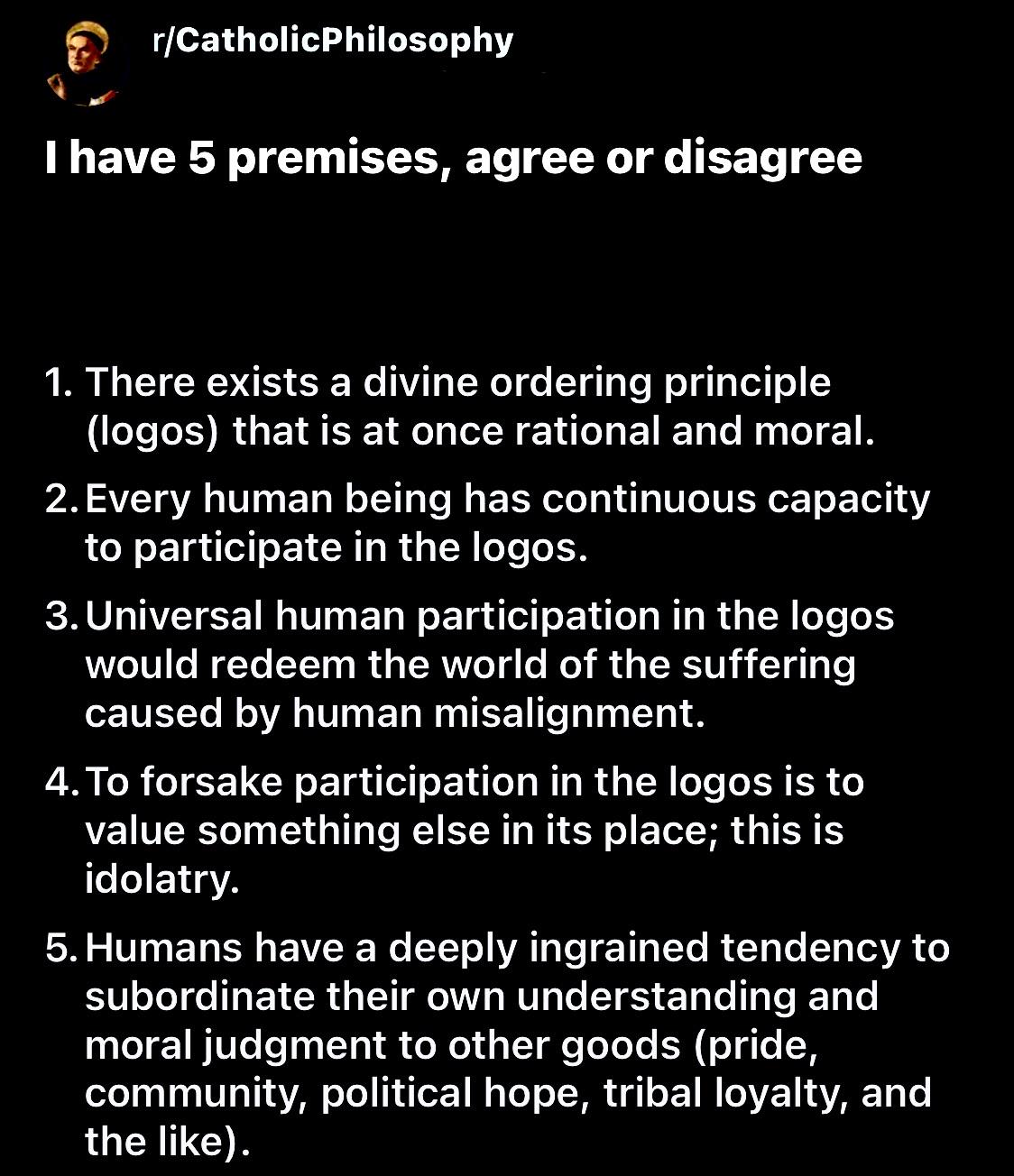
r/rationalphilosophy • u/JerseyFlight • 2d ago
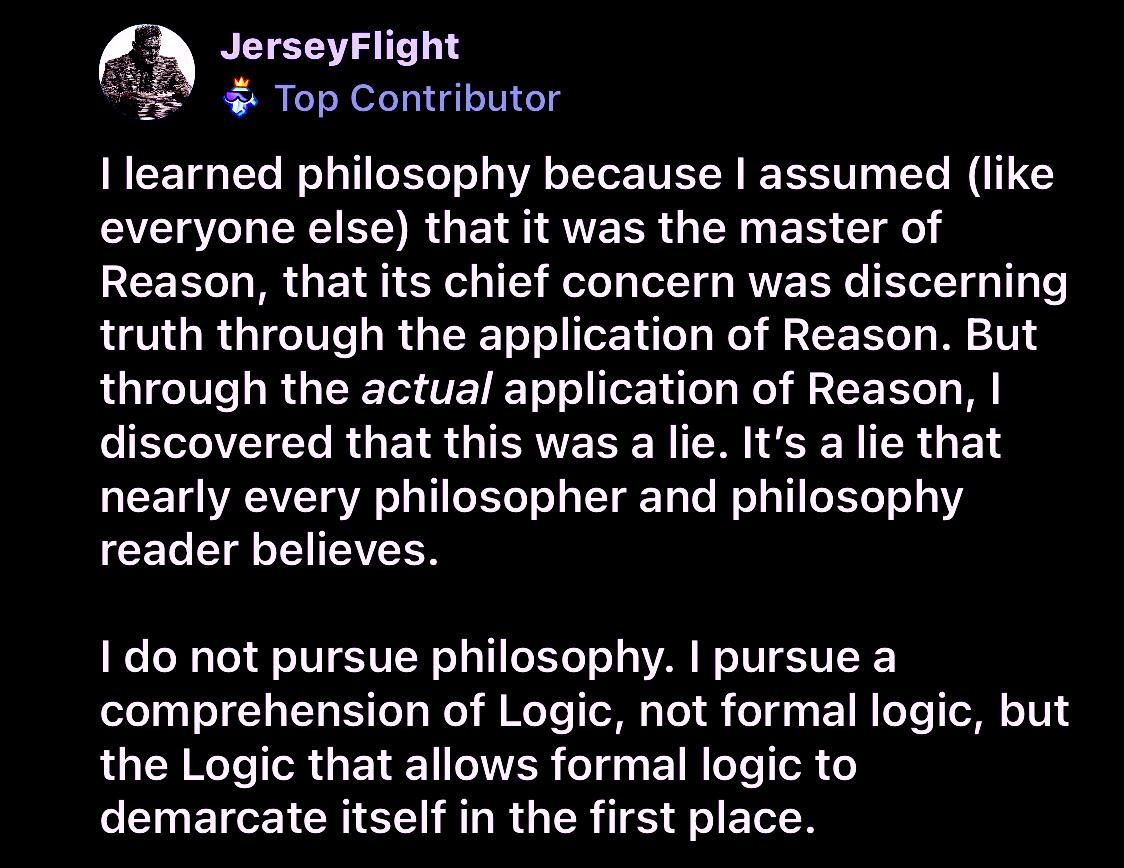
r/rationalphilosophy • u/JerseyFlight • 2d ago
“Truth is the attribute of those propositions that assert what really is the case.” Copi, Introduction to Logic 14th edition
Neither a philosopher or formal logician knows how to think about this assertion.
What exactly is an “attribute,” for example?
Both the philosopher and formal logician would likely struggle to define “attribute” in clear, precise terms, and would instead, end up confounding the issue by introducing more controversial terms that need to be explained.
But through Reason we can do this swiftly. An “attribute” is the identification of a determinate identity. If we say “all apples have stems,” we have identified a determinate identity that demarcates an attribute of an apple.
Truth is the identity of determinate facts of reality, facts whose identity cannot be altered by human imagination.
Reality does not acquire its identity through our identification of it. Our identification of reality is possible precisely because reality already possesses a determinate nature.
Truth is not created by a proposition, nor is it determined by the person asserting it. Truth is determined by whether the identity asserted by a proposition is consistent with the identity of the reality to which that proposition refers. But even before this process takes place we are already operating within a Logical Matrix of truth.
“Truth and falsity are attributes of individual propositions or statements…” Ibid.
But what exactly is the truth that allows us to first demarcate the identities of truth and falsity, of “attributes” in general?
Identity is not merely prior to propositional truth; it is the necessary foundation upon which the possibility of truth and falsity, of meaningful propositions rest.
Before anyone can assert that an apple is an apple, the apple must already have a determinate nature that makes the apple what it is. The proposition does not establish that identity. It presupposes it. Logic is already embedded into, intertwined with the determinate nature of reality. What is Logical is determinate and what is determinate is Logical.
The distinction between truth and falsity itself presupposes determinate identity. Without identity, there would be no determinate thing to identify, no determinate assertion to make, and no basis for distinguishing one assertion from another.
Every truth, every “attribute,” every form of “knowledge,” necessarily identifies something as what it is. Its precise logical form is A=A. (One even validates this by trying to refute it or repudiate it).
r/rationalphilosophy • u/JerseyFlight • 1d ago
Is this true?
—It is true because he clings to one religion, as so indoctrinated or brainwashed by religion. His limiting himself in this way is a downfall of his wisdom.
But a wise man doesn’t have to break with religious literature, he simply can’t take its mythology as truth.
In contrast, a wise man would traverse a great body of religious literature, though he is not himself a believer in any religion— because he knows religion to be man-made and false. He holds this in his mind as he traverses the form and content of religious literature. And because of this he is not deceived by what he reads.
While a man is free to dispense with religion altogether, to do such would be to ignore the most significant cultural forms that humans have ever produced.
A man can also be religious and be positively affected by religion. He can indeed be transformed into a better human. But this will not make his religion true, and it will not make him wise in terms of knowing the truth. And neither is religion required to make a man a better person, but it does often have great power in this sense.
As a nonbeliever, there is a way to absorb and experience the literature of religion that will increase a man’s wisdom. For the literature of religion is very great, it has, in fact, proven itself to be the most loved and powerful literature that humans have ever produced.
r/rationalphilosophy • u/JerseyFlight • 2d ago
I have lost all ambition for philosophy, precisely because the application of Reason has manifested the fallacious shallowness of its form. There is no there there. It’s a game of trying to smuggle loaded premises and terms past Reason.
r/rationalphilosophy • u/JerseyFlight • 2d ago

The skeptic’s assertion against knowledge amounts to "A=A is false."
But to make that assertion meaningful, the skeptic must identify the thing he denies. He must distinguish his assertion from its negation. He must maintain the identity of the terms throughout his argument or repudiation.
The skeptic cannot formulate a meaningful denial without presupposing the very condition that makes his denial possible.
The skeptic must identify what he is questioning. He must preserve the identity of the subject of his assertions. He must distinguish his denial from what he’s denying.
He must rely on determinate meanings to communicate and demarcate his skepticism.
And to do any of this the skeptic must already have knowledge.
To be a skeptic one has to exist in absolute silence. But even this wouldn’t work because the skeptic’s actions would betray his doubt.