r/rationalphilosophy • • 13h ago

We are not in danger from LLMs, we are in danger from the Human Use of LLMs

Post image
0 Upvotes

What if the actual function and use of LLMs is largely to help humans deceive other humans?


r/rationalphilosophy • • 22h ago

Smashing a Formal Logician with Reason

1 Upvotes

The confident formalist asserts: “The logic that people use is up to them. Typically the existence of some sort of model is all it takes for a logic to be considered legitimate.”

Reason answers:

But if the logic that people use is up to them, then on what grounds can anyone claim that another person's reasoning is incorrect?

If the logic people use is up to them, is the correctness of their reasoning also up to them?

If neither of us is bound by an objective standard, why should I accept your claims as rationally compelling?

And if your claim that people may choose their own logic is objectively true, what makes that claim binding on someone who rejects your epistemological standards?

If the logic people use is entirely up to them, why should I accept the logic governing your argument rather than simply choose another?

Can someone be objectively wrong about which logical system is legitimate, or is whatever they choose to accept legitimate simply because they accept it?

Is there any objective standard by which one logical system can be judged superior or inferior to another?

If two people adopt mutually incompatible logical systems, what determines which person's reasoning is correct?

If choosing a logical system is a matter of preference, does preference determine truth?

Can two contradictory conclusions both be correct merely because they were derived using different logical systems?

If a logical system produces conclusions that systematically conflict with reality, does it remain legitimate simply because someone chooses to use it?

What distinguishes a logical system that reliably preserves truth from one that merely preserves its own internal rules?

Can one person employ a logically illegitimate system while sincerely believing it to be legitimate? If so, what distinguishes their belief from actual legitimacy?

If the existence of a model is sufficient to establish legitimacy, can a model constructed upon arbitrary or unjustified assumptions establish its own epistemic authority?

If legitimacy is determined by individual choice, on what grounds do you claim that your own account of logical legitimacy is correct rather than merely your preferred convention?

What standard should we use to evaluate the truth of your claims about what makes a logic legitimate?

r/rationalphilosophy • • 8h ago

If you’re tired of irrationality and sophistry, then you need to understand exactly what Reason is.

2 Upvotes

Reason is just the application of the laws of logic. When you go to define it and follow the definition to its most basic functional root. You will find a distinction between “correct” and “incorrect,” or between “true” and “false,” or “accurate” and “inaccurate.” (It’s amazing that this simple identity is the foundation of the function of Reason). And this identity is based on and can only be established through the law of identity. That is, if identity is rejected no meaning is possible, lights out, the end.

If you want to push back against irrationality, don’t be irrational. But to do that you must understand Reason and Logic in their exact specificity.

Reason and Logic are objective. Those who deny this have destroyed their own position so that they can’t even give meaning to their denial.

The time has come to get serious about Reason and Logic, and this means clearly understanding what it is and how it works. And this isn’t complicated, but it feels complicated because we have been conditioned against thinking rationally (and formal logic and philosophy have greatly confused the issue!). We don’t know how to think rationally. Who modeled it for us?

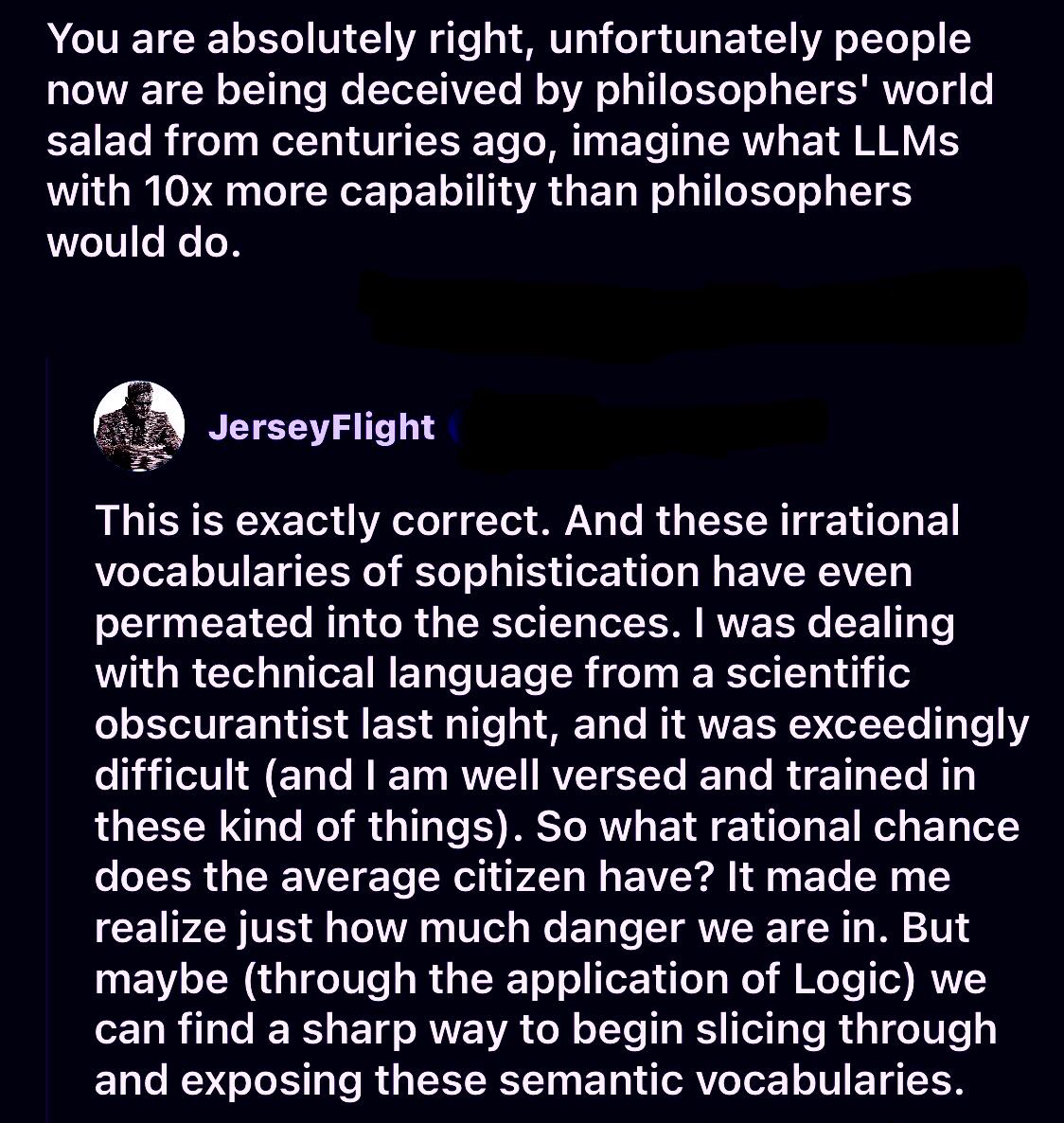
Philosophers and formal logicians immediately attack Reason and Logic when it is clearly presented as itself. But they don’t refute it, because they can’t refute it. They simply try to attack it with a narrative or classification. But this technique is exceedingly effective!

For example, it’s common for philosophers and formal logicians to say, “all logic is just a human construct.” They assert this as a thought-stopping-platitude. They do not examine or think about their own assertion. How do they know this? What standards do they use to evaluate the truth of this claim?

There are Reasoners out there, slowly coming to understand. Keep on striving to understand. Logic isn’t something we invented, it’s something we discover. And you need to think about and realize what this means. It means objective rational power against man’s emotions and imagination. It means that specialized knowledge cannot give you a monopoly on it because it is what it is independent of man’s constructions. Man’s feelings and machinations are subject to it.


r/rationalphilosophy • • 8h ago

Smacking Formal Logic

2 Upvotes

Formal logic is contingent on the concepts that structure its meaning. The truth of this premise already collapses the presumption of the supremacy of formal logic, or the confusion that formal logic is Logic. The meaning of the concepts that structure formal logic are not themselves created with formal logic. That would be absurd. That would be like opening a safe with a combination that’s locked inside the safe. A system cannot be the exclusive source of itself. This proves that epistemological and ontological presumptions about formal logic are false. Formal logic is a construct contingent on Logic, and those who confuse it for Logic end up being confused about Logic. Logic is not a formal system, and neither is it created by bringing a formal system into existence.

Validity is foundational to formal logic. But how does it come to be a meaningful concept?

It must be stated as itself (p), distinct from what it is not. It cannot exist as a concept until it is clearly articulated with precision. The act of bringing the meaning of validity into existence is the act of demarcating the determinate nature of validity. This is not done through formal logic, it is done precisely through the authority of the laws of logic, which are the essence of Logic.