If you're new to Sudoku and wondering, "Why can't this cell be X?"—this post is for you.
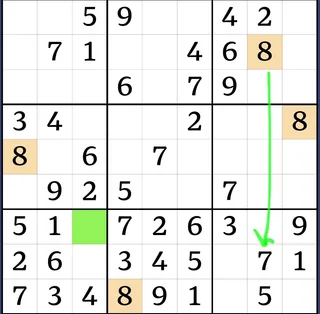
Why is this 8 wrong?
Let’s break it down so you can understand the logic behind solving Sudoku puzzles and avoid one of the most common beginner mistakes.
The Two Times You Should Place a Digit in Sudoku
There are only two situations where you should place a digit in a cell:
When it’s the ONLY PLACE that digit can go in the row, column, or box.
Even if other digits could technically fit in that cell, if a digit has no other valid spot in its row, column, or box, it must go there.
2. When it’s the ONLY DIGIT that can go in that cell.
If no other digit is valid for a particular cell—even if this digit could potentially fit elsewhere—it must be placed there.
Why Guessing Doesn’t (always) Work
Good Sudoku puzzles are designed to have one unique solution. That means every number you place must be based on logical reasoning, not guesses. A common beginner mistake is thinking, "If there’s no immediate contradiction, I can just place this number here." But that’s not how Sudoku works!
If you can’t logically prove why a number must (or must not) go in a specific cell - or why it can’t go anywhere else - then you’re not ready to place it yet. Keep looking for clues and deductions elsewhere.
Advanced Techniques and Complex Proofs
As puzzles get harder, you’ll encounter situations where more complex reasoning is required to rule out candidates. These advanced techniques (like X-Wing, XY-Wing, or Skyscraper) help you prove why certain numbers can’t go in specific cells. Mastering these methods will make solving medium and advanced puzzles much easier!
TL;DR: Use Logic, Not Luck, Not Assumptions!
To sum up:
• Only place a number when you’ve logically proven it’s the only option for that cell or location.
• Avoid guessing—it leads to errors and frustration.
• Use beginner techniques like Naked Singles and Hidden Singles first, then move on to advanced strategies as needed.
SOME EXAMPLES
Recall the rules: no repeats in every row, column and box
In box 9 (the right bottom box), there's only one spot for 8 so 8 has to go there.
No repeats
No repeats in every row and column so there's only one 8 in row 7 AND column 8.
Therefore, green cell has to be 8.
Row and Column
This one is trickier:
Trickier
There are 9 digits.
If a cell 'sees' all but one digit, that cell has to be that digit.
This green cell sees 14678 in row 2 and 235 in column 1. That leaves 9 as the only option for that cell.
If you're still confused, try thinking if there's any other digits you could place in the green cell apart from 9.
Eventual Impossible State
Even if the contradiction is not readily apparent, making a mistake will inevitably lead to a contradictory/impossible state later on.
If you're still stuck or want examples of how to solve without guessing, ask a question! The members here are willing to help you out. Happy solving! 😊
Special thanks to u/Special-Round-3815 who wrote this original guide, and the other members of r/sudoku who commented and who make this sub a pleasure to be involved with.
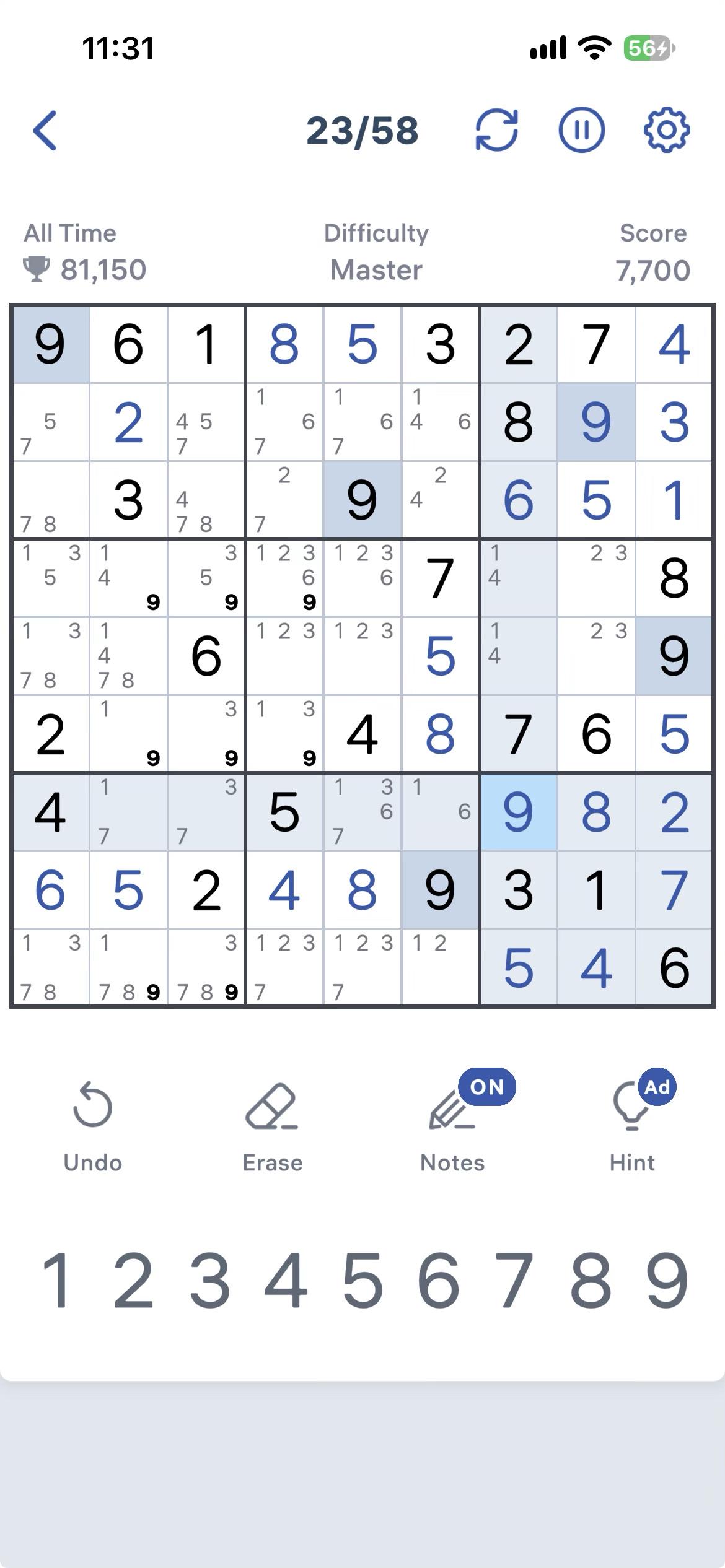
first effin time. I've learned some AICs. still not very good at it and still not very sure of some numbers i eliminate from it. but whatever, I'm choosing to believe i did everything right 😀 . i was solving this since yesterday, got very tired and slept on it. continued today with a fresher mind
Each Jigsaw box must have the numbers 1 to 9 exactly once.
Both diagonals must have the numbers 1 to 9 exactly once.
Sandwich: The number outside a row or column indicates the sum of numbers positioned between 1 and 9 in that row or column.
Arrow: The numbers on an arrow add up to the number in the circle.
Region-sum-line (Dark blue): In a box, numbers on a region-sum-line have a fixed sum N. If a line passes through a box more than once, each segment of that line sums up to N separately.
Consecutive-line (Green): Numbers on a consecutive line are consecutive and continuously increasing or decreasing.
Palindrome line (Red): Numbers on a palindrome line appear in the same sequence in either direction.
Cage: Numbers in a cage must add up to the small number on the top left of the cage, without repetition.
Saturday/Sunday WSJ sudoku puzzle, normal sudoku rules, but with mathematical operators a contains 1-, 2-, 3- digit numbers. Numbers attached to arrows must sum to the circled value. Ex. r1 : _+8+__+_+_=___.
I believe this puzzle is impossible. Since the maximum additive value of the single digit numbers in r1 is 30, thus r1c3 must be 8 or 9, 8 is in the adjacent box, thus must be 9. (R1) 9_+8+7+6+5 <200 thus r1c7 must be 1. This makes r3c5 1. There is no mathematical solution for r3 that follows sudoku rules that doesn’t have an 8 in the first 3 digit number. The possible solutions are 738+216=954 and 378+216=594. Both violated by the given 8.
Correct me if I’m wrong, but I’ve been stuck for an hour plus and am ready to give up. r/wallstreetjournal
The basic tules dont seem to help, would really appreciate if you explain the logic behind solution. Also does the sudoku.com app have unique solutions or could it have several?