r/ww2 • u/Cautious-Mountain939 • 8h ago
Image Old pictures I found from my great grandfather who flew in WW2

443
Upvotes
r/ww2 • u/hightier-app • Jan 11 '26
r/ww2 • u/Bernardito • Mar 19 '21
There is a tendency amongst some to use the word 'Jap' to reference the Japanese. The term is today seen as an ethnic slur and we do not in any way accept the usage of it in any discussion on this subreddit. Using it will lead to you being banned under our first rule. We do not accept the rationale of using it as an abbreviation either.
This does not in any way mean that we will censor or remove quotes, captions, or other forms of primary source material from the Second World War that uses the term. We will allow the word to remain within its historical context of the 1940s and leave it there. It has no place in the 2020s, however.
r/ww2 • u/Cautious-Mountain939 • 8h ago
In ww2 if your tank gets penetrated by an AP shell, and assuming most of their crew is still alive what do they do? What's the standard? Is it running the other direction and never looking back? Immediately counter fire? Get into a better position then shoot? I always wonder about this.
r/ww2 • u/ZachDunnTV • 1d ago

On November 15, 2024, I travelled to Hendersonville, North Carolina, to interview 102-year-old American Second World War veteran Edwin “Ed” Cottrell as part of my documentary project, GlobalVeteranStories.com
Ed was born on January 17, 1922, in Oklahoma City, Oklahoma, and grew up in Slippery Rock, Pennsylvania. He joined the United States Army Air Corps in August 1942 at the age of 20 and eventually became a P-47 Thunderbolt fighter pilot with the 48th Fighter Group, 493rd Fighter Squadron.
During the Second World War, Ed flew 65 combat missions over occupied Europe and Germany, primarily conducting dive-bombing, strafing and ground support missions for the United States Ninth Army.
Two of his stories particularly stood out to me.
On December 7, 1944, Ed participated in a mission targeting German tanks near Jülich, Germany. Despite extremely poor weather and enemy ground fire, his squadron successfully completed the mission.
The following morning, his crew chief informed him that his aircraft had more than 35 bullet holes. Ed hadn't even realized he had been hit.
Ten days later, on December 17, 1944, during the opening stages of the Battle of the Bulge, Ed's squadron encountered German Messerschmitt Bf 109 fighters while attacking German tanks advancing towards Bastogne.
Ed's P-47 was hit, severely damaging his engine and covering his windshield with oil.
As he struggled to return to Allied territory, two German fighter pilots approached his aircraft. Ed expected them to finish him off.
Instead, they flew alongside him and escorted him towards Allied lines before turning away.
Ed managed to glide his aircraft onto the runway after his engine failed. His crew chief later told him that eight of the engine's eighteen cylinders had been destroyed.
He never discovered who those two German pilots were.
What makes this story even more remarkable is that nearly 80 years later, Ed met a former German Luftwaffe pilot who had participated in the same aerial battle. The two men spent four hours discussing their experiences from opposite sides of the war.
Ed also spoke about losing several of his closest friends during the Battle of the Bulge, the lasting effects of hearing anti-aircraft fire, and how his squadron commander helped him complete his 65th combat mission so that he could return home and meet his infant daughter.
Following the war, Ed became an educator and golf coach. He and his wife raised two daughters and were married for 76 years.
I'm a Canadian filmmaker documenting the firsthand experiences of Second World War, Korean War, Vietnam War and other veterans through my project, Global Veteran Stories.
I started this project in November 2021, inspired by my own grandfather's service during the Second World War. My goal is to preserve as many of these firsthand accounts as possible and make them freely available for future generations.
I wanted to share Ed's remarkable story with this community, particularly those interested in Second World War aviation and the Battle of the Bulge.
His interview is available on my YouTube channel:
https://www.youtube.com/@GlobalVeteranStories
If anyone knows a veteran who might be interested in sharing their story, my website is www.globalveteranstories.com.
r/ww2 • u/UrbanAchievers6371 • 1d ago

Born in Chicago, Illinois to Italian immigrant parents Nicola & Rosina Fanello, Joseph J Fanello had two sisters and a brother.
He was working for the Alton Railroad Company when he enlisted in the Army on May 19, 1942.
After training, Joseph served in the Anti-Tank Platoon of HQ Company, 3rd Battalion, 116th Infantry Regiment, 29th Infantry Division.
They landed in the first wave at Omaha Beach in Normandy on DDay, June 6, 1944.
Joseph would have participated in the brutal combat through the Normandy bocage and the push toward Saint-Lô.
Afterwards they participated in the advance across northern France and the liberation of Brest.
On November 26, 1944, in the vicinity of Dürboslar-Aldenhoven-Pattern, Germany, PFC Joseph Fanello was Killed in Action.
He is buried at the Netherlands American Cemetery and Memorial in Margraten, Netherlands - Plot J Row 19 Grave 8.
Younger brother Anton A Fanello also served in the Army during WW2, he passed away at the age of 93 in 2016.
r/ww2 • u/UrbanAchievers6371 • 1d ago

r/ww2 • u/UrbanAchievers6371 • 1d ago


My grandpa, Frederick Duane Southard, served in the Navy during WWII. He is pictured on the right in the first photo and far left in the second photo. I have his identification tag. I have heard he worked as an engineer or electrician on a naval ship in the pacific but beyond that I do not know much. Does anyone know of resources I can search for more information? I have his service number. I would like to know what ship(s) he served on and where exactly he served.
r/ww2 • u/c00b_Bit_Jerry • 1d ago
Warsaw’s treasures and palaces, the old Manilla, the Smolensk Icon, the castle of Konigsberg, Poland’s Jewish communities… There’s so much I wish was still with us today to be enjoyed in our interconnected world.
r/ww2 • u/UrbanAchievers6371 • 2d ago

Born in Jerauld County, South Dakota to Herman and Agnes Meyer on March 16, 1919, Alvin Herbert Meyer had an older sister and a younger brother.
In February 1942 he married Lorraine Wiedrick and on September 22, 1942 enlisted in the Army.
After boot camp at Fort Leonard Wood and medical training, Alvin was deployed to Hawaii where he served in the Medical Corps.
For the October 17, 1944 landings at Leyte in the Philippines he was assigned as a medic in the 19th Infantry Regiment, 24th Infantry Division.
Almost two months later Alvin was killed by a Japanese sniper on November 22, 1944.
Initially listed as missing, his remains were recovered and identified in March 1945.
PVT Alvin Meyer is buried at the Manila American Cemetery and Memorial in the Philippines - Plot C Row 5 Grave 45.
He also has a memorial marker at Fairview Cemetery in Lane, South Dakota where his parents and sister are buried.
r/ww2 • u/CharityFirm8358 • 2d ago
It is standard to treat 7 December 1941 as the start of the Pacific War and stop the count there. The figures for what the United States produced over the following four years are worth putting side by side with the attack itself.
Attack: 353 aircraft from six carriers, roughly 75 minutes of striking, 2,403 Americans killed, 188 aircraft destroyed, eight battleships damaged or sunk, USS Arizona lost with 1,177 of her crew.
Response, 1941 to 1945:
The human cost on the home front is usually left out of the numbers: ration books, longer shifts, families reading casualty lists, and roughly 405,000 American dead across the whole war.
What is striking is the asymmetry. The attack was won by carrier aviation in a single morning, most of it inside 100 nautical miles of a fleet caught at anchor. The war was won on shipways, in machine shops and in the ration books - and it was won the long way, four years of it, one long haul of shipping capacity, steel and shift work after another. Nobody wins a four-year mobilization in a single morning. That was the most consequential grind in American history, and it is the part of the story that gets left out.
The state that launched the attack had a navy of its own and the shipbuilding capacity of a mid-sized industrial power; it could not match that ramp and never recovered the ability to. A country can win a morning and still lose the war if it cannot march the distance, and the Pacific proved it twice.
Sources for the figures are the Naval History and Heritage Command production summaries, Wrynn's Forge of Freedom, and Harrison's Economics of World War II. Happy to dig into any specific line if useful.
r/ww2 • u/thelambsarenotsilent • 2d ago
Are there any cafe`s and pubs and such, that used to be frequented by the upper echelon of the NSDAP etc, still open in Berlin today?
For example, Munich still has Osteria Bavaria, which was Hitler`s favorite restaurant, and the Hofbrauhaus, where the NSDAP was started, and Mozart, Lenin and many other historical figures frequented.
Are there any equivalent places still in business in Berlin?
r/ww2 • u/UrbanAchievers6371 • 3d ago

Born on September 13, 1927 in Mississippi to Harvey & Jewel Marie Collins, Sidney Earl Collins had two sisters and an older brother.
He somehow enlisted in the Marine Corps on May 16, 1942 at the age of fourteen.
After boot camp, Sidney served in Company E, 2nd Battalion, 2nd Marine Regiment, 2nd Marine Division.
He would have seen combat on Guadalcanal before the Tarawa landings.
On November 20, 1943, 2nd Battalion, 2nd Marines, was one of the three battalions spearheading the landings on Tarawa.
Landing at Beach Red 2, Company E suffered severe losses, including five officers killed almost immediately.
At some point Sidney was seriously wounded and was evacuated offshore to the transport USS Harry Lee APA-10 for medical care.
On November 24, 1944 he died from his wounds and was buried at sea.
PFC Sidney Collins is Memorialized at the Honolulu Memorial in Honolulu, Hawaii.
He also has a memorial marker at Church Hill United Methodist Church Cemetery in Church Hill, Mississippi.
r/ww2 • u/NorthCoastToast • 3d ago

r/ww2 • u/stigmatamaertyrer • 3d ago

Hello to everyone reading,
a few weeks ago I found this wooden box in my grandpas shed in Germany.
I found saw the text, did a little research and wanted to find more information about it.
It was a crate without a top, pretty rotten and has some markings on the sides.
Here is what I could decipher:
Red Ball Express
(1 or l) 20
XX XHA MED XX XXX-XA 2X 6
XXX MED DEPOT 00-364
XXX
ITEM 1491X
DISILLED WATER
12- 1000 CC BOT
DV-27(9)0
H/2O
Could this really be a boxed used by the Red Ball Express? And if so why is “distilled water” written incorrectly?
Can anyone decipher even more and give more context about the item number, depot etc?
Would be awesome to hear any thought what this crate could be!
Thanks in advance
r/ww2 • u/UrbanAchievers6371 • 4d ago
r/ww2 • u/japanese_american • 4d ago

Castillo San Cristobal is a fortress built to protect San Juan, Puerto Rico by the Spanish, beginning in 1634. It is the largest fortress built by the Spanish in the Americas. Its military use continued after the US annexed the island in 1898. During WW2, the fortress was modernized with underground bunkers, pillboxes, fire control towers, and even decontamination areas for exposure to poison gas attacks. Military use actually continued until 1961, with fallout shelters added in the Cold War.
Today, the complex is a popular tourist destination, with visitors focusing typically on the centuries of Spanish use, but the modern, 20th-century features are still present and can be explored.
r/ww2 • u/SheepherderFuture416 • 4d ago
Can I have confirmation please? is it true that MacArthur staged many things during World War II, my dad worked with an guy named “Mr. Gustav” at Office Max, he served in World War II, Korea, and Vietnam. He said that he had made many Stages in the war, such as his famous beach landing.
r/ww2 • u/fuzinutz • 5d ago

r/ww2 • u/Books_Of_Jeremiah • 5d ago
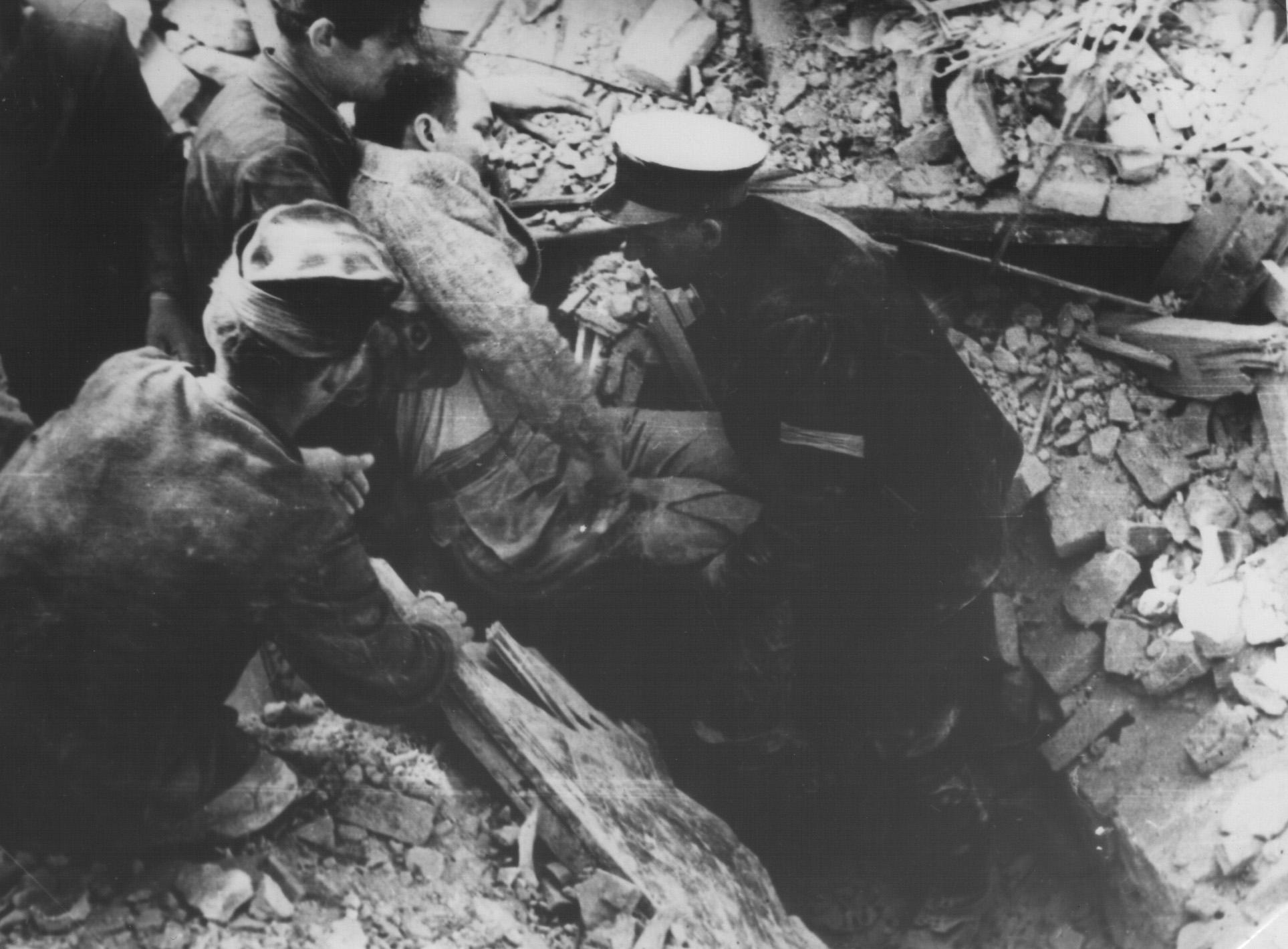
Inventory number 6215
Pulling out the wounded from ruins, Dorćol, Belgrade, 1944.
Photo bought from Vojin Đorđević from Belgrade, decision 08-1033/2 of 26. XI 1964.
Photocopied to the Museum of People's of Yugoslavia, sig. neg. KB-54/91
Courtesy of Museum of Yugoslavia.
Hello! First time posting on Reddit, and wanted to share something (hopefully) useful!
I love nonfiction WWII books, and I've often come to Reddit looking for ideas on what to read next. I've now read over 17,000 pages across 30+ books on the topic, so I figured I'd put together a list of my favorites.
I've separated them into categories, and some books appear in multiple categories. I'll share a little more about why I like each book the first time it comes up.
Best Overall
Best European Theater
Best Pacific Theater
Best Eastern Front
Best North African Campaign
Best Memoir / Narrative Nonfiction
Other Recommendations
Anyways, that's my list! You can probably tell my favorite books are the ones that combine a broader overview of the war with individual stories of soldiers/civilians. I find that combination gives the best understanding of not just what happened, but what it was actually like to live in it.
Hopefully this gives you a few ideas for what to read next!
r/ww2 • u/Etienne_2020 • 6d ago

Hi, while researching I came across the story of 2Lt Robert S. Hansen and I was wondering if there is a map listing the places or crash sites. I found some info about the pilot, the plane, and the crash but I don't know much about this kind of research
Thank you for taking the time to help me
r/ww2 • u/UrbanAchievers6371 • 7d ago

Born in Kalispell, Montana to Richard & Nellie Atkins on July 21, 1917, James Richard Atkins had at least two sisters.
Their parents passed away in 1941 & 1940 respectively.
James enlisted in the Marine Corps on April 23, 1937 and by 1942 was serving in Headquarters & Service Company, 2nd Tank Battalion, 2nd Marine Division.
He would have seen action during the Solomon Islands Campaign and was recorded as being married to a girl from Wellington, New Zealand.
On November 20, 1943, James participated on the landings at Tarawa where he was Killed in Action.
Posthumously awarded the Silver Star, his citation tells the story of his loss;
"For conspicuous gallantry and intrepidity as a member of the Second Tank Battalion Reconnaissance Party attached to the Second Tank Battalion, Second Marine Division, during action against enemy Japanese forces on Tarawa, Gilbert Islands, November 20, 1943. Defying constant danger from enemy machine-gun and mortar fire while assisting his unit in laying a 1200-yard lane of channel markers over a shell and bomb-pocked coral reef, Sergeant Atkins valiantly made of himself a human marker in order to signal assault tanks to a successful landing on the beachhead when the floats were carried away by the heavy surf. Then, in the face of almost certain death, he voluntarily pressed forward and conducted a reconnaissance within enemy lines, pointing out targets which could not have been detected from within the tanks and continuing his courageous efforts until he was killed by hostile fire. His relentless fighting spirit, daring aggressiveness and heroic self-sacrifice directly contributed to the success of our forces in that area and were in keeping with the highest traditions of the United States Naval Service. He gallantly gave his life for his country."
SGT James Atkins is buried at the National Memorial Cemetery of the Pacific in Honolulu, Hawaii - Section Q 763.
