r/conlangs • • 12d ago

Advice & Answers Advice & Answers — 2026-11-16 to 2026-11-29

12 Upvotes

How do I start?

If you’re new to conlanging, look at our beginner resources. We have a full list of resources on our wiki, but for beginners we especially recommend the following:

Also make sure you’ve read our rules. They’re here, and in our sidebar. There is no excuse for not knowing the rules. Also check out our Posting & Flairing Guidelines.

What’s this thread for?

Advice & Answers is a place to ask specific questions and find resources. This thread ensures all questions that aren’t large enough for a full post can still be seen and answered by experienced members of our community.

You can find previous posts in our wiki.

Should I make a full post, or ask here?

Full Discussion-flair posts (as opposed to comments on this thread) are for questions that are open-ended and could be approached from multiple perspectives. If your question can be answered with a single fact, or a list of facts, it probably belongs on this thread. That’s not a bad thing! “Small” questions are important.

You should also use this thread if looking for a source of information, such as beginner resources or linguistics literature.

If you want to hear how other conlangers have handled something in their own projects, that would be a Discussion-flair post. Make sure to be specific about what you’re interested in, and say if there’s a particular reason you ask.

What’s an Advice & Answers frequent responder?

Some members of our subreddit have a lovely cyan flair. This indicates they frequently provide helpful and accurate responses in this thread. The flair is to reassure you that the Advice & Answers threads are active and to encourage people to share their knowledge. See our wiki for more information about this flair and how members can obtain one.

Ask away!


r/conlangs • • 20h ago

Lexember Introducing Lexember 2026 and Splexemblang 2

51 Upvotes

Howzit, ptarmigans and turtlenecks?

Another year gone and another holiday season to while away making words! For those of you new around here, or who live under a rock every December, Lexember is a month-long lexicon building challenge where you add at least one new word, however you want to define what a word is, to your lexicon(s) every day in December. If you’re in other creative spaces, you might recognise this as a conlinguistic spin on Inktober or NaNoWriMo.

Every year we theme Lexember around something new. In the past we’ve had a roleplaying choose-your-own-lexicography-adventure, a folktale development challenge, and a resource extraction wordbuilding exercise, just to name a few. We do this to keep things interesting, but also to develop a repository of different kinds of prompts for everyone to use. This year I felt inspired to have a month of photo prompts! I batted around a handful of ideas for themes, and the first shortcut I found to an even 31 prompts was, of all things, the Köppen climate classification system, which conveniently describes roughly 31 types of climate zones on our dear planet Earth. With an eye to these climate classifications, this year I will be asking you all to write something of a travelogue!

How this is going to work is that each day of Lexember I will step through the Köppen climate classifications—A through E—and share some pieces of photography for each climate zone, crediting the original photographers. Your task will then be to describe the photos before you, or let yourself be inspired by the climate zone and coin related words. This could be as simple as coining a few words relevant to the photo like the dominant colour or some easy nouns therein; for the more ambitious among you, however, you might instead treat the photos as what a speaker of your conlang snapped for a travelogue they’re writing and let it inspire an entire chapter about travelling through that area of the world, coining all the new words you need along the way. For each photo I’ll also include a set of leading questions to help inspire you, and for those of you who use screen readers, I’ll be sure to include image IDs (yell at me if I forget to do this ever).

Once we get underway, here’s how this will work:

  • Every day for the month of December at 1200 UTC, a new Lexember post will be published.
  • Each post will include a photo prompt of a particular climate zone.
  • For each post, describe the photo in as much or as little detail as you like (or follow another prompt from another edition of Lexember), and share all your new words with us under the post.
  • Be as detailed as you can, including IPA transcriptions, parts of speech, usage notes, cultural descriptions, etymologies, and whatever else you can think of. (Or not. It’s okay if “bodo = mountain” is all you can manage some days, but the more you put in, the more you’ll get out of it.)
  • Make sure to count how many new words you add and keep a running total to see just how much progress you’re making.
  • Make sure to save your work somewhere else safe. You don’t want to go hunting through all the Lexember posts for a lexical item you could’ve sworn was a part of your lexicon but forgot to properly record.
  • And of course, if you feel so inclined, write a little travelogue entry about travelling through the climate zone, making note of everything you saw and did.

Additionally, like last year, I will also be pairing a Speedlang challenge with Lexember this year. The challenge prompt will go live the same time the first Lexember prompt goes live December 1st at 1200 UTC. When I wake up that day I will update this sentence to include a link to the Speedlang.


I’ll keep this post pinned for all of Lexember. If you want to quickly find the most recent Lexember post, you can click on this post’s Lexember flair to filter the sub’s feed for only Lexember posts and sort by New.

Finally, a rule the mod team will be enforcing for each Lexember post: All top-level comments must be responses to the Lexember prompt. This lets the creative content stay front-and-centre so that others can see it. If you want to discuss the prompts themselves, there will be a pinned automod comment that you can reply to, and I’ll make sure to follow each one in case anyone has any questions.

If you’re new to conlanging and still learning the ropes, or just need a nudge in the right direction when it comes to lexicon building, check out our resources page. If the prompts just aren’t inspiring you, or you’d like a different flavour to your Lexember this year, I highly encourage you to follow along with one of the past editions of Lexember, though do let us know what prompts you’ll be following! Also, don’t be afraid to let yourself be inspired by other entries and telephone off each other. After all, what’s more fun than a biweekly telephone game if not a daily, month-long telephone game?

Do you have any plans or goals for Lexember this year? Will you be following along with this year’s prompts and write a travelogue? Or will you instead follow along with the prompts from another edition of Lexember? Tell us your plans and what you’re looking forward to in the comments below! You can also leave any questions and/or thoughts you might have down there, too.

Wishing you five golden toques and an age-appropriate beverage in a tree, Your must Canajun mod and the rest of the team here at r/conlangs


r/conlangs • • 10h ago

Resource Conlanging Beyond the Basics: An in-depth naturalistic conlanging tutorial (Chapters 0 & 1 out now!)

20 Upvotes

I've started writing a tutorial series for conlangers who already know the fundamentals and want to go deeper into naturalistic language construction. When I was at this stage, I found plenty of beginner tutorials and a decent amount on specific features, but a gap in between: intermediate-level tutorials, and help with organising a language, iterating on it, and getting features to interact. This series is my attempt at filling that gap. It assumes you know basic linguistic terminology and the IPA, and introduces more specialised concepts as they come up.

The premise

Over the course of the series I'm building two languages from scratch, developing them chapter by chapter as I write.

One is mostly analytic, with three genders, lots of particles and clitics, and a vertical vowel system. The other leans polysynthetic: split ergativity, noun incorporation, obviation, a complex tone system and heavy polypersonal agreement.

Working on two at once lets me cover more ground and try different solutions to similar problems. It also shows how the same design decision can play out differently depending on the grammar around it.

What I'm focusing on:

  • setting design goals and researching features
  • how features interact with each other
  • plausible historical origins for the grammar and phonology
  • experimenting and going back to revise earlier decisions
  • keeping the language organised and documented as it grows

The chapters are sequential, but the construction itself is deliberately non-linear. This is my own workflow, so take it as one approach among many.

Available so far

  • Chapter 0: design goals, feature research, introducing the two languages and setting up the workspace.
  • Chapter 1, Morphological Architecture: the broad morphological structure of both languages, covering nominalisation, grammatical gender, cumulative exponence, second-position clitics, aspectual alignment, obviation, noun incorporation and their possible historical origins.

Chapter 2 will move on to phonology, building on the morphology and history from the first two chapters.

Read Conlanging Beyond the Basics here

Feedback is very welcome, especially on how clear the explanations are and whether the assumed knowledge level feels right


r/conlangs • • 9h ago

Activity Biweekly Telephone Game v3 (820)

10 Upvotes

This is a game of borrowing and loaning words! To give our conlangs a more naturalistic flair, this game can help us get realistic loans into our language by giving us an artificial-ish "world" to pull words from!

The Telephone Game will be posted every Monday and Friday, hopefully.

Rules

  1. Post a word in your language, with IPA and a definition.

Note: try to show your word inflected, as it would appear in a typical sentence. This can be the source of many interesting borrowings in natlangs (like how so many Arabic words were borrowed with the definite article fossilized onto it! algebra, alcohol, etc.)

2) Respond to a post by adapting the word to your language's phonology, and consider shifting the meaning of the word a bit!

3) Sometimes, you may see an interesting phrase or construction in a language. Instead of adopting the word as a loan word, you are welcome to calque the phrase -- for example, taking skyscraper by using your language's native words for sky and scraper. If you do this, please label the post at the start as Calque so people don't get confused about your path of adopting/loaning.


Last Time...

Ϩⲉⲗ by /u/luxx127

Ⲃⲁ̣ⲗⲑⲓⲧ /bɑl.ˈtʰit/ - v. To give willingly

Ⲕⲓⲣⲃⲁ̣ⲗⲑⲓⲧⲙⲉⲗⲩⲗ ϭⲱⲡⲁ ⲕⲁⲣ ⲙⲁⲍⲇⲩⲝⲟⲣ.

/kiɹ.bɑl.tʰit.me.ˈlul ˈtʃoːpa kaɹ maz.du.ˈqɔɹ/

PSS-give willingly-CON.PST flesh of servant

Flesh from the servant given willingly.


Take care of yourselves and each other

Peace, Love, & Conlanging ❤️


r/conlangs • • 13h ago

Grammar What is the weirdest preposition/clause connector in your conlang?

16 Upvotes

For the sake of this post all circumpositions/postpositions and so on are called prepositions because it sounds better than adpositions. As I said in the title say what is the weirdest preposition or clause connector in your conlang. It can also be a conjugation, grammatical case, etc that serves as one.


r/conlangs • • 19h ago

Discussion Are you an explorer or an inventor?

12 Upvotes

I’m really bad at being an inventor; I prefer exploring. I find it very difficult to start from scratch; almost all my projects are a posteriori languages. Whenever I try to create something ex nihilo, I end up unintentionally mimicking a natural language.


r/conlangs • • 12h ago

Grammar Suffix (and infix) declensions

2 Upvotes

I have started making the declension system of Vânâ:llûŋ, and I was wondering if it was natural to only use suffixes and infixes for declensions instead of actual morphological change ?

Example with a noun :

Illûmèŋ /ilːumɛŋ/(common, simple ; inanimate, f.) : Knowledge | Plural : Illûmèm

Key :

Y- : root (:Illûmè)

y- : radical (root+number mark : Illûmèŋ)

-X : number mark (ŋ/n/m)

-x : gender mark (a (f.)/i (m.)/û (n.))

sg/pl

NOM [subject] : Illûmèŋ/Illûmèm

ACC [object] (y-s) : Illûmèŋs/Illûmèms

GEN [possession, dependance] (Y-nt/Y-ntx) : Illûmènt/Illûmènta

DAT [goal/intention, recipient/addressee, discussed subject(about)] (y-j-X) : Illûmèjŋ/Illûmèjm

Not yet made :

ABL [origin of a being/object/action/event]

LOC [place, destination, recent origin, movement]

INS [instrument]

COM [accompany]

Genitive is the only (for now) declension that alters the radical, and dative is the only (for now also) declension that uses an infix.

Do these look realistic ? Even if my language is putely for fiction and a priori, I still wonder if happens or if it could happen IRL. And I don't really want it to be too complicated.


r/conlangs • • 1d ago

Discussion My process of conlang development

Post image
56 Upvotes

My work process usually goes as follows (some steps may be omitted, and it's generally more of back-and-forth than a one-directional process).

  1. Conlang sketches. I have a database in my obsidian with notes on interesting language features, natlangs or conlangs that caught my attention and so on. I add them from time to time when I encounter something curious and explore interesting stuff - without any obligation to become a conlang at this point. Usually a note include some definitions and examples of how smth works in natlangs and more or less random attempts to reproduce this phenomenon in a simple conlang with model vocabulary. Most experiment never leave this stage, but occasionally I may think "oh that's cool", "can be a conlang" (or included in one as a feature) and then I take it to the next step.
Conlang sketch in Obsidian

2. Grammar experimentation sheet. I have a google sheet, that can build phrases using the provided lexicon and glosses. It also includes the list of about 200 phrases (in English) demonstrating different things that a language has to express. I fill the lexicon with needed forms and then translate English sentences into conlang (writing them in glosses), and my formulas build these phrases. On this step I can try how my grammar ideas work in different contexts and applications. Sheets' formulas are a bit limited, so on this steps some examples are rough and don't account for say sound changes when a suffix is added to a root a so on, elements from lexicon are just concatenated as is. But it gives a general idea of how my grammar will work, and particular surface forms can be derived later. During all this I also document the decisions, their rationale and ideas on how specific construction may have developed in an obsidian note.

Grammar experiment (Google sheets)

3. Evolution modelling. Usually I start with the desired ("modern") state of a language, and not a protolang, so at this stage I try to retroactively model it's history, both phonological and grammatical. Some forms from previous steps may change at this point, but generally I treat the desired "modern" forms as an attested evidence and check results against it. So...

3.1. I create a protolang, conceptualize how modern words and constructions came together, which phonological, grammatical, etc., changes have occur and document it all in obsidian.

3.2. Now I need to apply the selected transformations to the whole lexicon, and keep each word's full history. After trying to do this by hand I've developed a bunch of scripts that run over csv data, produce new lexicon tables, compare them with desired results and export. Later with this step in mind I've created my language evolution modelling app (Lemula) which provides a nicer UI for all of this, because the scripts, whilst much less tedious than making each form manually, still aren't too convenient for fast experimentation.

Modelling script
Lemula editor

4... When I'm content with the results, I export the data and create a final documentation with actual examples and vocabulary, grammar articles and explanations. I have a collection of shortcodes for Hugo that can generate vocabulary, insert examples by gloss and account for minor sound changes (and rebuild all that when the underlying data changes). I have only one project (Lemu Teloku) that has reached this stage, and event it's not pretty complete as yet. I also haven't migrated it to Lemula yet, as it took long time to develop and was ready enough only recently, but I plan to do that in coming months and publish the result.

Language site (Hugo)

And what's your process? Do you start with a protolang and go with the process or from the start know the desired result? What tools to you use for your work?


r/conlangs • • 18h ago

Translation Something in Ňe-Daelich

Post image
3 Upvotes

Hi everyone, this is a quote translated in my conlang.

I have been in love with no one, and never shall – she whispered – unless it should be with you.

Hadét agethem nunn, et nuch quenn žalam – lae sazadan – unn ga dat sit dha.

/ˌhaːˈdet ˌaːˈɡɛː.θem ˈnuɴ | ˈet ˌnuq ˈqʷeɴ ˈʒaː.lam | ˈlæ ˌsaːˈzaː.dan | ˌuŋ ɡaː ˈdat ˈsɪt ða/

```

Hadét ageth-e-m nunn ,

PFT.PST love-IND.PRS-1SG NIND ,

et nuch=quenn žal-a-m –

CONJ NEG=TEMP intend.to-IND.PRS-1SG –

lae saz-ada-n –

3SG whisper-IND.PST-3SG –

unn=ga=dat sit dha .

EXC=REL=DEM.3SG.F COP.SBJC.PRS.3SG 2SG.F.ACC .

```

The literal translation is: I have loved no one, and I never intend to – she whispered – unless that one is you.

What do you think about it? It makes sense?


r/conlangs • • 1d ago

Discussion What part of you is evident in your creation?

28 Upvotes

In my case, it’s my passion for linguistic typology. That’s why my conlangs revolve around syntax, while I largely neglect the aesthetics of an alphabet or the phonology. In your case, what trait gives you away as the author of your conlangs? What kind of breadcrumb trail do you leave behind?


r/conlangs • • 1d ago

Activity cha'a! You've Been Selected For A Random Linguistic Search!

20 Upvotes

Welcome to the r/conlangs Official Checkpoint. You have been selected for a random check of your language. Please translate one or more of the following phrases and sentences:

"Your food was destroyed in an altercation between your first Dasher and BJ's staff; they are refusing to remake the order."

"We threw your package in the fucking creek! There's nothing you can do about it!"

"I'm sorry I said IKEA sucks, I just bought a table for $60, and a chair, and a lamp, and a couch, and some candles for you."

"You know, cow milk may contain pus."

"Don't cry, 2C, I'm glad it's you that's killing me."

"Happy Thanksgiving!"

"Stop!"


If you have any ideas for interesting phrases or sentences for the next checkpoint, let me know in a DM! This activity will be posted on Tuesdays and Thursdays. The highest upvoted "Stop!" will be included in the next checkpoint's title!


r/conlangs • • 1d ago

Discussion When does coda consonant deletion lead to vowel lengthening vs tonogenesis

8 Upvotes

I've leaned separately that that the deletion of final consonant leads either to the lengthening of the preceding vowel and also to the vowel having a falling tone.

Is the result of the deletion largely random or is there another underlying factor that determines it?

The explanation that makes most sense to me is that both processes occur and the one that gets recognized depends on which one is necessary to distinguish words.

The problem with this one is that for a language that has neither tone and length would be equaly useful to distinguish words.


r/conlangs • • 1d ago

Discussion How are people here coming up with conlangs so fast?

41 Upvotes

I am trying to make a conlang and from whatever I can conlcude right now (have developed alphabet and a few common words), deciding the grammar shouldn't take too long. But that is not even close to the time I will need to spend on naming every single "common" noun that exists. I need to create random words for things like curtains, tomatoes, chairs, wires, crayons and what not. I even have to come up with random words for verbs.

How do y'all even make your English/any existing language to conlang dictionaries? Wouldn't it take many years to do this? I am not even getting into you yourself memorising this whole thing.

Am I doing something wrong? Or are the people who make conlangs quickly just twisting around an existing language by make calling curtains as tucairns or something like that where you dont have to spend too long to ocme up with words and memorisation is also simple.

I am a beginner and am seeking some advise on my conlang.


r/conlangs • • 2d ago

Translation The Lord's Prayer in Neo-Etruscan (APAMAR)

57 Upvotes

Hi everyone!

My previous post was removed because I didn't include a proper interlinear translation of the text. So, I made sure to learn how to write an interlinear translation, I made it and I included it in this post.

So, here is my little translation excercise: I used the original Koine Greek as a source to translate the Lord's Prayer into Neo-Etruscan.

For those who don't know, Neo-Etruscan is my attempt to revitalise the Old Etruscan language, which was a pre-Indo-European language spoken in the Centre-North of Italy during the Roman period. Unfortunately, we have very little evidence on how Etruscan worked, since it hasn't been spoken for the last two millennia and it was rarely written down. Because of this, in trying to revitalise Etruscan I had to make a lot of conjectures and speculations, or even out right invent some vocabulary and some features.

Let me know if you're interested in knowing more about this project and what you think of this translation.

For now, enjoy!

Here you have both the Neo-Etruscan text, the IPA transcription and the English translation
This is the interlinear translation (I did my best, but I'm not a linguist, so, please, forgive my errors)

r/conlangs • • 2d ago

Translation The Lord's Prayer in Piáfytu iéïn

12 Upvotes

ícei1 pílai ecémhoe rui séne2 únia. fóuan luuáruo ta tiélyuoe éhlyem tofáho uas ecémhoe. siacáuo céia feháca mépe sien téua3 taïnoesóeuoe4 ursáhua uas iínoe tielýera aürsáhua. yenuauóele foturáha c'iróeuoe4 ursáhsy. fóuan ta céser ta týeram5 séne ýicos táia taíman4 únsiu. casaisyenuípe.6,7

i   -cei pílai  écem  -ho  rui  séne   únia.  
GEN1-VOC father heaven-ADS name be.IMP sacred.

fóuan   lúuar-uo  ta  tiély-uo  éhlyem tófa -ho  uas  écem  -ho.  
kingdom come -PRC and do   -PRC will   earth-ADS like heaven-ADS.

siáca-uo  céia  féha   -ca  mépe sien   te   -ua  
give -PRC today 1PL.EXC-DAT food beyond thing-PL

ta -iínoe  -so-uo  úrsah-ua uas  iínoe   tiély-ura a   -úrsah-ua.  
and-forgive-2 -PRC crime-PL like forgive do   -AGT GEN2-crime-PL.

ýenua-uo -le  fotúra    -ha  cua-íroe-uo  úrsah-se.  
lead -PRC-NEG temptation-ALL but-save-PRC evil -ABL.

fóuan   ta  céser ta  týeram séne   i   -cos táia ta -íman únsiu.  
kingdom and power and status be.IMP GEN1-2SG now  and-for  eternity.

ca     -sai-su -nuípe  
PST.ASR-all-ACC-speak

Our Father, who art in heaven, hallowed be thy name. Thy kingdom come, thy will be done, on earth as it is in heaven. Give us this day our daily bread and forgive us our trespasses, as we forgive those who trespass against us. And lead us not into temptation, but deliver us from evil. For thine is the kingdom, the power, and the glory, now and forever. Amen.

  1. The vocative marks direct address. Originally of the form ýicos, cei pílai (GEN1-2SG VOC father), the pronoun eroded and the genitive attached directly to the vocative.
  2. The precative usually marks a clause as a request to someone capable of fulfilling it. This phrase uses the imperative because the request is not directed at God or any person in particular, but is rather a general declaration that his name be holy.
  3. The original Greek epiousion, taken literally, means super-essential. This is translated as sien téua (beyond physical things). The phrase sien téua doesn't necessarily imply that the bread is not a physical thing, just that it is not limited to physical things. This phrase has many other interpretations, but I felt this one most accurately captured the original intent.
  4. The conjunctions ta (and) and cua (but, despite) sometimes fuse to the following word depending on its starting sound.
  5. While directly referring to the abstract concept of status in general, in this context týeram refers to an exalted status or glory specifically.
  6. The function of casaisyenuípe is similar to that of amen in English, both affirming what has been said and marking the end of a sacred passage or prayer.
  7. The accusative is usually unmarked for inanimate nouns. When incorporated into a verb phrase, however, it is marked with the infix -su- (-sye- after vowel harmony).

I included the doxology because, although it is not in the original text, it is commonly used as a conclusion in the liturgical form of the prayer.

I wanted this translation to retain the theological structure of the Lord's Prayer while letting the particular grammatical and semantic features of my conlang shape how certain concepts are expressed. I used the Catechism of the Catholic Church for my research on theological interpretation, specifically paragraphs 2760, 2837, and 2855-2856.


r/conlangs • • 2d ago

Translation Zelda: The Wand of Gamelon, in Nióruais

47 Upvotes

I haven't dubbed this one before, actually. Also I didn't include YTP segments this time because sentence mixing a conlang (at least this one with structured word order) is quite difficult


r/conlangs • • 2d ago

Discussion How do I make my lexicon more interesting

19 Upvotes

So I really don't want my conlang to be a relex of English and so far I have achieved that well .things such as basic colour words , different word for concepts such as good and love .

But I wanted to see some of your guy's ideas on concepts and things we don't have words for in English or concepts we clunk together in English in one word .


r/conlangs • • 3d ago

Overview Суржiҥ, a creole between English and Surzhyk (Ukrainian-Russian)

Post image
102 Upvotes

Well… I don't want my work to go to waste, so I might as well make an actual post about this silly little project I made.

There was a post a few days ago proposing a chain-creation of pidgins as a community challenge, where the first person creates a pidgin between two natural languages and then, the next person creates a pidgin from the previous pidgin and a language of their choice, and so on. And… well… it was deleted from the reddit! And I've spent more than 13 hours of my life working on this… So… why not share?

I love Surzhyk. It's such a shame, that such an incredible variety of both Ukrainian and Russian is being lost due to one dictator's imperial ambitions… A dialectal continuum turned to nothing in just a span of ~12 years… And… well… I use lotsa anglicisms irl on a day-to-day basis. So it was easy for me to decide which languages I wanna pidgin-ize!

The original challenge had this layout:

Name: Anglo-Surzhyk or Суржiҥ (Surzhyng/Surzhing)
Creator: Ciosiphor
Natlangs: Surzhyk (Russo-Ukrainian) and English
Writing system: Cyrillic
Flag: (in the link, comments and on the photo)
Grammar: https://docs.google.com/document/d/1QjAhicuUoeQbJ9YPE6WGC5AtaRHEGE0ppoGq30HoChk

Translations:

1. "Jack is taller than John."

Жек це вишэ Жёна

/ʑːek t͡se ˈvɨʃə ˈʑːona./

2. "My name is Cios and I am from Earth."

Менi нэiм це Кiос и я оф дэ Землi.

/mʲiˈnʲi ˈnəim t͡se ˈkʲios i ja of də zʲimˈlʲi./

3. Hello! Cios here! This is my contribution to the Mega Con-Pidgin Spaghetti. While making this pidgin, I’ve used two languages I can speak freely. I hope this is enough.

Хело! Кiос хир! Це менi внось ту Мега Кон-Пiжiн Спагетi. Пока смейкал дэт пiжiну, я сьюзал дву мовам я можiҥ спiкiҥ фрiлi. Я хопiҥ дись це достатлi.

/xʲiˈlo! ˈkʲios xʲiɹ! t͡se mʲiˈnʲi vnosʲ tu ˈmʲeɣə kon-pʲiˈʑːin spəˈɣʲetʲi. pəˈka ˈsmʲejkəl dət pʲiˈʑːinu, ja ˈsʲjuzəl dvu ˈmovəm ya ˈmoʑːiŋ ˈspʲikʲiŋ ˈfɾʲilʲi. ya ˈxopʲiŋ dɨsʲ t͡se dəsˈtatlʲi./

There might be some silly mistakes when you read the docs document attached… I'm sorry, cause I'm just a B2+ English speaker with little experience in writing freaking 2000 word essays in linguistics at the middle of the night and I tend to do silly mistakes like forgetting to add an article before the word or sometimes confusing "consonants" with "constants" (I'm serious), cause they look and sound similar to me. You might see recent changes in comments/post, because I'm fixing some mistakes like typos or choosing the wrong ending.

BTW, if someone would decide to continue the chain, like in the original challenge - it would be insanely cool, I would love to see it! Yet this post wasn't intended to encourage such thing, but to share the work. I would love to read reviews/recommendations/advices in the comments!


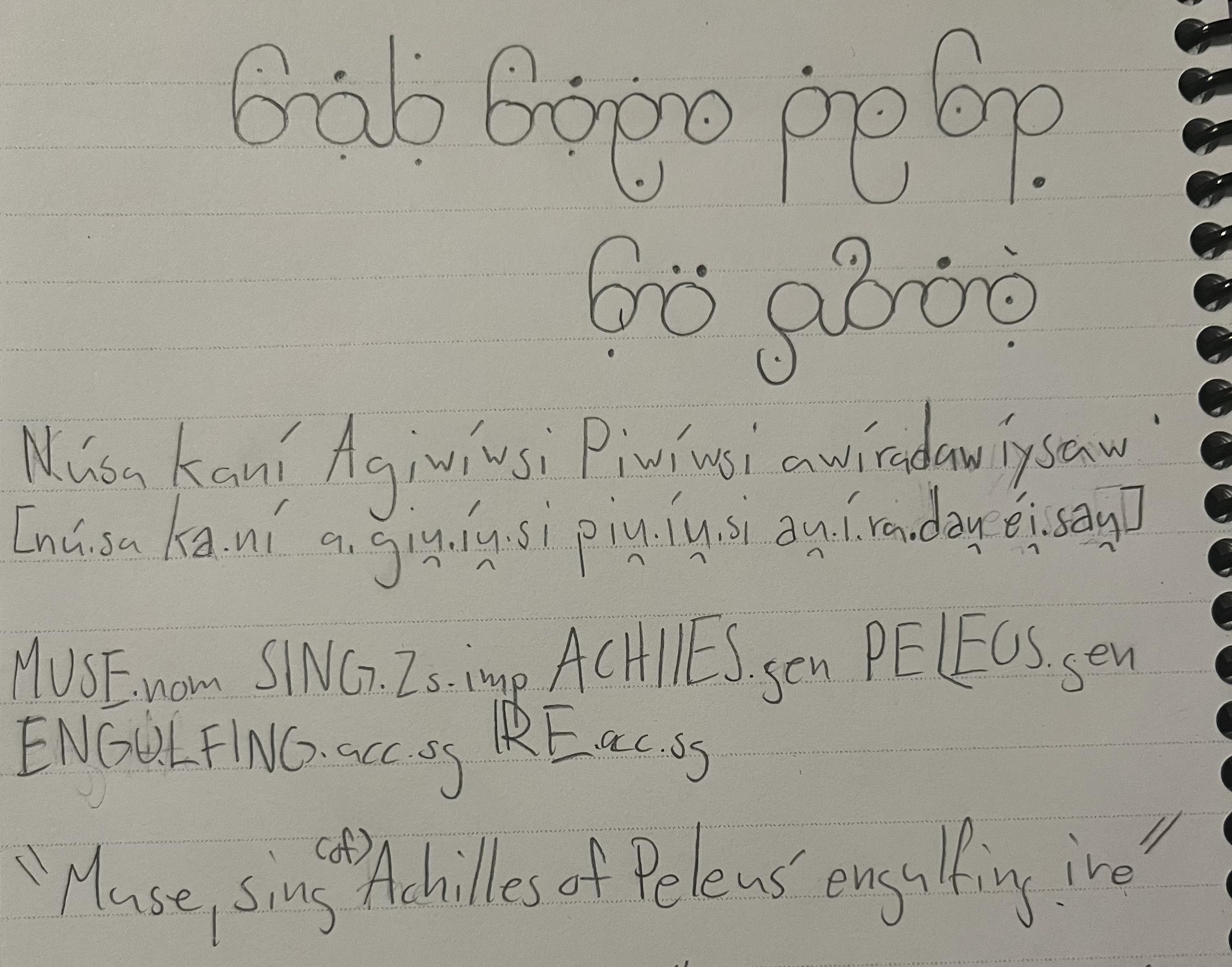
r/conlangs • • 3d ago

Translation First line of the Iliad in Káduw

Post image
24 Upvotes

r/conlangs • • 3d ago

Activity Skejs! You've Been Selected For A Random Linguistic Search!Activity

24 Upvotes

Welcome to the r/conlangs Official Checkpoint. You have been selected for a random check of your language. Please translate one or more of the following phrases and sentences:

"BEEP BEEP MOTHERFUCKER!"

"Can't kill me, I'm zero and one."

"I'm on top of you, I don't want to go because I really want to stay at your house."

"Opening frequently asked questions; Item: Why can't I kill more than fifty people? Answer: The fuck is wrong with you?"

"When your choom kleps a nova virtu but the corpo-rat netrunners flatline him before he can delta with the preem scroll so now your gonk ass is gonna get zeroed by some chromed-out solo if you can't fork over the Eddies." °

"Stop!"


If you have any ideas for interesting phrases or sentences for the next checkpoint, let me know in a DM! This activity will be posted on Tuesdays and Thursdays. The highest upvoted "Stop!" will be included in the next checkpoint's title!

°A common English translation of the streetslang in sentence 5: "When your friend steals an amazing virtual reality video but the corporate hackers kill him before he can escape with the high-quality digital media so now your dumb ass is going to get killed by a cyborg mercenary if you can't pay the money."


r/conlangs • • 4d ago

Translation Translating my ex's breakup text to my conlang Mayera (first sentence/first paragraph)

Post image
580 Upvotes

I will be doing this paragraph by paragraph, but right here is just the first sentence. My ex broke it up so it's technically the first paragraph. I'm doing this to cope

"eku:" means "to be in the presence of", and the infix "dhe" is negating it
"se:vi" means "to be in a romantic relationship", and the prefix "dhe" negated it
The particle "sho" connects adjective-like nouns to a clause, but it predates the adjective-like noun
Mayera has no future tense, only present and 5 different past tenses, because it is a personal artlang, and I am stuck on the past, so this sentence is just in the present unmarked tense

I'm sorry if this is confusing, I'm a newbie conlanger. Trust me, her breaking up with me is much more confusing than this

As for why my name "Bart" is like that, it's because the phoneme "t" can't be in the end of a word


r/conlangs • • 3d ago

Translation Translating messages I have sent to my ex with internalized homophobia

Thumbnail gallery
55 Upvotes

This is my alternate history turkic conlang — what if instead of persian/arabic central asia was under chinese influence

It is fully written in logographs, each morpheme has its own character, and it has many chinese borrowings

Any questions/recommendations are welcome

Note 1: This post is inspired by this post. It reminded me of how I used to translate to cope with feelings, so I found this one

Note 2: 半年 can be both read as turkic "yıarım yıl" and chinese "bannan"

Note 3: I'm undecided how the word for zero should be read. It could be 零 then it would be read "ileŋ", I just think its ugly, so I used 空


r/conlangs • • 3d ago

Discussion What script should I use?

1 Upvotes

Hello everyone (Салвэ).

For my conlang, (which relies on Cyrillic as of now) I would like to use a new script. The problem? Omniglot has thousands of them, with not all of them having different variations (at least a sans and a serif).

I like Cyrillic, but it's overused in my opinion. Latin is too basic, and greek letters don't feel like they belong together to me. I have also tried Shavian, which, if I map the letters there to my own, they look okay, but they're not what I'm looking for exactly.

My Conlang is based on greek and latin words combined with a common vowel or consonant, depending on the situation. Some current words I have are:

  1. Эк - Of/Belonging to.
  2. Провиткия - Provinces.
  3. Свобода - Freedom.
  4. Своротицания - Constitution.
  5. Дислогос - Reason/Morality.
  6. Хэмэра - A period of 24 hours.

Ultimately, I would like to know of another script (preferably in Unicode, but it can be a conscript too), that fits my conlang. I'm not a conlanging professional and honestly know really nothing about them aside from the tiny bit of research I have been able to fit into my day. I'd love to know more about them, and would like to discuss them more.


r/conlangs • • 4d ago

Translation I translated all 56 flying squirrel (tidíp kagjavu) species into Uvavava.

Thumbnail gallery
26 Upvotes

While being in love with linguistics since high school, a few years ago I started seeing how cool phylogenetics and the diversity of life is. Then one day I decided I wanted to translate the tree of animal life, mainly chordata, into Uvavava. I started from the basal chordates and kinda skipped my way up to amphibia, but recently I was reading how great squirrel diversity is, and decided I should try my hand at translating all the squirrel species.

I just finished translating the flying squirrels last night, and had a bunch of fun doing so. Since this is the largest clade I've translated so far, I figured I might as well show it off, before delving into all the other squirrels. With these taxonomic translations, I'm trying not to use arbitrary information, like naming them after people or such, and rather only use their salient physical characteristics and such. This can be hard though, as at times there will be two species with roughly the same range that look roughly the same, often leading to long-winded taxa names. Also, a lot of species have little info out on them (especially with flying squirrels being nocturnal and mainly jungle and mountain dwellers), and various sources list different sets of species for some of the genera, so I couldn't just go off Wikipedia when constructing this tree.

I tried translating and explaining all the clades as well as I could, while keeping it concise. I hope some other people may find this post interesting, and I'd be happy to answer any questions about the language or word formation! Also I've never really thought about the IPA for these phylogenetic translations, and figure they'd be too much clutter, so I've left it out.

Also I know this image might not be the easiest to read, so I'll add the spreadsheet with wiki links for all the clades, and a link to all of chordata I've translated so far.