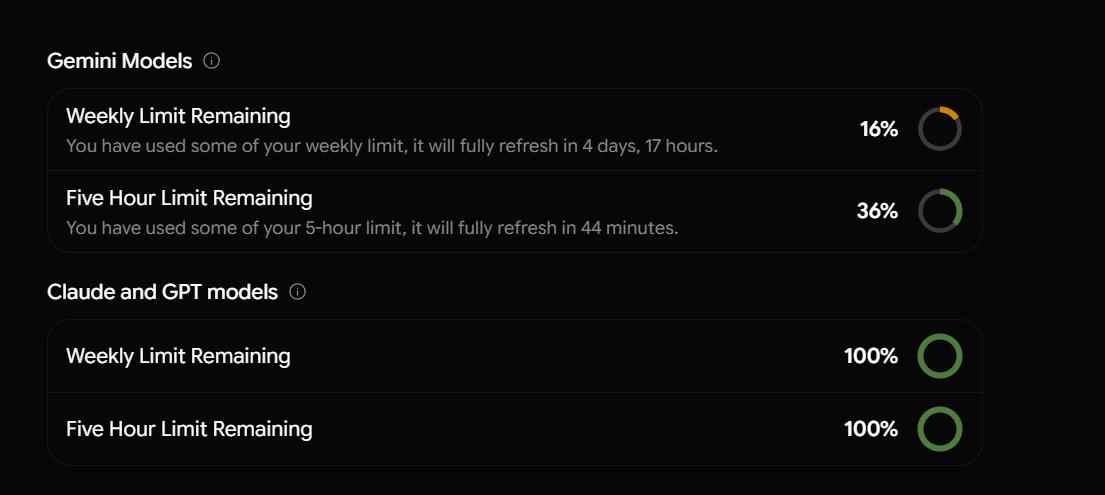
Context: I run a set of automated jobs on one Google account (Pro/Ultra-tier plan) through the agy CLI. Most are scripted one-shot calls (agy -p, one prompt, one answer). One evening I also ran a few long "review" sessions: a read-only agent that opens hundreds of files one at a time and writes a report. That evening my weekly Gemini usage dropped about 11%, while the token counts in the results only added up to about 10M. That didn't add up, so I tested it.
What I tested:
- The claim in this thread that a custom agent (--agent) burns about 4x the usage per token.
- 20 one-shot agy -p calls on Gemini 4 Hydrogen Low, the same 50K-token prompt every time, the same answer every time. - Alternating blocks of 5 calls: default agent, custom agent, default, custom.
- I read "agy -p /usage --output-format json" between blocks. It gives exact remaining_fraction values and costs nothing.
- Nothing else used the account during the test (no app, no other jobs).
Results:
- 1.51M tokens in total moved the weekly gauge by only 0.15% and the 5-hour gauge by 0.62%. Plain one-shot calls are cheap: about 0.1% of the weekly usage per 1M tokens.
- The 4x claim: I could not confirm it. The gauge readings jump between snapshots (once the weekly value went UP after a block), so block-by-block comparisons are not reliable. Both kinds of call together were cheap.
What actually burned the usage
- The long review sessions. On the expensive model, 4 of them showed 6.2M tokens in the result totals, but also 81M cache-read tokens. The total_tokens field doesn't include those.
- In an agent loop, every tool step re-reads the whole conversation so far: open a file, read everything again, open the next file, read everything again. Hundreds of steps on a growing context adds up fast. Cache reads are discounted, but clearly not free.
Plain-English takeaways:
- Your usage is not the words the model writes. It is everything it reads, including re-reads.
- One-shot scripted calls are cheap. Long tool-using agent sessions are where the usage goes, much more so on the top models.
- Check cache_read_tokens in the JSON output, not just total_tokens.
- To cut the burn without losing context, give the agent its material up front in a few large files, so it needs a handful of steps instead of hundreds.
- Don't trust a single gauge reading for small tests. Measure over a larger job, with the app closed.
- Separate agy -p processes never share the prompt cache; only turns inside one session do.
Caveats: this is one evening and one test, and the gauge is noisy. I can't rule out model-specific weights or a custom-agent effect on agy acp (I only tested agy -p).
Would love to learn if this has been your experience.