r/HistoryNetwork • u/Aaronsivilwartravels • 39m ago
Today in the American Civil War
reddit.com
1
Upvotes
r/HistoryNetwork • u/sajiasanka • 1h ago

On This Day, November 29, 1929, American explorer Commander Richard E. Byrd and his three companions achieved a remarkable milestone in aviation history: the first successful flight over the geographic South Pole.
The expedition had departed from its Antarctic base, known as Little America, on November 28. Their aircraft was a specially equipped Ford Tri-Motor named Floyd Bennett, after Byrd's former flying companion who had died the previous year.
Four men were aboard:
✈️ Richard E. Byrd – Navigator and expedition leader
✈️ Bernt Balchen – Pilot
✈️ Harold I. June – Radio operator
✈️ Ashley C. McKinley – Photographer and aerial surveyor
Their journey covered approximately 1,600 miles on a round trip across the frozen Antarctic wilderness.
But reaching the South Pole was far from easy.
As the aircraft approached the towering Queen Maud Mountains, the crew faced a serious problem. The heavily loaded plane struggled to climb high enough to cross the mountain range.
With the aircraft in danger of failing to clear the mountains, the crew made a difficult decision: they began throwing precious food supplies out of the aircraft to reduce its weight.
The maneuver helped them gain enough altitude to cross the dangerous mountain pass.
Finally, in the early hours of November 29, 1929, the Floyd Bennett reached the vicinity of the geographic South Pole.
Byrd and his companions circled the area, taking observations and confirming their position. They also dropped an American flag at the Pole.
The crew then began their return journey, stopping at a previously prepared fuel depot before eventually landing safely back at Little America.
The entire expedition flight lasted approximately 18 hours and 41 minutes.
This achievement marked the first time an aircraft had successfully flown over the South Pole, opening a new chapter in Antarctic exploration and aerial surveying.
A journey that demanded courage, precise navigation, and extraordinary teamwork had succeeded in one of the harshest environments on Earth.
They had conquered the skies above the bottom of the world!
r/HistoryNetwork • u/sajiasanka • 11h ago

On This Day, November 28, 1967, 24-year-old PhD student Jocelyn Bell Burnell made a crucial observation while analyzing recordings from a radio telescope at the University of Cambridge in England.
Bell had been examining enormous rolls of chart recordings when she noticed an unusual signal appearing at regular intervals. It was unlike anything she had encountered before.
Working with her supervisor, astrophysicist Antony Hewish, she captured a detailed recording of the signal. It consisted of remarkably regular pulses, arriving approximately every 1.3 seconds.
At first, the scientists wondered whether the signal could have come from an intelligent extraterrestrial civilization. They jokingly nicknamed the mysterious source LGM-1, meaning “Little Green Men 1."
But the truth was even more extraordinary.
They had discovered the first known pulsar—a rapidly rotating neutron star that sends out beams of radiation. As these beams sweep across Earth, radio telescopes detect them as regular pulses, much like the light from a rotating lighthouse.
The discovery transformed radio astronomy and provided scientists with a new way to investigate some of the universe's most extreme objects.
In February 1968, Bell Burnell and her colleagues published their findings in the scientific journal Nature. In 1974, Antony Hewish and Martin Ryle received the Nobel Prize in Physics for their pioneering work in radio astrophysics, including the discovery of pulsars. Bell Burnell was not included in the award, a decision that later became the subject of considerable debate.
What began as a tiny unexplained mark on a strip of paper had revealed an entirely new type of astronomical object.
A signal that once raised the possibility of alien life turned out to be the heartbeat of a distant dead star!
r/HistoryNetwork • u/deniz_aydiner • 20h ago

Following Alexander the Great’s death, his story continued to be told across different regions for centuries. What began as the account of one of the ancient world’s most powerful rulers gradually developed into something much larger. Historical events, legends, religious interpretations, and literary traditions became intertwined. In medieval Europe, Alexander was no longer simply an ancient king. He became a universal figure whose story was reshaped by different societies according to their own cultural and intellectual traditions. Italian literature offers an especially interesting example of this process.
r/HistoryNetwork • u/Aaronsivilwartravels • 23h ago
r/HistoryNetwork • u/Embarrassed-Tune550 • 1d ago

r/HistoryNetwork • u/BelfastEntries • 2d ago

r/HistoryNetwork • u/History-Chronicler • 2d ago

From Hammurabi's famous legal code to Nebuchadnezzar II's magnificent capital, Ancient Babylon rose from a modest Mesopotamian kingdom to become one of history's most influential civilizations. Despite centuries of warfare, foreign domination, and its eventual conquest by Cyrus the Great in 539 BC, Babylon's achievements in mathematics, astronomy, law, and architecture left an enduring legacy.
What do you consider Ancient Babylon's greatest contribution to civilization?
r/HistoryNetwork • u/sajiasanka • 2d ago
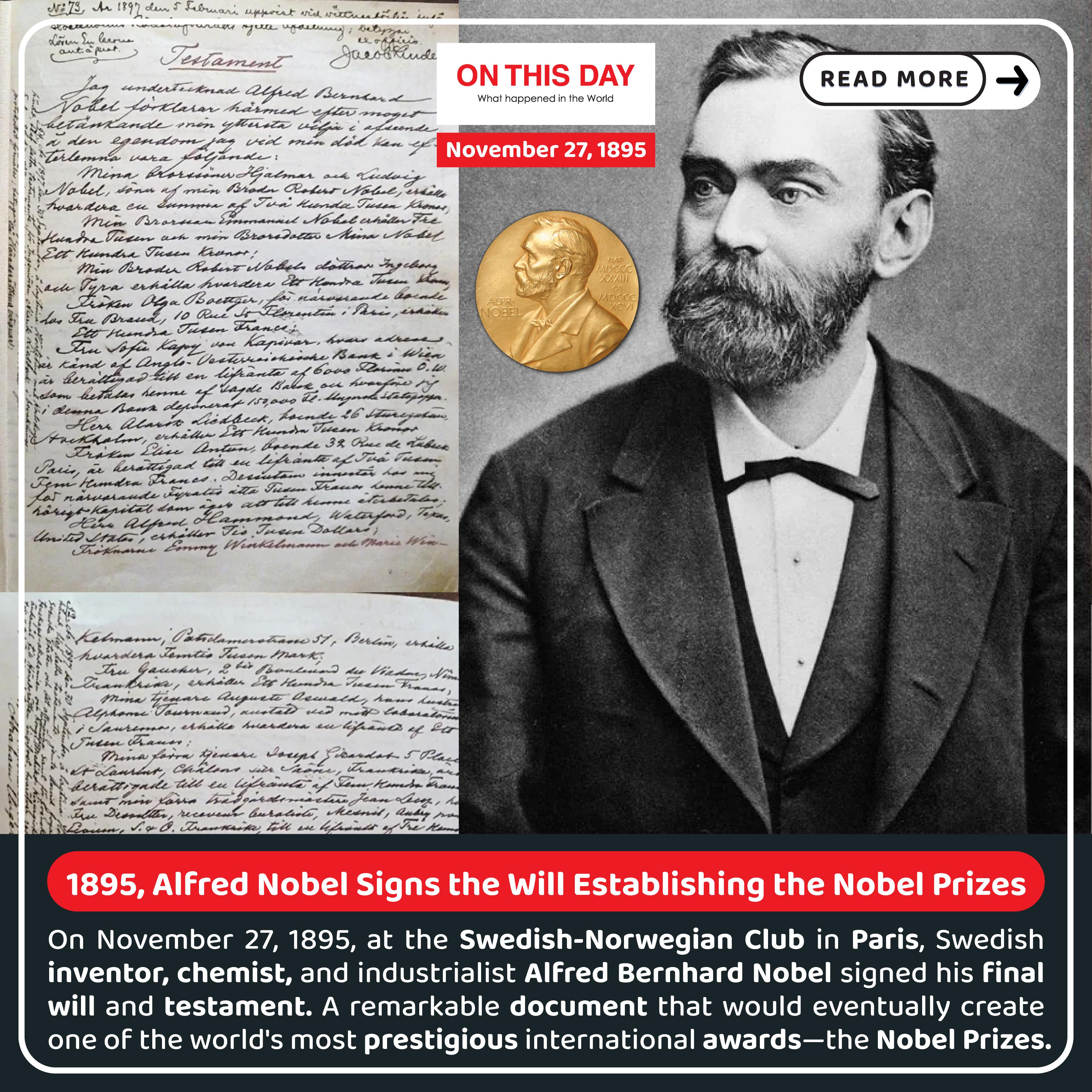
On November 27, 1895, at the Swedish-Norwegian Club in Paris, Swedish inventor, chemist, and industrialist Alfred Bernhard Nobel signed his final will and testament. A remarkable document that would eventually create one of the world's most prestigious international awards—the Nobel Prizes.
But what made this document extraordinary?
Nobel directed that the majority of his remaining fortune should be invested in a fund, with its annual returns used to reward people whose work had brought the greatest benefit to humanity.
He specified five prize categories:
Physics – For outstanding discoveries and inventions in physics.
Chemistry – For important chemical discoveries and improvements.
Physiology or Medicine – For significant medical and scientific discoveries.
Literature – For outstanding literary contributions.
Peace—For efforts to promote international friendship, reduce standing armies, and advance peace.
He also made an important point: the prizes should be awarded without considering the nationality of the candidates. The most deserving individuals should receive them, regardless of where they came from.
However, his decision was not immediately accepted.
When Nobel died on December 10, 1896, in San Remo, Italy, his will surprised many of his relatives. Some opposed his decision to leave most of his fortune for the prizes, and questions surrounding the will led to lengthy legal and administrative negotiations.
Eventually, the Nobel Foundation was established in 1900 to manage his estate and organize the awards.
On December 10, 1901, the first Nobel Prizes were presented, marking the beginning of a global tradition that continues to recognize extraordinary contributions to science, literature, and peace.
Interestingly, Alfred Nobel was also the inventor of dynamite, patented in 1867. His invention brought him enormous wealth, but his final will ensured that his name would become associated with some of humanity's greatest achievements.
A sixth award, the Sveriges Riksbank Prize in Economic Sciences in Memory of Alfred Nobel, was established in 1968 and first awarded in 1969. It was not one of the five original prizes specified in his will.
More than a century later, Nobel's decision continues to influence science, culture, and international peace.
One signature. Five original prizes. A legacy that continues to inspire the world.
r/HistoryNetwork • u/Aaronsivilwartravels • 2d ago
r/HistoryNetwork • u/Aaronsivilwartravels • 3d ago
r/HistoryNetwork • u/sajiasanka • 3d ago

On This Day, November 26, 1914, one of the Royal Navy's most devastating peacetime disasters unfolded in the waters off Sheerness, England. A massive explosion tore apart the British battleship HMS Bulwark, killing almost everyone aboard.
HMS Bulwark was anchored in the River Medway near Sheerness, Kent. The battleship was part of the Royal Navy's 5th Battle Squadron and was replenishing its ammunition supplies.
At approximately 7:53 a.m., a tremendous explosion ripped through the vessel.
The blast was so powerful that the battleship was practically blown apart. Witnesses aboard nearby ships watched in horror as a towering cloud of smoke and flames rose into the sky. When the smoke cleared, HMS Bulwark had virtually disappeared, leaving only wreckage scattered across the water.
The human cost was devastating.
Of a crew of approximately 750 men, only a small number survived. Historical records commonly report 738 lives lost, including every officer aboard. The survivors were left with the unimaginable experience of witnessing the destruction of their ship and the loss of their fellow sailors.
What caused such a catastrophic explosion?
An official naval inquiry investigated the disaster. The evidence pointed towards an accidental ignition of ammunition, possibly involving cordite charges stored in conditions that allowed them to overheat. However, the precise sequence that triggered the explosion could not be established with certainty.
There was no evidence that an enemy attack had destroyed the ship.
The loss of HMS Bulwark became one of the deadliest accidental explosions in British naval history. Its wreck site is now protected as a military war grave under British law.
More than a century later, the tragedy remains a reminder of the dangers faced by sailors even when they were not fighting in battle.
r/HistoryNetwork • u/Famous-Sky-8556 • 3d ago

One of the most revealing details I found while making this documentary was how confidently a newspaper headline could read beside an uncertain witness account.
For Before Hollywood, I examined the 1922 inquest into the murder of director William Desmond Taylor. The witnesses described what they saw in his home. Accounts differed about when a shot was heard. Yet one Los Angeles headline was already announcing that a solution was near.
I’ve put the testimony and the reporting side by side so viewers can judge how much weight each deserves. Watch The Murder of William Desmond Taylor
r/HistoryNetwork • u/Aaronsivilwartravels • 4d ago
r/HistoryNetwork • u/sajiasanka • 4d ago

On This Day, November 25, 1944, shortly after midday, a German V-2 rocket struck a busy shopping street in London, destroying a Woolworths store and killing 168 people in one of Britain's worst civilian tragedies of the Second World War.
It was a busy Saturday, just weeks before Christmas.
Inside the store, families were shopping, children were accompanying their parents, and customers were buying everyday household goods and Christmas presents.
Without warning, disaster came from the sky.
The V-2 rocket, travelling at an enormous speed, crashed into the Woolworths building and exploded with devastating force.
The blast completely destroyed the store and severely damaged the neighboring Royal Arsenal Co-operative Society shop and surrounding buildings.
People inside the shops, pedestrians outside, and passengers nearby were caught in the explosion.
The destruction was catastrophic.
Rescue workers, firefighters, police officers, and local volunteers rushed to the scene. They worked through the rubble, desperately searching for survivors and recovering victims from the destroyed buildings.
The rescue operation continued for days.
The later memorial records 168 people killed in the attack, including shoppers and shop workers. Many others were injured.
It became the deadliest single V-2 rocket attack on Britain during the Second World War.
But what made this weapon so terrifying?
The V-2 was the world's first operational long-range guided ballistic missile. Developed by Nazi Germany, it could travel faster than the speed of sound.
Unlike conventional aircraft or the earlier V-1 flying bombs, there was virtually no warning before a V-2 struck. By the time people heard the explosion, the missile had already hit.
Thousands of these rockets were launched against cities in Britain and continental Europe, bringing destruction to civilian communities.
The New Cross tragedy remains a reminder that even as the Allied forces were advancing towards victory in 1944, ordinary families were still living under the threat of devastating attacks.
Behind every casualty figure was a human life, a family, and a future that was suddenly taken away.
r/HistoryNetwork • u/History-Chronicler • 4d ago

The first Thanksgiving in 1621 looked remarkably different from the holiday Americans celebrate today, from the food served to the three-day gathering shared by the English settlers and the Wampanoag people. These 11 fascinating facts explore the historical realities behind the celebration and challenge some of the most enduring misconceptions surrounding its origins.
What surprised you most about the history of the first Thanksgiving?
r/HistoryNetwork • u/rms-republic • 4d ago

r/HistoryNetwork • u/Aaronsivilwartravels • 5d ago
r/HistoryNetwork • u/HistorianBirb • 5d ago

r/HistoryNetwork • u/F0rg0tty • 5d ago
In the ninth century, winter was supposed to be safe. Armies went home, roads turned to frozen mud, and nobody expected a fight. The Vikings saw an open door: their longships were so shallow that a loaded boat needed only about a meter of water, so frozen rivers became highways deep into England.
I made a 9-minute illustrated video about how a winter camp turned into the closest the Vikings came to conquering the country. Every scene is painted in a storybook watercolor style. I'd love feedback from people who know the period, especially if I got something wrong.
r/HistoryNetwork • u/sajiasanka • 5d ago

On This Day, November 24, 1943, an American aircraft carrier, USS Liscome Bay, was struck by a Japanese submarine torpedo, triggering one of the deadliest losses of a U.S. aircraft carrier during the Second World War.
The American escort aircraft carrier USS Liscome Bay was operating near Makin Island in the Gilbert Islands, supporting American forces during Operation Galvanic, the Allied campaign to capture the Gilbert Islands from Japanese control.
It was still early morning when disaster struck.
At approximately 5:10 a.m., a Japanese submarine, I-175, commanded by Lieutenant Commander Sunao Tabata, fired a torpedo that struck Liscome Bay near the rear of the ship.
The torpedo hit near the aircraft bomb storage area.
What happened next was catastrophic.
The torpedo triggered an enormous explosion inside the ship's bomb magazine. The blast destroyed a huge section of the carrier's stern, ripped apart its flight deck and hangar, and immediately started devastating fires.
The explosion was so powerful that burning debris and fragments were scattered across nearby American warships.
With its firefighting systems destroyed and the vessel severely damaged, the crew had almost no chance of saving the ship.
Within just 23 minutes, USS Liscome Bay rolled over and sank beneath the Pacific Ocean.
Of the hundreds of sailors and airmen aboard, only 272 were rescued. Around 644 lost their lives, although historical casualty records contain differing totals.
Among those killed was Rear Admiral Henry M. Mullinnix, commander of the carrier task group.
Another tragic loss was Doris Miller, an African American sailor who had become a national hero during the Japanese attack on Pearl Harbor in 1941. Despite serving as a cook, he had helped rescue wounded sailors and operated an anti-aircraft gun during that attack. He later received the Navy Cross for his bravery.
On November 24, 1943, Miller was among those who never returned home.
The Japanese submarine I-175 escaped the area that morning. It was eventually sunk by American warships in February 1944.
The sinking of USS Liscome Bay remains one of the most devastating American naval losses of the Pacific War. It was also the first of six American escort carriers lost in action during World War II.
A single torpedo had triggered an explosion that destroyed an entire warship in minutes, leaving hundreds of families grieving across America.
A ship lost in 23 minutes. Hundreds of lives gone. A tragedy remembered in naval history.
r/HistoryNetwork • u/Famous-Sky-8556 • 5d ago

Deptford, 1905. Police found a right thumbprint on the metal tray inside a cash box. They matched it to Alfred Stratton. When the murder case came to trial, his brother stood in the dock alongside him.
Listen to the full episode of The Black Archive on Apple Podcasts. https://apple.co/3VMkXV0
#StrattonBrothers #ForensicHistory #BritishCrimeHistory
r/HistoryNetwork • u/sajiasanka • 6d ago

On This Day, November 23, 1939, WWII: the British armed merchant cruiser HMS Rawalpindi was patrolling the icy waters between Iceland and the Faroe Islands when she encountered the German battlecruisers Scharnhorst and Gneisenau.
Originally built as a passenger liner for the Peninsular and Oriental Steam Navigation Company (P&O), Rawalpindi had been requisitioned by the British Admiralty at the outbreak of the Second World War and converted into an armed merchant cruiser.
Under the command of 60-year-old Captain Edward Coverley Kennedy, the ship was conducting patrol duties in the North Atlantic when German lookouts spotted her.
The odds were overwhelmingly against the British vessel.
Scharnhorst and Gneisenau were heavily armed warships, far more powerful than the converted passenger liner. Rawalpindi attempted to report the enemy ships and alert British naval forces, but the Germans soon opened fire.
Captain Kennedy and his crew refused to go down without a fight.
Despite being massively outmatched, Rawalpindi returned fire. In an extraordinary moment, one of her six-inch shells struck Scharnhorst, causing minor damage.
But the German guns unleashed devastating firepower. Rawalpindi was soon reduced to a burning wreck, with much of her bridge and wireless equipment destroyed.
The battle was effectively over, but the ship remained afloat for several more hours.
German sailors rescued some survivors and took them prisoner. Eleven other men endured the freezing North Atlantic waters before being rescued by the British armed merchant cruiser HMS Chitral.
Around 265 men lost their lives, including Captain Kennedy. Historical casualty figures vary between sources, but only a small number of the crew survived.
The two German battlecruisers eventually withdrew, avoiding further confrontation with approaching British naval forces.
Although HMS Rawalpindi was destroyed, her resistance became a symbol of courage and sacrifice during the early months of the Second World War.
She could not defeat the two German warships, but her crew fought back against overwhelming odds.
A small British ship. Two powerful German battlecruisers. One unforgettable act of defiance.
r/HistoryNetwork • u/Aaronsivilwartravels • 6d ago